This franchise is the main reason the Hollywood knows anything about survival horror games.
It was such a bestselling phenomenon among gamers, the Capcom software company
hired George A. Romero to direct a commercial. They should have hired him for
the films too, but they didn’t. Nevertheless, the Paul W.S. Anderson movies were
solidly successful. Frankly, they look even better compared to the 2021 reboot
and the 2022 streaming series, which is probably the most despised show Netflix
ever produced. Fortunately, the rights managers finally found a filmmaker who
gets the franchise. Although it avoids directly incorporating any of the video
game story arcs (unlike previous films), the aesthetics and energy of
director-co-screenwriter Zach Cregger’s Resident Evil (2026) will appeal
to fans when it opens tomorrow in theaters.
Poor
Bryan is a total loser working as a medical courier. Usually, he transports
organs, but savvy viewers might suspect there is something else in the cooler
he agrees to deliver to Raccoon City Hospital. The job pays double, but he really
just accepted it to avoid talking to his girlfriend about her surprise pregnancy.
He
really should have stayed home. The weather is terrible, so he accidently hits
a woman, but bizarrely, she pops back up and runs off into the woods. He is a schmuck,
but he is a decent schmuck, so he follows her—through the looking glass.
Cregger’s
pre-credits prologue is essentially a first act in itself. It is also a
masterclass in building tension. His panning camera perfectly mimics a gamer’s
field of vision, but this extended sequence is still massively eerie and
unsettling to non-gaming viewers as well. Franchise fans will also appreciate the
way the farmhouse he soon stumbles into gives off vibes reminiscent of the
creepy mansion in the original game.
To an
extent, the film loses some of its mojo when Bryan finally arrives in the urban
environment of Raccoon City, but not before Paul Walter Hauser brings some much-needed
comic relief as Carl, an Umbrella Corp. scientist, who inspires little confidence.
Frankly,
the monsters in Cregger’s Resident Evil (2026) are better described as
mutations than zombies. However, there is surely enough horde rampages to satisfy
zombie fans. They will also appreciate how luckless Bryan closely tracks his
dwindling supply of ammunition. The stakes are truly life-or-death, because he
is so ill-prepared and constitutionally ill-equipped to handle such an apocalyptic
crisis.
Beyond the zombies, it is easy to understand how Umbrella, the evil
pharmaceutical company in the Resident Evil video game franchise would
resonate with an old-fashioned liberal like George A. Romero. Ironically, that
distrust of big pharma has become more prevalent on the populist “right” in
recent years. Similarly, Romero’s commentary regarding government censorship
and misinformation during times of crisis probably seemed “leftwing” when he
made Diary of the Dead, but it lands very differently today. If the
government ever starts censoring his films, it will start with Diary.
Unfortunately, fans never had the chance to see Romero’s take on the popular
survival horror game, even though he scripted several drafts. Friends and
insiders consider what might have been and offer their tributes to the master
in Brandon Salisbury’s documentary, George A. Romero’s Resident Evil,
which releases today on VOD.
Everyone
at the Japanese video game company Capcom fully understood the Resident Evil
game never would have existed without George Romero. He essentially
launched zombie horror with Night of the Living Dead and maintained it
as a subgenre with his subsequent sequels. Evidently, Romero felt the same way,
so he had mixed feelings about the game (which he claimed to enjoy).
Nevertheless, Capcom was eager to forge a closer association, so they hired
Romero to direct the commercial for the second installment of the game (known
as Biohazard in Japan).
Inevitably,
the commercial caused a minor sensation in the horror world and it helped
propel the new game to record-setting sales. Consequently, Capcom recommended
Romero to direct the feature film adaptation. Although the surviving rough
drafts of his proposed scripts are all pretty rough, fans agree they would have
captured the spirit of the games much more successfully than the Paul W.S.
Anderson live-action movies. However, a key executive at Constantine Films, the
Germany production company, just didn’t understand the IP they bought—and eventually
fired Romero, because he did.
Salisbury’s
doc grows a small but growing list of films that document films that never came
to be, but should have, as previously exemplified by Jodorowsky’s Dune and
Henri-Georges Cluzot’s Inferno. Sadly, Romero’s Resident Evil never
advanced as far as either of those non-films.
Whether it came from a lab leak or a wet market, there is no serious debate that
the CCP regime in China covered up the Covid outbreak we are all still enjoying
two years later. However, the folks managing the Resident Evil franchise
apparently did not notice. In their new anime series, it is the American
government that covered-up the zombie viral outbreak in Raccoon City and now
the corrupt Defense Secretary hopes to provoke a war with China to distract the
President. Fan favorite characters Leon Kennedy and Claire Redfield must save
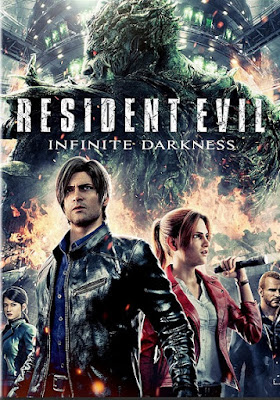
the day in the anime series Resident Evil: Infinite Darkness, directed
by Eiichiro Hasumi, which releases tomorrow on DVD and BluRay.
Something
bad happened in Penamstan six years ago. It started out like Black Hawk Down,
but then the zombies showed up. The leader of the “Mad Dogs” unit barely
survived. Now, he is known as the “Hero of Penamstan,” but he is uncomfortable
with that title. Likewise, Kennedy would be uncomfortable to be called the “Hero
of Raccoon City,” but it gave him enough credibility for the President to ask
for him by name.
He
and the Mad Dog commando will be investigating Sec. Wilson’s suspicions that
China was behind the Penamstan incident, along with Shen May, a Chinese
American officer, who still has highly-connected family in Shanghai. Meanwhile,
Redfield turns up evidence of a suspicious biological agent is still infecting
residents of Penamstan, but there are people in the administration who want to keep
a lid on her allegations.
Since
there have already been six Resident Evil films in the Mila Jovovich
continuity, a reboot, and three anime features, so practically no time is given developing
Kennedy and Redfield. You either know them or you don’t. Jason “the Mad Dog” is
not much more than a stock character either. Although Infinite Darkness is
packaged as a series, there are only four twenty-four-minute episodes, so it is
really more like another anime feature cut into quarters. There is plenty of
action, but it often looks more like a video game on-screen, which sort of
makes sense, given its source material. There is also a fair amount of
halls-of-power intrigue, but it is largely derivative and entirely half-baked.