Arthur Spiderwick's field guide to the fairy world is the bestiary to rule all
bestiaries. The old eccentric wanted to catalogue his discoveries, but the
secrets it holds would be dangerous in the wrong hands. Mulgarath, the shapeshifting
ogre, certainly qualifies as the wrong hands. He wants to eat all the humans in
the world, basically because he is an ogre. If he successfully revives the baby
dragons suspended in amber (like a fantastical Jurassic Park), nothing
will stop him. Unfortunately, his primary antagonist is a troubled teen who
cannot even count on his siblings in creator Aron Eli Coleite’s eight-episode The
Spderwick Chronicles, adapted from Holly Black & Tony DiTerlizzi’s YA
novels, which premieres Friday on the Roku Channel.
Reluctantly,
freshly divorced Helen Grace relocates her three kids to Henson, Michigan (it
is New England in the books), because of Jared’s “troubles.” He is the bad twin,
whereas Simon is the good twin. Their older sister Mallory largely fends for
herself. Both resent Jared for forcing them out of Brooklyn, where their
deadbeat dad still lives, but Simon still tries his best to defend his brother.
Of
course, everyone blames Jared for the strange things that happen in the old
Spiderwick manor. Mostly, they are the work of Thimbletack, an annoying winged
fairy-beast who lives in the Spiderwick walls. Supposedly, he is a good friend of
Helen’s institutionalized Aunt Lucinda Spiderwick, Arthur’s widow. As you might
assume, she is not as crazy as she looks.
In
fact, she is the one who hid the pages of Uncle Arthur’s field guide around
Henson and then charmed herself into forgetting, so Mulgarath could not trick
her into revealing the locations. Instead, he lured the Graces to Spiderwick,
so they would find them for him.
That
gets to one of the biggest problems plaguing Coilete’s adaptation. Arguably, the
Graces should be able to foil Mulgarath by simply sitting on their hands and doing
nothing. Since the pages are magically protected, they are only vulnerable to
Mulgarath once Jared collects them for “safe-keeping.” It is sort of like Mayim
Bialik’s awkward criticism of Raiders of the Lost Ark on The Big Bang
Theory, except it is much more glaringly obvious.
That
is a shame, because Christian Slater is a lot of fun to watch playing Mulgarath,
who has a big, evil DNR to spring on viewers. He is definitely the best part of
the series, which is particularly ironic, since a lot of his business is
original to Coleite and company (but not the ogre character).
Lyon
Daniels will also drive most viewers to distraction as Jared, while Noah
Cottrell’s Simon often expresses the audience’s exasperation with him quite
aptly. Helen Grace’s unintuitive obliviousness stretches credulity, but Joy
Bryant somehow manages to work out some interesting chemistry with Slater (in
ways that cannot be revealed). However, the way the character of Thimbletack feels
under-developed and often shoehorned into scenes, suggests a good deal of his screentime
was cut for budgetary reasons.
On
the other hand, the Spiderwick manor looks very cool, in a family-friendly
gothic kind of way. Kat Coiro even creates some nicely creepy moments helming
the initial episode, but she cannot match them in the second, nor can any of
the subsequent directors.
Anyone who thinks British actors are classy hasn’t met Steven Toast yet. When
you do meet him, you can’t umeet him. However, the abrasive blowhard has such a
knack for bringing out the worst in people, it weirdly almost makes him
sympathetic by comparison. After annoying his British colleagues during a few
seasons of Toast of London, he takes a shot at Hollywood in creators
Arthur Mathews & Matt Berry’s six-episode sequel series Toast of
Tinseltown, which premieres today on the Roku Channel.
Toast
comes to Hollywood with the delusional understanding he will co-star in the next
Star Wars film. Of course, his long-suffering agent is happy to have a
break from him, referring him to her Hollywood colleague, Brooke Hooberman, who
specializes in Brits. She also works out of her car, sort of like the Lincoln
Lawyer, but in a way that inspires less confidence.
At
first, Toast assumes he is lucky to meet Russ Nightlife on the flight from
London, because the stranger offers to put Toast up in his Hollywood Hills
home. Then the actor discovers his host is ragingly neurotic and deeply
anti-social. On the plus side, Nightlife’s housekeeper-caretaker Billy Tarzana
is quite charming. She pretends to only speak Spanish around Nightlife, but she
is happy to relax and converse in English around Toast.
The
first episode is basically an extension of Toast of London, in which
Toast’s agent sends him off to an anger management workshop, which seems to be suspiciously
successful. “LA Story” introduces Toast to Hollywood, exaggerating its
eccentricities in ways that hit somewhat more than they miss. As he acclimates to
Hollywood, he thinks he has a torrid affair with a dominatrix and lands a role
on cheesy medical drama. There is a weird, feverish Manson-family-influenced Western-style
detour, before the series culminates by revealing the truth about Russ
Nightlife.
Mae Cannon is sort of like a Marvel or DC hero, because she travels through
the parallel realities of the multiverse, but she does so with more sex and
more Buddhism. On paper, that might sound like a more enjoyable way of doing
it, but the experience quite confuses Cannon. The new lives that come with each
reality are very different, but she assumes the similarities must mean
something in creator-star Zoe Lister-Jones’ seven-part Slip, which premieres
tomorrow on the Roku Channel.
Cannon
always thought she had a cool job being an assistant museum curator, but she is
starting to tire of her underachieving, somewhat boring husband Elijah. On the
other hand, Eric, the hipster DJ she starts flirting with after her Buddhist-influenced,
“Hungry Ghost” exhibition opening, is not boring at all. In fact, she goes home
to his place. One thing leads to another—and suddenly, Cannon wakes up married
to Eric, but they are both very different. He is now a bigger celebrity than
Steve Aoki and she is tabloid fodder, who has been in and out of rehab.
Already
reeling from her new reality, the stress of the paparazzi pushes the new Mae to
her breaking point. However, she finds a safe harbor in the arms of Sandy, the
owner of a lesbian bar, which leads to another reset, triggered by the consummation,
so to speak. As the pattern repeats, each Mae always finds her best friend Gina.
She also desperately seeks out Elijah, with varying degrees of success.
Although
Slip is largely presented as a sitcom, the multiverse travels and the
Buddhist references are surprisingly smart and intriguing. However, viewers
should be warned there is more sex in the show than you would have seen in
vintage late-1990s HBO programming. Just keep in mind, it is definitely not for
kids.
In
fact, maybe a little less sex and a little more Buddhism wouldn’t have been a
bad call. Frankly, one of the best scenes of the entire inaugural season
involves Mae seeking enlightenment from Monk Dawa, memorably played by Nicco
Lorenzo Garcia, with understated intelligence.
It looks like we can also blame Richard Nixon for the alien invasion of Earth. He is the
one who agreed to fund the Voyager probe, which the Gu’un just followed its
trajectory back to us. If only he hadn’t been such a liberal big-spender. They
are here regardless and they intend to stay. Poor Stewart is the junior
bureaucrat recruited to help communicate the new overlords message in Fergal
Costello’s We Are Not Alone, which premieres tomorrow on the Roku
Channel.
The alien
invasion was especially traumatic for Stewart, because their advance capsule
landed on his best friend Robbie when they were leaving the pub. The Gu’un
really don’t get how things work here, so the regional commander decides to
govern the UK from Clitheroe, because it is in the dead center of the country.
She adopts the inappropriate name of Trater, due to an equally iffy grasp of
the language. The Gu’un all chose odd new “earthly monikers, because the sound
of their real names cause humans to void their bowels.
Stewart
lacks ambition under the best of circumstances, so he is very conflicted about
working for the alien occupiers. However, he likes the generous new salary and
the swanky new pad. Unfortunately, he will have to share it with his alien
minder, the dim-witted Greggs. Even more awkwardly, the resistance pressures
him to be their inside saboteur. Most of the Anti-Alien Alliance (AAA) does not
inspire much confidence, except for Elodie, the pub owner he has long carried a
torch for.
Laurence
Rickard and Ben Willbond (known for writing and appearing in the original Ghosts)
have a knack for penning “stupid” sounding dialogue, in a smart way. They also
make a drolly amusing Heckle and Jeckle pair as Cirsch and Darrenth, two
flat-footed Gu’un sentries. Their soft science fiction is not groundbreaking,
but they and Costello really keep the dialogue consistently snappy.
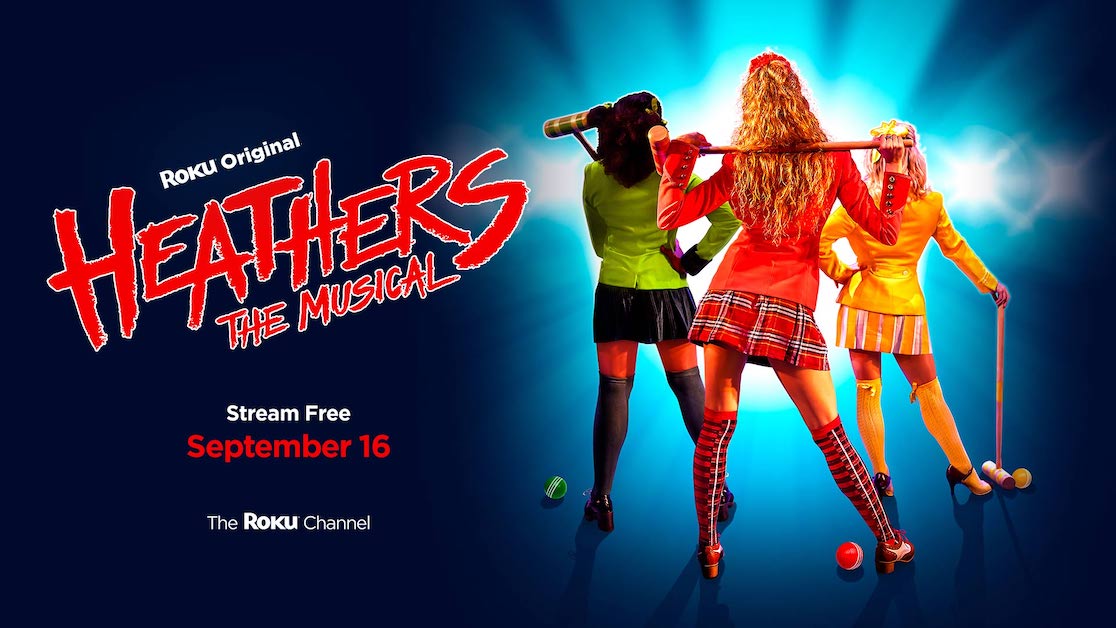
Seriously, Gen X really did have to work harder than subsequent generations. For
instance, our high school mean girls had to bully fellow students without the
help of social media. Just imagine Michael Lehmann’s 1988 cult favorite Heathers
with Instagram and TikTok. Wisely, the stage musical adaptation never tries
to update anything. It doesn’t need to, because the black comedy still feels contemporary.
The tunes composed by Laurence O’Keefe and Kevin Murphy are also pretty
rousing, as viewers can hear during the stage performance (or edited performances)
Andy Fickman captures on film in Heathers: The Musical, which premieres
tomorrow on the Roku Channel.
Heathers:
The Musical had
regional and Off-Broadway runs here, but the original London production made it
to the West End, where it was recently revived. This is that production. As you
might remember, Veronica Sawyer (the Winona Ryder character) is somewhat shy,
but she shrewdly takes advantage of an opportunity to ingratiate herself with
the trio of “Heathers” who stand atop the school’s social food chain. Heather
Chandler is the meanest of the lot. However, the freshly transferred Jason “J.D.”
Dean (still Christian Slater’s best role) is not intimidated by her or the two
dumb jocks she uses as her enforcers.
There
are serious sparks flaring between Sawyer and Dean, but that threatens to snuff
out her sudden popularity. After defying Chandler, Sawyer trundles to the head
Heather’s house to make a groveling apology, but instead, she and Dean sort-of
kind-of accidentally kill her. When they successfully make it look like
suicide, they ironically turn her into an After School Special-style martyr.
Additional bodies will follow.
O’Keefe
& Murphy, who also wrote the stage-book, stay quite faithful to the original
film, but they somewhat bulk up the role of Martha Dunnstock, Sawyer’s unfortunately
overweight childhood friend, which works out quite well, especially given
Mhairi Angus’s nice featured performance. Frankly, the sets are more colorful
than you probably remember the film looking, while the choreography is
appealingly upbeat and energetic, in a Fame-ish kind of way.
Of
course, the show requires a strong Sawyer, which Alisa Davidson supplies. Her
voice is impressive and she has a nice facility for comic timing. Frankly, she might
have better chemistry with Simon Gordon playing Dean than Ryder and Slater had.
Their initial courtship sequences are weirdly sweet and endearing, before it
all descends into macabre chaos. After Sawyer, the most important character is
probably her nemesis, Chandler, whom Maddison Firth portrays with entertainingly
nasty flare.
It was a powerful comic book tag-teaming, but it was completely
uncoordinated. In 1940, Jack Kirby and Joe Simon created Captain America (first
comic book appearance March 1941) to fight Nazis. That same year, DC produced a
special issue of Look Magazine, featuring Superman beating the heck out
of Hitler. Those were the days. In many ways, it was the big comic publishers’
finest hour and a good example of their “friendly rivalry.” Directors Don Argott
& Sheena M. Joyce chronicle the competition and occasional cooperation
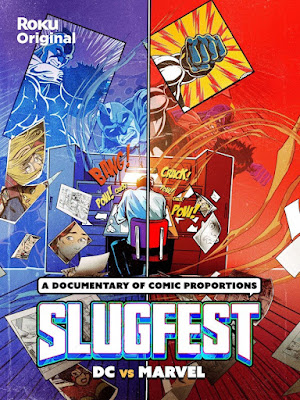
between Marvel and DC in the 10-mini-episode Slugfest, produced by the
Russo Brothers, which is now streaming on Roku Channel.
Slugfest, based on the non-fiction
book of the same title by Reed Tucker (who also appears as a talking head) was
greenlighted for Quibi, but the bite-sized streaming service folded before it
could premiere, so here it is now. The six-to-eight-minute installments are
punchy, but together they do not tell a cohesive narrative.
Regardless,
the first installment, “Nazis are Bad,” is easily the best. You have to give
Simon and Kirby credit for taking on Hitler and the National Socialists. Cap
was a hit, but he was not universally popular. In fact, Mayor Fiorello La
Guardia dispatched police guards to protect Timely Comics (as Marvel was then
known) from violent Bund protesters. What would Kirby and Simon think to see
the current management of their old company desperately currying favor with a
CCP regime currently conducting a campaign of genocide in Xinjiang, just to get
Chinese release dates for their movies.
In
contrast, “Halloween Hero” is a fun footnote explaining how the first
unofficial Marvel-DC crossover story was hatched by a group of writers and
artists for both companies. Throughout the series, Argott and Joyce stage the
sort of quirky reenactments they used in Framing John DeLorean. The most
colorful is Ray Wise, slyly chomping on his cigar as the older Jack Kirby in “Funky
Flashman,” which chronicles the artist’s departure from Marvel to
DC, where he infamously mocked his old boss Stan Lee.
“Reverend
Billingsley” plays up the 1970s trippiness of Doctor Strange, which does not
have much to do with DC (and the whole Age of Aquarius vibe of the mini-sode gets tiresome). “Superman
vs. Spiderman” is a cool look at the crossover fans always wanted, but the two
companies never thought they could pull off (with an appearance from Ron
Perlman, as a bonus). Likewise, “Cancelled Cavalcade” is a fascinating
chronicle of the dramatic 1978 “DC Explosion” of titles and the sharp
contraction that soon followed.
“Kill
Robin” and “A World without Superman” both present solidly entertaining (and
weirdly nostalgic) pop culture histories of the murder of the second Robin and
the hyped-up “death of Superman,” which of course, it wasn’t. “Send in the
Clones” tries to do the same for Spiderman clone storyline, but it won’t have
as much traction for casual comics fans. However, the series ends with what
could be its second-best episode, “Just Imagine,” a tribute to Stan Lee, with
an emphasis on his once in a lifetime stint at DC, reimagining their signature
characters, the Stan Lee way.
The Quibi short-bite 5-to-10-minute programming-platform folly was only in business
from April to December last year, but it still managed to squeeze in two “seasons”
of Sam Raimi’s horror anthology. They still didn’t have time to get to all
fifty states, let alone territories like Guam. Nevertheless, if any of their
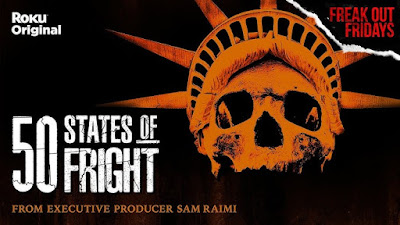
series had a following this would be it, so fans will be happy to see Raimi’s 50
States of Fright will be available again this Friday on the Roku Channel.
To
hook fans, Raimi himself helmed the first episode, “The Golden Arm (Michigan),”
up in Hemingway’s and Nick Adams’ neck of the Michigan woods. The golden arm has
nothing in common with Frank Sinatra in Man with the Golden Arm. It is
the sparkly prosthetic of the old folk tale Mark Twain and scores of others
used to tell. In this case, it belongs to Heather, the vain wife of Dave, a rugged
furniture artisan, following her misadventure in the forest. She intends to
keep that arm with her even if it kills her and even then, she still isn’t
letting go.
Michigan
probably
boasts the most star-studded cast of the anthology, with Rachel Brosnahan and
Travis Fimmel portraying the ill-fated couple. However, it is John Marshall
Jones who really makes the three-episode arc work with the way he tells the
tale as Dave’s friend Andy. Old man Clemens would approve.
Yoko
Okumura’s “Ball of Twine (Kansas)” should have been titled “What’s the Matter
with Kansas.” Regardless, it does a nice job tapping into both the nostalgia of
road trips and the uneasy feeling you get when driving through long, flat,
not-particularly-well-lit states like Kansas. In this case, the scenic
attraction Susan and her daughter Amelia stop to gawk at, the titular twine,
seems to exert an uncanny control over the entire town. Even Sheriff Stallings
is rather unhelpful when Amelia disappears, but Susan is not about to be
intimidated by their cultish small-town ways.
Ming-Na
Wen really makes these three ex-quibis standout with her fierce axe-wielding performance
as Susan. She is pretty awesome, plus Karen Allen is quite sinister, in an
unusually understated kind of way, as Sheriff Stallings. There are also some
cool makeup effects going on, as an extra bonus.