Showing posts with label Alfred Molina. Show all posts

Saturday, December 20, 2025

Chill Out, Scooby-Doo, on Cartoon Network

You might think Casey Kasem was from Shangra-La, considering the voice-over artist dubbed that “meddling kid,” Shaggy Rogers well into his eighties. Unfortunately, time catches up to even the eternally youthful. Although Kasem once again performed as Shaggy in this feature, it was animation legend Josph Barbera’s final Scooby project. It was also dedicated to the memory of late Disney and Hanna-Barbera animator Iwao Takamoto, a longtime contributor to the Scooby franchise. Scooby and Shaggy have outlived them all, presumably thanks to diet and exercise (all that running from monsters). They get another workout (this time at high altitude) in Joe Sichta’s Chill Out, Scooby Doo, which airs on the Cartoon Network.

Fred, Daphne, and Velma thought they were meeting Scooby and Shaggy in Paris for a well-earned vacation. Instead, Rogers and our favorite Great Dane are lured to the Himalayas by cryptid-hunter Alphonse LeFleur, by the promise of an all-you-can-eat flight. He intends to use the duo as bait for the Yeti.

Fortunately, Scooby and Shaggy quickly ditch LaFleur, reconnecting with an old friend, cryptozoologist Del Chillman, who now happens to be the local DJ, even though he only has one regular listener, Minga, the sister of Pemba the sherpa. Unfortunately, Pemba’s latest client is clearly up to no good. Professor Jeffries hopes to plunder the crystals of Shangra-La, right under the nose of the High Lama. There is also the Yeti, who clearly enjoys chasing Scooby and Shaggy. In fact, he pursues them right into Shangra-La.

As straight-to-DVD features go,
Chill Out really plays like an extended episode of the various Mystery Incorporated series. Even by the franchise standards, the humor is shamelessly goofy and logic immediately goes out the window. For instance, the rest of the meddling kids manage to drive their van from Paris to Himalayas, within the first act.

Sunday, July 06, 2025

DC League of Super-Pets, at Look Cinemas

It might be the “Summer of Superman,” but Krypto has been the biggest winner from the trailer release. If you think he is cute there, check out Krypto All In #1. Every panel fully capitalizes on his adorableness, while still telling a dramatic story. Hopefully, Ryan North and Mike Norton can sustain that high quality. At this point, most viewers probably still know Krypto best from this animated film. He is a bigger Krypto, but he probably had to be, since he is voiced by The Rock in Jared Stern & Sam J. Levine’s DC League of Super-Pets, which has a special family screening this Tuesday at Look Cinemas.

Originally in the comics, Krypto landed on Earth after Superman. In
League of Super Pets, he jumped into the escape-craft with Kal-El (in far and away the cutest scene of the film). Of course, they grow up to be Superman and Krypto, inseparable superhero buddies, protecting Metropolis from villains like Lex Luthor. However, Krypto feels like Lois Lane is on the verge of breaking up the band, like an animated Yoko Ono.

Ironically, it is not Luthor who renders Superman and Krypto powerless. It will be his literal guinea pig, Lulu, whom Krypto rescued from Luthor’s lab. However, Lulu did not want to be rescued, because she absorbed Luthor’s villainous persona. Consequently, she works on her evil scheme to refine Orange Kryptonite from the animal shelter, where she is imprisoned with Ace the Boxer, Merton the turtle, PB the potbellied pig, and Chip, the squirrel, who really shouldn’t be in a domestic adoption shelter, but whatever. Together, they all gain superpowers as a result of Lulu’s Kryptonite super-charge.

Krypto got off on the wrong paw with Ace and his pals, because he is not good with other pets. However, they all start to grow on each other. Krypto also promises to hook them up with nice farm homes in Smallville. Unfortunately, Lulu acclimates to super-villainy much quicker than the Super Pets adjust to super-heroism.

League of Super-Pets
is undeniably kid-friendly and amusing, but sometimes maybe in ways that are a little too silly for fans of the DC Animated Universe, which this film is not a part of. Arguably, the talking animal business drives the film rather than their roles within the DC Universe. Obviously, Krypto has an honored place in the Universe and Ace is also an established member of the Bat-Family. Chip and Merton have precedent but they are very loosely based on their namesakes, while PB and Lulu are entirely original.

The best moments capture the human-animal bond shared by Superman and Krypto, who are nicely voiced by John Krasinski and The Rock. Conversely, Kevin Hart is a lot as Ace—sometimes too much. Natasha Lyonne and Vanessa Bayer are almost as much as Merton and PB. However, there are some standout guest voices, notably including Keanu Reeves as Batman (that one makes a lot of sense, right?), Alfred Molina as Jor-El, and Keith David as Dog-El, Krypto’s father, whose hologram provides some of the best jokes for hardcore DC fans.

Friday, August 02, 2024

Apple & Doug Liman’s The Instigators

Boston's two leading industries must be organized crime and political corruption. Frankly, the latter produces so much dirty money, a shady crime lord organizes a heist targeting the mayor’s dirty cash. However, the long-suffering voters complicate the caper in Doug Liman’s The Instigators, which opens today in theaters, ahead of its August 9th premiere on Apple TV+.

Due to unforeseen circumstances, the ruthless Mr. Besegai has a shortage of henchmen, so his impulse control-challenged lieutenant Scalvo must recruit from the bottom of the barrel. He finds Cobby, and ex-con who is decidedly rusty and Rory, a veteran with money trouble who will be committing his first illegal job ever.

According to the plan, the three will sneak into Mayor Miccelli’s primary election victory party and steal all the bribe money he collected in suspicious plain brown envelopes stashed in the safe, long after the revelers have gone home. Of course, everything goes wrong.

For starters, Miccelli and most of his cronies are still there, because this election is much closer than anticipated. In fact, it is pretty clear he lost. On the other hand, there is almost no cash, because a special armored car was requested for all his ill-gotten loot. Instead, Scalvo starts holding up party guests, including the Mayor, taking a very important bracelet with a critically important set of numbers inscribed on the back. Miccelli needs it back, especially since he apparently must soon vacate his office, so he calls Frank Toomey, his enforcer with a badge (and an armored assault vehicle for a car), to recover it.

Like his brother Ben, co-screenwriter and co-star Casey Affleck clearly has an affinity for Boston crooks. However, he and co-writer Chuck Maclean recognize the worst criminals are those plundering the public trust. In fact, their treatment of Beantown pols is unexpectedly shrewd including their depiction of the supposed progressive reformer.

Ron Perlman is perfectly cast, slyly chewing the scenery as the grotesquely corrupt Mayor Miccelli. Affleck and Matt Damon have amusing chemistry as the bickering blokes. Neither comes across as a complete idiot. Instead, Damon plays Rory a stubbornly naïve Joe Sixpack, who always has to do things the hard way, while Affleck leans into Cobby’s roguishly degenerate lunkheadedness.

Wednesday, November 30, 2022

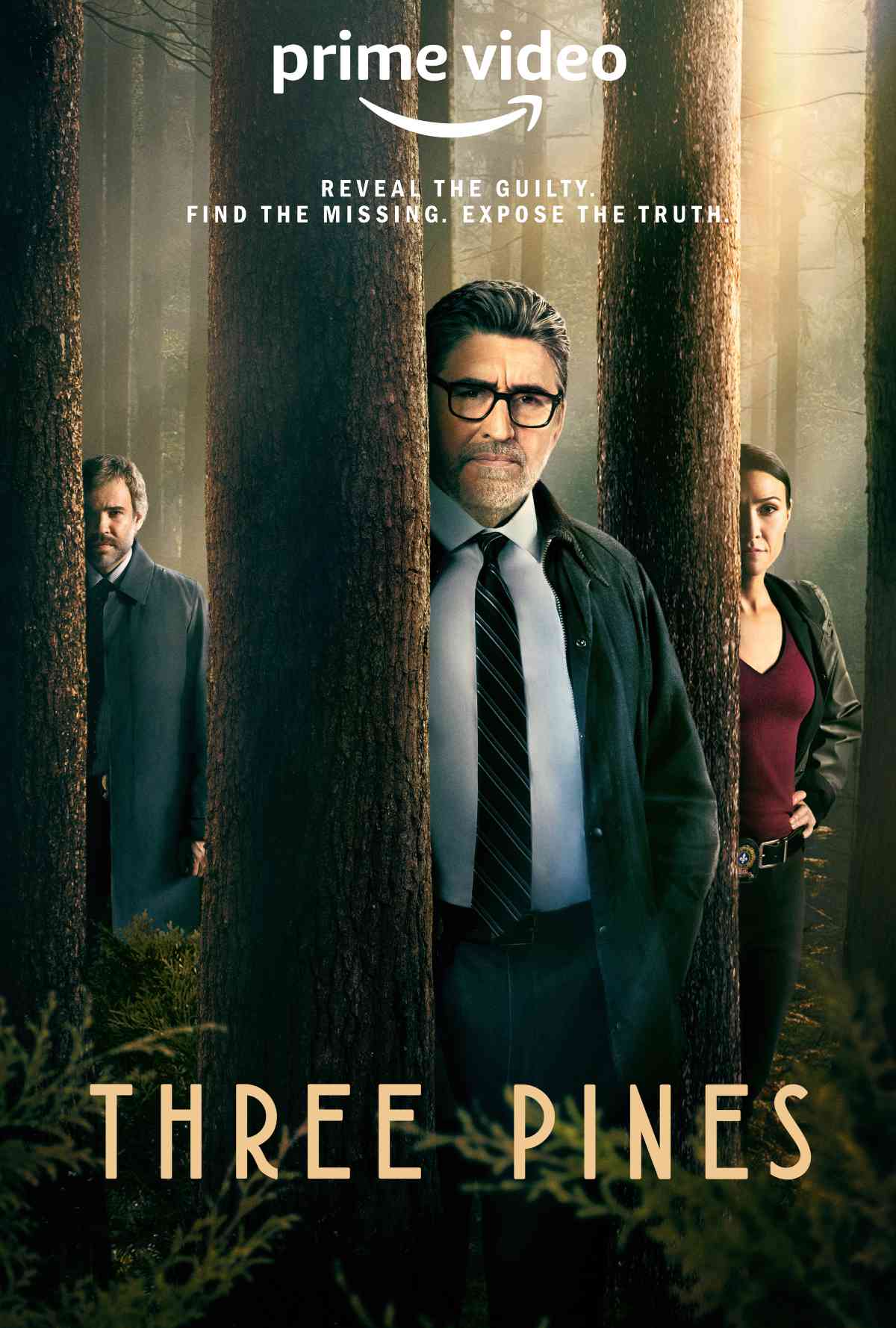
Three Pines, on Prime

The married, middle-aged Chief Inspector Armand Gamache is sort of like a French Canadian Maigret. However, he also has some the erudition and emotional baggage of Adam Dalgliesh. Obviously, it would be folly to deceive the good Inspector, yet people keeping trying, with often woeful results. Despite the community’s lack of cooperation, Gamache keeps solving murders in titular Quebec village throughout the eight-episode Three Pines, adapted from Louise Penny’s novels by Emilia di Girolamo, which premieres tomorrow on Prime Video.

Gamache is so competent and well-respected, he won’t be fired when he shows up his snotty boss, Superintendent Francoeur, but he will be assigned to investigate a freak death way out in Three Pines. Apparently, the town’s least favorite self-help guru was electrocuted in her chair while watching a curling match. Yes, this show is definitely set in Canada. Nobody liked the deceased very much, but they don’t have much to say to Gamache’s team: moody Jean-Guy Beavoir, First Nations single-mom Isabelle Lacoste, and the annoying local cop Yvette Nichol. You’d almost think they were all trying to cover for the killer.

Somewhat like
Hjerson, Three Pines adapts several Penny novels in two-episode arcs, but it also maintains a series-long investigation into the presumed death of a missing indigenous teen, Blue Two Feathers. Gamache’s pal Pierre Arnot originally investigated her disappearance, but the trail has gone stone-cold, partly because Francoeur never allocates resources to such cases.

Tragedy begets tragedy when Gamache is next dispatched to Three Pines. The previous victim’s abandoned house, a former indigenous conversion school, has become the scene of a fresh crime. Bad karma seems to pile up in Three Pines, but it is not supernatural, in the
Twin Peaks tradition, which the title inevitably evokes—except maybe the spooky dreams related to the Two Feathers case that plague Gamache’s sleep.

Even when Gamache checks into a luxury hotel outside of Three Pines for his anniversary, Three Pines still finds him. In this case, the estranged sister of one of the villagers turns up dead, after inheriting the family fortune, much to everyone’s surprise. The final arc is roughly drawn from Penny’s novel
The Brutal Telling, in which a stranger is found dead after he inexplicably burst into the café to tell everyone they would get what’s coming to them, because he knew all their dirty secrets. It turns out that is not advisable in Three Pines. However, the case of “Arthur Ellis” gets squeezed to the margins, to make way for the resolution of the Two Feathers case.

The mysteries of
Three Pines are just okay, at least as adapted by di Girolamo, but Alfred Molina still makes the series worth watching. He is terrific as the kindly but disillusioned Gamache. He also has great workplace chemistry with Rossif Sutherland and Elle-Máijá Tailfeathers as Beauvoir and Lacoste. However, Sarah Booth’s bumbling shtick as Nichol clashes with the tenor of the series.

Frankly, the “secret” bad guy stands out like a sore thumb right from the start. It is like di Girolamo didn’t even bother to attempt any misdirection. That might be fine for an episode of
Cannon or Columbo, but it will irk fans of Penny’s novels—and there are a lot of them, which is presumably why the series was produced in the first place.

Friday, August 30, 2019

Don’t Let Go (a.k.a. Relive, from Blumhouse)


It is rather fittingly ironic when a film about communicating in the present back into the past to prevent tragic mistakes is substantially re-edited. Supposedly, that was the case for the film previously known as Relive, which I reviewed for Criminal Element, as part of my exclusive Sundance coverage. The latest version of the film sure seems a lot like what screened in Park City, but that was actually quite a good movie, so there really wasn’t any call to run it through a Soderberghian blender. As a result, Jacob Estes’ Blumhouse-produced Don’t Let Go is still recommended when it opens today in New York.

Det. Jack Radcliffe is a good cop and a good uncle. His brother is a bit of an irresponsible flake, so he often picks up the slack with his bright teen niece Ashley. As a result, he is completely devastated when she is brutally murdered, along with her parents and the family dog, presumably the victims of the sort of violent drug-dealers her father was supposedly no longer associating with. He prays for chance to somehow turn back time and save her—and then he gets a mysterious call from Ashley, originating a week before the murders will be committed.

With the clock ticking in the earlier timeline, Radcliffe will guide Ashley’s investigation over the phone, while trying not to freak her out with the prospect of her looming murder. There is indeed some rather clever time-bending material in DLG, which distinguishes it from similarly themed films (particularly the sadly under-seen Cryptic).

David Oyelowo still deserves genuine breakout stardom for the smart intensity of his performance as Radcliffe. His chemistry with Storm Reid (as Ashley) also holds up well during a second viewing. Plus, it is still a pleasure to watch veteran character actors like Mykelti Williamson, Alfred Molina, and Bryon Mann dig into their characters and Estes’ well-written dialogue as Radcliffe’s partner, their captain, and a rather insensitive Internal Affairs detective, respectively.

We liked this film enough to write an entirely new review (albeit a tad shorter), which should say a lot, considering how many releases clamor for our attention every week. This is a good one, so genre fans really ought to give it a chance. Enthusiastically recommended for fans of time-warping movies (but not necessarily for devotees of the Blumhouse horror brand, which does not really apply here), Don’t Let Go opens today (8/30) in theaters around the City, including the AMC Empire.

Tuesday, December 27, 2016

Close to the Enemy: A Grand Hotel for Espionage

For many of Britain’s Greatest Generation, it was hard to believe how quickly things changed after the war, like the towering Winston Churchill getting turned out of office. That was obviously a mistake they rectified in 1951. For partially PSTD-rattled Victor Ferguson, making nice with “useful” National Socialist scientists is also a mistake. His older brother, Capt. Callum Ferguson might just agree with him, but his latest and most likely last assignment involves winning over a reluctant German aeronautical engineer. At least he will have agreeable digs for the gig. Ferguson and his charge will be “safely” ensconced within London’s only functioning luxury hotel in Close to the Enemy (trailer here), a seven-part British limited series, which releases today on DVD, from Acorn Media.

Victor Ferguson survived Monte Cassino, but he has been acting erratically and anti-socially ever since his discharge. Capt. Ferguson landed at Normandy. Outwardly, he is cool and confident, but we are given reason to believe his psyche is deeply troubled. Babysitting Dieter Koehler was not his idea, but if he can convince the German to help his new British patrons break the Sound Barrier first, he will be in a highly advantageous position to restart his engineering career. There are also fringe benefits to being stationed in the Connington Hotel. The food is decent and the aspiring actress-working girl staying in the next-door room is certainly friendly. Plus, an expat American jazz diva leads a legit swing band in the basement club, which is of particular interest to a frustrated composer like Ferguson.

Ferguson will steadily gain Koehler’s trust, initially through pleasing his little girl Lotte. Unfortunately, he is frequently called away to tend to brother Victor’s dramas. For reasons we never really understand, Ferguson also commences an affair with his best friend’s rich American fiancée, Rachel Lombard. More interestingly, the Captain develops a highly complicated working relationship with Kathy Griffiths, an investigator in the British war crimes office. Of course, she is trying to prosecute exactly the sort of people who have been stashed away at the Connington. Yes, much to Ferguson’s own surprise, it turns out there is another old National Socialist a rival agency is keeping on ice in the hotel.

Enemy is stuffed with characters and subplots, which espionage genre fans generally appreciate. In this case, it means the lists of what works and what flops are both long and detailed. The basics are pretty strong, starting with the Connington setting. Generally speaking, it is good fun to watch Ferguson skulking around mothballed building. It is sort of like Grand Hotel or Arthur Hailey’s Hotel, but with guns and war criminals. To give credit where it is due, Jim Sturgess, who can be pretty hit-or-miss is really terrific as Capt. Ferguson, nicely handling both his flip façade and slow-burning angst. However, his relationship with Charlotte Riley’s Lombard is never the slightest bit believable, especially when Charity Wakefield seems like so much more fun, as the slightly scandalous Julia.

Regardless, Capt. Ferguson is all business with Griffiths, but their scenes crackle with energy, thanks to the first-rate platonic love-hate chemistry Sturgess and Phoebe Fox share together. Speaking of fun, Angela Bassett is clearly having a blast playing the Billie Holiday-Josephine Baker composite. Then there’s Freddie Highmore as Victor Ferguson—and there’s just so blasted much of him. His petulantly boyish screen presence is so annoying, Martin Scorsese will probably make him the lead of his next six films if DiCaprio suddenly goes through puberty. Whenever Victor lurches onto the scene, everything comes to a screeching halt, even when the crafty old vet Alfred Molina tries to cover for him as Harold Lindsay-Jones, a retired Foreign Office official, who takes an interest in the Brothers Ferguson.

So, both columns of Enemy’s ledger are pretty full. Yet, thanks to Sturgess and the nearly bullet-proof hotel-for-spies premise, it keeps viewers sufficiently intrigued and invested to sit through Victor’s interminable acting up, so they can get back to the good stuff. Recommended for fans of British period spy dramas (despite Victor “Fingernails-on-the-Blackboard” Ferguson), Close to the Enemy is now available on DVD and BluRay, from Acorn Media.

Monday, October 08, 2012

A Whisper to a Roar: Democracy on the March?


Freedom and democracy are not the same things, but they tend to go together.  Democracy advocates in Venezuela, Malaysia, Egypt, Zimbabwe, and Ukraine understand only too well how their repressive regimes use rigged elections to legitimize their rule.  Largely informed by the writings of Hoover Institute fellow Larry Diamond and the expelled Prince Moulay Hicham of Morocco, Emmy-winning filmmaker Ben Moses follows the struggle for free and fair democracies in all five countries throughout A Whisper to a Roar (trailer here), which opens this Friday in New York.

Whisper uses an animated fable as a framing device that illustrates how the corrupting influence of power makes today’s hero tomorrow’s despot.  Indeed, Hosni Mubarak might have been popular immediately after the Sadat assassination and the freshly "re-elected" Hugo Chavez might have been legitimately elected originally, but that was then.  Up until the Arab Spring, elections in Egypt never involved alternative candidates.  They were simply an up or down referendum on retaining Mubarak.  Likewise, Chavez has rigged the Venezuelan electoral system through the mother of all gerrymandering and forcibly silenced the independent press.

Probably nobody interviewed in Roar has paid a higher price for their advocacy than former Malaysian Deputy Prime Minister Anwar Ibrahim, who was twice arrested and tried on trumped-up sodomy charges, a transparent attempt to make him socially radioactive in a country where Islam is the official state religion.  Yet, Malaysia seems to be one of the two countries that have made the most progress towards democratic reform, along with Zimbabwe.

When longtime dictator Robert Mugabe finally agreed to share power with reformist Prime Minister Morgan Tsvangirai it represented a dramatic victory for the opposition.  However, that victory came at a high cost, after militias loyal to Mugabe systematically beat and killed supporters of Tsvangirai’s party across the country.  Mugabe’s cynical land reform proposals, clearly intended to stoke racial resentment, also offer a textbook example of how dictators resort to demagoguery to hold onto power.

Most frustrating is the case of Ukraine, where Viktor Yushchenko survived a poisoning attempt to lead the Orange Revolution, temporarily sweeping the neo-Soviet government out of office.  Unfortunately, divisions within the Orange coalition opened the door for the old regime’s return in the next election, fair and square.  As journalist turned opposition deputy Andriy Shevchenko trenchantly observes, winning freedoms is an arduous process, but surrendering them is quick and easy.

While Roar obviously has an agenda, it is one just about all people of good conscience will buy into.  It features some valuable on-camera interviews with prominent world figures, including Yushchenko, Tsvangirai, and Ibrahim, as well as boots on the ground activists, such Roberto Patiño in Venezuela.  Even the animated transitions, narrated by Alfred Molina, are rendered with more style than you might expect.

The only problem with Roar is hardly Moses’ fault.  Each of these stories is still very much developing.  Despite hopeful signs in Zimbabwe and Malaysia, Venezuela has only gotten worse, while the Ukraine has taken one step forward and then one step back, whereas Egypt remains an open question.  As a result the five strands do not parallel each other very well and none has a satisfying sense of closure.  Of course, Moses and his colleagues would surely like nothing better than to produce happy epilogues for each country, for reasons beyond the cinematic.  As things stand, they interwove their stories rather well. 

Informative and remarkably even-handed, A Whisper to a Roar is a very watchable status report on the state of undemocratic democracy.  Recommended fairly highly for general news junkies and those particularly interested in any of the five subject countries, Roar opens this Friday (10/12) in New York at the Quad Cinema.

Thursday, January 22, 2009

Inspired by Hitchcock and the Ripper: The Lodger

In an eminently defensible decision, BBC History magazine’s 2005 readers’ poll selected Jack the Ripper as the “Worst Briton in History.” At least Whitechapel’s notorious serial killer would inspire some interesting fiction, including Robert Bloch’s classic short story, “Yours Truly, Jack the Ripper” and Marie Belloc Lowndes’ novel, The Lodger. The latter would become the source material for several motion picture adaptations, including Alfred Hitchcock’s classic 1927 silent film and David Ondaatje’s contemporary updating of The Lodger story (trailer here), which opens in New York tomorrow.

While Ondaatje’s Lodger takes place in present day Los Angeles and Hitchcock’s Lodger is set in foggy London eighty-some years prior, both films start in roughly the same place. As a serial killer stalks his victims, sensational press coverage heightens the city’s growing anxiety. Against this backdrop, a reserved stranger with a mysterious black bag rents living quarters from a family, but insists the portraits be removed from his walls, because their eyes disturb him. From there, the films diverge completely.

Malcolm, Ondaatje’s secretive lodger, explains to his prospective land-lady, Ellen, that as a writer he keeps odd hours and can never be disturbed. He refuses to meet her husband, but offers plenty of up-front cash. Ellen has no problem with any of his conditions, particularly his cash, but she is also clearly attracted to her new tenant.

Simultaneously, Chandler Manning of the L.A. County Sheriff’s department is pursuing a serial killer who is re-enacting the murders of Jack the Ripper. As an expert in Ripper history Manning would seem to be the perfect cop for the case, but the forensic evidence from the recent killings has exonerated a man Manning previously sent to death row for a similar pattern of murders. With his career in jeopardy, Manning is convinced the key to the case lies in determining which historical Ripper suspect the killer believes he is emulating, so he enrolls his unfortunate partner in a crash course of Jack the Ripper 101.

In what is more-or-less the lead role, Albert Molina is an impressive screen presence as Manning, elevating the film above standard thriller fare. The British actor is great fun to watch as he growls politically incorrect abuse at his partner and delves into the Ripper lore. A number of interesting character-actors flesh out Lodger’s cast, including Philip Baker Hall (who was probably born stern and flinty), as the territorial LAPD Captain Smith. Unfortunately, Simon Baker (star of TV's The Mentalist) fails to convey a true sense of menace as the title man of mystery, but Hope Davis is quite convincing in the surprisingly tricky role of Ellen, his on-screen foil.

Ondaatje and cinematographer David A. Armstrong (known for his work on the Saw franchise) often visually channel Hitchcock and the script even lifts an entire scene from Psycho (not the shower sequence) as a tribute. Unlike Armstrong’s previous films, Ondaatje wisely keeps most of the gore safely off-screen. While the clichéd final ending is a bit of a disappointment, The Lodger is still a modest, but enjoyable little thriller, thanks in large measure to Molina’s thoroughly entertaining performance. It opens tomorrow in New York at the Quad Theatre.