He truly was the “architect of rock & roll.” Richard Wayne Penniman was
rocking before Elvis and at one point he had Jimi Hendrix in his band. His
shows had more energy than Springsteen’s and more flamboyance than Elton John’s.
Actually, his flamboyance is a major focus of Lisa Cortes’ documentary, Little
Richard: I Am Everything, which airs Monday on CNN.
Penniman
was the third son out of twelve children for his father, a Pentecostal deacon
and bootlegger, who often took issue with the future rocker, because he was
small, sensitive, and gay. That last part is maybe a little more complicated,
but not to his dad. Of course, Penniman could sing, starting in the Church and
then on the chitlin circuit (which sometimes included drag performances).
While
giving a rough chronology of Little Richard’s life and career, Cortes’ central
theme is the tension between his sexuality and his Evangelical Christianity.
She also interviews his longtime off-and-on girlfriend Lee Angel at length,
which is where some of those complications come in. Yet, there is no mention of
his classic supporting turn in Down and Out in Beverly Hills, which contributed
considerably to his 1980s comeback (the soundtrack also featured one of his
final hits, “Great Gosh A’Mighty”). On the plus side, the coverage of Little
Richard’s gospel period is pretty solid.
Maybe
his identity issues will mean a lot to some people, but his fans would probably
rather hear more about his music. Little Richard is a legend, so it is nice to
get some sense of his personality. Even today, his wicked sense of humor still
often plays like knowingly outrageous performance art. Yet, he is still
entitled to some privacy, even posthumously, which is why Cortes’ obsessive
interest in his romantic life and sexual pursuits sometime feels excessive and
intrusive, especially when there is so little song-by-song discussion of his
recorded output.
Dionne Warwick almost sang a Bond theme,
but “Mr. Kiss Kiss Bang Bang” was replaced by Tom Jones’ “Thunderball” at the
last minute, because the producers were so literal-minded. Nobody mentions it
in her documentary, probably because she had 56 other singles that hit the
charts, making her one of the top-selling recording artists of all time.
Warwick looks back on her life and career in David Heilbroner & Dave Wooley’s
Dionne Warwick: Don’t Make Me Over, which airs Sunday night on CNN.
Warwick is widely considered the first vocalist
to fully crossover from R&B to pop. Her long association with the
song-writing duo Burt Bacharach and Hal David is the major reason why. They
have been dismissed as loungey, but tunes like “Alfie,” “I’ll Never Fall in
Love Again,” “Do You Know the Way to San Jose,” and “Always Something There to
Remind Me” are quite interesting musically. If nothing else, Heilbroner and
Wooley will convince viewers the time has come for an in-depth documentary
profile of Bacharach.
Jazz fans will also be interested to know
Warwick was twice married to jazz musician William Elliott, who was a sideman
with Willis “Gator” Jackson and co-led a session with Joe Thomas. Their first
marriage was sort of a false start, but the second take lasted twelve years—and
Warwick’s memories of it sound mostly positive. It was with Elliott that
Warwick had her two sons, Damon and Elliott, who are far and away the doc’s
funniest interview subjects.
You have to appreciate a celebrity chef who acknowledges the five-second
rule. Julia Child wasn’t above brushing off a little dirt from kitchen mishaps,
which was one of the reasons she was so fun to watch. For years, she was also
the original and only really notable TV chef. If she were alive today, she would
probably have her own streaming channel, but the magnitude of her success in
her time was still no can of corn. Julie Cohen & Betsy West chronicle Child’s
life and career in the documentary Julia, which airs tomorrow on CNN.
Before
she served dinner, Child served her country as a staffer for the OSS, Wild Bill
Donovan’s forerunner agency to the CIA. Her family insists she never did any spycraft,
but that still seems like a good idea for a fictional thriller. Regardless, she
met her future husband, Paul Cushing Child, when they were both posted to
Ceylon. Eventually, his career in the Foreign Service brought them to France,
where she met Simone Beck and started collaborating on Mastering the Art of
French Cooking, an unusually detailed cookbook, intended for American
readers.
Public
television was pretty grim in the early 1960s, but WGBH viewers appreciated how
she livened up a book review program, by demonstrating the proper technique for
making an omelet. As a result, they took a chance on a show of her own, The
French Chef. The best part of the doc gives a behind-the-scenes view of its
early, by-the-seat-of-its pants years. The production process might have been
an adventure, but the show was an immediate hit.
Everyone
gives Child credit for making PBS watchable, yet Public Broadcasting thought it
was time to put her out to pasture in the early 1980s, so she signed with Good
Morning America instead. It is clear throughout Julia that Child was
a shrewd capitalist. However, Cohen & West (whose RBG celebrated
Justice Ginsburg for having a kneejerk political record on the bench, rather than
a coherent judicial philosophy) do their best to transform Child into a
divisive figure, by celebrating her liberal activism.
Marilyn Monroe is a lot like John Wayne—stay with me here—in that they are still
just about as popular now as they were at the height of their fame and they
still mean exactly the same things to their fans. In Monroe’s case, that would
be sex appeal first and foremost, but also music and comedy. Unfortunately, that
led to a career of typecasting and underestimation for the iconic movie star. A
nearly entirely female battery of commentators offers more sympathetic (and “feminist”)
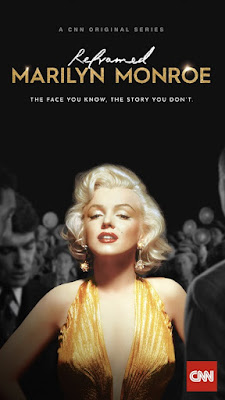
spins on Monroe’s life and career in the four-part Reframed: Marilyn Monroe,
narrated by Jessica Chastain, which premieres Sunday on CNN.
Monroe
is still a huge star, but she had to fight for everything she had, before
tragically dying far too young. She grew up as an orphan, so she learned to
make the best of things. While working in an airplane factory during WWII, Monroe
caught the eye and lens of a photographer, who convinced her to start modeling
professionally. Subsequently, she signed as a contract player at 20th
Century Fox, but she was initially only cast in inconsequential parts, because
studio mogul Darryl Zanuck just didn’t get her.
Obviously,
she eventually caught on, with the aid of some unprecedented publicity.
However, the conflict between her and Zanuck was a constant refrain throughout
her career. Frankly, the best parts of Reframed explore that studio
intrigue. Yet, there are probably bigger villains in Reframed than
Zanuck, such as Hugh Hefner, who built his empire on her nude pictorial, but
never paid her a dime for the photo shoot she had signed away all rights to.
Given
her enduring stature, it is pretty amazing how short Monroe’s career was, only
truly “starring” in about a dozen films. Reframed nicely covers Some
Like It Hot, The Misfits, Bus Stop, and The Prince and the Showgirl (which
was the subject of My Week with Marilyn), but it gives rather short
shrift to Niagara and almost entirely ignores Otto Preminger’s River
of No Return. There are not a lot her star-vehicles, so it is a shame to gloss
over an interesting one.
On
the other hand, jazz fans will be happy Reframed discusses her
friendship with Ella Fitzgerald. She also gets credit for her USO tour, which
cemented her appeal to her military fans. Of course, her unfortunate marriages
are discussed in detail, but the treatment of Joe DiMaggio is totally unfair
(recycling abuse rumors, but not crediting the Yankee Clipper for his help
getting her out of the Payne Whitney psych ward). Yet, the biggest oversight in
Reframed is it ignores her conversion and continuing identification with
Judaism. Seriously, how did Adam Sandler overlook her for “The Hanukkah Song?”
Wisely, interview subjects do their best to defuse Kennedy conspiracy rumors,
especially her close friend Amy Greene.
She must have led an eventful life, since this new documentary profile does
not even mention she was bestowed an OBE by the Queen. Frankly, it is more
concerned with the aspects of Jackie Collins’ life that were more like her bestselling
novels, as her fans will appreciate. Her friends and famous sister recall how
she built her brand and lived the glamorous life in Laura Fairrie’s Lady
Boss: The Jackie Collins Story, which screens as part of this year’s
Tribeca Film Festival, before airing on CNN.
In
her teen years, Collins lived in the shadow of her sister Joan, the Dynasty
actress (or maybe you think of her first in the “City on the Edge of Forever” Star
Trek episode). The younger Collins also tried to make it in show business,
but it just didn’t happen for her. Instead, she opted for her first marriage,
which would end tragically for her emotionally troubled husband. Her second husband,
Oscar Lerman, was the love of her life, who encouraged her to finish her first
novel. And the rest was history.
Her
early novels were big hits in the UK, but she became a global bestseller when
she moved to Los Angeles and focused on cracking the American market. Hollywood
Wives became the breakout hit she was hoping for. However, Collins was
shrewd enough to build on it. No matter what you think of her writing, many
subsequent marquee authors have tried to emulate her approach to marketing,
publicity, and branding—as best they can.
In
fact, Lady Boss inspires nostalgia for Collins’ salad days of the 1980s.
Several of her colleagues in the film liken her to a female Harold Robbins,
which is indeed apt. Both wrote Horatio Alger-esque stories, in which their
protagonists (men in Robbins’ case, women for Collins) manage to claw their way
to wealth and power through their sheer drive and sexual confidence. Unfortunately,
there is no place for a successor to either in the current cultural climate,
because of puritanical attitudes towards sex and a socialistic contempt for
bootstrap-success stories.
Lady
Boss
does a nice job of capturing the tenor of Collins’ personal relationships,
especially the complicated love and sibling rivalry she shared with sister Joan.
Clearly, Fairrie was blessed with access to a treasure trove of Collins’ home
movies, as well as the candid participation of her three daughters and famous
sister. We also hear a number of professional insights from her agent,
publicist, and business manager, all of which Fairrie and editor Joe Carey cut
together in a lively and sometimes ironically amusing manner.