Showing posts with label NYFF '17. Show all posts

Monday, October 16, 2017

NYFF ’17: Amalric’s Music Films

What do Canadian Opera soprano Barbara Hannigan and Downtown multi-everything John Zorn have in common? Aside from the fact both have probably conducted ensembles playing in a broadly classical context (certainly true in her case), they both are known associates of French actor-director Matheiu Amalric and been the subjects of his short films. Usually they were largely unplanned. Amalric just had his camera running, suspecting something interesting would happen. His rapport with his subjects and their remarkable talent produced the three highly distinctive short documentaries that screened as a program at the 55th New York Film Festival.

Hannigan is the subject of C’est presque au bout du monde and Music is Music, which each clock in around twenty minutes and bookend the nearly hour-long John Zorn (2010-2017). Presque was an online commission for the Paris Opera, but seeing it on a theater screen instead of a little streaming window is an almost overwhelming experience.

When you are an artist of Hannigan’s caliber, you do not simply crack your knuckles and hit the high notes. You have to warm up your instrument, which in her case is her entire body. Amalric captured her warm-up process before several performances, which he and his editor Caroline Detournay assembled into a master-cut. To say this is a private process would be an understatement. Hannigan is incredibly exposed, captured often in a ritual that suggests auto-eroticism. Yet, when you watch it, viewers will feel an extraordinarily personal and protective attachment to her.

The Zorn film is something completely different, starting with the fact is not, strictly speaking, finished yet—and may never be. According to Amalric’s lively post-screening discussion, he and Detournay have already cut together more footage for the next installment, which is great news, because what he has so far is terrific.

Again, Amalric was commissioned to do a standard TV doc on Zorn, but apparently that went by the wayside. Instead, they became fast friends. Every time they crossed paths, Amalric filmed Zorn in performance, as well as his backstage comings and goings. In just fifty-four minutes, Amalric conveys the wide ranging stylistic diversity and virtuosity of Zorn’s work. We see him in a variety of settings, including a Downtown-style jazz ensemble (featuring Dave Douglas) and approvingly watching a string trio perform his chamber composition, “Freud.”

Yet, probably the greatest merit of the Zorn piece is the way it captures his sense of humor. I know several jazz musicians and most of them are very funny, because when you accept that kind of life, you have to have a sense of humor or you’ll soon be crying. In later sequences, Amalric and Detournay show Zorn listening appreciatively to other musicians sets, which is another decision that really pans out.

Similarly, viewers get a keen sense of how Hannigan relates to other musicians in Music is Music. For her latest CD, Crazy Girl Crazy, Hannigan chose a program of Alban Berg and George Gershwin that she performed as both featured vocalist and conductor. To make things even more interesting, the musicians of the Ludwig Orchestra would also perform the chorale arrangements, sort of like the flip-side of John Doyle’s Sondheim revivals. Initially, they are clearly uncomfortable in their new role, but Hannigan coaxes them out of their shells, which is lovely to watch. The way she makes connections between Berg and Gershwin is also fascinating. Frankly, it is just nice to see her expand the classical canon to include the Great American Songbook.


None of Amalric’s music films could be described as fannish, but they each can turn viewers into fans because they really get at the essence of their subjects. You feel like you have been backstage with them and then watched them perform from the wings. Very highly recommended, Music is Music is now available as an extra with Crazy Girl Crazy and John Zorn 2010-2017 will continue to expand and hopefully screen again at future NYFFs. Presque is also available online from the Paris Opera, but you won’t get the same overpowering impact that way.

Thursday, October 12, 2017

NYFF ’17: Ismael’s Ghosts, Director’s Cut

It is like Day for Night mixed with a little le Carré, but it is all very Arnaud Desplechin. Ismaël Vuillard (the protag of Desplechin’s Kings & Queen, again portrayed by Mathieu Amalric) is supposed to make a movie about notorious diplomat and possible spy Ivan Dedalus, who certainly sounds related to Paul Dedalus, a recurring character in three other Desplechin films, also played by Amalric. Everything is related and possibly everyone is Desplechin in Ismaël’s Ghosts (trailer here), which screens as a Main Slate selection of the 55th New York Film Festival.

This is not the version of Ghosts that garnered Cannes jeers. Instead, we get a “director’s cut” that is twenty-minutes longer. Frankly, the long version is still pretty confused, but it must be even harder to follow with pieces carved out. Vulliard is supposed to be telling the story of Ivan Dedalus, a notorious diplomat and spy from a working-class background, who ironically was often attached to missions precisely because he was suspected of dealing with the Russians.

However, Vulliard’s personal drama keeps getting in the way. Depending on what point Desplechin flashes back to, the surrogate character is either romancing Sylvia, the shy astrophysicist, preparing his mentor-father-in-law Henri Bloom for a retrospective tribute in Israel, or dealing poorly with the sudden reappearance of his long presumed dead wife Carlotta Bloom. Eventually, the stress gets to be too much for Vulliard, forcing his long-suffering friend and line producer Zwy to track him down.

Even if Desplechin added an additional hour, Ghosts would probably still be a jumbled, herky-jerky affair. The constant flashing forwards and backwards can leave your head spinning, but the whole point is how everything is supposed to be mixed up in Vulliard’s head, so you just have to roll with it.

In fact, there is a lot of good stuff in here. Louis Garrel is almost unrecognizable as the intriguing Ivan Dedalus, so much so, we wouldn’t mind seeing Desplechin return to his character. Amalric and Charlotte Gainsbourg’s Sylvia also have some appealingly fresh and mature chemistry together. Hippolyte Girardot also shows a flair for physical comedy as the poor, put-upon Zwy. Surprisingly, it is Marion Cotillard’s sequences as Carlotta Bloom (dig the Vertigo reference) that mostly muddy up the film.

It hardly matters if viewers have not seen Kings and Queen, because the significant events of that film are barely referenced in Ghosts. Anyone who can write up a cogent, detailed five-page synopsis of it has our respect. Yet, one could argue the old joke about the weather also applies to this film. If you are not enjoying it, just wait five minutes and it will change. Frankly, Ghosts is more briskly paced than the equally Proustian My Golden Days, but it has none of the whiny teen angst. Better than reported, Ismaël’s Ghosts, Director’s Cut is recommended for patrons who enjoy unpacking films when it screens tomorrow (10/13) and Saturday (10/14) during this year’s New York Film Festival.

Wednesday, October 11, 2017

NYFF ’17: Farewell, My Lovely

It is hard to believe, but Robert Mitchum was the only actor to play Philip Marlowe in more than one feature film. Even Humphrey Bogart was one-and-done after The Big Sleep (he was Sam Spade in The Maltese Falcon). Chandler fans prefer to forget Mitchum’s second outing in a modern day Big Sleep remake, but his debut as Raymond Chandler’s classic gumshoe is justly considered one of the best. Fittingly, Dick Richards’ Farewell, My Lovely screens as part of the Robert Mitchum retrospective during the 55th New York Film Festival.

Some perhaps thought Mitchum was too old for the part in 1975, but this is also an older, more reflective Marlowe. After years of working cases for twenty-five dollars a day, plus expenses, Marlowe finds himself aging out of a profession that provides plenty of enemies but no health insurance. Currently, he is laying low in a flea bag motel, trying to avoid both the cops and the bad guys. His latest case has taken a particularly nasty turn, as we shall see, in media res.

By being in the wrong place at the wrong time, Marlowe is hired by Moose Malloy, an ex-con fresh out of the joint, to find his missing lover, Velma. It is hard to say no to anyone named Moose. As Marlowe starts to follow leads on Velma, he initially gets the runaround and then people start trying to kill him. Apparently, they want to kill Moose too, but he lays low even better than Marlowe. When in doubt, Marlowe and everyone else he crosses paths with swill gallons of booze. Seriously, this could almost be Hong Sang-soo’s Marlowe movie. Frankly, as in most great Chandler movies, the plot details are a little hazy, but the noir atmosphere and 1940s period production details are to die for.

John A. Alonzo’s moody color cinematography is absolutely gorgeous, in a nostalgic, back alley kind of way. Yet, David Shire (still probably best known for his funky Taking of Pelham 1-2-3 theme) does him one better, with a dreamily bluesy crime jazz score. Featuring jazz musicians who were totally comfortable in a studio session, such as Dick Nash, Ronnie Lang, Chuck Findley, Cappy Lewis, and Larry Bunker, the soundtrack album stood on its surprisingly well (take it from me).

Of course, it is Mitchum who utterly dominates the film as a haggard, world-weary Marlowe in a performance of seemingly effortless perfection. There have been other good Marlowes (Powers Boothe was the man when it came to television), but Mitchum was the only one who could hang with Bogart.


Yet, Farewell is fully stocked with colorful supporting turns, including a wonderfully vampy Charlotte Rampling as femme fatale Helen Grayle. Former boxer Jack O’Halloran (one of the three super villains in Superman II) is absolutely terrific as Malloy, the lovestruck tough guy. Criminally underappreciated John Ireland is rock solid as the honest copper, Lt. Nulty, while Harry Dean Stanton plays the brazenly corrupt Det. Rolfe with understated menace. In terms of historical footnotes, Farewell features a young Sylvester Stallone as a henchman, crime novelist Jim Thompson in his only movie cameo as Judge Baxter Wilson Grayle, and Jerry Bruckheimer receiving his first full producer credit behind-the-scenes.

David Zelag Goodman’s adapted screenplay has an end-of-an-era vibe, poignantly heightened by the pleasure Marlowe takes throughout the film following Joe DiMaggio’s famous pursuit of the consecutive-game hitting streak record, which baseball fans know will end in frustration. Again, it is Mitchum’s narration that makes it work so well. This is simply a classic P.I. film and a representative high-point in Mitchum’s filmography. Very highly recommended, Farewell, My Lovely screens this Saturday (10/14) as part of the 2017 New York Film Festival.

Monday, October 09, 2017

NYFF ’17: Lover for a Day

Comparisons between Philippe Garrel and Éric Rohmer were never completely inapt, because both French filmmakers had a knack for uncomfortably intimate relationship dramas. Some of us maybe didn’t realize it until now, but Garrel has completed a Rohmeresque thematic trilogy exploring the darker emotions associated with love. In the Shadow of Women addresses lust, whereas the subject of Jealousy is announced up front. This time around, Garrel examines fidelity, something cineastes probably considered to be positive and even laudable, at least before we saw it as the focal point of a Garrel film. Garrel is very Garrelian, but it is his daughter Esther rather than son Louis who co-stars in Lover for a Day (trailer here), which screens as a Main Slate selection of the 55th New York Film Festival.

Having been dumped by her boyfriend Mateo and evicted from his flat, Jeanne has no choice but to seek shelter with her teacher father. However, she is rather surprised to learn middle-aged Gilles is cohabitating with a student roughly her own age. Initially, there is tension between Ariane and Jeanne, as they resent any form of attention Gilles bestows on the other. Yet, slowly and steadily, the two young women form a truce and share confidences. Ariane tries to instill in Jeanne a more casual approach to love and sex, to counteract her unhealthy fixation on Mateo. Given her sensitive temperament, it will be hard for Jeanne to put her advice into practice, nor does it necessarily reflect Gilles’ relationship notions.

Like all of Garrel’s films, Lover is talky rather than plotty, but like the best of them, there are some remarkably resonant moments. Renato Berta’s lovely black-and-white cinematography greatly helps evoke that late-night, soul-bearing vibe. Even when the characters are out and about at high noon, the film still has a 2:00 feel to it.

Without her famous brother to overshadow her, Esther Garrel really comes into her own as Jeanne. It is not necessarily a “likable” performance, but it is uncomfortably real and brittle, in a nakedly vulnerable kind of way. In her feature debut, Louise Chevillotte’s work as Ariane is admirably complex and notably restrained. Éric Caravaca’s Gilles is a suitably Garrel-ish, hypocritical man, but his resemblance to the late Benoît Régent, co-star of Garrel’s grueling masterwork I Can No Longer Hear the Guitar, adds a further element of eeriness.


We do not really remember Jealousy and Shadow being pitched as part of trilogy (thematic or otherwise), but they are easily retconned into a Rohmeresque series of moral tales. They also happen to be particularly strong yet highly representative Garrel films. Perhaps most significantly, the third film could be remembered as the film in which Esther Garrel decisively staked her claim to the family business. Recommended for fans of Garrel, Rohmer, and maybe even Cassavetes, Lover for a Day screens tomorrow (10/10) and Wednesday (10/11), as part of this year’s New York Film Festival.

NYFF ’17: The Rider

Thanks to the spectacular success of Roger Goodell’s double-secret plan, the media has been completely distracted from the NFL’s concussion problem. In the long run, players would be better served by stricter safety regulations than the league’s political posturing. At least, there is a considerable upside to being a pro football player. Professional rodeo riders will never see that kind of compensation, but they run similar head trauma risks. Brady Blackburn is a case in point. He always aspired to be the best bronco rider on the circuit, but just as he won that kind of recognition, he suffered a life-altering injury. Blackburn will slowly come to terms with his new reality in Chloé Zhao’s The Rider (clip here), which screens as a Main Slate selection of the 55th New York Film Festival.

Blackburn is played by real life horse-trainer and former bronco-rider Brady Jandreau, as is his little sister and father Tim (whose name changed to Wayne, perhaps to establish more distance between the elder Jandreau and his character’s drinking and compulsive gambling). Brady Blackburn/Jandreau self-describes as an “Indian cowboy:” Lower Brule Sioux by heritage and a cowboy by vocation, which is about as American as it gets. South Dakota is one of the least populous states, but within his circles, Blackburn’s small pond fame was on the rise. Then he had what doctors insist must be a career-ending injury.

We see the scars vividly close-up when Blackburn removes his bandages in the opening scene, but we can’t see the steel plate he now carries inside his head. Resigning from the cowboy life seems like the only responsible thing for him to do. However, his family’s debt adds additional uncertainty to his situation. More fundamentally, he just seems to be born to work with horses, as when we watch him tame one beautiful but fiery specimen. Yet, even that more limited involvement carries great risks.

Blackburn/Jandreau’s personal circumstances are especially trying, but we clearly get the sense Zhao is documenting a more broadly endangered way of life. It somewhat shares a kinship with the doc Sweetgrass, but Rider is exponentially more emotionally gripping. Zhao portrays her subject and his friends and family with great sensitivity and dignity. Rider is her second feature set in and around the Pine Ridge Reservation, so clearly, she had an affinity for the locals and they developed a trust in her, which is was indeed justified.

The Rider is a very nice film that deserves its accolades (most definitely including Joshua James Richards’ sweeping cinematography), but Zhao’s film that still haunts us is the nine-minute Daughters, a short narrative about a young Chinese girl, whose parents suddenly decide they have one daughter too many now that they finally have their much-desired baby boy. Truthfully speaking, Daughters was one of the first films that convinced us covering shorts was an important thing to do. Hopefully, it will get more attention when Sony Classics releases The Rider in theaters. Recommended for those who appreciate aesthetically sophisticated western cinema and deeply personal drama, The Rider screens this Thursday (12/12), Saturday (10/14), and Sunday (10/15) as part of this year’s NYFF.

Saturday, October 07, 2017

NYFF ’17: On the Beach at Night Alone

Hong Sang-soo is often dubbed the “Korean Woody Allen,” but that superficial comparison was never really that apt, until now. Hong’s extramarital relationship with thirty-something actress Kim Min-hee (star of Right Now, Wrong Then) is nowhere near as problematic as Allen carrying on with his long-term girlfriend’s adopted daughter, but the resulting Korean scandal has been even more intense. Adding fuel to the fire, Hong finally acknowledged the relationship at a press conference for one of his three most recent films, in which an actress played by Kim herself deals with the fallout resulting from her affair with a prestigious director. You could think of it as Hong’s Husbands and Wives. Regardless, the meta-ness is often downright uncomfortable in On the Beach at Night Alone (trailer here), which screens as a Main Slate selection of the 55th New York Film Festival.

Even though she is still young, Young-hee’s acting career was already in the doldrums before her affair with Sang-won. To avoid the media feeding frenzy, she first visits her friend Jee-young in Hamburg and then tries laying low in her provincial small town. She walks incessantly, while her friends do their best to distract her. Yet, she compulsively ruminates on her scandal, yearning to see him again, yet deeply regretting their affair.

Throw in a prodigious amount of drinking and you pretty much have Hong’s film in a nutshell. Of course, there is more to it than that. However, much like The Day After, Beach, lacks the narrative gamesmanship that has distinguished Hong’s best recent films. Arguably, there is still a bifurcated structure, split between Hamburg and Korea, but it follows in strict chronological order.

Kim is quite arresting playing a slightly unstable analog of herself, but her exquisitely sensitive performance in The Day After is even more accomplished and arresting. Arguably, the finest work in the film comes from Seo Young-hwa, who charms and disarms as the complex but defiantly independent Jee-young. Kwon Hae-hyo exemplifies an exemplary Hong supporting character as Young-hee’s shaggy haired, hard-drinking art-house programmer crony Chun-woo. As if we needed additional layers of irony, actor-turned-politician Moon Sung-keun memorably appears as the adulterous Sang-won.

Beach is a revealingly personal film that will loom large for anyone studying Hong and his oeuvre. Nevertheless, it is not one of his more rewarding films. Kim Min-hee and Seo Young-hwa do nice work, but they cannot dispel the awkward vibe. Even viewers not hip to the behind-the-scenes drama will pick up on it. If you only see one Hong Sang-soo film at this year’s NYFF, it should definitely be The Day After. Recommended mostly for dedicated Hong and Kim fans, On the Beach at Night Alone screens tomorrow (10/8) and Monday (10/9), as part of this year’s New York Film Festival.

Friday, October 06, 2017

NYFF ’17: Dragonfly Eyes

Given the proliferation of security cameras, Mainland Chinese increasingly live in public. However, it is hard for them to object when they willing trade away so much privacy through web-cams and social media. Installation artist Xu Bing tells a modern fable exclusively through cobbled-together excerpts of CCTV footage and cloud-stored internet video in Dragonfly Eyes (trailer here), which screens as a Projections selection of the 55th New York Film Festival.

Ting Qing (“Dragonfly”) has lived a sheltered existence in a Buddhist monastery, but she is restless to see some of big city life. Will she ever. Repeatedly told she is plain, the unskilled young woman accepts a series of menial jobs. At a large dairy farm, she turns the head of a Ke Fan, a skilled worker with anger management issues. He will follow her from city to city and job to job, lashing out whenever he feels she has been mistreated.

Eventually, this lands Ke Fan in prison and Ting Qing in need of another fresh start. She gets a crack at it, thanks to plastic surgery, obtained through her before-and-after modeling. Suddenly, she finds creepy fame as an internet idol. Unfortunately, the masses are fickle and the trolls will be cruel.

Frankly, Dragonfly makes you wonder why the Chinese government bothered to install so many cameras, when nobody makes an effort to stop the various beatings and drownings they captured. If they aren’t being watched, then what is the point?

In fact, some of the edited footage is highly disturbing, almost in a Faces of Death kind of way. While some of the most disastrous clips are used as metaphorical interstitial buffers, they register just the same. For instance, Xu incorporates car accidents, suicides, roof cave-ins, bridge collapses, train derailments, and an airliner falling out of the sky. China never looked more dangerous than it does in Dragonfly, because it is all real.

Zhai Yongming and Zhang Hanyi’s screenplay definitely leans towards the melodramatic, but it takes a gender-bending left turn late in the third act that is definitely gutsy for the Mainland. Their story might be sudsy, there is something oddly compelling about Ting Qing and Ke Fan, two young people trying to make it in the city, but finding the deck stacked against them. The disembodied voices of Liu Yongfang and Su Shangqing that narrate the grainy footage are weirdly compelling in a similar way.

Yet, considering how it was assembled, it is rather surprising Dragonfly is more of an indictment of the corrosive madness of social media than the invasiveness of the surveillance state. Either way, the film clearly suggests a bit more privacy would be a good thing.

China could very well be the most connected and tech-savvy country in the world, but it is also one of the most socially and economically stratified. Xu and his team throw that dichotomy into sharp relief. They also give viewers a feel for everyday life in China, albeit often in times of sudden stress. Watching some of the particularly violent and tragic scenes will make viewers feel like intrusive voyeurs, but at least Xu employs (or exploits) them to make a progressive point. Recommended with minor reservations for patrons of experimental cinema, Dragonfly Eyes screens this Sunday (10/8) and twice on Monday (10/9), as part of this year’s NYFF.

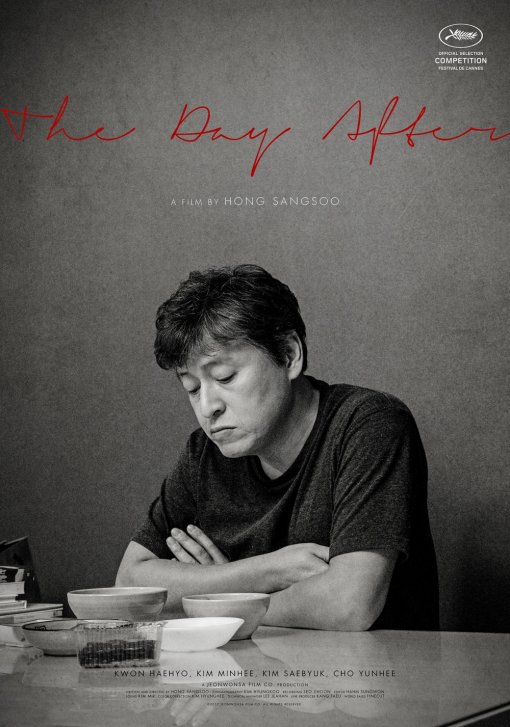
NYFF ’17: The Day After

Sure, there are exceptions, but by and large, people working in book publishing are ragingly neurotic and they drink like fish. Could there be another film director better suited to making a film set in a high-brow small press than Hong Sang-soo? In this case, the publisher also happens to be an unrepentant adulterer. Again, who better than Hong? News of his extramarital affair has scandalized Korea, but it has not slowed Hong’s prolific output. He has two new films at this year’s NYFF (how they missed out on Claire’s Camera starring fest fave Isabelle Huppert is rather baffling). Hong dials down the narrative gamesmanship in The Day After (trailer here), the less uncomfortably awkward of his two Main Slates selections screening at the 55th New York Film Festival.

Song Ah-reum is the sort of thoughtful, responsible employee a boutique literary house would be lucky to employ. Kim Bong-wan hired her because she was pretty. He just let his former assistant go, because his wife Song Hae-joo was starting to suspect they were having an affair, which they were. Unfortunately, Song Hae-joo storms into the office to deliver the Dynasty power-slap to her rival on Song Ah-reum’s first day.

Understandably, the new assistant is rather taken aback by the jealous wife’s torrent of abuse. Kim tries to convince her to stay despite the drama, until his former mistress-assistant Lee Chang-sook drops by to rekindle their affair. Since Song Hae-joo has never seen Lee, they hatch a scheme to return the real mistress to her former job, by pretending Song Ahreum really was the other woman, if she will agree to leave after only one day. It is not a particularly well thought out master-plan, but it evidently involves drinking a great deal of soju.

Even by Hong’s standards, Day After is small in scope, but it has a rarified air of sophistication and an unusually sharp edge. Somewhat ironically, the unfairly accused Song is played by Kim Min-hee, who has been absolutely pilloried in the Korean press after she and Hong came out with their relationship. Seriously, think Pitt-Anniston-Jolie raised to the power of fifty.

It is a shame outside events will inevitably color people’s perception of Day After, because this really is one of Kim’s finest performances. It is a wonderfully subtle and graceful turn. Ironically, you would expect such a wise and forgiving portrayal to come at the end of an affair rather than at the high point of media scrutiny.

As usual, Hong regular Kwon Hae-hyo is a gently amusing bundle of anxieties and hang-ups as the philandering Kim Bong-wan. Think of him as a Seinfeld character you could actually spend time with, especially with the soju flowing. He and Kim Min-hee share some wonderfully gawky scenes together. You could call it anti-chemistry, but they still play off each other beautifully.

Throughout Day After, Hong skewers male vanity and the hypocritical pretensions of the literary smart set. Kim Hyung-ku’s warm, glowing black-and-white cinematography also greatly heightens the feeling of intimacy. However, Hong fans will miss the narrative eccentricities of his recent films, like Hill of Freedom, Yourself and Yours, and Right Now, Wrong Then (also starring Kim Min-hee). Some might interpret it as an apology or a case of protesting too much, but we see it as a fair representation of book publishing. Recommended for admirers of Hong and literate, chamber dramas, The Day After screens tomorrow (10/7), Sunday (10/8), and the following Sunday (10/15) as part of this year’s NYFF.

Thursday, October 05, 2017

NYFF ’17: A Gentle Creature

It is a matter of inspiration rather than adaptation. Dostoevsky’s short story sparked something for the Moscow-trained, Ukrainian filmmaker, but it is way more upbeat than Sergei Loznitsa’s resulting film. In terms of literary comparisons, think of it as Candide rewritten by Kafka in present day Russia. However, this much abused woman is keenly aware she is absolutely not living in the best of all possible worlds. She lives in Russia, a corrupt and soulless country, where nobody passes up an opportunity to victimize others. Of course, it starts with the venal officials and rolls downhill in Loznitsa’s A Gentle Creature (trailer here), which screens as the “Film Comment Presents” selection of the 55th New York Film Festival.

We never really learn how and why the meek office worker’s husband was sentenced to prison for murder, but it is probably safe to assume he was unjustly convicted. One day, her care package is returned to her, because it was refused by the prison. Concerned about her husband’s status, she makes the arduous journey to the unnamed provincial village, but all her bureaucratic inquiries are rebuffed out of hand.

Apparently, exploiting visitors in “the Gentle Creature’s” position is a cottage industry in this town, which looks unchanged since the Stalinist era. Unfortunately, everyone immediately recognizes she is particularly easy pickings. A grotesque boarding house proprietor quickly gets her claws into the confused wife, but it is her criminal associates who represent the real danger. They claim they can facilitate a visit with her husband, but we suspect their ultimate designs involve something like human trafficking.

Creature is absolutely, positively guaranteed to garner a divisive reception from New Yorkers. Older viewers will be put off by its deliberately slow, agonizingly naturalistic first two hours, as well as a sudden turn towards the surreal in the third act. On the other hand, Social Justice Warriors will be confused by Loznitsa’s not-so-veiled criticism of Russia’s Communist past and possibly outraged by a scene of sexual violence that is admittedly tough to watch (but it is supposed to be horrifying, that’s the whole point). However, for those who understand the film’s historical and cultural context, it is a bracing indictment of contemporary Russia, both socially and politically. There are also moments of bitterly dry humor, which is so very Russian.

Granted, the Gentle Creature is such a perfectly passive victim, she often induces groans and face-palms. However, it is important to remember Creature is essentially an allegory, so we should expect a level of characterization proportional to Pilgrim’s Progress or Everyman. Still, the “Human Rights Activist” is a rather fascinating exception. When we initially meet her, she is overworked and physically intimidated to her breaking point. Yet, her later appearance suggests she fetishizes her martyrdom.

As the Human Rights Activist (nobody needs bourgeoisie names in a film like this), Liya Akhedzhakova covers quite a gamut, but she leaves us chastened and disillusioned in both her bravura scenes. In contrast, the wafer-thin and sunken-eyed Vasilina Makovtseva is profoundly haunting and disturbing as the Gentle Creature. It also should be stipulated, the ensemble is fully stocked with utterly convincing thugs, bullies, grifters, and freaks.

Pointedly, Human Rights Office is located on Dzerzhinsky Street and the bust of Lenin oversees all the humiliation from its place of honor in the shabby village square. For obviously reasons, Creature was filmed in Daugavpils, an ethnic Russian village in Latvia, “blessed” with a vintage Soviet prison—but to dispute its authenticity or current relevancy would be disingenuous denial at its most risible.

Nor can we argue Creature is a work of perfection. The film’s didactic nature is inescapable and pacing can be an issue, especially in the early going. Regardless, this is an important cinematic statement, produced out of moral outrage and bitter black bile that is light years removed from Loznitsa’s cerebrally constructed documentaries. It maybe isn’t the best film at this year’s NYFF, but it is probably the most significant. Recommended, with a sense of urgency, warts and all, A Gentle Creature screens again tonight (10/5) and Sunday (10/15) as part of this year’s New York Film Festival.

Wednesday, October 04, 2017

NYFF ’17: Thelma

Maybe it is just as well Thelma is poorly socialized late-bloomer, considering her raging hormones can make birds crash into windows. Her confused sexual identity takes on nearly biblical proportions in Joachim Trier’s Thelma (trailer here), Norway’s official foreign language Oscar submission, which screens as a Main Slate selection of the 55th New York Film Festival.

Go ahead and blame Thelma’s Evangelical Christian parents, Trond and Unni. Trier wants you to. He even shows Trond tempted to shoot his young daughter in the back of the head during a hunting trip in the opening prologue. Eventually, we will learn her parents had good reason to be freaked out by the little girl, but first we will root for the home-schooled Thelma as she finally tries to chart her own course as a university student in Oslo.

Just attending classes and living on her own are new experiences for Thelma, but her attraction to the pretty and popular Anja, confuses her greatly. In fact, the stirring of feelings will even induce seizures in the poor girl. Yet, a magnetic force seems to be drawing them together. Unfortunately, it might also ignite her darker, Carrie-like powers.

You can definitely tell Thelma is a Scandinavian film, in part due to its severely icy vibe and the ultra-modernist architecture. It would probably spoilery to discuss her supernatural powers, but they are somewhat unique—and also subject to heavily allegorical interpretation. Trier plays up the repressed lesbian angle, probably because it more closely relates to his angsty prior films, like Louder than Bombs and Oslo, August 31st, but Thelma’s developmental arc might have better suited his co-screenwriter Eskil Vogt, who helmed the subtly surreal and richly challenging Blind.

Still, Trier creates a palpable sense of mystery. Eili Harboe and Kaya Wilkins forge some convincingly halting, painfully-awkward-in-a-collegiate-kind-of-way chemistry as Thelma and Anja, respectively. Yet, it is Henrik Rafaelsen and Ellen Dorrit Peterson who really make a lasting impression as the Puritanical but understandably conflicted parents, dramatically humanizing them, despite Trier’s efforts to stack the deck against them.

Jakob Ihre’s crisp cinematography and Ola Fløttum’s minimalist score reinforce the chilly, Nordic vibe. Despite all the roiling passions, this is a cold, deliberately crafted film. We can see its kinship with Vogt’s Blind, even though he was not at the helm. Recommended for fans of cerebral arthouse genre films, Thelma screens this Friday (10/6) and Saturday (10/7), as a Main Slate selection of the 2017 New York Film Festival.

Monday, October 02, 2017

NYFF ’17: Before We Vanish

What does it take to make a person hasten the extinction of their own species? In Liu Cixin’s Three-Body Problem, witnessing the cruelty of the Cultural Revolution causes a highly trained scientist to lose all her fellowship with humanity. In the case of Sakurai, it is the promise of an exclusive story to end all exclusives, but to be fair, he isn’t really human. He is a journalist. The question of what it truly means to be human is examined on philosophical and emotional levels in Kiyoshi Kurosawa’s Before We Vanish (trailer here), which screened as a Main Slate selection of the 55th New York Film Festival.

Narumi Kase’s salaryman husband Shinji has been acting weird ever since an alien parasite commandeered his body, but he is actually easier to live with. He is one of three alien scouts collecting information in advance of the apocalyptic invasion. The aliens don’t write bureaucratic reports. Instead, they retrieve entire human concepts, like “work” and “family” straight from human’s brains. Rather inconveniently, the process erases all comprehension of the concepts from the minds of their mere mortal subjects. However, alien Shinji will not do that to his human wife, because he has appointed her to serve as his “guide” during the recon mission.

While working the story of Akira Tachibana, a parasite-carrying teen suspected of gruesomely murdering her family, Sakurai is approached by the cocky young Amano, who asks the journalist to be his guide while he is on earth. Initially, he agrees to humor the strange slacker, but he soon finds himself in over his head. Sakurai is indeed helping to usher in the alien invasion, which horrifies him. Yet, he might be sufficiently curious and disillusioned to play out his part to the end.

Although recent films like Journey to the Shore and REAL have been criminally underappreciated by critics, nobody has been better at realizing intellectually challenging and psychologically sensitive science fiction. This is especially true of Vanish, which Kurosawa and Sachiko Tanaka adapted from a stage play by Tomohiro Maekawa. Their screenplay directly asks viewers to really question what things like love and family mean to us. Believe it or not, it also presents the organized Christianity in a highly favorable light. Yet, more than anything, it is a love story between Narumi and alien Shinji, who seems to identify and amplify the best of who human Shinji was, from the dormant kernel remaining inside him.

Masami Nagasawa is absolutely terrific as Narumi Kase. It is a grounded but surprisingly soulful portrayal of a woman facing unimaginably cosmic challenges as well as the undignified trials of everyday life, facing them on roughly equal footing. She also develops tremendous chemistry with Ryuhei Matsuda’s alien Shinji. It is a tricky part for him, because the body-snatched salaryman is necessarily distant and socially awkward, yet he subtly but perceptibly shows hints of his growing emotional attachment to Narumi.

Whether it works for you or not, it must be said Vanish ends like no other alien invasion film ever has before. Ultimately, it is a tragedy, but it gives us hope for humanity. Characteristically thoughtful and deeply moving, Before We Vanish is easily one of the best science fiction films of the year. Enthusiastically recommended, Before We Vanish next screens tonight (10/2) as part of Beyond Fest and October 21st and 22nd during the Chicago International Film Festival, following its sold out Main Slate screenings at this year’s NYFF.

Sunday, October 01, 2017

NYFF ’17: Félicité

Being a musician in the Democratic Republic of the Congo is not so different than in any other country, especially the lack of health insurance. This is even riskier in the rough-and-tumble DRC, which is not very democratic and nor much of a republic. A hit-and-run accident leaves a club singer’s son in desperate need of surgery, but she will have to rely on her wits and the mercy of others to raise the considerable hospital fee in Alain Gomis’s Félicité (trailer here), which screens as a Main Slate selection of the 55th New York Film Festival.

You can hear a lot of life in Félicité’s voice when she sings in neighborhood clubs. It would be an exaggeration to say she has fans, but there are regulars like Tabu, who often come out to hear her—at least before he hooks up with an available woman who will go for his lines. Unfortunately, her world implodes when her son Samo is driven off the road. He requires surgery to keep his leg, but the $600 bill must be prepaid. Of course, that is a discouragingly sum for any workaday working class Kinshasan. For a musician, it is prohibitively onerous.

To make matters worse, Félicité even falls prey to a petty scam artist targeting distraught parents such as herself. Nevertheless, desperate times demand desperate measures, so Félicité borrows and begs from some of her worst enemies, including her ex-husband. She will ask from everyone in her social circle, but only Tabu the player seriously steps up. As Félicité agonizingly scrapes together the needed funds, an unlikely romance haltingly blossoms between them, even though she is fully aware Tabu has decidedly not changed his ways.

Félicité is a defiantly messy, undisciplined movie that could easily be trimmed by at least twenty minutes, but it packs a powerful punch. Véro Tshanda Beya Mputu is simply a revelation as Félicité. She is an intense presence during the straight dramatic scenes, but when she sings, all bets are off. In fact, the film’s most striking aspect is the way her vocal performances reflect her character’s state of mind. Her story is always right there in her song.

She also develops some appealingly ambiguous chemistry with Papi Mpaka’s Tabu. Despite their myriad flaws and mistakes, their budding relationship gives us all hope. Of course, the Kasai Allstars sound terrific essentially playing themselves. They have a really funky groove that sounds influenced by soul, R&B, and Highlife music. They never get to leave the bandstand, but the film wouldn’t work without them (according to the French-Senegalese Gomis, they were the reason he made the film in Kinshasa). Yet, Félicité also has distinctive counterpoint sounds provided by the impressively scrappy Symphonic Orchestra of Kinshasa, who perform Arvo Pärt’s Fratres with her classical chorale ensemble.

Frankly, Félicité could become one of those rare cases, where a soundtrack album could vastly outperform the film that spawned it. The head-bobbing rhythms of the Kasai Allstars are highly accessible and downright infectious, but the haunting Pärt rendition might be the tracks listeners return to most frequently. As a film, Félicité is a bit unruly, but you could say it mirrors the central character’s life. Gosh, does it ever force us to confront the realities her life, which is an experience that involves pleasure as well as pain—and it always sounds great. It is a grungy, street level film, but it is shockingly life-affirming. Highly recommended for general audiences and fans of Congotronics-style music, Félicité screens this Wednesday (10/4) and Thursday (10/5), as part of the 2017 NYFF.

Saturday, September 30, 2017

NYFF ’17: Look But With Love—Episodes 1 & 2

Of all the countries you could immerse yourself in, Pakistan probably would not be anywhere near the top of your list, due to its reputation for terrorism and intolerance. Of course, it does not have to be that way. Many activists (including some gutsy women) are getting involved on a grass roots level to spur positive change. Two-time Oscar-winner Sharmeen Obaid-Chinoy literally brings viewers into their lives in her virtual reality documentary series Look But With Love, the first two episodes of which are available for viewing today and tomorrow as part of the Convergence showcase at the 55th New York Film Festival.
In the first episode, “A Story of Women,” a group of young Pakistani women, who have never really enjoyed full rights of civic participation, are completing their SWAT training to directly battle terrorism. Obviously, the weapons drills and rappelling down buildings well suits the 360 VR. This is real deal counter-terror training, most definitely including bomb disposal.

There were times when LBWL inadvertently hinted at VR’s potential for the horror genre, because there are several instances when you suddenly realize heavily armed people are standing next to you. Hey there. It also illustrates one of the potential drawbacks for documentary filmmakers, because headset-wearers might find they miss subtitles with presumably useful information, because they are too busy looking around, gawking at the training compound. That’s a rather unique problem of viewers getting too absorbed in a film.

The second episode, “A Story of Dance,” profiles a distinguished but still spry dance teacher, who instructs her young students (girls and boys) in traditional dance forms, despite the Islamist prohibitions. She does indeed often find herself defending her dance lessons against radicalized parents, but she has a knack of winning them over. Her appeals to their pride in Pakistani culture and the beauty of the performances she stages mostly do the trick.

As you would expect, the dancing nicely lends itself to VR documentation. It is sort of like Wim Wenders’ Pina raised to the power of ten. For a while, there was a mini-boomlet in 3D documentaries that seems to have subsided. Perhaps that energy has been redirected into VR, because if you are going to do something, you might as well do it all the way.

When a multiple Academy Award winner start embracing VR, it suggests the format is reaching mainstream acceptance. It is particularly notable in the case of Obaid-Chinoy, who took home Oscars for the short docs, Saving Face and A Girl in the River: The Price of Forgiveness. In this case, the technology certainly gives immersed-viewers a vivid and visceral appreciation of these women’s lives. Recommended for VR early-adopters and anyone interested in a boots-on-the-ground perspective on social change in Pakistan, Look But With Love can be experienced today and tomorrow (10/1) as part of the Convergence program at the 2017 New York Film Festival.

NYFF ’17: A Gentle Night (short)

With this film, Qiu Yang became the first Chinese filmmaker to win the Cannes Palme d’Or for best short film. Appreciative festival officials also claim he gave Cannes’ shortest acceptance speech ever: “****ing amazing.” His characters do not have a great deal to say either, but the film is still quite eloquent. Cai Zhuo might be stoic by nature, but she won’t sit quietly waiting for confirmation of the grimmest news a parent can receive in Qiu’s short film, A Gentle Night (trailer here), which screens as part of Shorts Program 1 during the 55th New York Film Festival.

Cai’s thirteen-year-old daughter Linlin never came home from school. She is not the sort of girl to run away from home, not that the cop handling their missing person report believes it or cares very much. He tells Cai and her less concerned husband to come back tomorrow, when the trail is cooler, but to bring her teacher with them. Of course, the pedagogue does not want to get involved. Feeling desperate and depressed, Cai starts walking the streets of their neighborhood, unsure whether it would be good or bad news if she discovers a clue to Linlin’s fate.

Loosely inspired by a real child disappearance in Changzhou, Gentle shares common themes with Qiu’s previous short film, Under the Sun. Both critique the “don’t get involved, mind your own business” attitudes prevalent in a consumerist Mainland culture increasingly divorced from traditional Chinese values. Whereas Sun depicts the grubby, exploitative behavior that gives rise to such sentiments, Night clearly establishes the resulting human cost.

Throughout Night, Cai is profoundly alone, like nobody would ever want to be. Li Shuxian’s performance might be quiet and taciturn, but it emotionally devastating just the same. Frankly, Li does not need many words to communicate her fundamental truth, over and over again.

As he did in Sun, Qiu and his cinematographer Constanze Schmitt often frame the characters at oblique angles, through open doorways and windows. Yet, instead of distancing viewers, it heightens the sensation of our eavesdropping on excruciatingly private moments.

They also perfectly capture a sense of eerie stillness of city life during the late night hours. Initially, the title sounds ironic, yet long dark nights of the soul are often hushed and placid for those not sharing in the crisis. Qiu depicts contemporary Chinese society in cold, unfeeling terms, but his film is deeply humanistic. Very highly recommended, A Gentle Night screens this coming Wednesday (10/4) and Friday (10/6) as part of Shorts Program 1 at the 2017 New York Film Festival.

Thursday, September 28, 2017

NYFF ’17: Genre Shorts

It is nice to know wherever you go in the world, you can still find vicious psycho killers and ragingly dysfunctional families—the two often go together hand in hand. Once again, the short programmers indulge our appetite for the chaotic and speculative when a new block of genre short films plays during the 55th New York Film Festival.

Frankly, the family in Natalie Erika James’ short film Creswick (trailer here) seems to be healthy and well-adjusted, but their furniture is sinister. Sam never felt comfortable in her father Colin’s cabin-workshop-home, but she never really understood why. Nevertheless, she is somewhat sad to return as a grown adult to help him close-up and move out of the property. However, he finally realizes what unsettled her as a child. Rugged old Colin is convinced there is another entity haunting the space.

Although only ten minutes long, Creswick is a terrific example of economical and evocative story telling. Thanks to the smart disciplined performances of Dana Miltins and Chris Orchard, the audience quickly picks up on the loving but somewhat strained nature of their relationship. It is also cool whenever a horror film credits a furniture designer—in this case Isabel Avendano.

The family in Angelita Mendoza’s The Last Light also love their children. Unfortunately, they are already down one cousin, who presumably fell victim to the budding ten-year-old serial killer they have tied up in the barn. Sadly, it seems tragedy is likely to compound when another young girl sneaks off, hoping to cultivate a friendship with the boy. Even though we suspect we know exactly where it is headed that sense of inevitability makes it palpably intense.

We next shift gears from the arid, windswept Mexican desert to a deliciously lurid Italian clinic. You might uncharitably accuse Alberto Viavattene’s Birthday of favoring style over substance, but what rich giallo style it is. A morally flexible nurse is assigned to help a rich old patient celebrate her 100th birthday. The nurse isn’t exactly Willard Scott, but that’s okay, the patient isn’t exactly Jessica Tandy. Birthday might be a bit more fantastical than classic giallos, but Sandro De Frino’s cinematography and Enrico Ascoli’s score or totally in the patent leather glove.

Gabriel de Orioste’s Program is probably the slightest film in the block addressing themes more fully explored in Guy-Roger Duvert’s feature Virtual Revolution and Grace Rowe’s short The Sweetening: digital love as a means of escape in trying times. Juan Pablo Arias Muñoz’s Hombre also treads a familiar path, forcing us to watch a sensitive adolescent struggle through a hunting trip with his judgmental father, while suspecting something unnatural is out there in the woods.

In a surprise rebound, the genre program closes with one of the strongest shorts, Hitchhiker from Damien Power, whose brutal and somewhat pedestrian Killing Ground we did not dig at Sundance. As an homage to hitchhiking horror and noir, Power cut-and-pastes his dialogue from films like The Hitcher and Detour, yet it never sounds like it is trying to do something cute. In the rather macabre tradition of Rabid Dogs, a violent but somewhat immature fugitive crosses paths with a no-fooling-around psycho hitchhiker. Hilarity does not ensue, but there are some lean cuts of morbid humor and man oh man, is Julian Garner ever something as the titular hitchhiker.


Cheers to Australia for starting and ending the program on high notes. Special thanks should also go out to Italy for inventing and constantly reinventing the giallo. The combined merits of Creswick, Hitchhiker, Birthday, and Last Light are more than sufficient to recommend Shorts Program 2: Genre Stories when it screens this Saturday (9/30) and Monday (10/2), as part of the 2017 New York Film Festival.

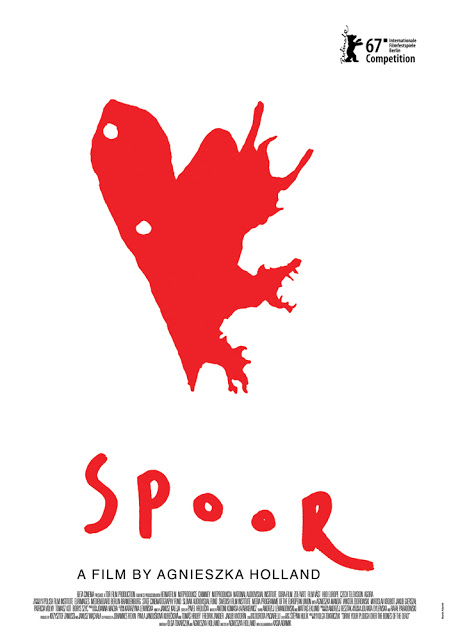
NYFF ’17: Spoor

It turns out Count Zaroff was right. Man is the most dangerous game. Something is poaching the poachers, because it is never hunting season for well-armed male chauvinists in this ridiculously backward Polish village. We had a good run at the top of the food chain, but the natural world just might be fighting back in Agnieszka Holland & Kasia Adamik’s disappointing Spoor (trailer here), which screens as a Main Slate selection of the 55th New York Film Festival.

A retired engineer and part-time school teacher like Janina Duszejko ought to be a forceful advocate for animal rights, but whenever she tries to file a complaint against poachers, she ends up sputtering incomprehensible moral outrage. It makes it easy for the venal police chief to disregard her, but still earns her plenty of enemies. Waking one morning to find her beloved dogs missing, Duszejko suspects the worst and her fears are justified. However, a noxious poacher turns up dead shortly thereafter. The circumstances are suspicious, but baffling, since the only tracks leading up to the body are of the four-legged variety (you know, animal spoor).

Is something supernaturally natural afoot, as in Fessenden’s The Last Winter and M. Night Shyamalan’s The Happening, or is there a more Scooby-Doo explanation, involving Old Man Smitters and a wolf costume? Somehow, Holland and co-screenwriter Olga Tokarczuk (adapting her own novel) come up with an answer that will leave all sides deeply unsatisfied, which is sort of perversely admirable.

We are supposed to be charmed and impressed by Duszejko’s pluckiness, but it is frankly annoying how she is always feeling things so deeply. She even recruits an amiably geeky hacker to her cause, but her strategy still largely consists of ineffectual tantrums. Her motives for investigating the murders never really compute either, especially if they are the result of Mother Nature rising up.

Nevertheless, Holland’s skill as a filmmaker remains crystal clear throughout Spoor. Holland, co-director Adamik, and cinematographers Jolanta Dylewska and Rafal Paradowski give it an evocatively icy noir look. Just watching it will make you feel chilly. Holland also manages to maintain a palpable sense of tension, despite giving us so little in terms of real deal genre business. Viewers just keep watching, because they will feel like something significant is always about to happen.


Agnieszka Mandat-Grabka is fine as Duszejko, but like her character, she probably would have reaped better results by working smarter rather than working harder. Clearly, subtlety was not a priority for anyone involved. Nicely atmospheric but filled with light-weight polemics, Spoor should not be a priority when it screens this Saturday (9/30) and Sunday (10/1), as part of the 2017 NYFF.

Wednesday, September 27, 2017

NYFF ’17: Mrs. Hyde

Despite her titular surname, the nocturnal alter-ego of Marie Géquil (sound it out) is more like an impersonal, fiery monster in the tradition of the H-Man than a down-and-dirty Victorian ripper. She doesn’t get a lot of breaks, but her mutation still has transformative effects for her Jekyll persona in Serge Bozon’s Mrs. Hyde, which screens as a Main Slate selection of the 55th New York Film Festival.

For most festival patrons, the casting of Isabelle Huppert as Madame Géquil is all they need to know. The fact that it is also a loose reworking of Robert Louis Stevenson is hopefully a bonus, but we are really talking loose here—like those pants need a belt and suspenders, plus some gathers round the cuffs.

Despite thirty years of experience, Madame Géquil finds herself on probation due to her ineffectual classroom manner. Teaching physics in a distressed urban technical school is not an easy task—and her openly hostile students do not make it any easier. Unlike the hypocritically unctuous principal, she has no truck with the soft bigotry of low expectations, but her refusal to dumb it down only increases her class’s antipathy. Than one fateful day, while Madame Géquil is performing an experiment, a lightning bolt from out of the blue strikes the school’s laboratory (a refurbished shipping container).

Suddenly, Madame Géquil has more confidence and appetite by day, but she sleepwalks by night. Eventually, she starts transforming into a Human Torch like figure that preys on the thugs running wild in the nearby projects. This two-pronged attack will help her finally reach Malik, her worst tormentor in class, who turns out to have an unsuspected aptitude for electrical engineering.

Although there is a thimble full of genre business in Mrs. Hyde, it is more an educator’s trials and tribulations, much in the tradition of The Class or Dangerous Minds, but it is darker and more fatalistic. It also has Huppert, who is terrific. Everyone seems to think she is playing against type here, but the truth is, you can see all the too-quiet intensity and barely contained resentment she has always conveyed so vividly. If you tipped her Géquil over, she might shatter.

As Malik, Adda Senani is a natural who looks like he really attends Arthur Rimbaud Technical School and hates every minute of it. He is a genuine discovery, but Romain Duris’s outrageously flamboyant, bang-flipping turn as the serpentine principal will really burn itself onto your corneas. Unfortunately, José Garcia’s Pierre Géquil is rather lightweight and inconsequential.

Mrs. Hyde is probably just good enough to satisfy Huppert’s admirers, but not chaotic enough to satiate Jekyll and Hyde buffs. Huppert and Duris certainly strut their stuff, even while pointedly critiquing French public education. It is an interesting, sometimes ironically amusing film, but not a knock-out punch. Recommended for fans of Huppert and patrons of French cinema, Mrs. Hyde screens this Friday (9/29) at Alice Tully Hall and Sunday (10/1) at the Walter Reade, as part of this year’s NYFF.