Wednesday, April 10, 2019

Black Site: Retro-Lovecraftian


It is like a Guantanamo for Elder Gods and it is definitely necessary. For decades, a multinational consortium has been waging a not-so cold war against the Lovecraftian entities. They have more power than we do as mere mortals, but once we boot them from our dimension, they are gone for good. We thought we had them on the ropes, but a particularly nasty elder god has a few surprises in store for the secret facility in Tom Paton’s Black Site, which is now available on VOD.

For Ren Reid, it is personal. When she was a little girl, Erebus murdered her parents, as vengeance for “deporting” his elder god lover. She has since followed in her father’s footsteps as an agent of the ultra-top secret Artemis. Unfortunately, she has just been passed over for a promotion again, because of her difficulty controlling her emotions. That will get even harder for her when the captured Erebus arrives.

Reid was supposed to merely look after Sam Levy, the gawky deportation specialist, but when human members of the Erebus cult storm the compound, she will have to Die Hard-up to protect the banishment export and score some payback. Of course, Erebus constantly tries to rattle his captors with a lot of supernatural Hannibal Lecter dialogue. However, he is still held in check by the magical runes and electrical grids. Rather, it will be Ker, the sword-wielding leader of the death cult who will be a more pressing danger for Reid.

Paton is definitely channeling the Eighties in a major way, but it mostly works as an affectionately grubby pastiche. The moody lighting and old school John Carpenter score are spot-on, while the action scenes are executed with a lot of grit and energy.
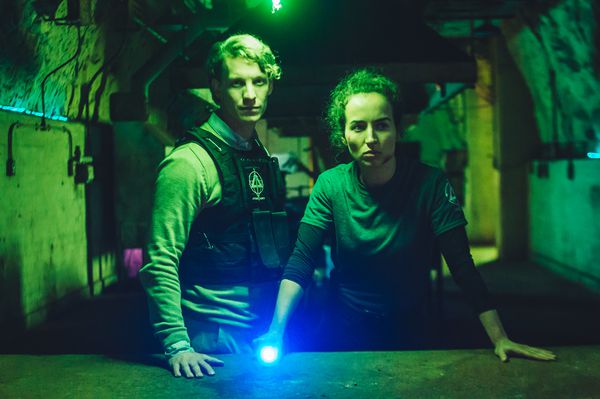
As Reid, Samantha Schnitzler combines convincing twitchiness and credible action chops. Despite her villainous role as Ker, Phoebe Robnison-Galvin probably surpasses Schnitzler when it comes to fighting skills and screen presence.  As the eldest of the elder gods, Kris Johnson definitely has a knack for glowering and making heavy statements. Frustratingly, Lauren Ashley Carter (Imitation Girl, The Mind’s Eye, Darling) is under-utilized (and quickly exits) as Agent Leonhart. However, Bentley Kalu really raises the film’s thesping bar as Agent Austin, Reid’s surrogate father.

Even though Paton is clearly paying tribute to his heroes and favorites, he still creates a compelling neo-Lovecraftian world. As a result, Black Site has its own identity, beyond serving as a valentine to Carpenter. VOD is the right distribution avenue for it, but that means it will pleasantly surpass a lot of genre fans’ expectations. Recommended for those who dig Lovecraftian and retro horror, Black Site is now available via VOD.

Tuesday, April 09, 2019

Master Z: Ip Man Legacy


Originally, the whole point of the various Ip Man movies was to be one degree removed from Bruce Lee. Now, the franchise is spinning off characters with only brief associations with Lee’s great Wing Chun master. Nevertheless, the action is worthy of a place in the Ip Man world. We only see producer Donnie Yen in brief, stylized flashbacks, but some of the brightest motion picture martial artists face off during Yuen Woo-ping’s Master Z: Ip Man Legacy, which opens this Friday in New York.

Cheung Tin-chi fought hard against Master Ip Man, but that made it all the more humbling when he lost his challenge. Resolving to lead a quiet life, Cheung tries to become a modest shopkeeper in Hong Kong. Yet, despite his retirement, Cheung is pulled back into the martial arts life when he saves two young women, Julia and Nana, from a drug-dealing gang led by Tso Sai Kit—at least he likes to fancy himself the leader. The truth is, the Tso syndicate is overseen by his older sister, Tso Ngan-kwan, who intends to take the organization completely legit. She is therefore not amused when her brother tries to kill Cheung and his young son as payback.

Having been burned out of their shop and flat, Cheung finds work and digs with Julia’s brother, Fu, a bar-owner catering to western customers. He knows a fair amount of martial arts too, which will make him a worthy partner for the younger Tso starts pushing hard stuff like heroin in the bar district. Unfortunately, there is an even worse offender than Tso—who also happens to be much more dangerous.

The storyline of Master Z could have been lifted from any middling Golden Harvest release from the 1970s. It almost looks like Yuen was pulling scenes out of a hat at random. Yet, that hardly matters, because of the fight scenes and the star power. Star-in-the-making Max Zhang really comes into his own as Cheung. He is quiet, but he has real presence, not unlike Yen himself. This time around, he gets to face-off versus some of the best in the business, including human tree-trunk Dave Bautista, Tony Jaa (who is almost unrecognizable as the stealthy assassin), and the legendary Michelle Yeoh, who is commandingly regal as Tso Ngan-kwan. Plus, Xing Yu (the former Shaolin monk) does some of his best work yet as the rakish but deeply principled Fu. Frankly, he shows just as much breakout star potential as Zhang.

To summarize the important points: Zhang takes on Yeoh, Bautista, and Jaa—and also teams up with Xing Yu against dozens of thugs. The action is terrific, but the father-son story also has some heart (although not as much as Ip Man’s relationships with his wife and son). It also confirms Yeoh is something like the Hong Kong female version of Clint Eastwood, because her star wattage just continues to grow in brightness over time. Very highly recommended for all martial arts fans, Master Z: Ip Man Legacy opens this Friday (4/12) in New York, at the AMC Empire.

Monday, April 08, 2019

AFF ’19: Fly by Night


Tailo can’t pick and chose his family anymore than the rest of us can. Unfortunately, that also means he is stuck with the same people when it comes to his extortion ring. You are much better off calling for an Uber at the K-L airport, then ordering a cab from Tailo’s sister-in-law, Michelle. When her husband and his thuggish buddy go off the reservation, they bring down heat from both sides of the law in Zahir Omar’s Fly by Night, which screens during the 2019 Atlanta Film Festival.

Tailo is cautious in all respects, including expansion. He only trusts a longtime friend like Ah Soon, a freshly released ex-con. Both older men know Sailo and his running mate Gwailo are bad news, but they are stuck with them. Alas, Sailo and Gwailo are complete idiots, who think a jilted mistress like Reanne would be a good mark. Instead, she manipulates them into targeting her wealthy ex-lover.

Reanna is not a particularly stable partner to do business with, but Sailo and Gwailo really make a hash of things when they pick a fight with a regular customer in a mobbed-up casino. Suddenly, they owe a lot of money to a real, leg-breaking gang. They also have the only slightly corrupt Inspector Kamal sniffing around. Frankly, the two knuckleheads make so many mistakes, Tailo would like to throttle them, but what can he do when they’re family?

Fly has a lot of people connected to the Malaysian film world excited for its prospects—for easily discernible reasons. This isn’t just the first hip post-Tarantino kind of noir produced by the country’s film industry. It is a good enough film to get picked up by any mid-sized specialty distributor.

Omar’s execution is tight and taut and the screenplay, credited to him, Ivan Yeo and Frederick Bailey offers several new twists to the old family-gangster story. However, it is Sunny Pang who really elevates the film as the grimly fatalistic, drily understated Tailo.  He personifies the film’s tone and attitude, but the entire ensemble is quite strong. Fabian Loo and Jack Tan are totally destabilizing wild cards as Sailo and Gwailo, while Bront Palarae just oozes charismatic malevolence as the crooked Kamal. Joyce Harn plays Reanne as a dangerous combination of hot mess and femme fatale, while Ruby Yap is deeply compelling as the scared and vulnerable Michelle.

Despite taking a very different narrative direction, Fly by Night compares quite directly and favorably with David Michôd’s Animal Kingdom, because of the way both films depict families corrupted by their own criminal endeavors. Yet, like the best noirs, FBN also shares a kinship with classical tragedy. Very highly recommended, Fly by Night screens tomorrow night (4/9) at the Atlanta Film Festival and Sunday (4/14) in DC at the Freer-Sackler, as part of the Crazy Broke Asians film series.

Saturday, April 06, 2019

MSPIFF ’19: The Purity of Vengeance


Department Q was created to clear cold cases, but it has also specialized in airing Denmark’s dirty national laundry. That will be especially true of their latest case, which could also be the last for the current team, if the long-suffering Hafez al-Assad accepts a well-deserved promotion-transfer. However, the investigation will hit pretty close to home for the immigrant detective in Christoffer Boe’s The Purity of Vengeance, which screens during the 2019 Minneapolis St. Paul International Film Festival.

Three mummified bodies are discovered behind the false wall of a flat long rented to a nurse with a rather checkered history. As Assad and his boss, Carl Mørck (who has somehow found a way to be even more miserable than usual) start investigating, they discover all three victims and the missing nurse were connected to a controversial home for wayward girls on Sprogø island. Judging from the flashbacks, we can safely assume the murders have something to do with all the wrong done to young Nete, even though she is one of the three bodies posed as part of a gruesome dinner party.

There is not a lot of mystery in Vengeance, because Dr. Curt Wad is quickly served up as the film’s nasty villain. These days, the public knows him as the director of a fertility clinic, but it is conspicuously obvious he still subscribes to all the eugenics theories he practiced while on staff at Sprogø.

Considering how little Mørck and Assad have to figure out, it is rather irresponsible how long they let their investigation drag on. Even though everyone will immediately assume the eugenics doctor is the bad guy, Boe should at least provide a few more suspects, just to make Mørck and Assad look more professional.

Still, the messed-up chemistry shared by the two detectives is quite compelling. Nikolaj Lie Kaas manages to set an all time low for depressed brooding and self-indulgent self-loathing. His commitment as a thesp is impressive, but we still just want to give him a good slap. Fares Fares is charismatic and convincingly conscientious as Assad, while Johanne Louise Schmidt helps keep the film grounded as their faithful, mediating assistant Rose. However, as the unfortunately named Dr. Wad, Anders Hove completely throws subtlety out the window and wears his villainy on his sleeve.

The first three Department Q films steadily improved, with the third, A Conspiracy of Faith being the best and the smartest of the initial trilogy. Unfortunately, the fourth film is a bit of a step down from there. Those of us who have invested our time in the previous trilogy will be happy to revisit the characters, but as a suspenseful crime story, Vengeance is probably the least of the series. It is also most likely the last film featuring the current cast and creatives, because the franchise has moved to a different studio. Frankly, it is probably time for a reboot and a fresh approach.

Still, it is always worth the price of admission to see what new agonizing depths Kaas can reach. Recommended for fans of angsty, existential Scandinavian mysteries, The Purity of Vengeance screens tomorrow (4/7), Thursday (4/11), and Friday (4/19), as part of this year’s MSPIFF.

Friday, April 05, 2019

Warrior: From the Pen and Sword of Bruce Lee


From 1849 through 1851, San Francisco was a real tinder box that almost burnt to the ground seven times. Building methods were somewhat safer by 1878, but rival tong gangs still might just incinerate the city with their open warfare. Frankly, the city’s various white political factions would be only too happy to let them, because it would serve their secret agendas. A newcomer named Ah Sahm will walk headlong into this dangerous environment. If that name sounds familiar than you probably really know your Bruce Lee. The iconic martial arts star’s concept for an American Asian action television series finally hits small screens over forty-five years after his death when the first season of Warrior premieres on Cinemax.

Lee pitched the network a show about the title character, a hard-fighting recent immigrant navigating San Francisco’s rough-and-tumble Chinatown neighborhood. They passed, but soon thereafter, they greenlit the white-washed Kung Fu series, starring David Carradine. It was not a great moment in American media, so it is rather satisfying to see it finally get corrected.

Ah Sahm is still one cool customer. He has come to San Francisco in search of his sister Mai Ling. Unfortunately, he will find her quite easily, because she is the lover of the leader of a rival tong outfit. Thanks to her influence, the two major factions are poised on the brink of a major gang war. Initially, Mai Ling wants nothing to do with Ah Sahm, but they will furtively come to each other’ aid, even though their respective tongs are mortal enemies.

As the freshly-minted and less-than-thrilled leader of the department’s new Chinatown squad, it is Sgt Bill O’Hara’s’ job to keep the peace. He is not doing it well, but in his defense, he is somewhat distracted by his compulsive gambling. However, there are a few progressive San Fransciscans who might even become allies of Ah Sahm at some point down the line, including O’Hara’s Savannah-born junior officer, Richard Henry Lee and Penny Blake, the wife of the city’s corrupt Mayor (is the any other kind?).

As you would dearly hope from a series based on a Bruce Lee concept, Warrior features some absolutely terrific fight scenes. Stunt coordinator-fight choreographer Brett Chan does some first-class work in each episode. At one point, director Lin Oeding teases us with the promise of a big street battle at the end of episode seven, but he duly delivers it at the start of episode eight. Regardless, fans should not be disappointed by the level of action Warrior delivers. Plus, the main theme composed by Reza Safinia and H. Scott Salinas is seriously funky, but its definitely a man’s world in 1870s Frisco and a male-focused show, even though Olivia Cheng has some moments as the resourceful, morally complex Madam, Ah Toy.

Most fans will also appreciate the performance of Andrew Koji as the English-speaking Ah Sahm. Although he never tries to slavishly channel Bruce Lee, he plays the tong fighter with similar levels of cockiness and brooding intensity. Jason Tobin nicely offsets him as the roguishly hedonistic and recklessly energetic Young Jun, the heir apparent to Ah Sahm’s tong. Kieran Bew and Tom Weston-Jones (from Copper) play off each other well as the mutually distrustful O’Hara and Lee. Frankly, Joe Taslim (of The Raid) is mostly under-employed as Mai Ling’s lover and champion, but his promised big showdown with Ah Sahm has us looking forward to episode nine (one through eight were provided to media).

Indeed, the combination of original Bruce Lee material (an eight-page treatment and some sketches) combined with the presence of executive producers Shannon Lee (Lee’s daughter) and Justin Lin (from the Fast and Furious franchise and Finishing the Game) and Taslim from The Raid should have many fans giddy with anticipation. So far, it definitely delivers some strong fight scenes and plenty of hip attitude. Recommended for martial arts fans and connoisseurs of meathead TV shows, Warrior premieres tonight (4/5) on Cinemax.

Thursday, April 04, 2019

MSPIFF ’19: The Song of the Tree


This is the first movie musical to be produced by the nation of Kyrgyzstan, but it as archetypal as films get. There are two brothers, one of whom will make a prodigal return. Of course, there are also musical numbers and some striking mountainous vistas in Aibek Daiyrbekov’s The Song of the Tree, which screens during the 2019 Minneapolis St. Paul International Film Festival.

Esen is rash and a bit undisciplined, but he is not a bad lad. Unfortunately, Bazarbai, the clan headman, is dead-set against Esen’s romance with his daughter Begimai, even though they are very much in love. Instead, the shallow headman has been deceived into favoring the loutish Oguz, who has often bested Esen through cheating. It gets to be more than the hot-headed brother can stomach, so he tries to elope with Begimai. Unfortunately, Oguz and his lackeys track them down, bringing her back to her father and leaving Esen for dead—but not dead enough.

Alas, Bazarbai’s pride will definitely goeth before his fall. It will be hastened by the desecration of a sacred prayer tree. Initially, Ogun frames Esen’s brother Asan for its destruction and subsequently murders him to cover up his misdeeds. Yet, their livestock continues to die, so the clan banishes Bazarbai and his immediate family. Meanwhile, Esen learns how to fight and control his temper from a wandering warrior.

Like most movie musicals, the course of true love never runs smooth in Song of the Tree, but eventually fate will intervene. Esen will face up to his love and his rival—and sing a few songs. Even though there is a samey consistency of tone throughout the Song of the Tree songbook, these tunes are way more polished than most viewers might expect. Frankly, this film works just as well as a big screen book musical as did The Last Five Years or LesMiserables.

Although Esen is supposed to be our rooting interest, Omurbek Izrailov is upstaged and then blown off the boards by the more intriguing character of Bazarbai and Temirlan Smanbekov’s richer, more complex performance. Zholdoshbek Apasov’s music and Baktygal Choturova’s lyrics definitely exceed expectations. It all sounds quite expansive and heartfelt. Yet, it is cinematographer Akzhol Bkbolotov who really gets to put his stamp on the film, thanks to its wildly cinematic locations and backdrops. It looks and sounds terrific, so we can easily forgive its narrative predictability.

There probably hasn’t been this much singing around horses since the heyday of Gene Autrey and Roy Rogers. It also must have the record all to itself for musical numbers staged in yurts. Yet, it is all pretty universal and largely quite compelling. Recommended for fans of folkloric cinema and nontraditional musicals, The Song of the Tree screens this Sunday (4/7), Monday (4/15), and Tuesday (4/16), as part of this year’s MSPIFF.

Wednesday, April 03, 2019

Division 19: Dull Dystopia

The future will be voyeuristic, with a taste for blood sport, but you already knew that, because you have seen The Running Man, and The 10th Victim, and Turkey Shoot, and Channeling, and Bertrand Tavernier’s infinitely superior Death Watch. Even Paddy Chayefsky’s brilliant Network covered a lot of this supposedly cutting-edge material. S.A. Halewood goes back to the dystopian well, but she makes it all slower and duller throughout Division 19, which opens this Friday in Los Angeles.

Hardin Jones is the most downloaded prisoner in the penal system, so there’s something his mother can stick up on the fridge. He went to jail to protect his hacker activist brother Nash, who is active in the underground organization, Division 19, thereby establishing the otherwise meaningless title. However, in the future prisons double as reality TV shows, to make them economically self-sufficient and to distract the masses.

However, no prisoner had ever caught on with the general public like Jones, so Nielsen, the president of the Panopticon TV network plans to build her rehabilitation Potemkin village show around him She hopes Jones will buy in, not sell-out, but instead he escapes with the help of Nash’s gang. Yet, he remains a loose cannon, going rogue, instead of serving as a revolutionary mouthpiece.

Mostly, this is a case of been there, done that, but this time around, Jones makes a problematically passive protagonist. We so get how awful it is for the convicts to be exploited and displayed, 24-7. Of course, Jones does not play that game. He is all about going off the grid, but this time, he might do whatever it takes to get Big Nielsen off his back.

Yawn. Everyone looks bored in Division 19, so we are well within our rights to feel that way too. It is doubtful there is a single original sequence in the film. Plus, Jamie Draven is just dull as dishwater as Jones. The same is true of Will Rothhaar brooding relentlessly as Nash. Alison Doody (from Indiana Jones and the Last Crusade) is a terribly nondescript villain, but Linus Roache is even more wishy-washy as the dystopian fat cat, Charles Lynden. At least character actor Clarke Peters (Adrian shows some signs of life as Perelman, the off-the-grid guru.
When you really get down to it, there is no pressing need for any of this. It’s really all quite nondescript and forgettable. Not recommended,
Division 19 opens this Friday (4/5) in LA, at the Laemmle Music Hall.

Tuesday, April 02, 2019

CIFF ’19: The Little Comrade

As a parent, how could you explain to your six-year-old daughter Stalin took her mother away from her, but she still has to worship the dictator like a secular god? Feliks Tungal can’t, so he tries to shield young Leelo from the worst of the truth. However, her incomplete knowledge also carries risks in Moonika Siimets’ The Little Comrade, which screens during the 2019 Cleveland International Film Festival.

It starts when the Tungals are forced to move from their stately home to a shack in the woods. Her father repeatedly explains this reversal of fortune is permanent, but Leelo just doesn’t get it. She will be even more confused when the NKVD comes for her school principal mother, Helmes. It is quite a bitter pill for Feliks to swallow, especially because the arresting agent is their former friend, Paul Varik. Of course, as the husband of a “traitor,” Feliks is necessarily under suspicion and the creepy, duplicitous Varik has a good idea of the potential evidence that might link him to Estonian “Nationalism,” like Feliks’ old Estonian sports medals.

Little Comrade is like an Estonian riff on Carol Reed’s Fallen Idol, but the entire nation has betrayed Leelo’s confidence. Siimets dramatically employs Tungal’s childhood perspective to give the film a fable like feeling, even though it is based on all too real events (and two autobiographical novels written by the real-life Leelo Tungal). We understand why she is so fascinated by the colors and pomp of Young Pioneers, even though the Party it serves is directly responsible for her mother’s absence. Indeed, we can well understand her father’s impulse to shield her from as much as possible. Yet, her trusting nature and stilted perception of Soviet life could be very dangerous for the entire family.

Leelo’s vantage point makes the film exquisitely sad and achingly innocent. However, she seems almost willfully ignorant of danger, whereas most kids have a reasonably well-developed intuitive spider sense. Regardless, Tambet Tuisk is quite remarkable as her father Feliks. It is a deeply moving performance that covers a wide emotional spectrum. Anyone doing that level of work in an American film would be guaranteed some awards consideration later in the year. Likewise, Liina Vahtrik is memorably brittle and vulnerable, but also brassily defiant as beloved Aunt Anne. Yet, Lembit Peterson outdoes everyone when it comes to grizzled dignity. However, little Helena-Maria Reisner is just too precocious for school as Leelo.

Little Comrade is a deeply moving father-daughter story and a timely history lesson (partly produced to help commemorate the 100th anniversary of the state of Estonia). Indeed, the extent to which the Communist Party prosecutes those who have symbols of Estonia’s sovereign history will confuse many contemporary viewers just as much as it baffles little Tungal. Very highly recommended, A Little Comrade screens tomorrow (4/3), Friday (4/5), and Saturday (4/6), as part of the 2019 Cleveland International Film Festival.

Beverly Hills ’19: The Ghost of Peter Sellers


In the 1970s and early 1980s, before there was “elevated horror” or “post-horror,” studios used to release ambitious, big budget horror movies, such as The Exorcist, The Omen, and The Shining. Peter Medak’s The Changeling was also of that era and caliber, but he lived through his greatest horror story. It involved filming the evil genius of Peter Sellers on the high seas. Medak revisits the disastrous production that nearly short-circuited his promising career in his cathartic documentary, The Ghost of Peter Sellers, which screens during the 2019 Beverly Hills Film Festival.

Medak, who escaped Communist Hungary after the Soviet invasion of 1956, was a hot new indie director thanks to his 1972 sleeper hit The Ruling Class. He only agreed to helm Ghost in the Noonday Sun as his follow-up project to work with the already legendary Sellers, despite his reservations regarding the weak script. In retrospect, he dearly wishes he had run the other way. As the late great producer John Heyman explains, Sellers was the only reason the shticky pirate farce received financing, but the eccentric star was determined to get himself fired from the film as soon as he arrived in Cyprus. Unfortunately, that forced Medak to go to elaborate lengths to cajole Sellers unto the set or shoot around him. That was the early going—it quickly got worse, much worse.

Still carrying mental and emotional baggage from the fiasco, Medak thoroughly documents each stage of the dumpster fire production with the surviving cast and crew members. Sellers and his old crony Spike Milligan, Noonday Sun’s alleged screenwriter, might be legends, but clearly everyone sympathizes Medak, especially the widow of co-star Anthony Franciosa (who emerges as one of the movie’s good guys, who supported Medak and wouldn’t take guff off Sellers).

Alas, what was going on behind-the-scenes was much funnier than anything that ended up on-screen. Indeed, there are anecdotes in Ghost of Peter Sellers that make the head spin and the mind reel, but it is important to keep in mind, each one was almost a nail in the coffin of Medak’s career.

Clearly, this is an attempt by Medak to set the record straight, to some extent, but more importantly to exorcise the Noonday ghosts that still haunt him. Yet, as our host, guide, and confessional confidant, Medak comes across as a charming, sophisticated, and rather witty raconteur. He is also a survivor. Medak went on to direct some great films, like The Krays, Let Him Have It, and Romeo is Bleeding. In fact, Ghost of Peter Sellers is an unusually auteuristic documentary. It is cleverly directed by Medak—and we often see him doing it on-camera.

It is also a very funny film—although maybe not for Medak. There is no question fans of Sellers or anyone else associated with the film should watch Medak’s documentary and not the cobbled together cut of Ghost in the Noonday Sun that eventually escaped out into the world without fanfare in the early 80s. In many ways, it is a terrific love letter to the filmmaking experience. Very highly recommended, The Ghost of Peter Sellers screens this Thursday (4/4), during this year’s Beverly Hills Film Festival.

Monday, April 01, 2019

Lost & Found: Gentle Irish Ironies


This interconnected slice of Irish life could have been titled Two Weddings and Three Funerals, except one of the weddings is called off at an embarrassingly late date. You could also think of it as Friday the 13th: The Series, without the horror elements. Each of the linked storylines revolves around an object that finds its way into a sleepy Irish rail station’s lost items department. Somehow, they tend to find their way into the right hands during the course of Liam O’Mochain’s Lost & Found, which is now playing in select theaters.

Daniel is the new lost & found guy. He was hired by Joe, who is a drunken reprobate, who constantly hits on Daniel’s mom, but in a charming Irish kind of way. Daniel plays it rather fast-and-loose with the office’s stupid rules, but he is also a soft touch for a panhandler’s sob story. He pops up in nearly every story, and he will play the leading role in at least one, in addition to the framing device.

Perhaps the most poignant tale is “Ticket to Somewhere” in which Eddie, a rather agitated middle-aged gentleman, begs for train fare to visit his wife and daughter in hospital. Ironically, the best of the braided tales happens to be The Tent, which is partially set it Poland. Daniel returns to the homeland of his recently deceased grandmother, a Kindertransport survivor, in hopes of recovering a small part of her legacy. Of course, he will do so in a rather eccentric fashion.

Lost & Found is an unhurried, low-impact film, but it is not without its charms. O’Mochain and editor Ciara Murphy stitched together several short films he made over a number of years, squeezing them into the framing conceit. That maybe doesn’t sound so promising, but they manage to shoehorn everything in quite effectively.

It helps that they have a game cast, starting with O’Mochain himself. Initially, he is likably lunkheaded as Daniel, but he shows greater range in The Tent. Few would argue Liam Carney is the head-and-shoulders standout for his heart-breaking performance as Eddie the distressed traveler. Even though the humor is mostly rather gentle, Brendan Conroy and Seamus Hughes mine the material for laughs quite diligently, as Daniel’s boss Joe and his meat-headed running mate, Gabriel, respectively.

Admittedly, Lost & Found is an extremely Irish movie, but fortunately, O’Mochain did not feel compelled to load up the soundtrack with a bunch of traditional Irish fiddle music. Instead, Richie Buckley’s upbeat score swings nicely thanks to its easily audible jazz inspirations.

Lost & Found won several awards while on the festival circuit—and it is not difficult to see why. It is not a particularly deep film and O’Mocahin does not quite tie together all the loose end. However, he still pays it off nicely. Frankly, according to the laws of nature and the principles of science, it is impossible to actively dislike this film. Pleasant but mild mannered, Lost & Found should be relatively accessible for more mature patrons, who are most likely its target demo. Recommended fans of Roddy Doyle movies and Patrick Taylor novels, Lost & Found is now playing in select theaters, including the Kew Gardens Cinemas in Queens.

Thursday, March 28, 2019

White Chamber: Dystopian Simplicity and Elegance


Centuries ago, Edmund Burke warned us revolutions inevitably lead to reigns of terror, but we keep willfully forgetting his lessons. This latest polemical dystopian thriller is a case in point. It seems to welcome both the revolution and its associated terror. The shoe will switch to the other foot in Paul Raschid’s White Chamber, which opens tomorrow in select theaters.

As the film opens, a woefully unlucky clerical worker is getting the snot tortured out of her by a notorious terrorist, who has apparently taken over the top-secret facility, where she pushed paper. The titular room of wondrous methods for dispensing pain was way above her pay grade—or so she claimed. Of course, when the movie shifts gears, flashing back five days prior, we realize there is more to her involvement than she lets on.

In this dark vision of the future, Britain’s immigrants have risen up, openly revolting against the respectable, hard-working, crown-respecting class. Hopefully, most Americans will still be horrified by the prospect of open warfare as a method of settling differences of political opinion, but it is dashed frightening that this seems like a reasonable course of action within some quarters of the UK. In fact, it seems like Raschid considers the violence not merely an unfortunate byproduct, but a jolly good end result in its own right.

Still, it should be duly noted Shauna Macdonald and Oded Fehr play quite an effective cat-and-mouse game together as captive and terrorist (don’t you so get how we are supposed to question which is which?). As Anglophile movie patrons might expect, the great Nicholas Farrell helps humanize the film as the senior scientist assigned to the White Chamber project. Of course, the actual task at hand does not make much sense, but nobody is much worried about logical narrative details.

However, the real star of the film is the design team responsible for the chamber itself. It is indeed white, but it is considerably more cinematic than four plain white walls. Some hard work and quality performances went into the Chamber, but its manipulative trickiness does not sustain itself well over time. The ultimate implications and takeaways are also quite confused when not profoundly problematic. Not recommended (check out Infinity Chamber for a better dystopian confined-space film), White Chamber opens tomorrow (3/29) in select cities, including the Gateway Film Center in Columbus and simultaneously releases on VOD platforms.

Money: The Wolf of Yeouido


A broker’s job is relatively simple: buy low, sell high, and take your commission. They are also supposed to avoid insider trading. That will be the tricky part for Cho Il-hyun. The young broker was struggling before he started making trades on behalf of a secretive financial mastermind. Unfortunately, his high six-figure commissions come with legal scrutiny and potential physical danger in Park Noo-ri’s Money, which opens tomorrow in Queens.

Cho did not attend the right school or have the right parents, so he is stuck with a lot of gofer work as a very junior broker. That changes in a hurry when a senior broker introduces him to the mysterious money man, known simply as “The Ticket.” Cho fully understands he is violating dozens of Korean financial regulations, but he should get away with it, as long as he follows the Ticket’s security protocols.

However, Cho’s under-exercised conscience starts to reassert itself when he realizes several ineffective CEOs conveniently died to drive up the value of the Ticket’s recent stock purchases. It also dawns on him just how expendable he is to the Ticket and his dodgy circle of Yeouido financial district elites.

Money is a sleek, sharp financial thriller, that is smart about its financial shenanigans and its office politics. You can tell it is intelligent, because Park never resorts to the trite shorthand of loading up the soundtrack with tunes like Th O-Jays’ “For the Love of Money,” Pink Floyd’s “Money,” or Barrett Strong’s “Money (That’s What I Want).” Instead, she surrounds Ryu Jun-jeol’s Cho with some of Korea’s best character actors, including Kim Min-jae and Jung Man-sik ravenously chewing the scenery as Cho’s colorfully corrupt seniors.

Arguably, both Ryu and Yoo Ji-tae are both a bit too pretty and bland for Cho and the Ticket, respectively, but Jo Woo-jin more than makes up for them as Han Ji-cheol, the financial services investigator, who is one of the clammiest, most off-putting cops you will ever see crusading for justice in the movies. Won Jin-ah is delightfully Machiavellian as Park Si-eun, Cho’s femme fatale girlfriend. Plus, Daniel Henney kicks up the energy level even further in his important cameo as Korean-American fund manager Roy Lee.

Watching Money will give you new respect for those unsung compliance officers. Cho never makes things easy for them. However, it is always great fun to watch the scams and schemes unfold. Enthusiastically recommended, Money opens tomorrow at the AMC Bay Terrace in Queens and the AMC Ridgefield Park in Jersey.

Wednesday, March 27, 2019

A Vigilante: Olivia Wilde Out for Payback


No matter how much it asserts its feminist bona fides, this film will always be considered rightwing—and with some justification. It is highly debatable what Murphy Brown might think of Sadie, an abuse survivor who frequently takes the law into her own hands, but Dirty Harry would approve of the intention (but not always the execution, so to speak). Sadie will deliver some frontier justice to abusive husbands and mothers alike in Sarah Dagger-Nickson’s A Vigilante, which opens this Friday in New York.

Sadie has found her purpose defending the innocent, yet she will never truly be free until she faces up to the husband who terrorized her. Inconveniently, he is missing, but presumably not dead. We will see her intervene on behalf of several clients, while searching for the disappearing deadbeat.

And that is pretty much it. Daggar-Nickson is clearly more interested in Sadie as a character under stress than as an action figure, but her screenplay is still quite stark and spare, especially when it comes to those extravagant plot points. Nevertheless, she throws in some temporal gamesmanship to needlessly confuse the timeline. A Vigilante is not You Were Never Really Here, but it is surprisingly close, stylistically.

Regardless, Olivia Wilde does some of her best work probably ever as Sadie. She de-glams and goes largely non-verbal throughout her viscerally intense performance. In fact, only Tonye Patano manages not to whither next to her as Sadie’s support group leader. Problematically, that is especially true of Morgan Spector, who turns out to ne a big nothing as her husband.

Daggar-Nickson walks an exasperatingly fine line. Clearly, she refuses to indulge in the baser, cathartic impulses of traditional grindhouse revenge movies. As one might expect, by standing in the middle and refusing to make a choice, she still sets a tone for the film. Thanks to Wilde, it isn’t bad, but it should have much more visceral pop to it. It is not terrible, but it is definitely a missed opportunity.

Frustratingly, it is not recommended for those who will be most interested in a film titled, A Vigilante. For Wilde’s fans primarily, it opens this Friday (3/29) in New York, at the Cinema Village.

QWFF ’19: Hawaii


During Romania’s dark days of Communism, the state controlled all three means of production with an iron fist, most definitely including natural resources, in accordance with the principles of socialism. Owning land was completely out of the question, especially a farm valued at $3 million. Taking possession of such a property in the Aloha State would be an utter pipe dream, but an oppressed cab driver is determined to claim his inheritance and his freedom, despite the serious risks in Jesus del Cerro’s Hawaii, which screens as part of the 2019 Queens World Film Festival.

Even though his sister married a borish Party member, Andrei Florescu’s family will always be under suspicion, due to his father Vasile. Back when the regime really consolidated power, Vasile and his two brothers tried to escape via a makeshift hot air balloon. He was captured alive and another brother was recovered dead, but Petrus disappeared, never to be heard from since—until now. It turns out, Petrus made it to America and eventually settled on a nice little coffee plantation in Hawaii. He lived a happy life there, but he missed his family, so when he died, he willed his estate to Vasile.

Unfortunately, Ceausescu’s strict socialist government does not recognize property rights. If the Party found out about the bequeathal, they would claim it themselves. That is not something Florescu, his father, or the American government would like to see come to pass. Increasingly annoyed by the petty humiliations and constant shortages of socialism, Floresu resolves to claim the property for himself in neighboring Yugoslavia, where Tito has much more liberal policies regarding property ownership. However, just as he starts wrestling with visa and passport applications, he ever so coincidentally meets Ioana Balan, who happens to be perfectly his type. Unfortunately, she is also her boss’s type. That would be Scarlat, a ruthless officer in the secret police.

Even though it is a much darker film, the hot air balloon plot element brings to mind Delbert Mann’s better-than-average live-action Disney movie, Night Crossing, which dramatized the Strelzyk and Wetzel families’ escape from East Germany. There is a bit of black humor, at Ceausescu’s expense, but there is no nostalgia for life under his misrule. In fact, del Cerro and co-screenwriters Manuel Feijoo, Beatriz G. Cruz, and Ruxandra Ghitescu incisively explain the psychological ramifications of living under a repressive regime, including how some dissidents could take leave of their families, potentially forever, for the sake of freedom.

Dragos Bucur is terrific as Florescu, who initially seems to be a likably roguish everyman, but he develops into a figure of great depth and poignancy.  Likewise, Cristina Flutur’s work as Blatan really sneaks up on viewers, especially when she is forced to confront the consequences of her decisions. Constantin Cojocaru performance as old Vasile is similarly complex and humanistic, while Andi Vasluianu absolutely chilling as the sadistic and manipulative Scarlat.

Frankly, it is probably a little too easy to see the Communist past in contemporary Bucharest, but production designer Calin Papura and the design team still deserve credit for their impressive recreation of the drably draconian Ceausescu era. It provides a timely reminder of what socialist living was like and also makes the case that nice guys can be interesting too. Very highly recommended, Hawaii screens tomorrow night (3/28), during the 2019 QWFF.

Tuesday, March 26, 2019

King of Thieves: Michael Caine Recruits the Old Gang


They were like a real-life Going in Style, but these retirement aged crooks had sharper elbows. They also pulled off what is considered the biggest heist job in British history. This is the third film version of the unlikely Hatton Garden caper, but the first to reach our shores in any noticeable way. Crime does not pay, not even for seniors, but at least it provides a way to pass the time in James Marsh’s King of Thieves, which releases today on DVD.

Brian Reader didn’t exactly go straight, but he got out of the game relatively on top. Out of his past “known associates,” John “Kenny” Collins is somewhat comfortable, but Terry Perkins, Danny Jones, and Carl Wood are largely scuffling. When “Basil,” a socially awkward security specialist comes to Reader with a potentially lucrative score (a safety deposit company catering to gem merchants), he has no trouble recruiting his old accomplices. The question is whether the recently bereaved Reader’s heart is really in it. Just try doing him dirty and see what happens.

Details of the Hatton Garden heist are still coming to light, even at this late date. Regardless, the Rififi-esque caper business is pretty entertaining, but Joe Penhall’s screenplay focuses more on the subsequent double-crosses.

Of course, the whole point of King is watching Sir Michael Caine do his thing as Reader. He has been stealing jewels in films since before you were born, so show some respect. He’s Michael Bloomin’ Caine and he is terrific as Reader. When he gets hacked off, all that old magic comes back with a vengeance.

As usual, Ray Winstone is as compulsively watchable as ever as the brawler, Jones, while Jim Broadbent takes advantage of the opportunity to finally chew some scenery as the goonish Perkins. Tom Courtenay plays Collins as a bit of a silly duffer, but it is just embarrassing to see Michael Gambon stuck as the butt of jokes as Billy “The Fish” Lincoln, the incontinent fence. Still, there is Caine and Winstone.

Clearly, nobody better understands the appeal of this greybeard A-Team than Marsh because he openly invites nostalgia by incorporating clips from their classic street-smart swinging sixties films, most especially the original Italian Job. British pop-jazz vocalist Jamie Cullum also maintains the cool retro vibe with his groovy, brassy cover of The Killers’ “The Man.”

Harry Brown is still probably the ultimate Michael Caine film, but it is great to see him strut his way through a capery lark, more or less in the tradition of Italian Job and Silver Bears. Recommended for fans of heist movies and the accomplished cast, King of Thieves releases today (3/26) on DVD and BluRay.