They went from being stoner draft-dodgers to running sweatshops in Southeast
Asia, allegedly. Presumably, this Australian import series does not get that
far. As a highly fictionalized, twentynothing soap opera riff on the early days
of the Billabong and Quicksilver surf fashion rivalry, it will encourage most
viewers to wear Ocean Pacific instead. Creators Michael Lawrence, John Molloy,
and Liz Doran take us back to the birth of board shorts in Barons, which
premieres Monday on the CW.
Snapper
Webster built his surfing goods line off the proceeds of his mates’ annual surfing
expedition to Bali, if you know what I mean. He is tightly controlling of the
business, yet perversely averse to risk and change. That frustrates his best
mate Bill “Trotter” Dwyer, who is brimming with new ideas.
Inevitably,
he sets out on his own, with the help of his newlywed wife Tracy, who is
awkwardly Webster’s ex. To compile the insults, they launch their company with
seed money Tracy borrowed from Webster, ostensibly for her wedding. Webster
takes it badly, launching a very public feud. Meanwhile, several of their
mutual friends are sweating out the draft. The vociferously anti-war Dani Kirk
has even offered herself for sham marriages, even while she questions her own sexual
identity, especially after meeting acclaimed surfing photographer Shirley
Kwong.
Barons
would
have been much more watchable if it had more Endless Summer and less Hair.
Honestly, its New Left anti-war politics look overly simplistic and self-serving,
especially when considering the subsequent plight of the Vietnamese Boat People
and the oppressive corruption of the current Communist regime.
Unfortunately,
the subplots focusing on deserters and questioning draftees detract from what
could have been a deliciously ironic depiction of the peace-and-lover surfers
growing into cutthroat capitalists, at least judging from the first two
episodes, “Paradise Lost” and “Gone Surfing.” Instead of embracing the
characters’ inner Gordon Gekkos, Doran and co-writers Matt Cameron and Marieke
Hardy basically give us a shallow “Dawson’s Wave.”
Father-son relationships are often complicated. A foreign occupation will not make it any
easier for Jurgis Pliauga and his adopted son Unte. The young man is drawn to
the more proactive means of resistance advocated by Deacon, a leader of the
Forest Brothers partisans, whom he starts to see as a competing father figure. In
contrast, his father prefers to play dumb, drag his feet, and even hide, if
necessary, when the new occupying authorities come calling. Of course, tragedy
comes for all men of good conscience in Sharunas Bartas’s In the Dusk,
which premieres today on Film Movement Plus.
The
War is over, but the Lithuanians would hardly know it. From their perspective,
Soviet uniforms have simply replaced those of the Germans. Supposedly, they are
now part of the Soviet Union, but the reparations and protection money the
Soviets extort from them clearly imply their lowly position in the Soviet
hierarchy. As the owner of a sizeable farm, Pliauga is a prime target for their
shake-downs and his lazy farmhand Ignas also expects to receive part of his
employer’s land holdings, through the promised socialist distribution.
Both
Pliauga and Unte have social and commercial dealings with the rag-tag band of
partisans in the forest. Increasingly, Unte is swayed by Deacon’s greater
intellectual understanding of communism, democracy, and the Cold War, as well
as his willingness to fight for Lithuania’s freedom. However, Pilauga is
instinctively cautious. When the local troops come looking for him, the old man
hides in a secret room hidden in his barn, which obviously evokes memories of
those who hid from the Germans in a similar fashion.
In
the Dusk is
definitely an intentionally slow and deliberate film, but it is more accessible
than Bartas’s previous film Frost. Through the former, we witness the
long, slow death of innocence, experienced by Unte and anyone else who might have
hooped for a better life under the Soviets. The Forest Brothers are often rude
and crude, but they are not wrong about the Soviets.
Neither
is Pilauga. Watching the tragedy unfold, it is clear the partisans and the
farmers needed a more widespread, more coordinated, and more flexible campaign
of resistance. Of course, nobody looks worse than the Soviets, who are sadistic
torturers. Yet, they clearly do not believe their purported ideology either.
They just cynically mouth the right platitudes, while practically rolling their
eyes.
Inevitably,
it all ends in heartbreak, unless you are Putin or one of his Western amen
chorus, like Chomsky or MTG. This is a brutally realistic film that is rooted
in the muddy muckiness of the forests and farms. Cinematographer Eitvydas
Doskus makes it all look appropriately dark and ominous. Yet, Bartas still gets
some terrific performances from his cast, particularly Arvydas Dapsys, as the
cagey but sadly dignified Pilauga.
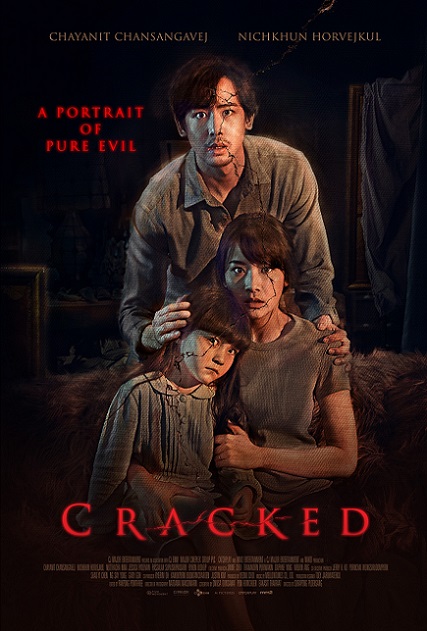
Maybe Ruja's famous artist father Pakorn used lead-based paint. For some
reason, his most notorious paintings seem to kill their owners. Technically,
they are hers now, but she cannot wait to sell them, for several reasons. Her
daughter Rachel urgently needs eye surgery, but she is also just plain uncomfortable
having them around. She has just cause to be uneasy in Surapong Ploensang’s Cracked,
which releases tomorrow on VOD.
Even
after her husband’s death, Ruja wanted nothing to do with her father.
Collectors might think he was a genius, but she knows he was a sadistic jerk. She
can’t remember all the details, but she knows he was bad. Nevertheless, she needs
the inheritance when his dealer, Wichai, informs her of Pakorn’s death.
Rather
ominously, a related pair of late career masterworks were returned to the
estate after the owner’s family-annihilation-suicide. Ruja won’t even let
Rachel in her dad’s studio, even before she sees the sexually suggestive portraits
of his late model, Prang. To maximize the re-sale value, Wichai’s son, Tim
restores the cracking areas. As he fiddles with the canvas, he finds evidence
of hidden portraits underneath Prang, which intrigue him considerably more than
Ruja. Intuitively, she suspects the paints are related to the supernatural
forces that have been harassing her and Rachel.
Cracked
(as
in chipping paint) is a lot like many other Thai and Southeast Asian horror
films, but Ploensang’s execution is super-effective. The film oozes atmosphere,
thanks in large measure to some terrific art and scenery design. The creepy old
manor is a perfect horror movie setting and the pair of paintings look like
they radiate pure evil.
This Australian cult has its members undergo recorded confessions, or
so-called “clearings,” which provide them ample blackmail fodder, should anyone
ever step out of line. Gee, can you imagine any purported cults with ties to
Hollywood engaging in similar practices? Yet, for Australian audiences, the
cult matriarch’s “children,” amassed through questionable adoptions and foster
arrangements, would immediately recall “The Family,” led by Anne
Hamilton-Byrnes. In the case of Adrienne Beaufort’s cult, things start to fall
apart when an over-zealous member kidnaps a little girl, who refuses to be
indoctrinated into the “family.” The mystery of young Sara’s fate will haunt
every character in writer-creators Matt Cameron & Elise McCredie’s The
Clearing, which premieres today on Hulu.
Sometime
in the past, Freya (as she now calls herself) was traumatically associated with
the cult based at Bronte-esque Blackmarsh Manor. She got out, but the scars
remain, especially when news of a child abduction triggers (the word is actually
appropriate in this case) bad memories.
Tamsin
Latham is a true believer, unwaveringly devoted to Beaufort, but her initiative
has been disastrous. No matter how hard they try to brainwash Sara, she refuses
to accept her new name, “Asha,” or her new “mother.” Beaufort’s favorite “child,”
possibly her own biological daughter, Amy, was supposed to win Sara/Asha over.
Instead, the little girl’s deep sense of self raises questions in Amy, at the
worst possible time—right before her first ritual “clearing.”
Cameron
and McCredie play a lot of devious games with the timeline that might be easier
to guess from this review than from watching The Clearing from the
start, despite my good faith efforts to be vague and misdirecting. However,
they are not simply being clever for the sake of cleverness. By the time you
get through the first four episodes provided for review (out of eight), you get
a potent sense of how the sins of the past continue to exert an evil influence
over everyone in the present, especially since several characters cut their own
deals, rather than holding fast to their principles.
Without
question, Miranda Otto is the star of Clearing as the chillingly regal
Beaufort. She makes the cult leader’s Svengali-like control over people totally
believable and absolutely terrifying. Likewise, Kate Mulvany might be even
scarier as the sadistic Latham, who seems to have joined the cult for the
opportunity to bully children. Guy Pearce is also pretty creepy and clammy as Beaufort’s
consigliere and theoretician, Dr. Bryce Latham, but it is still not clear why
the role was meaty enough to attract the well-known thesp.
This isn't just a series finale. It is a universe finale, marking the end of
the interconnected Arrowverse shows on CW. Either Superman & Lois
or Gotham Knights might still eke out a renewal, but they are both
set in different DC universes. Logically, a lot of familiar faces come back for
the “final run,” which is fortunate, since Barry Allen will need plenty of help
saving the current timeline in “A New World, Part Four,” the final episode of The
Flash, airing tonight on the CW.
Obviously,
a lot has happened since “It’s My Party and I’ll Die If I Want to,” much of it
involving time and speed. It seems a lot of the Flash’s old nemeses, living and
dead, have been brought together, to combine their powers and harness the speed
equivalent of The Force to defeat Team Flash. It would be deemed a spoiler to
name names, but if you have only watched a few cherry-picked episodes this
season, they might not be immediately recognizable. Regardless, they are all
speedy.
Meanwhile,
Iris West-Allen is in the hospital poised to deliver Baby Nora. The
long-awaited arrival of babies is a staple of series finales. Frankly, “New
World, Part Four” includes pretty much each and every one you could think of,
except the Seinfeld-style clip-package trial. Honestly, The Flash’s finale
is more satisfying, for exactly that reason.
Did make sense for the post-monarchy Hawaiian government to quarantine
indigenous leprosy patients at the colony on Molokai, despite the disease’s low
level of transmission? Before you answer, review your positions on Covid mandates
and lockdowns. In light of the last three years, it is illuminating to revisit
the Leper War of 1893. Ko’olau, the Hawaiian cowboy previously immortalized by
Jack London, fights for his family and his way of life in David L. Cunningham’s
The Wind & the Reckoning, which opens this Friday in New York.
Both
Ko’olau and his son Kaleimanu have contracted the disease, but not his wife Pi’ilani.
Unfortunately, she would not be permitted to accompany her husband and son to
the colony, where all marriages are declared void on arrival. It is clear
Sheriff Stoltz and his lowlife deputies consider this a side-benefit to the
quarantine policy when they arrive for Ko’olau and Kaleimanu, because Pi’ilani
is quite pretty. However, neither Ko’olau or his Yankee “Uncle” Eben Sinclair
will submit, but their violent resistance makes the father, mother, and son
fugitives.
A
party of soldiers follow Ko’olau into Kalalau Valley, along with Marshal Edward
G. Hitchcock, a holdover from the days of the Kingdom, who has little
enthusiasm or stomach for the man hunt. According to the historical record,
they were also accompanied by a Board of Health rep, but that character was
dropped for the film (perhaps out of fears of potential Fauci-esque echoes).
Regardless,
Wind & Reckoning is inescapably timely. Throughout the film, viewers
should ask themselves is this all about health or control—and which outbreak are
we talking about? Sadly, health crises are often used as an excuse to curtail
civil liberties. Cunningham and screenwriter John Fusco clearly argue that was
the case in Kalalau.
It
is also a solidly executed revisionist western. Jason Scott Lee (from Dragon:
The Bruce Lee Story and Rapa Nui) is a credible strong, silently
steely rifleman. Likewise, Lindsay Marie Anuhea Watson is fiercely protective
and keenly sensitive as Pi’ilani. Arguably, Johnathon Schaech’s portrayal of
Marshal Hitchcock makes him the film’s most complex and conflicted character. The
late Patrick Gilbert also contributes a lot of heart and poignancy as the profoundly
decent Sinclair. Plus, action star Ron Yuan adds his big presence to the film
as Lee, the soldiers’ literal howitzer bearer.
Becky is a little like John Wick, but her movies are smaller and more didactic.
You really want to keep your dirty hands off her dog, Diego. That should be
easy enough to respect, but if you ever opened a Parler account, she also thinks
you deserve a violent, painful death—or at least that is how screenwriter-directors
Matt Angel and Suzanne Coote see the world. Regardless, trouble keeps finding
Becky Hooper in The Wrath of Becky, which opens this Friday in theaters.
Since
killing the Neo-National Socialists who murdered her widower father in the
first film, Becky Hopper has become a bit of a drifter, but she finally started
to feel at home again while staying with Elena Connor, an elderly kindred
spirit. She still is not about to be intimidated when a group of looser “Noble
Men” white supremacists make trouble at the diner where she works. After Becky
gets the better of them, they follow her home, killing Connor and dognapping
Diego. Ill-advisedly, they leave Hopper alive and hungry for raw, bloody
vengeance.
It
is hard to say which is more cartoonish, the film’s over-the-top graphic
violence or its crudely simplistic politics. At one point, one of the “Noble
Men” literally brags: “that would blow-up on Parler.” Sure, the bad guys have
it coming and there are plenty of people like that out there, but Angel and
Coote freely indulge in very broad strokes to promote an “us vs. them”
perspective of contemporary America. As a result, the film will likely just
reinforce the polarization of the extremes.
On
the plus side, Lulu Wilson is convincingly fierce reprising her original role
as Becky and Seann Williams Scott is entertainingly sinister as Darryl (Jr.),
the leader of the Noble Men. Weirdly, Wrath is also a bit like Newhart,
in that it has multiple characters named Darryl, who are related. Unfortunately,
the rest of the Noble Men are cardboard caricatures, who fade from memory as
soon as the film finishes. Frankly, there should have been more cat-and-mouse
games featuring Becky facing off against Darryl and less of the other Noble Men’s
crude, cement-headed thuggery.
The word "Mogwai” roughly means “evil spirit” or “demon” in Cantonese, but
the CCP does not want Cantonese spoken anymore, especially not in Hong Kong. Of
course, they wouldn’t accept a Chinese villain either, even though the prequel under
consideration is set in 1920 Shanghai. Yet, evil criminal mastermind Riley Greene
is by far the funniest character in this animated series, so do not even try to
root against him when showrunners Tze Chun & Brendan Hay’s ten-episode Gremlins:
Secrets of the Mogwai premieres Tuesday on [HBO] Max.
Before
Gizmo the Mogwai ended up in Mr. Wing’s Chinatown curiosities shop, he was unceremoniously
plucked out of the Valley of Jade and literally dropped into the human world by
a bird of prey. Young Sam Wing’s irresponsible adventurer grandfather recognizes
the dangers Mogwai represent to humanity, especially if they get wet and eat
after midnight, so he prepares his grandson to return Gizmo to his fabled home.
Unfortunately, Greene and his henchmen get to the Wings first.
Most
of his goons show little initiative, but Elle (who is ambiguously "anime"-looking) is the exception. She will help Sam and Gizmo escape,
but young Wing remains distrustful of the “Mary Sue” street urchin. However, he
needs Elle’s street smarts to elude Greene and return Gizmo to his home. He is
also worried about his parents, whom Greene holds hostage, for leverage. His
grandfather will not be able to help either, because Greene ingested him, using
“pearl magic.”
Poor
Sam Wing could not inspire any less confidence as a hero, which is a problem,
considering has the most screen-time of all the human, non-Mogwai characters.
Anybody we have to spend this much time with should at least be able to walk and
chew gum at the same time. Likewise, Elle’s relentlessly abrasive attitude quickly
becomes grating.
Of
course, little Gizmo is still cute, but let’s be honest. He is a terrible “father.”
As in Joe Dante’s original film, his offspring are never as sweet-tempered as
he is, even during their furry stage, and they seem to want the evil
transformation caused by a post-midnight snack. Why can’t he ever pass along his
adorable genes?
The
one thing Chun and Hay generally get right is the tone. Like the films, they
combine a “gee-whiz” sense of wonder with some outrageously over-the-top mayhem.
This show has a high body count, produced in extraordinarily violent ways. Even
though Dante joined as a “consulting producer,” real fans will be disappointed
that no character in Secrets of the Mogwai resembles his late, beloved crony, Dick Miller.
Generally, it is unpleasant to have your name affixed to the word “affair,” as in
the “Profumo Affair.” It was even worse for Heberto Padilla. Essentially, he was
accused of unfaithfulness to the Communist revolution, having dalliances with
art and truth. When he “confessed” his “sins” in an epic self-criticism session,
the sick spectacle ironically turned many left-leaning European and Latin
American intellectuals against the Castro regime. It is easy to see why they
were so horrified by his ordeal from the rarely-seen archival footage Pavel
Giroud incorporated into The Padilla Affair, which screens tomorrow at
MoMI, as part of its regular Las Premieres film series.
Like
so many Cuban intellectuals, Padilla was initially a supporter of Castro’s “revolution,”
but the regime’s turn towards censorship soured his enthusiasm. As art became
increasingly subservient to the state, Padilla started speaking out. (All those
jazz fans who took “ambassador” tours of Cuba, please explain why Alberto
Cabrera Infante & Orlando Jimenez Leal’s short doc P.M., capturing
Havana nightlife was censored by the dictatorship, an incident cited by Padilla
in his ill-fated criticism of the revolution.) Inevitably, the secret police
arrested him, releasing him 37 days later, after arranging his “self-criticism”
session.
Presumably,
Padilla said everything the regime told him too—and then some. Yet, it is easy
to see why the footage was taken out of circulation. The profusely sweating
poet is obviously physically unwell. Yet, the nervous discomfort on the faces
of Padilla’s assembled fellow members of UNEAC, the Cuban artists and writers’
union, are even more telling.
HBO Max's SPY/MASTER is far more cerebral than Bond movies, but it is still bingeably grabby and it has no nostalgia for Communism, either as an ideal or in practice. EPOCH TIMES exclusive review up here.
This former Phenom Penh landmark was not important architecturally. Frankly,
it was an ugly eye-sore. However, it was a potent symbol of how things now work
in Cambodia. They were originally constructed to serve as affordable
working-class housing, but became home to many low-level government officials in
the years after the Khmer Rouge madness. In 2017, it was sold to developers,
who evicted residents, with the current government’s blessings.
Twentysomething-ish Nang watches it happen, knowing he and fellow residents have
little power to resist in Kavich Neang’s White Building, which opens
today in Brooklyn.
Neang
knows the so-called “White Building” well. He was raised there and recorded the
traumatic evictions in the documentary, Last Night I Saw You Smiling.
This follow-up film is technically a fictional narrative, but it has a loose
structure and docu-realistic vibe, stylistically akin to the films of Jia
Zhangke and Davy Chou, who took on producer roles for the White Building.
Nang
definitely serves as surrogate for Neang, as he fatalistically watches his way
of life disintegrate. Nang’s great ambition was to perform on Cambodia’s TV
talent show as part of a hip hop dance trio, but the group break-ups when their
frontman moves to France, to join his cousins. His father is the fictional
chief of the White Building’s residence association, but Nang instinctively understands
the old man’s passivity can never effectively unify the group or prompt any
kind of constructive response from the development company. Likewise, he can
predict only too well how his father’s similar approach to his infected toe will
turn out.
The narrative flow of GHOSTS OF BEIRUT is a bit uneven, but helps humanize CIA Officers, like the late Bill Buckley, reminding us of their service and sacrifice. EPOCH TIMES exclusive review up here.
This childhood fantasy could scar most kids worse than Watership Down or
Return to Oz. It is a child’s story, but it definitely is not for kids. The
situation is gravely serious when five-year-old Emma falls into a coma, as are
the circumstances surrounding her accident. To regain consciousness, she must
journey through the nightmarescape of her subconscious in screenwriter-editor-director
Ryan Stevens Harris’s Moon Garden, which opens tomorrow in New York.
Before
Emma tumbled down the stairs, her mother, Sara, had intended to run off with
her into the night, deserting her father, Alex. Initially, he seems fiercely
domineering and prone to outbursts of rage, but as we see flashbacks of their
lives together through their daughter’s eyes, it becomes clear their
relationship is more complicated and emotionally fraught. It should immediately
be established Alex is never directly abusive towards Emma. Much of his impatience
and rage stems from Sara’s own severe bouts of depression and perhaps other
mental health issues.
That
is bad, but the macabre world Emma’s subconscious mind creates is even scarier.
In creating this fantasy world, Harris clearly took inspiration from Jan
Svanmajer and the Brothers Quay. The environment is highly textured and fibrous.
Wolfgang Meyer’s cinematography is dark, but his golds and crimsons glow, in a
manner reminiscent of William Cameron Menzies’ Invaders from Mars.
Harris’s
narrative is simple, but every episode of Emma’s journey is probably loaded
with symbolism, for those who are bold enough to dive in looking for it. This is
guaranteed to become a cult film, because it is a remarkably singular vision,
but you really have to be in the right mood for it.
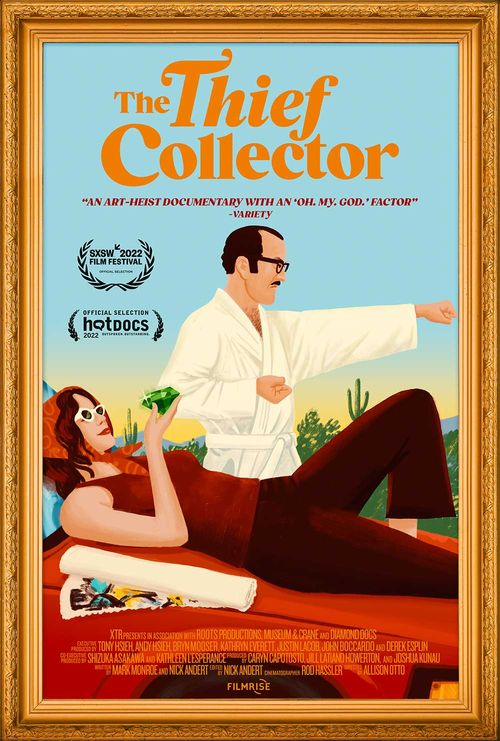
It is strange how we all enjoy watching films about art thieves, even
though by stealing from museums, they deny the general public the ability to
view great masterpieces, even though Raffles and Thomas Crown are admittedly
charming. At first glance, school teachers like Jerry and Rita Alter would look
like exactly the sort of people who would be disgusted by a museum heist, yet a
notorious painting by Willem de Kooning was found in the possession of their
estate. Allison Otto documents the mystery surrounding de Kooning’s “Woman-Ochre”
and the strange secrets of the Alters in The Thief Collector, which
opens Friday in select theaters.
The
documentary opens with a breezy dramatic vignette that we later learn is based
on one of the stories Jerry Alter published in his vanity press collection. At
the time, friends and family assumed they were fictional, but through Otto’s
lens, they start to look like confessionals. Frankly, the Alters’ nephew had no
idea there was anything of notable value in their eccentric home when he
started liquidating their estate. (The Alters were also survived buy two adult
children, who were apparently not sufficiently competent to serve as their
executor and make no appearance in the film.)
Nobody
thought all the bric-a-brac the Alters collected during their world travels
were worth much, so the donated some to a charity thrift shop and brought in
Manzanita Ridge Antiques to liquidate the rest of the house. Most of the
paintings on the wall were Jerry Alter’s own ugly work, but one of them vaguely
rang a bell for the antique dealers. After an extensive internet search, they
realized it looked exactly like “Woman-Ochre,” brazenly stolen from the
University of Arizona Museum of Art in 1985, because it was. To their enormous
credit, they could not wait to return it to the museum, especially when the
vultures started to approach them.
The
guys from Manzanita are definitely the heroes of Otto’s documentary. It is much
harder to classify the Alters role in the story. They generally match the
description of the couple presumed to have sliced “Woman-Ochre” out of its
frame on an otherwise typically quiet Friday after thanksgiving. What about the
other valuable works that turned up in their collection (not de Kooning level,
but still nice) and how did they afford all that international travel, anyway?
Plus, there is the matter of Jerry Alter’s “murder story.”
Both
Alters are long gone and they clearly held their secrets closely while they
were living, so we will probably never know the full truth. Nevertheless, Otto
digs into the story as best she and her on-camera interview subjects (including
the nephew and the Manzanita staff) can. She asks all the right questions and
traces the Alters history back to their time in New York, where they traveled
in the sort of Bohemian circles that could very well have included de Kooning.
Gen. George S. Patton was not exactly woke, but he was generally
well-remembered by the black soldiers of the 761st Tank Battalion who
served under him. For most of the film, the so-called “Black Panthers” will be
on their own, behind enemy lines. That wouldn’t be so bad, given the hostility
of some of their fellow soldiers, were it not for the crazy German officer setting
ambushes for them. However, a downed American pilot will be happy to tag a ride
with them in Steven Luke’s Come Out Fighting, which releases Friday in
theaters and on-demand.
Maj.
Chase Anderson is the kind of commanding officer Lt. Robert Hayes can respect.
Obviously, Anderson is cool, because he is played by Dolph Lundgren. Unfortunately,
the captain between them is a racist trying to blame Hayes for his mistake. The
captain is also an incompetent, who gets his convoy back to HQ hopelessly lost
and quickly ambushed by the unhinged Captain Hans Schultz.
Hayes
is the only survivor, trying to cross back over enemy lines by himself, until
Lt. Frank Ross blunders into him. Ross survived a dogfight with the Luftwaffe’s
newly redesigned fighter plane, so top brass would like to debrief him. That is
how Maj. Anderson convinces Gen. Patton to sign off on the previously
unsanctioned rescue mission Hayes’ sergeant, Sgt. A.J. “Red” McCarron was planning,
with the help of Black Panthers tanker Sgt. Warren Crecy. Hayes’s platoon and
the 761st are still largely on their own, but they are highly
motivated.
Weirdly,
Come Out Fighting does not feature the most famous 761st
veteran, Jackie Robinson (or it’s the briefest of name-checks that you could
easily miss). Regardless, the gritty, fatalistic attitude of most of the troops
rings pretty true. However, there is the big credibility issue when it basically
lets McCarron and Crecy get away with “taking their own initiative.” Chain of command
is critically important. They do not take too kindly to it if the generals want
your men one place, but you decide to move them someplace else, but hey, it’s a
movie.
It
also seems like the Germans never had a chance, since we have Michael Jai White
and Lundgren in uniform. White definitely looks and acts like a leathery tough
NCO. Lundgren is suitably commanding as Anderson, continuing to gracefully
transition into less physical, but still ultra-manly action-support roles.
Hitman guilds are never very collegial. Just ask Mike Fallon from the Accident Man films. Sure, they will throw a lot of work your way, but sooner or
later, they contract all their members to kill each other. Morgan Gaines is
about to go through one of those phases. Technically, he really isn’t part of
any “club,” title notwithstanding, but shares a common handler with at least
one hired guns out to kill him in Camille Delamarre’s Assassin Club,
which releases tomorrow on digital.
Gaines
always insisted on killing parasitic monsters, like the Slovenian human
trafficker he has a bead on, in the opening scene. Unfortunately, Alec Drakos
also has a bead on him. Gaines just barely escapes with his life, but Drakos
takes out his contract. When he gets home, Gaines is quite put-out by the whole
business, but his self-consciously sleazy handler Caldwell only wants to talk
about this new super-contract: six targets at one million dollars a pop.
Initially,
Caldwell neglects to mention the contract out on Gaines as well. Contemplating
retirement, Gaines declines, until he saves his innocent civilian girlfriend
Sophie from an assassination attempt (mostly targeting himself). As he starts
to get the ugly truth out of Caldwell, he realizes it will more-or-less be a
case of kill or be killed. However, the mysterious, faceless assassin Falk proposes
a temporary working truce, to her benefit, of course.
There
is nothing wrong with a film about a pack of assassins trying to kill one another,
but the Accident Man duology did it so much better. Delamarre (who previously
helmed The Transporter: Refueled) helms some serviceable action
sequences, but Thomas Dunn’s screenplay is dumber than a duffle full of doornails.
There are moments when you have to ask the screen: “seriously dude, you’re
going to buy that?”
These teens have no future and they know it. The kind of Chinese films
that tell their sort of stories do not have much future either, but nobody
wants to admit it. It is harder to see Chinese cinema that accurately represents the extreme economic stratification and open public corruption that is rife
throughout the Mainland, but a drop-out like Zhao Xiaolong can see it clearly. Out
of his wild social circle, Li Dongdong is one of the few with any ambitions,
but she is the one who winds up dead in Song Wen’s The Enigma of Arrival,
which premieres Thursday on OVID.tv.
Fang
Yuan thinks he is the alpha of his gang of running mates, so Li must be attracted
to him. However, she actually carries a torch for the strong, silent Zhao,
because she can tell he is the real man of the group. Yet, he just cannot handle
romance or much of any kind of close relationship. Nevertheless, her presumed
murder will impact him greatly. Even when he meets his old friends years later
during their in medea res reunion, Li Dongdong is really the only thing on his
mind.
On
the surface, Enigma of Arrival (which has nothing to do with de Chirico
or Naipaul) is definitely a thriller, but there is a lot of social observation
and critique baked into every frame, much like Back to the Wharf. The film
wears its Wong Kar-wai influences proudly, not on its sleeve, but up on its
lapel. The ne-er do well punks even attend a Days of Being Wild screening,
just for the sex scene. (Nowadays, they probably can’t even do that, when out
on the hunt for some risqué entertainment in Mainland China.)
The
poverty and corruption Song incorporates into the narrative is not even
subtext, but the central mystery still unfolds in an intriguing “half-Rashomon”-style.
Yet, the truth will be revealed and it will be painfully bitter.
Perhaps
counter-intuitively, the film’s best performance comes from Gu Xuan as Li.
Instead of a cypher everyone projects upon, she is the most human of the lot,
so her loss means something. It is a sensitive, vulnerable turn from Gu, whose
credits are oddly limited, despite starring as Shirley Yang in two Ghost
Blows Out the Lamp movies.
Max Roach was one of jazz’s two great “trouble-making” musical activists,
along with Charles Mingus. Together, they formed Debut Records, the short-lived
independent jazz label. Tragically, Mingus was undermined by his own body at
the age of 56, but Roach lived into his eighties, having successfully channeled
his protest anger into music. Documentarians Sam Pollard and Ben Shapiro
chronicle Roach’s long, challenging career about as well as anyone could with a
mere ninety minutes in Max Roach: The Drum Also Waltzes, which screens
at the 2023 Seattle International Film Festival.
Roach
left this world in 2007, but Pollard started filming him for a prospective
documentary in 1987. At the same time, Shapiro was recording audio interviews
with Roach for a book about jazz drums. Apparently, other projects and events
intervened for Pollard, but he had a wealth of material to draw from when they
finally joined forces and finished the film.
Roach
was the classic Bebop drummer, but he was probably more responsible than any
for Bebop’s evolution into Hardbop as the co-leader of the Clifford Brown-Max
Roach Quintet. His protest music with Abbey Lincoln was about as avant-garde as
any Free Jazz and he later explored the unexpected melodic and harmonic
possibilities of his instrument in the all-percussion ensemble M’Boom.
By
far, the best sequences in Drum Also Waltzes cover Roach’s relationship
with Brown, who died far, far too young, through no fault of his own. The
memories of Roach and legends like Sonny Rollins will move many jazz fans to
tears.
On
the other hand, the biggest absence in the doc is that of Mingus. Roach had a
long association with the bassist, as co-founders of Debut, as members of the
celebrated one-night-only “Jazz at Massey Hall” Quintet, the rhythm section of
Duke Ellington’s Money Jungle record, and the so-called “Newport Rebels.”
I suspect Pollard and Shapiro are keenly aware of the oversight and it probably
kills them, but maybe one Mingus reference would have necessarily led to another,
until he took over the film.
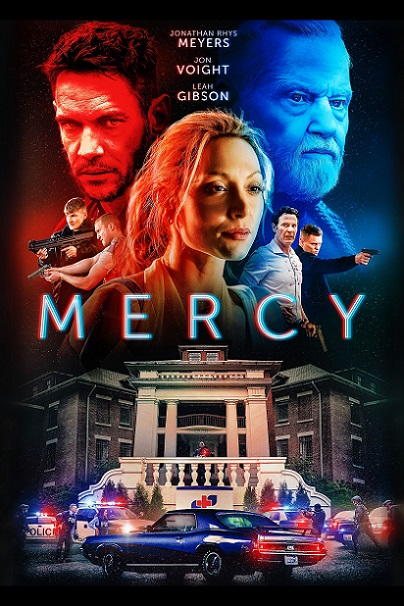
Dr. Michelle Miller’s military background serves her well in Mercy’s emergency
room. She is very experienced treating bullet wounds. She is also highly trained
in handling firearms, which will come in handy when a Die Hard-like
situation breaks out in her hospital. Of course, her son is rattling around the
halls someplace, to further raise the stakes in Tony Dean Smith’s Mercy,
which opens today in select theaters.
Miller
barely survived the bomb that killed her husband, while they were serving together
in Afghanistan. Now, she raises her soccer-crazy son Bobby as a single mother,
when she isn’t pulling bullets out of patients at Mercy Hospital. Someone
really wanted to kill her latest. They even used exploding rounds, one of which
goes off in the operating theater. Rather awkwardly, he happens to be Ryan Quinn,
the heir apparent of the Quinn crime family, who was in Federal custody, when
his brother Sean tried to kill him.
Old
man Patrick Quinn has no idea his reckless older son is making a power play. Initially,
he only came to Mercy to visit his injured son, as a concerned father. However,
Sean’s violently erratic and paranoid behavior sets off a chain of events that
results in a hostage situation. The Irish mob patriarch is not at all pleased
with this turn of events and neither is Miller, who is one of the only hospital
staffers still at liberty within the building.
Obviously,
this all sounds very familiar, but it is greatly elevated by Jon Voight’s performance
as old school Patrick Quinn, who definitely still believes there are things
that should be out-of-bounds for gangsters, like holding an entire hospital
hostage. Voight lays on the blarney accent thickly, but that is all part of the
charm of his scenery-chewing. When he is on-screen, Mercy is never boring.
Leah
Gibson is also a pretty solid VOD-action lead. She certainly looks like she
trained for this film. Jonathan Rhys Meyers uses the same trowel as Voight to apply
his Irish accent, but his unhinged twitchiness further energizes what is now a
run-of-the-mill storyline. Mercy is probably his best film since Yakuza Princess and his best performance since Damascus Cover.
The Twilight Zone was
prestige television before prestige television. Rod Serling wrote a heck of a
lot of it, but George Clayton Johnson was one of a handful of regular writers
who also contributed. Johnson also co-wrote one of the most ripped-off
dystopian novels of all time (looking at you, Hunger Games). He was
never as well known as his colleagues, but Johnson inspired hipper fans, like
Henry Chamberlain who tells his life story as the writer and artist of George’s
Run: A Writer's Journey Through the Twilight Zone, which goes on-sale today.
Johnson
came out of obscure poverty in remote Wyoming (as Chamberlain tells us multiple
times), but somehow in Hollywood, he talked his way into a group of genre
writers fittingly known as “The Group.” Members included Richard Matheson,
Robert Bloch, and Johnson’s eventual co-writer on Logan’s Run, William
F. Nolan. Charles Beaumont was their unofficial leader and Ray Bradbury was
their godfather. Serling was the boss, who produced some of the best work of
Johnson, Matheson, and Beaumont on The Zone.
By
far, the best stuff in George’s Run describes the behind-the-scenes camaraderie
of his Twilight Zone years. Chamberlain also nicely covers Logan’s
Run, Roger Corman’s The Intruder (in which Johnson played a
supporting role), and the screenwriter’s big break, the screenplay for the original
Ocean’s Eleven. However, some readers might be confused by the references
to Icarus Montgolfier Wright, the Oscar-nominated animated short he and
Bradbury co-adapted from Bradbury’s short story. On the surface, the 1956 story
has been rendered obsolete by the advance developments of the U.S. space
program, but the short film remains an eerily powerful allegory.