Friday, April 08, 2022

Fessenden/Glass Eye Pix at MoMA: Stake Land

Instead of a zombie apocalypse, we got a vampire apocalypse. Most of the rules remain the same. You can stake a vampire through the heart, but for the really tough ones, you have to sever the spinal column. “Mister” is good at killing them, so maybe he might just keep young Martin alive in Jim Mickle’s Stake Land, which screens as part of MoMA’s “Oh, the Humanity” retrospective film survey of Larry Fessenden’s Glass Eye Pix.

Martin is now an orphan, thanks to the vampire Mister was good enough to kill shortly thereafter. He is tough, but he willingly takes Martin under his wing. They are generally headed North, hoping reports of a sanctuary city are true (yes, this follows a lot of familiar zombie movie tropes). However, they will have to cross some dangerous territory controlled by White Nationalist Christian militias. The worst of the lot is led by messianic Jebedia Loven, who welcomes the vampires as a cleansing agent sent by God.

Frankly, it tis already beyond tiresome to see another post-apocalyptic horror film that only shows the Armageddon-like situation bringing out the worst in people. The truth is, national crises usually bring out the best in us. Late 2000/early 2001 was a very divisive time in American history, yet 9/11 unified us a country, at least for a while. Arguably, it might take a vampire or zombie apocalypse to unify us again, considering how polarized the nation has become. However, by so blatantly demonizing the Christian Right,
Stake Land contributed to that polarization. You could just as easily posit Antifa extremist celebrating vampires who preyed on white property and business owners (having a little of both would have increased the dangers and raised the stakes even further).

Would I Lie to You?, on CW

There was a time when gameshows featured panelists like Dorothy Kilgallen and Bennett Cerf, who would have been welcomed at any proper society dinner party. Then the Quiz Show scandal happened and game shows started to lean into dumb. The level of intelligence improved when they started recruiting comedians, who can at least think on their feet. This latest bit of primetime gameplay is based on a long-running British series, but it is also sort of a throwback to the original To Tell the Truth. However, there are no average Joe contestants nor money at stake. Only pride and bragging rights are on the line in Would I Lie to You?, which premieres Saturday on the CW.

The format is pretty simple. Celebrity contestants take turns reading a purportedly true anecdote from their lives off a note card, allowing the opposing team to ask questions to determine whether it is the truth or a lie. Eventually, in a later round, each team member tries to explain their unlikely connection to a prop-person, staring out at the camera with a blank expression—and again only one of them is telling the truth.

Frankly, based on the first three episodes, the host, Aasif Mandvi (who was great in the series
Evil) is the funniest of all the participants, so far. On the other hand, it is rather telling former U.S. Attorney Preet Bharara’s internal lie-detector only works about 50% of the time, at best—but that doesn’t necessarily mean his team didn’t still win, not that it really matters.

Thursday, April 07, 2022

Michael Bay’s Ambulance

This would be a good day in Los Angeles to do your banking online, for the usual reasons of traffic and street crime. Nevertheless, a rookie cop happens to want to ask out a pretty teller. Instead of a rom-com, he walks into a heist movie. After he is shot by a reluctant bank-robber, Officer Zach’s ride to the hospital is hijacked by two desperate armed robbers (very well armed) in Michael Bay’s Ambulance, which opens nationwide tomorrow.

Afghanistan veteran Will Sharp’s wife needs an experimental cancer treatment, so naturally insurance will not cover it. Swallowing his pride, he visits his estranged adopted brother Danny for a loan. Instead, he offers his brother a gig on a bank heist due to go down in minutes. Danny took over their father’s criminal business, but at least he is not the violent psycho killer the old man was. Unfortunately, this job is going to get unusually messy.

It turns out Captain Monroe was waiting outside the bank with his flying squad, or whatever he calls them. With the other three losers incapacitated, the Sharp brothers commandeer the ambulance dispatched for Officer Zach to sneak out of the trap. It not a clean getaway though. Like it or not, they have EMT Cam Thompson and the critically wounded Zach as hostages. While they evade Monroe’s dragnet, they desperately need Thompson to keep the officer alive, to prevent them ever facing murder charges.

Ambulance
is a perfect example of why Michael Bay is probably the only genuine auteur, with an immediately recognizable visual style, currently working within the Hollywood system. Even if you knew nothing about Ambulance, you could probably guess it is a Michael Bay film within the first five minutes. In this case, that’s actually a compliment.

There are still plenty of crazy explosions and car crashes in
Ambulance, but it is a much more grounded film than Bay’s Transformer spectacles. There is legit character development and drama here. Jake Gyllenhaal is impressively off-the-wall, pushing the envelop of deranged, as Brother Danny. Yahya Abdul-Mateen has the less flashy role, but he is suitably intense as the driven and guilt-wracked Brother Will. Eiza Gonzalez holds her own against both of them as Thompson, who has a surprisingly potent character development arc of her own.

However, the real star that will come out of
Ambulance is Bay’s mastiff Nitro, who plays Monroe’s loyal dog, whom he somehow fits in the back of his Fiat. The big guy just has massive screen presence. For the record, his co-star, Garret Dillahunt is terrific too as the sly, sarcastic police captain.

Wednesday, April 06, 2022

All the Old Knives, on Prime Video

During the Cold War, there were high-ranking traitors (particularly from Cambridge) who betrayed their countries in the West, because they were seduced by the Soviet ideology. The harsh dogma of Islamist jihadists was assumed to hold much less allure for anyone accustomed to the tolerance and/or “decadence” of the West. Yet, someone in the CIA’s Vienna station apparently fed sensitive information to a notorious jihadist terrorist group. Henry Pelham will interrogate his former lover and colleague Celia Harrison, over dinner and drinks, as part of his investigation into the hijacking of Flight 127 in Janus Metz’s All the Old Knives, adapted by Olen Steinhauer from his own novel, which premieres Friday on Prime Video.

The horrific mass murder of all souls aboard Flight 127 remains a source of embarrassment to the CIA, but they are forced to pick at the wound when a captured terrorist claims they had an inside source. Pelham gets that job, thanks to his old station chief, Vick Wallinger. His prime suspects are Harrison and her former boss, Bill Compton.

Heartbroken and guilt-ridden over the hijacking incident, Harrison retired to Eastwood’s town, Carmel-by-the-Sea. It is there that she agrees to meet Pelham for an intimate evening of wine and memories. As we see in flashbacks, he also had a much less romantic meeting with Compton. In fact, most of the film consists of flashbacks, which slowly reveal exactly what went wrong with the agency’s response.

Watching their wary yet still flirtatious cat-and-mouse game is pretty compelling, if you like your espionage on the talky-side, rather than action-oriented. However, Steinhauer really draws out his revelations. His narrative probably could have been compressed into an hour-long episode of an anthology series, without any great loss of drama or context.

Still, the Vienna backdrop is well chosen (evoking the tradition of
The Third Man). The CIA station feels grounded in reality and veteran character actors like Jonathan Pryce and Laurence Fishburne add world-weary resignation and grizzled steeliness. Orli Shuka also has a big, powerful presence as terrorist mastermind Ilyas Shushani.

Tuesday, April 05, 2022

Cursed Films II: The Wizard of Oz & Rosemary’s Baby


If you only looked at these films as profit-and-loss entries on their studios’ ledgers, you would hardly consider them “cursed”—quite the contrary. Sadly, the subsequent fates of so many involved in their productions gave rise to such a reputation. Whether it be tragic rumors or fannish obsession, fan fascination continues to swirl around The Wizard of Oz and Rosemary’s Baby, the first two subjects explored in the second season of Cursed Films, written, directed, and edited by Jay Cheel, which begins this Thursday on Shudder.

Wizard of Oz
might not sound like a very Shudderish movie, but it has witches. Regardless, fans know it had its share of behind-the-scenes mishaps. For instance, Buddy Ebsen was originally cast as the Tin Man, but had to drop out after the makeup nearly killed him. Margaret Hamilton was also badly burned when a fire-based special effect launched too soon.

Of course, the star, Judy Garland went on live a tragically short, troubled life marked by addiction issues, which started with the “energy” pills the studio gave her to power through the chaotic production. Awkwardly, we eventually see director Steve Rash disavow his film
Under the Rainbow for perpetuating the baseless smear that the Munchkin thesps were engaged in wild, drunken carousing during the filming of Oz. It is definitely an uncomfortable moment of woke self-criticism, but there is still a good deal of crazy Hollywood lore that makes this episode far more interesting and entertaining than American Experience’s L. Frank Baum profile.

Of course, Polanski’s
Rosemary’s Baby is a horror classic and everyone knows the horrific Manson Family Tate-LaBianca murders were tragically committed just over a year after its release. To their credit, Cheel and company start by documenting the untimely death of the film’s composer, Krzystof Komeda. The murder of Sharon Tate and Polanski’s odd subsequent behavior are covered in detail. However, the contention that Tate was on verge of leaving Polanski to reconcile with Jay Sebring, which is quite credibly suggested in Jay Sebring…Cutting to the Truth, goes unacknowledged here.

The Long Night, on DVD

Evil things happened on this plot of Southern land, even before it became a plantation. The owner reached out to Grace Covington, who has long sought answers regarding her unknown mother. The truth she learns will be pretty darned bad in Rich Ragsdale’s The Long Night, which releases today on DVD and BluRay.

Covington grew up in foster care, so she always yearned to learn who her real parents were. Even meeting her boyfriend Jack Cabot’s nasty rich Hamptons parents cannot dampen her need for answers. Frank Caldwell claimed to have information, so he invited Covington out to his remote plantation-style home. Weirdly, Caldwell is missing when they arrive, but as night falls, a weird pagan-like group encircles the house. They are not just your average goat-skull-wearing death cult. To some extent, they also seem to have supernatural powers.

Initially,
Long Night shapes up like a largely conventional cult-horror movie, in the tradition of Jackals, but the cult’s backstory is unusually creepy, in evocative and archetypal ways. That also raises the stakes considerably.

Scout Taylor-Compton and Nolan Gerard Funk are both fine as the terrorized couple, but all they really get to do is run for their lives and yell at each other. Arguably, their bickering drags on a little too far into the crisis, but they are still at, or above, horror movie industry-grade, for victims lured to remote locations.

Monday, April 04, 2022

Agent Game

Covert ops is a tough business, because there is so much expendability built in—and everyone is always expendable to someone above them. At least, that is the cynical view of intelligence services presented in this film. Fair or not, Kavinsky’s team was recruited to take a fall, but he maybe picks up on the mission’s bad vibes before it is too late in Grant S. Johnson’s Agent Game, which releases this Friday in theaters and on VOD.

Olsen is a high-ranking “deep state” CIA administrator, who is having a bad day, judging from the prologue, showing him firing off shots on the streets of DC. It will take multiple, confusing flashbacks to explain how he reached this point. Somehow, it involves Kavinsky’s team of misfits, whom Olsen personally recruited to snatch and grab an unidentified target.

Then, there are the flashbacks to a black site in an undisclosed Eastern European country, where veteran officers Bill and Harris are interrogating Omar, who was formerly an American-backed revolutionary leader, but the agency seems to think he has gone over to the dark jihadist side. The thing is, the two old hands have been doing this long enough to know Omar’s denials are the truth. However, Visser, Olsen’s loyal enforcer wants them to just bury him and sign-off on the agency’s suspicions.

It would be nice to see a new film that actually celebrated the sacrifices of American intelligence personnel, instead of demonizing, but this is not that film. Nevertheless, there is a lot of surprisingly tense intrigue, especially that focused on Bill and Harris in the black site. Eventually, screenwriter Tyler W. Konney and Mike Langer tie everything together, but viewers almost need to take notes to keep track of the various timelines.

Be that as it may, Jason Isaacs and Dermot Mulroney are terrific as the two dubious interrogators. They are credibly smart and world-weary. If there is anyone viewers will identify with in this film, it would be them. It might be frustrating type-casting for him, but Barkhad Abdi (from
Captain Phillips) is also quite good as the unfortunate Omar. Scheming against them, Annie Ilonzeh makes a strong, forceful antagonist as Visser. However, Mel Gibson is more than a bit over the top spouting good-old-boy-isms as the villainous Olsen.

Sunday, April 03, 2022

Ashland Independent ’22: City of a Million Dreams


New Orleans' music and culture always helped it endure hard times. For most people, funerals are always the worst of times, but the city’s unique jazz funeral tradition gave mourners a feeling of uplift. Drawing from his nonfiction book, Jason Berry explores the history of jazz funerals and the challenges to their continued practice in City of a Million Dreams, which screens virtually as part of the 2022 Ashland Independent Film Festival.

New Orleans is famous for its brass bands and the “second-liners,” the revelers who follow parading bands, literally dancing in the streets (as documented by photographer William Claxton, amongst others). Berry fully explains the connection between brass bands, the Mardi Gras Indians, and the benevolent societies, which originally supplied de facto funeral insurance policies to black New Orleanians. For those who need the context, Berry and his on-camera experts also explain how New Orleans jazz grew out of the roots of slavery and Congo Square, the gathering place, where slaves were allowed to congregate on Sundays.

To keep things real, Berry had the on-screen participation and consultation of “advisory producers” Dr. Michael White (of the Young Tuxedo Brass Band and Original Liberty Jazz Band) and Deb “Big Red” Cotton, an online journalist, who chronicled the city’s brass band/second line scene. However, Berry’s documentary takes on unexpected tragic dimensions when Cotton is hit by a stray bullet while documenting a second line.

Indeed, there is considerable sorrow in
Million Dreams, despite the joyfulness of the music (which is terrific). Berry revisits the city’s darkest days, in the early 1980s and mid-1990s, when rampant crime threatened to derail the jazz funeral tradition. Of course, the film reflects on the disruption of Katrina, from White’s perspective (on the positive side, we hear some of the music he composed during the aftermath, recorded on his Blue Crescent album). Berry also necessarily ends on an uncertain note, with the practice of jazz funerals and second lining suspended due to Covid shut-downs and social distancing.

Benjamin Franklin, in the Epoch Times


He was a true renaissance man and the most world-renown American of his day. There's always something new to learn about Ben Franklin. Fortunately, Ken Burns and company mostly do right by the Founding Father in Benjamin Franklin. Epoch Times review up here.

Saturday, April 02, 2022

Branagh’s Rockin’ Death on the Nile

Who knew Hercule Poirot had such hip taste in music? It came as a surprise to him too, but he really grooves to Sister Rosetta Tharpe. Technically, she is called Salome Otterbourne, but she plays electric guitar and her repertoire includes “Rock Me” and “Up Above My Head.” However, she is not completely Sister Rosetta, since she might possibly be kind of slightly interested in him too. Regardless, Poirot will have to concentrate on the bodies that start piling up in director-star Kenneth Branagh’s Death on the Nile, which releases Tuesday on DVD and BluRay.

Like Branagh’s Wallander, his take on Poirot is decidedly sadder and, in this case, even tragic. Screenwriter Michael Green punches up Dame Agatha’s popular novel by giving the Belgian sleuth a rather heartbreaking backstory, flashing back to Poirot’s service in WWI. The truth is, it does help explain why Poirot is so fastidiously Poirot.

Regardless, Poirot finds himself in Egypt, along with newlyweds Simon Doyle and Linette Ridgeway-Doyle, who met at a Salome Otterbourne gig (that Poirot also happened to attend). At the time, Doyle was engaged to Jackie de Belfort, Ridgeway’s dirt-poor best friend. Since then, Doyle traded up to the heiress. De Belfort took the news quite badly. In fact, she has chased the happy couple every step of their Nile cruise honeymoon. Her stalking has grown so unhinged, Poirot agreed to give her a fatherly talking-to. Despite his concern, Ridgeway-Doyle is soon bumped off, but it happens after De Belfort is sedated, following a violent altercation with her former fiancé.

That leaves Poirot with literal boatload of suspects (all aboard the S.S. Karnak), all of whom have motives. Naturally, the elite detective proceeds to investigate, with the help of his old friend Bouc, substituting for David Niven’s Col. Race in the 1978 film. Several of the supporting characters have been reconfigured and assigned different jobs and stations in life, but the fundamental murder mystery remains the same.

However, the music is way better this time and Branagh maybe even makes better use of the grand Egyptian settings. He is a more neurotic Poirot than Ustinov ever was, but he also develops some unusually bittersweet, ambiguously romantic chemistry with Sophie Okonedo’s Otterbourne.

Friday, April 01, 2022

Neil Maskell is Bull

Everyone just calls him “Bull,” including his ex-wife—very ex. He is not the sort of gang enforcer you want to leave for dead. His mobster father-in-law was pretty certain he finished the job. Yet, somehow, he has come back, truly with a vengeance, in Paul Andrew Williams’ gritty payback thriller Bull, which opens today in New York and releases on VOD.

Norm would grudgingly admit his heroin-addicted daughter Gemma is not a great mother, but he still loyally takes her side in what you could call a custody battle from Hell. He assumed Bull went to a fiery death, but then he suddenly turns up ten years later. Not surprisingly, Bull wants to find Gemma and his son Aiden, so he will work his way through the bodies of Norm’s unfortunate associates to get to them.

Neil Maskell has played a number of memorable British working-class thugs and anti-heroes, but Bull could be his most vicious lowlife protagonist to date—but we cannot help rooting for him, because what choice is there?

Stylistically,
Bull is a lot like Hyena (also co-starring Maskell), but it is more accessible and emotionally engaging. Yet, it also shares a kinship with Ben Wheatley’s Kill List (which, of course, starred Maskell too), in that both films ostensibly follow the dirty business of some violent workaday criminals, but there is an unsettling feeling of something rather sinister going on in the background. Viewers should not ignore their intuition, but it would be spoilery to confirm how so here.

Thursday, March 31, 2022

The Contractor

For retired Special Forces operators (involuntarily so, in James Harper’s case), the private firms that hire their particular skill sets tend involve the dirtiest work. Rusty Jennings’ outfit was supposed to be different, but it wasn’t. When his first assignment goes bad, Harper becomes a dangerous loose end in Tarik Saleh’s The Contractor, which releases Friday in theaters.

Frankly, the circumstances surrounding Harper’s dishonorable, pension-revoking discharge are somewhat dubious, but he has to become the titular contractor somehow. Deep in debt, he accepts his old buddy Mike’s offer to join Jennings’ boutique mercenary firm. His first gig is in Berlin, where he and Mike are supposed to take out Salim Mohamed Mohsin, a terrorist-allied scientist and scoop up his super-virus formula. The thing is, Mohsin keeps calling it an antidote. Weird, huh?

Unfortunately, the job turns into a massive firefight that injures both contractors. Forced to separate, Harper finds Jennings’ people are actually hunting him. To his credit, this turn of events hardly seems to surprise him anymore than it does us, the viewers.

The Contractor
is a serviceable if predictable film, but you have to wonder if it was severely recut at some point. After all, it seems like a waste to cast the great Nina Hoss (from Phoenix and Barbara) as their local contact Katia, just for a few “hellos” and a shootout scene. Despite addressing issues of PTSD and the veterans’ economic hardships, Contractor really does not really feel like the kind film we would expect from Saleh (who previously helmed The Nile Hilton Incident and Metropia). Still, if someone did a ”Scissors-hand” job on this film, they made pretty smooth work of it.

Great Performances: Fire Shut Up in My Bones


Duke Ellington's opera Queenie Pie was sort of like Orson Welles eternally unfinished Don Quixote. He continued writing and polishing it throughout his life, but he never found the right venue to force him to finish it. Concert recitals have tried piece it together, but it never had the proper premiere it deserved. Today, jazz artists get more respect. In fact, Terence Blanchard became the first black composer to be produced by the Metropolitan Opera, launching their 2021-2022 season. The music is fresh, but Blanchard’s adaptation of Charles W. Blow’s memoir is as tragic as any great opera, with a libretto by Kasi Lemmons. Grown “Charles” returns to his hometown Gibsland, Louisiana to revisit his traumatic childhood abuse in Fire Shut Up in My Bones, which airs tomorrow night on PBS’s Great Performances at the Met.

Gibsland is best known as the nearest town to where Bonnie and Clyde met their untimely demise. Charles has something similar in mind. He has come back with a gun and he is looking for Chester the aptly-named cousin who molested him when he was a young boy. Instead, he finds “Char’es Baby,” the embodiment of his childhood self, who guides him through the memory play. Act 1 culminates with the abuse, whereas act 2 ostensibly shows teenaged Charles “getting on with his life,” by losing his virginity. However, in act 3, we see the abuse still haunts him as a freshman enrolled in Grambling.

Instead of a jazz opera, the Met describes
Fire as “an opera in jazz.” Don’t feel bad if that distinction is lost on you. Much of Blanchard’s score is stylistically akin to grand opera of the kind you expect to hear at the Met. Yet, Blanchard’s jazz background is still in there, especially in transitional passages that often a rhythmic bounce that you might even say swings. There are also a number of songs that transparently incorporate elements of the blues and gospel. Yet, ironically, one of the most memorable arias, “Golden Button,” would probably work even better as a Broadway book musical tune, given its lilting melody and endearing lyrics.

Jazz fans should also note musicians Jeff “Tain” Watts on drums, Matt Brewer on bass, and Adam Rogers on guitar supplement the Met orchestra. As a legit jazz rhythm section, they help Met pianist and assistant conductor Bryan Wagorn to really swing the score. Arguably, Blanchard might have found the sweet spot that keeps his jazz supporters tapping their toes, while remaining accessible to the Met’s core audience, without sounding like he is compromising or trying to placate either. (That’s a neat trick.)

Wednesday, March 30, 2022

Moon Knight, in The Epoch Times


We're still waiting for it to fully explore Marc Spector's Jewish heritage, but the Egyptian themes and motifs already make Moon Knight cooler than most superhero series. Exclusive Epoch Times review up here.

Let the Wrong One In: Vampire-Slaying in Ireland

This pack of vampires really ought to be more careful when they turn more vampires. Matt’s lowlife brother Deco is not the sort of bloke you want to spend eternity with. For Matt, he is still family regardless, so staking him will be difficult in Conor McMahon’s unruly vampire comedy, Let the Wrong One In, which releases Friday on digital and in select theaters.

Matt is the responsible, painfully nice brother, while Deco is not. The sunlight is really bothering him this morning, so he begs Matt to let him into their mum’s house. She threw him out because of his stealing ways, but Deco can still exploit his brother’s guilt. Awkwardly, he repays Matt’s mercy by projectile vomiting blood in his face. That won’t be the last time that happens in this movie.

Soon, Henry the vampire slayer is on their doorstep, pretending he is there to help. Slaying is personal to him, because the leader of the pack is his beloved fiancée, who was turned during her bachelorette party (in Romania, because it was cheap). He keeps tabs on vampire movements through reports from his fellow cabbies (which is kind of clever).

Wrong One
is often funny, but almost always in an outrageous meatheaded kind of way. The story itself is no great shakes, whereas the best horror-comedies (like Extra Ordinary) have a narrative that would be interesting even without the laughs. Despite the intentional echoes of the title, Wrong One never specifically spoofs Let the Right One In. They both just happen to be about vampires.

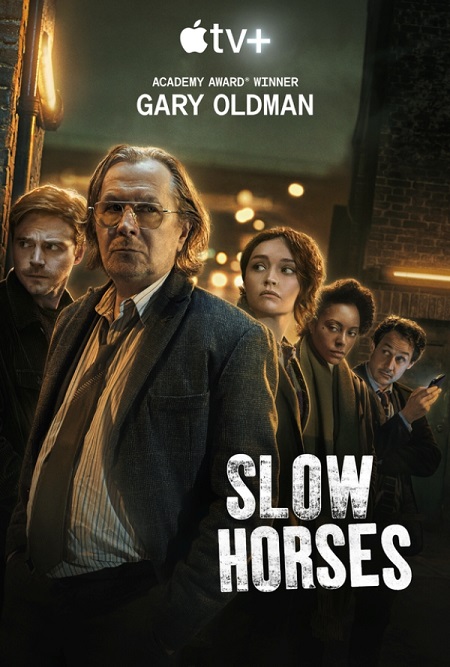
Slow Horses, on Apple TV+

In Mick Herron’s novels, Slough House is a lot like the “Circus” in Tinker Tailor Soldier Spy, except anyone stationed there knows their career is on the skids. Typically, their crusty boss, Jackson Lamb, hands out demeaning intelligence busywork to his team of “losers,” but they suddenly find themselves embroiled in an act of domestic terror in the six-episode Slow Horses, adapted by Will Smith (relax, it’s a common name), which premieres Friday on Apple TV+.

River Cartwright was cocky, because he thought he was a good agent and his grandfather David presumably still has influence after retiring from a very high position in MI5. Then he messed up during a highly visible training exercise, so now he is attached to Slough House. Lamb thinks he has only one decent agent, but it isn’t him. Instead, he means Sid Baker, who has apparently been tailing him since she arrived.

Cartwright discovers this while following up on leads he generated during some particularly nasty dumpster diving. Somehow, he might have a line on a disgraced far-right journalist, who seems to know something about the kidnapping of a young Muslim comedian by a mysterious cell of British nationalist extremists. However, Lamb’s rival, Diana Taverner, director of operations at the proper MI5 probably knows even more. Lamb deduces the abduction is part of a false flag operation she launched to entrap the “Sons of Albion” and discredit the far-right. If anything goes wrong, which it will, she intends to scapegoat Slough House.

Obviously,
Slow Horses follows in the tradition of le Carre’s Tinker Tailor, even sharing the star of the film version, Gary Oldman. There is a lot of dry, cutting British humor, which is perfect for Oldman and Kristin Scott Thomas. Frankly, the actual terrorist-thriller elements are just okay, but the politics involved could very well alienate both sides (nationalists are bad, but the “deep state” is also pretty slimy). However, the backbiting, bureaucratic in-fighting, and double-crossing are all jolly good fun.

As you would expect, Oldman is perfectly cast as the caustic, boozy Lamb. The same is true of Thomas, who gets nearly as many laughs as the regal but acid-tongued Taverner. In terms of tone, the humor is somewhat akin to
Yes, Minister, but darker, because characters really die, pretty regularly.

Tuesday, March 29, 2022

Kicking Blood: Vampires & Addiction

In fictional worlds where vampires are real, we still don’t really know much about their physiology, because the academics like Prof. Van Helsing who acknowledge their existence, mostly concentrate on killing them. Really, who can say whether a vampire like Anna can quit sucking blood cold turkey? Vampires are real, but addiction is a monster she and her mortal lover must both face in Blaine Thurier’s Kicking Blood, which releases this Thursday in theaters.

Nocturnal Anna actually works a library job, because she believes living off money plundered from her victims has no dignity. Her shallow hunting-mates, Boris and Nina, have no such scruples. They fancy themselves gods, but they are more like parasites—as Anna is starting to realize. Regardless, she still has to feed. When Anna brought home down-and-out Robbie, she assumed he would be an easy victim. Once he figures out her uncanny nature, Robbie even resigns himself to his fate. Yet, something stops her. Instead of sucking his blood, she gives him a place to stay while kicking booze the hard way.

However, she can’t let her so-called vampire friends know about him. They frown on human relationships. Boris and Nina would also be alarmed to see how emaciated she looks, after she swears off human blood-sucking.

Kicking Blood
is a grungy, low-fidelity vampire movie, aesthetically and thematically akin to Joe Begos’s Bliss, but its narrative and central relationship provide a far more compelling viewing experience. Unlike most films, Kicking grows on the audience as it goes along, because Anna and Robbie become more sympathetic (and more interesting) as they strive be a better man and vamp. Yet, they must overcome the opposition of the toxic people and vampires around them.

That might sound like vampirism is an annoyingly obvious metaphor for addiction, which it basically is, but somehow Thurier never conspicuously over-sells it. Anna’s concern for an aging human co-worker (nicely played by Rosemary Dunsmore) also adds a further “humanizing” element.

Monday, March 28, 2022

Never Forget Tibet, The Dalai Lama’s Untold Story

The world's most celebrated advocate of non-violence is also technically the most wanted fugitive. The Chinese Communist Party still calls him a criminal, but the world knows Tenzin Gyatso, the 14th Dalai Lama as a Nobel Peace Prize recipient. However, hardly anyone would have known him at all were it not for Har Mander Singh, an officer with the Indian Frontier Administrative Service. His Holiness reunites with the man who safely escorted him to his new home-in-exile in Jean-Paul Mertinez’s documentary, Never Forget Tibet, The Dalai Lama’s Untold Story, which has a special nationwide Fathom Events screening this Thursday.

Technically, the Dalai Lama’s 1959 escape was his second try. Frankly, he tried to reach some kind of accommodation with the CCP, but they were determined to dominate the Tibetan nation. When the PLA started shelling Lhasa, His Holiness was already gone, but his party was not sure where their journey would end.

Fortunately, Singh was posted to Bomdila. Even though Nehru agreed to extend asylum to His Holiness, communication was still pretty spotty. Singh stuck his neck out a little protecting the Dalai Lama’s party once he crossed the border, but his initiative was vindicated—and appreciated by His Holiness, whom the Singhs personally hosted like family.

Mertinez’s documentary largely follows
An Officer and His Holiness, a nonfiction account written by Singh’s niece Rani, a British journalist. Her uncle passed away in 2020, but Mertinez filmed his visit to Dharamshala, for an emotional final meeting with His Holiness.

There is also some new historical material in
Never Forget Tibet, including detail on the flight from Lhasa and the secret correspondence between the Dalai Lama, Nehru, and Harold Macmillan. It is an amazing historical episode, but Mertinez tells it in a restrained manner. Frankly, sometimes the energy level could have been raised a tad, without compromising the historical integrity.

Regardless,
Never Forget Tibet helps humanize an icon, His Holiness, while providing context on his relationship with his Indian hosts. It is more complicated than we might have assumed, because of India’s up-and-down diplomatic relations with Mainland China.

Sunday, March 27, 2022

The Yellow Wallpaper: Adapting Charlotte Perkins Gillman

Charlotte Perkins Gillman’s famous short story had fiction’s original unreliable narrator and some of the worst feng shui in the history of American literature. It was also post-horror before snobby critics fell in love with A24 Films. However, it is devilishly resistant to film adaptation, as director Kevin Pontuti and his co-adapting screenwriter and star Alexandra Loreth prove again with The Yellow Wallpaper, which releases this Tuesday on VOD.

The woman (here she is simply called Jane) is a bit moody since delivering her child, but her husband is suspiciously controlling. He also condescendingly dismisses her ailments as nerves or whatever. They have taken a summer rental, so she can supposedly recover her strength, but she finds the yellow wallpaper of her bedroom has the opposite effect.

As anyone who read Gillman’s story in their English lit class knows, the woman becomes increasingly obsessed with and unhinged by the wallpaper. She even starts to believe there is a woman creeping inside the paper. The question for readers is whether something uncanny is somehow tormenting her or is she just completely insane, but it is hard to achieve ambiguous uncertainty on film.

Indeed, even though Gillman’s story inspired a
Twilight Zone episode and a handful of prior films, the definite take probably remains Agnes Moorehead’s radio performance, precisely because so much of the conflict and drama unfolds in the narrator’s head.

Nevertheless, Pontuti and company take a credible stab at it. Cinematographer Sonja Tsypin makes the yellows appropriately sickly looking, while the outside garden is idyllically lush and verdant. It is a well-crafted period production, with richly detailed, Victorian era-appropriate costumes and trappings. The film looks terrific and often sounds quite eerie thanks to some unsettling sound design, but the narrative itself feels conspicuously padded.

As a result, there are seemingly endless scenes of Jane’s eyes wildly panning her room during manic phases or her solemnly starring out into space during depressive intervals. The film just hits the same notes and narrative beats, over and over. Arguably, the Moorehead radio production followed the story just as faithfully, but in a third of the time—and without leading visuals.

Saturday, March 26, 2022

Fessenden at MoMA: ABCs of Death 2

A little curation can sometimes be helpful. According to press materials, the participating filmmakers were given a completely free hand to do whatever they wanted in their contributions to the ABC’s of Death anthology films, as long as they tied everything into their assigned letter. It turns out a lot of them could have used some constructive feedback. The second anthology film is even rockier than the first, but it had a contribution from Larry Fessenden, which now screens without the other 25 letters as part of MoMA’s retrospective dedicated to Fessenden and his Glass Eye Pix production company. However, Fessenden’s “N is for Nexus” might look comparatively better when considered in the company of the entire ABC’s of Death 2, which is available for streaming.


Again, the titles are revealed at the end, to serve as a punchline for the horrors that came before. While the first
ABC’s of Death was highly uneven, #2 is a little too even, meaning the majority of its letters are a disappointment. Here’s the quick rundown:

“A is for Amateur” directed E.L. Katz, makes us initial think the A is for “action,” starting like a
Miami Vice homage but turning into a cautionary tale about air duct dangers. At least #2 starts strong, because this is one of the best letters.

“B is for Badger” from Julian Barratt is a very droll skewering of prima donna environmental TV personality, with Barratt himself getting big laughs as the insufferable Peter Toland, who gets what he has coming.

“C is for Capital Punishment,” by Julian Gilbey starts with a good set-up for an ironic community vigilantism thriller but the payoff is missing.

“D is for Deloused,” from Robert Morgan impressive stop-motion animation, but punishingly grotesque.

“E is for Equilibrium,” from Alejandro Brugues presents some dumb castaway comedy that turns into murder and back again.

“F is for Falling” from Aharon Keshales & Navot Papushado is another highlight, offering darkly ironic tale of an Israeli paratrooper facing a real-life horror.

“G is for Grandad” perpetrated by Jim Hosking is a
Greasy Strangler-esque family shocker. If you don’t know that film, chances are you will be appalled by his letter G (but you’re probably lucky not to).

“H is for Head Games” animated by Bill Plympton is a surreal trifle that trippily turns romance into warfare.