Monday, May 09, 2022

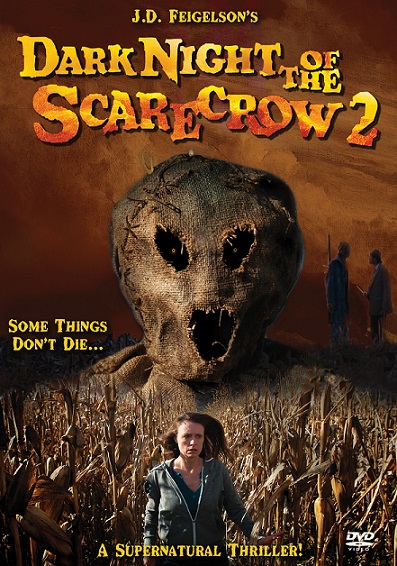
Dark Night of the Scarecrow 2, on DVD

Corn-horror really is a thing and it predated the first Children of the Corn movie on-screen by at least three years. Frank De Felitta’s Dark Night of the Scarecrow (1981) regularly makes lists of the best made-for-TV horror movies, but a sequel never re-awakened the Scarecrow—until now. The story picks up more than forty years later in Dark Night of the Scarecrow 2, written and directed by the original screenwriter, J.D. Feigelson, which releases tomorrow on DVD.

Chris Rhymer had no connection to the fateful Southern town from the first film, but she suddenly had to relocate there with her moody son Jeremy, because she testified against her mobbed-up boss in court. Only the sheriff knows she is in Witness Protection. Unexpectedly, Jeremy quickly takes to his after-school minder, Hilda Corvis, whom he calls “Aunt Hilda.” That is a little too familiar for Rhymer, but she is more worried about “Bubba,” the imaginary friend she constantly catches him talking to.

Obviously, we know that is the Scarecrow, whom Corvis seems to have a longstanding connection to. However, Bubba seems to take a more protective interest in Rhymer than Corvis realizes, especially when the bad guys start coming for her.

Although Feigelson’s new story is essentially self-contained, it refers back to the first film in ways that ought to satisfy its fans (who should definitely be out there). We briefly see a picture of Larry Drake’s poor, hapless Bubba Ritter and implying the Scarecrow adopted his name is definitely a nice touch. Yet, perhaps not-so-weirdly, the sequel would probably work better as a TV-movie, because it will be too tame for contemporary horror fans. You can almost see where the commercials would go.

Sunday, May 08, 2022

Crazy, the Hank Garland Movie

Hank Garland had some success in the music business, in both the country and jazz genres. Unfortunately, his lived some of the worst aspects of the country and jazz lives. He could play like Chet Atkins, until he tragically couldn’t. Garland’s life gets the bio-picture-treatment in Rick Bieber’s Crazy, which airs on This TV.

Wisely, Bieber skips over Garland’s short pants years, starting with his talent show debut, witnessed by Hank Williams himself (played by producer-musician Steve Vai), who provides his blessing. Before long, Garland is recording around the clock in Nashville studios. He is also building a bit of a reputation of his own, recording a few instrumental hits. Of course, the women are attracted to him, especially Evelyn, who will soon be Evelyn Garland.

Unfortunately, both Garlands have some rather pronounced jealousy issues and perversely, inclinations towards infidelity. However, despite them both being Southerners, they have very different attitudes about racial relations. His are not explicitly thought-out, but after getting an earful of Wes Montgomery in a Chicago club, Garland catches the jazz bug. Of course, that means playing with black musicians, which he has no problem with. His wife, on the other hand, worries about what people will think.

Crazy
originally released a just a few years after Walk the Line, so it was positioned as a country music film, but it has a whole lot of jazz. It is totally cool to see legends like Montgomery (played by Tony MacAlpine), Paul Desmond (played by Johnny “Vegas” Burton, whose name probably would have amused the droll alto player) and Joe Benjamin, who played on Garland’s Jazz Winds from a New Direction album and has a small but important dramatic role in the film (nicely handled by Ryan Cross).

Larry Klein’s soundtrack also leans more towards jazz than twang, featuring guitar work from Larry Koonse and Dean Parks. Even when the film does its country thing, it keeps a jazz element, like Madeleine Peyroux’s renditions of Patsy Cline’s “Crazy” (Garland backed her on her iconic recording) and “Lonesome Road.”

In the lead, Waylon Payne is just okay as Garland. He is sufficiently moody, but that is about as far as his performance goes. However, Ali Larter is terrific as the messily complicated Evelyn. She is definitely credible precipitating all kinds of trouble, while humanizer her, during her lowest moments.

Saturday, May 07, 2022

Human Factors, from Germany

The home invasion ended quickly, but the family dysfunction lingers on and on. Viewers get to see it all from multiple perspectives in Ronny Trocker’s Human Factors, which is now playing in Brooklyn.

Mark and Nina are an unhappy-on-the-inside German couple who run a boutique advertising agency together. They also have a teen daughter, Emma and Max, an introverted moppet with a pet rat named Zorro (who is easily the most likable character in the film). For a brief getaway, they popped over to their Belgian summer house, but while dad was off at the grocery, mom has a brief run-in with masked intruders, who were hidden upstairs—or did she? Or was he?

No real harm was done, except Zorro managed to make a break for the woods during the confusion. Nevertheless, Nina is shaken. The next day, everyone tries to act like everything is all better, but Max is worried about Zorro and Mark is even more annoyed by Nina’s brother Florian, when he decides to make a reassuring visit.

In the next few days, a lot of family angst and resentment will come out. It also spills over into the office when Mark admits he accepted a Euroskeptic political party as a client without consulting Nina. Just what happened in Belgium? Several flashbacks from other perspectives will help illuminate the truth.

The trouble is the crime itself is basically trespassing. The stakes are entirely familial and emotional, rather than criminal. Yet, it is structured like a
Rashomon-like thriller, sort of like a family drama directed by Henri-Georges Clouzot, but it is nowhere near that interesting. Trocker tries so hard to keep the audience at arm’s length, it ends up straining the entire film.

Friday, May 06, 2022

Snoopy Presents: To Mom (and Dad) with Love, on Apple TV+

Parents like to say every day is children’s day—unless you are Charlie Brown, who never gets to have his day. On the other hand, every day is usually great for Peppermint Patty, except Mother’s Day, because she doesn’t have one. However, she has Marcie to help her cope in Snoopy Presents: To Mom (and Dad) with Love, directed by Clay Kaytis, which premieres today on Apple TV+.

This new Mother’s Day special is a bit of a departure from the previous
Peanuts holiday commemorations, because it very much focuses on Peppermint Patty, with both Snoopy and Charlie Brown only playing supporting roles. Of course, Snoopy still gets an adventure in, when he sets off with Woodstock to find his avian friend’s sainted mother.

Although we never learn the circumstances, it is clear Peppermint Patty has grown up without her mother, just her cool, sporting dad, which probably explains why she always kicks poor Charlie Brown’s butt in sports. She always hated Mother’s Day, but this year it is really getting her down. Fortunately, Marcie will step up, the way Linus sometimes does for Charlie Brown.

To Mom
is consistently sweet and endearing. It helps define the idea of family inclusively, but without charging into the raging culture wars. Presumably, Charles Shulz would have been comfortable with it. After all, he always expressed humanistic compassion for kids who felt a little different or a little lonely. In this case, screenwriter Alex Galatis manages to build an entire story out of Peppermint Patty’s off-hand mention in one comic strip (from 1973) that she has no mother, without creating any new backstory of his own. That’s some agile writing and good management of a beloved licensed property.

Bosch: Legacy. On Freevee (a.k.a. IMDb)

Harry Bosch is one cool cop, because he has great taste in jazz. He is also a veteran and owns a dog (named Coltrane). Altogether, that must make him the most sympathetic and easiest-to-identify-with cop ever—except he is no longer a cop. Frustrated with LAPD bureaucracy, Bosch is now a private investigator, but catching bad guys is still his thing. His latest cases are positioned as a fresh start (now on Prime’s sister streamer), but it is really just Bosch “season 8,” but that should suit fans just fine when Bosch: Legacy premieres today on Freevee (formerly branded as IMDb).

Bosch and hard-charging criminal defense attorney Honey Chandler used to be mortal enemies, but they formed an alliance when crooked tycoon Carl Rogers tried to have them killed, along with Bosch’s daughter Maddie. That formed a bond between all three, but Bosch and Chandler still have very different ideas regarding criminal justice. Nevertheless, he and the counselor agree to work together when Rogers flips a witness to beat the rap. Unfortunately for the newly freed sleaze, his partners in the Russian mob now want all the revenue they lost while he was in prison, plus interest.

In the private sector, Bosch is free to work whatever case appeals to his sense of justice. In addition, to Rogers, he also works with (not for) Chandler to clear a homeless man charged with murder. Meanwhile, a dying billionaire Whitney Vance (a lot like Gen. Sternwood in
The Big Sleep) retains Bosch to find the illegitimate son he abandoned decades ago. A whole lot of money is at stake, so the board of his aerospace company would prefer Bosch did not find any heirs.

Of course, Bosch also worries about his daughter, especially since her experience with Rogers motivated her to join the police force. Finally patrolling the streets with tough but reasonably fair training officer, she struggles to maintain her objective detachment, especially when they respond to calls involving a serial rapist stalking their beat.

Legacy
cannot quite wrap-up all four strands in ten episodes. In fact, writer-creators Eric Ellis Overmyer, Tom Bernardo, and original novelist Michael Connelly do not even try, ending “season one” on a cliffhanger. At least they do a nice job bringing new viewers up to speed with their initial recap.

Regardless, Bosch is maybe the best American TV/streaming detective going these days. It is not just his taste in music, but the way he plugs artists like Art Pepper, Ron Carter, and Frank Morgan is definitely cool. (He even has a poster on his wall for the Morgan documentary,
Sound of Redemption, on which Connelly served as an executive producer). Titus Welliver is just terrific in the role. He is all kinds of steely and grizzled, but he also plays the worried dad quite compellingly.

Thursday, May 05, 2022

The Cultural (and Horror) Significance of Roger Corman, on Nightfire


As legends go, Roger Corman is especially legendary. I celebrate his cultural significance, from a horror perspective, at Nightfire here.

HIFF '22: Resurrection! Airto Moreira & The Preservation Hall Jazz Band

Brazilian percussionist Airto Moreira came to America for love, following his wife, Flora Purim, but he stayed for the music. Anyone whoever collected CTI Records in the 1970s inevitably bought many Moreira played on, perhaps including the sessions he led for Creed Taylor’s label. He was also a one-time member of Weather Report and Return to Forever. Those are some heavy fusion credits, but Moreira leaped at the chance to play with the band arguably most-steeped in jazz tradition, the Preservation Hall Jazz Band. Their meeting is documented in producer-director Dale Djerassi’s twenty-one-minute short film, Resurrection! Airto Moreira & The Preservation Hall Jazz Band, now screening at film festivals.

Djerassi gives viewers a brief thumbnail sketch of Moreira’s life and career, incorporating some colorful graphics (including an eye, an ear, and a toe, serving as a pictographic pronunciation guide for “Airto”). Moreira himself refers to the stormy drama that complicated his marriage during the 1970s, but he never talks specifically about Purim’s incarceration on a cocaine charge. This is a happy film, so do not expect anyone to dive too deeply into old pains.

Although Purim never appears in
Resurrection, the short documentary is still a family affair. His daughter, vocalist Diana Moreira also performed with him at Preservation Hall and his son-in-law Krishna Booker, the son of Moreira’s old musical comrade Walter Booker, also adds some additional percussion. The Moreiras only had about an hour of rehearsal with the Preservation Hall Jazz Band, some of which Djerassi filmed, but the percussionist was clearly comfortable being amongst family and the New Orleans musicians.

In fact, one of the most interesting aspects of
Resurrection is the parallel Moreira draws between the influence Brazilian Carnival exerted on his musical life and New Orleans jazz musicians’ formative experiences with Mardi Gras and second-lining. It turns out Djerassi’s short documentary nicely compliments Jason Berry’s film, City of a Million Dreams, an exploration of the New Orleans jazz funeral tradition, which is also currently playing on the film festival circuit.

Of course, the best part of
Resurrection is hearing the Moreira play with the real deal NOLA jazz musicians. Frankly, when the Moreiras jam with Charlie Gabriel on Ary Barroso’s “Aquarela do Brasil,” fittingly in Congo Square, a lot of viewers will wish Djerassi had included the entire tune.

Shepherd

Technically, Eric Black was hired to tend the sheep on a remote island, not the abandoned lighthouse. Still, at the first sight of its tower, we know he is in trouble, because lighthouses never portend good things in the movies. Black still bitterly grieves for his unfaithful wife, so he will be especially susceptible to all the bad business in store for him in Russell Owen’s Shepherd, which opens tomorrow in New York.

Black is so devastated, he can no longer hold down a conventional job, so he answers a classified for a shepherd position. “Fisher,” who ferries him to the island (sort of like Charon) is not exactly welcoming—and she will only get weirder. Black tells himself he does not mind the solitude, but any time he encounters heights of any extent, like the stairway to his bedroom, his vertigo kicks in. At least he has his dog for company, but loyal Baxter can tell something is very wrong.

Shepherd
mixes elements of the salty supernatural, especially films like Eggers’ The Lighthouse and Xavier Gens’ Cold Skin, with long-night of the soul movies in the Jacob’s Ladder tradition. Oftentimes, it doesn’t make perfect sense, but it is always pretty eerily effective. The incredibly lonely-looking locations (Wales and Scotland, including the Isle of Mull) are also a big asset.

Owen masterfully controls the foreboding mood and Kate Dickie is wildly disconcerting as Fisher. As Black, Tom Hughes could not possibly brood any harder, in what could be one of his best performances. Of course, Shuggie is money in the bank as trusty Baxter (but non-horror fans should be cautioned not to develop too strong an attachment, because we know he will mysteriously disappear at some point). Plus, the great Greta Scacchi creeps viewers out in a non-horror way, as Black extremely judgmental mother.

Wednesday, May 04, 2022

Blue Island (ND/NF), in the Epoch Times


Hong Kong was once a metaphorical and literal island[s] of freedom, but now its not. Two generations of HK activists reflect on the CCP crackdown in the hybrid documentary BLUE ISLAND. Exclusive EPOCH TIMES ND/NF review up here.

The Twin, on Shudder

Where better to recover from a profound family tragedy than a remote Finnish country village? If they are fortunate, they will be there in time for this year’s Midsommar ceremony. True to genre expectations, the Doyles somehow managed to move into an area that is a focal point for pagan weirdness in Taneli Mustonen’s The Twin, which premieres Friday on Shudder.

Sadly, Rachel and Anthony Doyle lost their son Nathan in a car wreck, but at least they still have his spare twin, Elliot. For a fresh start, they move to his ancestral Finnish home, but the standoffish locals welcome her like a case of Mad Cow Disease. Only Helen, a mildly eccentric English expat gives her the time of day. Unfortunately, Helen’s crazy talk about sinister pagan powers starts to sound believable when Doyle starts to suspect something is out to get Elliot.

Honestly, Elliot is such a sullen and off-putting kid, spending any length of time with him is hard enough. Enduring two of them is almost unimaginable. That is a major reason why the first half-hour or so hard to slog through. The film starts to click when Helen introduces a lot of creepy pagan lore. There is also a reasonably effective twist laying in wait for the audience, but Mustonen and co-screenwriter Aleksi Hyvarinen can’t quite stick the dismount.

One of the problems with the bulk of
The Twin is the cold, detached behavior of Anthony, which makes it feels like yet another horror film trying to earn scares by undermining the institutions of marriage and family. Yet, the Conjuring franchise (for instance) has been so successful precisely because they are all about families coming together to overcome profoundly evil horrors (with the help of the Warrens, of course).

Tuesday, May 03, 2022

Noe’s Lux Æterna

Benjamin Christensen's Häxan is probably the first horror documentary. Its images are so eerie, it has been excerpted and edited into dozens of subsequent films. (Being in the public domain also makes it attractive.) Once again, it sets the mood for a film about witches, but the lunacy that follows the opening snippets is all Gaspar Noe. First, they talk, then they go crazy in Noe’s Lux Æterna, which opens Friday at the Metrograph.

Throughout the film, Noe uses a split-screen, very much like the so-called “Duo-Vision” of Richard L. Bare’s notorious
Wicked, Wicked. Of course, Noe’s film is also all very meta, with the cast playing loosely fictionalized (and improvised) versions of themselves. It opens with director Beatrice [Dalle] talking to her star, Charlotte [Gainsbourg], while the rest of the crew prepare (haphazardly and chaotically) for a big stake-burning scene.

Clearly, Beatrice and Charlotte respect each other, because of their common experiences in the industry. However, the crusty old cinematographer and sleazy producers are openly contemptuous of the inexperienced director (most of whose work has been in front of the camera). It all comes to a head when the shoot nose-dives into Hell, but when that happens on a Noe production, it is simply called a Tuesday.

The film opens with an epileptic strobe warning, with good reason. It is short, but strange—and relentlessly flashing.
Lux Æterna is not even an hour long, but it would be hard to watch much more without your eyeballs exploding. A lot of the split-screen use is just as gimmicky as Bare’s 1973 cult favorite, but the visual explosion of the climax is vintage Noe.

Arguably, this is very much a horror film—a pretty shocking one in fact. It just really takes its time on the build-up. After all, there is a long tradition of artsier horror films, gravitating towards witches and witchcraft, including the Visconti/Pasolini/De Sica anthology
The Witches and good old Häxan. Like many of those films, there is also a pronounced feminist angle here, particularly when it comes to the film production process. Ironically, Noe might up indicting himself, in retrospect—given what he puts his cast through.

Cursed Films II: Cannibal Holocaust


Technically, no cast-members were killed during the making of this film, despite the director trying to create the illusion to the contrary, for the sake of publicity. The animals killed on-camera are a different story. Perhaps the most controversial and vilified film of all time, Ruggero Deodato’s Cannibal Holocaust, is featured during the final episode of Cursed Films, season II, which premieres this Thursday on Shudder.

Cannibal Holocaust
was the last gasp of Italian cannibal exploitation movies and Italian genre filmmaking in general. In retrospect, many consider it an early forerunner to the documentary-like horror that fully exploded with The Blair Witch Project. It also happened to be especially brutal—so much so, the cast were already regretting their participation, before even filming their scenes.

By all accounts, it was a horrible shoot, for reasons that are fully explained. In terms of the “curse,” it mostly just applies to the careers of those involved, except Deodato, who seems to have done just fine subsequently. (Remember, he helmed
The Barbarians, a jokey Conan knock-off for Cannon). Yet, it definitely fits the theme of the series, because good lord, what a sleazy horror show it was.

Monday, May 02, 2022

Black Site, on Redbox

Peace must be breaking out if Jordan is okay with the presence of a Mossad agent assigned to a Five Eyes black site hidden in the kingdom’s desert. Of course, it is not like Jordan has a lot of civil liberties to hinder its operations (Freedom House gives it a 34 out of 100, ranking it “Not Free”), but of course, we’re the bad guys in Sophia Banks’ Black Site, which releases tomorrow via Redbox.

When terrorists blew up a hospital in Ankara, they also killed the husband and daughter of Abby Trent, a CIA analyst. Why would a high-level analyst be doing in-country station work you might wonder? Well, don’t, because one year later she will be attached to the black site responsible for interrogating persons-of-interest, with respects to the bombing. Okay, some think it is a bad idea to have her on the case, but there she is.

Unfortunately, Trent is due to be shipped out soon, but right before she leaves, “The Hatchet” arrives. Supposedly, he was the terrorist mastermind behind the bombing that Trent now suspects was a drone strike. He also inconveniently let himself get captured, so he could wipe out Trent’s team and their incarcerated assets. The Hatchet seems to have inside help, but at least Trent can rely on Uli Wasserman from the Mossad (whereas not so much cocky American contractor Raymond Miller).

Jinder Ho and John Collee’s screenplay explicitly argues the CIA is more dangerous than international terrorists. Yet, it is produced to serve as an old school, bullets-flying VOD action movie, that even emblazons Old Glory across its on-sheet. The question remains, who is the intended audience expected to be entertained this film?

By far, the most interesting thing about the film is the character of Wasserman and Phoenix Raei’s portrayal of him. In this murky world, the Mossad guy is the moderate pragmatist (which could very well be true in the real world as well). On the flip side, Jason Clarke looks visibly bored going through the motions as The Hatchet, who must be the world’s most sullen and depressed terrorist ever.

Similarly, Jai Courtenay spewing anti-authority attitude as Miller makes no sense in this context. Anyone in a sensitive post like this would get bounced real fast for challenging the chain of command.

Sunday, May 01, 2022

Bad Roads, from Film Movement’s Ukrainian Collection

Why do American action film distributors keep releasing Russian WWII films? Several hit DVD shelves during the weeks following Putin’s invasion of Ukraine and another (about a sniper from Siberia, no less) was just announced. These movies feed Putin’s propaganda narrative of a Russia waging war against [neo]-Nazis, when the truth is the Communist partisans who really battled the Germans were purged after the War and even a hero of Ahmet-khan Sultan’s stature barely survived the ethnic cleansing of his Crimean Tatar people. We fought the Germans. Stalin fought domestic dissent. Film Movement has taken a different approach, releasing a number of films from Ukraine explicitly addressing Putin’s ongoing invasion and scorched earth occupation of the Donbass region. In addition to Loznitsa’s Donbass and Vasyanovych’s Reflection, Film Movement also recently released Natalya Vorozhbit’s Bad Roads in real and virtual theaters.

Submitted as Ukraine’s international contender for the slap-happy Oscars that just passed,
Bad Roads is a bit like a Ukrainian version of Manchevski’s Before the Rain, but its four constituent stories are not as explicitly interlinked and the does not turn in on itself in such a conspicuous way. In fact, the pieces vary quite a bit in their power and potency. The first and third really stand out, for very different reasons.

Bad Roads
starts with a somewhat inebriated school principal who is inconveniently unable to find his passport when stopped at a military checkpoint. Vorozhbit strangely but adroitly alternates between tension and absurdist Beckett-like humor, keeping viewers guessing who might be a threat to whom. It is also a distant-far cry from anything you might consider Ukrainian “propaganda”—quite the contrary, actually.

The high point of the film, which could and maybe should stand on its own, is the third story. We watch in absolute horror as a Russian-backed paramilitary separatist kidnaps a young Ukrainian journalist for the sole purpose of brutalizing and humiliating her. What transpires is often hard to watch, because it outdoes torturer-victim dynamic of
Death and the Maiden by multiple magnitudes. Yet, the survival strategies employed by the woman are so rivetingly intense and provocative, they will make your jaw drop.

Marina Klimova is absolutely extraordinary as the journalist. It is a truly harrowing and profoundly haunting performance that ought to earn her a best supporting Oscar in a more just war (memo to the Academy, here’s a way to show you “Stand with Ukraine”). Likewise, even though Vorozhbit often keeps him shrouded in shadows, Yuri Kulinich is absolutely chilling as her tormentor, Stas.

The second interlude, involving a rebellious teen’s contentious relationships with her school “friends” and her earnest grandmother feels almost inconsequential compared to rest of the film. However, the simple faith of the Granny (nicely played by Yuliya Matrosova) is a timely reminder of how misguided it is for some of our fringe super-Christians to side with Putin, when Ukraine is a much more devout God-fearing and -worshipping nation.

Saturday, April 30, 2022

Black Box

Don't rely on comedians for aerodynamic engineering. They don’t make the entire plane out of the black box, because they want it to fly. Mathieu Vasseur understands the science of planes and how they crash. He also has a lot of character hang-ups, but a lack of dedication is not one of them. When a French flight crashes in the Alps, he is the best and worst person to investigate in Yann Gozlan’s Black Box, which is now screening in New York.

Vasseur has a history of neurotic-obsessive thoroughness at the French equivalent of the FAA that has gotten him into trouble with his superiors in the past. He also has an acutely sensitive sense of hearing that allows him to pick up on things others miss. Initially, his frustrated boss, Victor Pollock, freezes him out of the crash investigation, but when Pollock inexplicably goes AWOL, the agency head, Philippe Renier brings him back in.

At first, Vasseur uncovers a cry of “Allahu Akbar” on the black box tapes, but the more he digs, the more questions he has. Quite inconveniently, some of those questions involve a safety study partly conducted by his wife Noemie, who is adroitly navigating the revolving door between French regulatory agencies and aerospace companies. The more people in their circle try to gaslight Vasseur, the more he suspects design flaws were the cause.

The first hour and a half of
Black Box have a lot of compelling audio tech procedural stuff that has earned the film comparisons to Blow Out. However, the last fortysome minutes revert to standard form (and no, it really need not run in-excess of two hours). Regardless, Fate is the Hunter remains the undisputed champion of plane crash investigation films and the first season of Departure covers some of the same causes, but with more interesting characters.

Friday, April 29, 2022

Shining Girls, on Apple TV+

The immortal body-possessing serial killer in Fallen often teased Denzel Washington by humming “Time is on My Side.” That is even more true for this killer. He always knows what his victims will do, because he already watched them do it. Kirby Mazrachi was the one victim who lived to report it. Her name was different then, but she legal changed it. That was the only alteration to her reality that she initiated. Somehow, she is linked to her time-traveling stalker in Silka Luisa’s eight-episode Shining Girls, adapted from Lauren Beukes’ novel, which premieres today on Apple TV+.

Mazrachi constantly writes the details of her life in a notebook, because they frequently change. One day, she lives with her rocker mother Rachel, and then suddenly they are estranged. Her desk in the basement research department of
The Chicago Sun-Times constantly moves on her. Sometimes she has a dog named Grendel, other times it is a cat. The disorienting phenomenon started after she survived the vicious slasher attack.

Obviously, Mazrachi has never been able to put the nightmare behind her, so when another woman is killed under similar circumstances, she starts investigating. Reluctantly, she becomes a source for Dan Velazquez, an alcoholic reporter at the paper. Together, they discover an inexplicable pattern. Objects found at the crime scenes link several unsolved homicides over a span of decades, even though some of those items refer to places and events that did not happen yet. Mazrachi had hers too—a matchbook for a non-existent bar.

Shining Girls
is an example of the sort of book that could only really be properly adapted during the current streaming boom. Luisa takes the time to let us experience multiple shifts in Mazrachi’s reality, which pays-off later when viewers see the implications of those shifts. Although the time travel itself is basically a fantastical device rather than something with a science fictional explanation, Shining Girls still represents some of the smartest and most character-driven time travel programming, since Needle in a Timestack.

Elisabeth Moss is terrific as Mazrachi. She is credible and compelling freaking-out, without visibly freaking-out, while also struggling to take charge of her shifting reality. Wagner Moura is also entertainingly grungy and boozy as Velazquez (who now happens to be Brazilian in the series, you can even see him wearing an Os Mutantes t-shirt).

Thursday, April 28, 2022

Beineix’s Diva

Opera singer Cynthia Hawkins is the opposite of Glenn Gould. She refuses to record, because she believes music requires an immediate relationship with a live audience. Jules is her biggest fan, but he is also a compulsive taper, even more so than the average Deadhead. He thinks he is being chased around Paris for a tape of her latest concert, but it is really a case of wrong-place-at-the-wrong time. The resulting noir misadventures became one of the biggest breakout hits for French cinema in America during the 1980s. It still looks great and holds up mightily when Jean-Jacques Beineix’s Diva re-releases in 35mm tomorrow at Film Forum.

Jules is a slightly obsessive fan who taped Hawkins’ latest concert and also impulsively stole her shawl. Unbeknownst to him, two dodgy Taiwanese record label sharks saw him do it—the taping that is. Of course, they would very much like to release that tape.

The next day, a prostitute-informer hopes to turn over an incriminating cassette to the police, but an ice pick in her back forces her to ditch the tape in Jules’ mailbag. Suddenly, he finds himself hunted by two colorful thugs, “The Caribbean” and “The Priest” out to protect their boss, Saporta, the chief of the homicide squad, who also happens to be the kingpin of a human trafficking ring. Jules is way out of his league, but he finds help from two recent acquaintances, Alba, a young kleptomaniac French-Vietnamese model, and her ambiguous lover, Serge Gorodish, a reclusive pianist.

Diva
is super-slick and uber-stylish. You can really see where 1980s slicksters like Adrian Lyne and Tony Scott could have stolen a lot from Beineix’s film. The timing is right for revisiting/rediscovering Diva, given the prominent role Beinneix’s Betty Blue plays in the recent cheesy Netflix weeper, The In Between. Together, the two films firmly established Beineix as an auteur of flashy excess, but Diva is considerably more fun.

Frankly, it is bizarre that neither Thuy An Luu or American opera diva Wilhelmenia Fernandez became big-screen stars after
Diva, because there are most deeply seductive and intriguing as Alba and Hawkins, respectively. Ironically, the thesp who probably got the most mileage out of the film was Dominique Pinon, who is definitely cool and creepy as the sinister Priest. As poor Jules, Frederic Andrei is probably the only cast-member who isn’t colorful, but we feel for the sad sack. Richard Bohringer’s Gorodish is also somewhat restrained, but his sly ethical ambiguity definitely keeps viewers guessing, especially if they do not Beineix and Jean Van Hamme adapted their screenplay from one of Delacorte’s “Alba/Gorodish” novels.

Wednesday, April 27, 2022

The Aviary

Say what you will, but cults have a solid business model. There are low barriers to entry and high barriers to exit. Two women learn that the hard way when they flee from their former cult leader “Seth” through the New Mexico desert in Chris Cullari & Jennifer Raite’s The Aviary, which opens Friday in New York.

Awkwardly, Gillian recruited Blair into the “Skylight” cult and now she wants to get her out. As a senior member, Gillian had a glimpse of Seth’s latest treatment and it scared her back into sanity (or did it?). They made a clean break for it, but as they make their way towards Gallop, Seth is still in their heads—certainly psychologically and perhaps also in fantastical uncanny ways. As a result, they find themselves walking in circles and increasingly distrusting each other.

Aviary
probably isn’t truly horror, but it has horror-ish elements. Cullari & Raite previously created the entertaining 12 Deadly Days, which a lot of fans unfortunately missed out on. It tries hard, but The Aviary is not as clever nor as much fun. This story might have worked better as a chapter in an anthology. There is a lot of is-it-or-isn’t-it manipulation going on that is intriguing, but it also comes weighted down with endless scenes of the two women trudging and bickering through the sand.

Corrective Measures, on Tubi

In comic books, when super-villains break out of prison, superheroes just catch them and stick them back in again. They finally built a better mousetrap, San Tiburon, a facility in an undisclosed location, fully loaded with super-power nullifiers. However, the big dangerous supervillains still have their natural strength and in the case of “The Lobe,” his advanced intelligence. A new inmate finds himself caught in the crossfire of an ongoing power-struggle in Sean Patrick O’Reilly’s Corrective Measures, based on Grant Chastain’s graphic novel, which starts streaming this Friday on Tubi.

According to the derivative backstory, San Tiburon is operated by a company very much like Vogt in
The Boys. They may or may not have been responsible for the string of natural disasters that also somehow caused the development of diverse superpowers in select individuals. By law, anyone convicted of a crime who is known to have powers must be incarcerated in San Tiburon. Unfortunately, that includes Diego Diaz, a mere empath. Basically, he is a super-Bill Clinton, who feels your pain, acutely.

San Tiburon should be a potentially fatal experience for him, but he catches a break when he stops the super-vigilante Payback from murdering the Lobe in the infirmary. Basically, the Lobe is a Professor X-like supervillain, who amassed a fortune through telepathic mind-control. The inmates revere him, so they cut Diaz some slack. However, Warden Devlin, make that Overseer Devlin, intends to extort the Lobe’s fortune from him, before his impending retirement, using threats of lobotomies and the like. Somehow, Diaz might figure in the Lobe’s counter-plans.

It is kind of awkward to review Bruce Willis film after the recent announcement of his diagnosis. Although many of his VOD films have been tarred with a broad brush, Willis has actually been pretty good in some of them, like
American Siege and Acts of Violence. In this case, let’s just say he is miscast as the Lobe, a role that really requires the sort of sneering scenery-chewing John Malkovich could have brought to the table.

ND/NF ’22: Fire of Love


Katia and Maurice Krafft were sort of like the Jacques Cousteaus of volcanism. For decades, they were beloved, especially throughout Europe, for their books and television documentaries on volcanoes. They even had their own red stocking caps. As a couple, they kept their privates lives private, but their passion for volcanoes was very public. It also led to their demise. The Kraffts’ lives and careers are documented in Sara Dosa’s Fire of Love, which screens as part of the 2022 New Directors/New Films.

The Kraffts talked a lot about volcanoes, but not so much about themselves. Dosa had extensive access to the Kraffts’ archives, which was a blessing, but a number of their personal details remain blank. Maybe that is okay, because everyone is coming for the volcanoes anyway, but Dosa too often tries to speculate (and then ruminate) anyway.

Maurice was always the adventurer who wanted to get closer, regardless of risks. Katia was the more analytical and conservative one, who was reluctant to raft across acid lakes. At first, they investigated both of their two loose classifications for volcanoes. “Red” volcanoes have the classic slow glowing lavas flows, but you really must be negligent to let one kill you. “White” or “grey” volcanoes are the really dangerous ones that suddenly just explode, like Mount St. Helens. It was that danger to human life that led the Kraffts to eventually specialize in the latter.

It is not much of a spoiler to reveal the Kraffts were killed by a white volcano, because Dosa starts with the reality of their deaths, rewinding in search of “Rosebud” moments. Much of the archival film she assembled is quite amazing. However, Miranda July’s narration is grossly over-written, dubiously offering loaded pop psychology and forced symbolism. This is a case where less would have been much more.