Seo Mun-ju sort of wants to be like Margaret Chase Smith or Mary Bono, but instead of
succeeding her late husband Jang Jun-ik in office, she intends to replace him
as a presidential candidate. It will be rather tricky, because he represented
the hawkish party, while she was appointed UN Ambassador by the incumbent president,
the standard bearer of the dovish party. Fortunately, she has the backing of
Jang’s powerbroker mother, but the services of her mysterious bodyguard will be
even more important in the political K-drama Tempest, written by Jeong
Seo-kyeong, which premieres Wednesday on Hulu.
Apparently,
Seo and Jang were not like Mary Matalin and James Carver. They could not dismiss
their political differences so easily. Frankly, they never really got along so
well, but Seo had resigned herself to loyally standing by him during the
upcoming campaign. That is why she resigned from her post at the UN—or maybe
she just didn’t complain when Pres. Chae Kyung-sin fired her.
Regardless,
she is genuinely horrified when Jang is assassinated in a spectacularly public
fashion. Coincidentally, it happened just as Jang adopted a more conciliatory tone
towards reunification. Even more disconcerting, he seemed to be expecting it.
Consequently, he secretly transferred his family’s entire fortune to her. Seo wants
to know why Jang was killed and her candidacy obviously shakes up the
establishment and foreign powers—judging from all the work it generates for
Baek San-ho.
Baek,
formerly of the U.S. Special Forces, now works for Valkyrie, which sounds a lot
like Caddis in Butterfly. He also has ties to the North Korean
underground railroad through the Catholic priest, who was also happened to be
Jang’s spiritual advisor. Baek apprehended the assassin, but could not prevent
his cover-up-facilitating suicide. Eventually, Seo agrees to hire him as her
chief of security, but Baek has another client who wants him to protect the
widow-candidate—at least for now.
Based
on the first three episodes provided for review, Jeong and company clearly sympathize
with the doves rather than the hawks. Yet, perhaps ironically, the series takes
North Korea’s imminent collapse as a given. That seems debatable, since Kim Jong-un
has become the leading supplier of arms and enslaved soldiers to Putin.
Regardless,
in the world of Tempest, the question is whether the DPRK provokes the U.S.
into nuking it out of existence or somehow the South manages to peacefully
integrate the North. Unfortunately, Baek learns her husband’s source in the
White House, Assistant Secretary of State Anderson Miller, has reason to
believe the Trump-like President Houser will soon agree to the former (even
though a Hawkish posture towards North Korea is embarrassingly un-Trump-ish).
Frankly,
the politics are rather confused in these early episodes, perhaps because Jeong
is trying to keep the intrigue murky. However, Seo’s relationships with both
Jang and Baek are quite engagingly complex. In fact, Gianna Jun Ji-hyun is
perfectly cast as the emotionally reserved and somewhat standoffish Seo.
Likewise, Gang Dong-won is steely, but in a sensitive brooding kind of way, as
Baek.
Considering Greenpeace blocked the cultivation of life-saving Vitamin A-enriched “Golden”
rice in the Philippines, how do you think environmentalists would respond to
entrepreneur Yoon Ja-yu’s laboratory-cultured meat and vegetables? Judging from
the unhinged protestors outside her corporate offices, probably not well. In
fact, she receives so many death-threats, she needs a bodyguard of Woo
Chae-woon’s butt-kicking caliber. However, the former Korean Naval officer has
his own agenda in the ten-episode Blood Free, which is now streaming on
Hulu.
Woo
showed up just in time, soon after a stockbreeder deliberately took a header off
an overpass, onto Yoon’s SUV, in protest of the economic threat her company,
Blood Free, represented to his livelihood. Soon thereafter, her lab’s computers
are hijacked by a ransomware gang. Not so coincidentally, Woo had an encounter
with the same gang during his military career.
His
presence is not a coincidence either. The former president, Lee Mun-gyu helped
facilitate his recruitment. Several years ago, Yoon was present when a
terrorist bombing killed dozens of people and forced the amputation of Lee’s legs
(along with his political career). Since then, Woo and Lee have suspected the
official story was a little too pat and convenient.
Initially,
Woo intends to investigate Yoon, but he gets distracted saving her life
repeatedly. Clearly, someone has it in for her. The suspects include a Shining
Path-style terrorist group, Park Dae-seong, the chairman of Blood Free’s
closest corporate competitors (and awkwardly Lee’s son-in-law), as well as
every farmer, rancher, and fisherman in Korea.
Although
Yoon talks a green game (her company is called Blood Free, after all), the
series does not feel very environmentally focused. In fact, there is sometimes
a Fountainhead-Atlas Shrugged vibe, as the government and special
interests constantly try to pull down the innovative company Yoon has built
with her blood, sweat, and capital. On the other hand, the storyline of terrorist-collaborators
hiding in the upper echelons of government and industry is very much in the
tradition of paranoid, post-Watergate thrillers (maybe there are some
similarities with The Terminal List too).
Regardless,
Ju Ji-hoon is as steely and hardnosed as it gets portraying Woo. He is not a
superman, because Superman never bleeds, but his many cuts and scrapes just
make him look tougher. Han Hyo-jo is also terrific playing the outwardly driven
and inwardly sensitive Yoon. Lee Mu-saeng, Jun Suk-ho, Park Ji-yeon, and Kim
Sang-ho also add lot of color as Yoon’s suspicious lieutenants. However, nobody
can out-sleaze Lee Hee-jun as Seonu Jae, the Prime Minister (and the son of
Park and grandson of Lee. It’s small world, isn’t it?).
Lee Je-hoon’s unit is like the “Untouchables” of post-Korean War Seoul.
Unfortunately, the rest of the Jongnam station is very touchable. Awkwardly,
the station captain is probably the most corrupt of the whole crooked Jongnam
lot. To fight crime and serve the common good, Lee and his teammates must
frequently work around their colleagues and superiors in creator Park Jae-beom’s
Chief Detective 1958, which starts streaming today on Hulu.
Eventually,
Lee becomes the revered central character in the vintage early 1970s K-drama Chief
Inspector, to which Chief Detective 1958 serves as a prequel.
However, when the new standalone series opens, Lee is new in town, having just
transferred from Hwangchun, where he set the national record for arresting cow
thieves. He figures he should keep arresting criminals in Seoul, but the
blatantly corrupt Choi Dal-sik keeps releasing them and forcing him to
apologize.
Yu
Dae-cheon, the honest leader of Investigative Unit #1, counsels patience, but
Lee is spoiling for a fight. He finds a natural ally in Kim Sang-sun, the
hard-charging Lethal Weapon-like detective nicknamed “Mad Dog” because
of his habit of biting suspects. They soon recruit Jo Gyeong-hwan, a burly
laborer, who is tired of seeing average folk getting pushed around. They also
poach the college-educated Seo Ho-jeong from Unit #2, because Lee understands
they can use someone like Charles Martin Smith’s forensic accountant in de
Palma’s The Untouchables.
Unit
#1 will definitely fight corruption in the Jongnam station over the course of
the series, but they also work separate, discrete cases each episode. Out of
the first four episodes, their plan to catch a band of armed bank robbers in
episode three, “Highwaymen,” is the best written and directed. We have all seen
thousands of bank heists on TV, but Park and writer Kim Young-shim come up with
some wild new wrinkles.
The
case of infants murdered by an evil orphanage in episode four, “Yellow Turtle,”
is so grim, it out SVUs Law & Order SVU. To its credit, it also
challenges attitudes towards disability. Unfortunately, many of the American
servicemen depicted in episode two, “The Headstrong Unit of Jongnam,” are just villainous
caricatures. No matter how virulent racist attitudes were in the 1950s, there
is no way a white 2nd Lieutenant would dare strike a Korean American
First Lieutenant and expect to get away with it. The American military has had
a few issues in the past, but chain of command is absolutely sacrosanct.
No matter how powerful they might be, your political connections cannot
protect you from an enraged Mamma bear. An ambitious politician’s money-man
learns that the hard after killing Eun Soo-hyun’s son. He beat the wrap, but he
was no match for her car. However, there will be further consequences for
everyone in Wonderful World, which premieres today on Hulu.
Congressman
Kim Joon’s fundraiser hit Kang Gun-woo with his car, drove around with him
hidden in the backseat, and then tried to secretly dump his body while he was
still living. It was too late by the time Eun found him, but if he had been
taken directly to the hospital, he probably could have been saved. Kim puts in
the fix during the trial, but when he still refuses to apologize afterwards,
Eun dispenses some poetic justice.
Apparently,
Alvin Bragg is also the DA in Seoul, because a murderer like Kwon gets
released, whereas the victims are prosecuted to the fullest extent. Of course, the
bereft Eun hardly cares, at least initially. However, Jang Hyung-ja, an older
inmate, takes Eun under her wing and revives her spirit. She too is a
murderess, but her circumstances were much less extenuating. While committing a
crime of passion, Jang also accidentally killed Kwon Seon-yool’s parents, for
which she has always been deeply sorry. Knowing she will soon die from cancer,
the older inmate convinces the soon-to-be released Eun to find Kwon and convey
her contrition.
It
turns out Kwon is a rather shadowy figure in his own right. In addition to his black
bag jobs, Kwon has some game-changing secrets of his own. Yet, Eun starts to
develop a strange rapport with him, based on their shared experiences as the
victims of violent crime—unless someone is getting played.
Wonderful
World has
some of the elements of Gillian Flynn/Liane Moriarty thrillers, but they are often
subservient to the angst and melodrama that are stereotypically associated with
K-drama. Perhaps, it is worth noting the series’ enormous domestic popularity.
However, straight thriller fans will find each episode is conspicuously
padded-out with overwrought dramatic moments for Eun to shine. Each installment
could easily lose fifteen minutes, oftentimes more.
This
is indeed a showcase for Kim Nam-ju, who makes the most of Eun’s agony and
outrage. Given the circumstances, it is impossible to not sympathize with her,
even when she is dealing with her somewhat hypocritical jealousy over Kang
Su-ho, her husband, who refused to move on from her, even though she refused to
see him throughout her imprisonment. More to the point, Kim taps into some deep
and dark emotions, while still staying relatively grounded.
Oh Taek has a hard ride ahead of him and the unfortunate cab driver does
not even have one of those beaded seat-covers. His biggest problem will be his
customer. The stranger is a talker and also a serial killer, who soon shows his
violent side during their long drive to the port city of Mukpo in the ten-part A
Bloody Lucky Day, which premieres today on Paramount+.
Oh
is an amiable fellow, but mistakes in life left him deeply in debt. He felt “lucky”
when he woke up, so he figures it must be coming true when Geum Hyuk-soo offer
of one million won for a ride to the notorious smugglers’ port. Of course,
there is a reason he is vastly overpaying for the long-haul ride. He needs to
get out of town after his recent murder has been discovered. He conveniently
happened to be a resident at the hospital where the barely surviving witness
was taken, but he still left too much physical evidence behind this time.
At
first, Oh assumes Geum’s grisly stories are very bad jokes, but he soon realizes
he has a psychopath in his cab. His passenger’s macabre origin story might hold
relevant clues for later, but Geum’s claim an accident left him unable to experience
the sensation of pain makes him particularly scary, especially when he
demonstrates with a sharp knife. However, Oh really starts worrying when Guem
hints he knows more about the cabbie than he initially let on.
This
is one heck of a dark Korean thriller, almost as grisly as I Saw the Devil.
Frankly, bingeing it can take a toll on your soul. It is a visceral white-knuckle
ride, but ten episodes is still pushing it. There are a lot of flashbacks, most
of which are justified, revealing events and context at moments of maximum
impact. Even with a little padding, Pil Gam-sung does a heck helming all ten
episodes. Bloody Lucky Day is dark, but its darkly stylish.
Lee
Sung-min, who has evolved from a schlubby everyman character actor to gritty
middle-aged protagonist in Shadow Detective is perfectly cast as the
sad-eyed, angsty Oh. Few thesps could handle the cabbie’s descent from naivety
to a very angry place, so convincingly. (Bloody Lucky Day is the kind of
show that lends itself to an overuse of the word “dark.”)
Speaking
of dark, Yoo Yeon-seok is so creepy and menacing as Geum, each minute the
psycho is still breathing will stir-up viewers’ bile. He is maybe the evilest
human-monsters you will ever see in a TV/streaming series, including Hannibal.
On the other hand, Lee Jung-eun is absolutely heart-wrenching as Hwang Soon-kyu,
the grieving mother of one of Geum’s victims.
Imagine getting trapped in a 1970’s-style disaster movie with the absolute worst
people in the world. That is the position Noh Hyung-soo finds himself in. Of
course, he is one those gross characters. He thought he was coming to the
remote hotel for a questionably legal sexual encounter, but instead, a gang of
organ-harvesters intends to auction his inside parts to the highest bidder.
Then a massive earthquake interrupts everything in creator Byun Seung-min’s six-part
Bargain, which premieres today on Paramount+.
Park
Joo-young lured Noh pretending to be a high school student offering her
virginity for sale, but she will actually be his auctioneer. About a dozen
potential buyers will bid and then the Mandarin-speaking surgeons from Mainland
China (the world capital of organ-harvesting) will carve him up, sort of like
when you order a live lobster in a restaurant. It is almost like divine retribution
when a sudden earthquake rips a giant hole through the center of the hotel.
Suddenly,
Park and Noh must work together to survive—or so he keeps telling her.
Obviously, neither really trusts each other, but they recognize they are
probably the best of the bad lot. Civil war erupts among the organ-harvesting
gang, between factions loyal to the boss and his chief deputy. Park would
probably side with the boss if she had to choose, but she does not feel much
loyalty, since she was also trafficked into the gang.
Meanwhile,
they also must contend with the clan of troglodytes in the basement that
dispose of the bodies and the increasingly unhinged buyer, Guk-ryeol, who keeps
insisting Noh must make good on the kidney he purchased for his dying father.
Clearly,
Bargain is the sort of feel-good drama, where everybody learns we are all
just the same deep down: nasty, brutish, and mean. The first three episodes are
so dark and scuzzy, you might want to take a quick shower before proceeding
further. However, the brutal fight scenes and karmic payback of the last three
episodes are definitely satisfying, in a grungy, exploitative kind of way.
Stan Lee always cautioned his superheroes: “with great power comes great
responsibilities.” That is especially true for super-heroic parents. They are
desperate to keep their powers and those of their offspring hidden from their
old deep-state bosses in South Korea’s NIS. However, a superhuman assassin is hunting
them all in the new Korean series, Moving, which premieres today on
Hulu.
Lee
Mi-hyeon has the super-heightened senses that every bratty child fears their
parents must have. She is indeed one protective mother, but she has her
reasons, as viewers will learn. To start with, her son Kim Bong-seok is unable
to control his mysterious floating ability. Technically, they can sort of
manage it with weights, but when unencumbered, he starts to rise, especially
when his emotions are stimulated. That will make a relationship with Jang Hee-soo,
the new senior transfer, tricky to pursue. Fortunately, she is surprisingly understanding.
It turns out she has Wolverine-like powers to immediately heal, just like her father,
Joo-won.
Some
of the mysterious teachers at their high school seem to have an inkling about
Kim and Jang’s powers, but they try not to let on. Instead, they have super-powered
class president Lee Kang-hoon keep an eye on them. The two almost girlfriend
and boyfriend are largely unaware of their interest. They also do not realize Lee
Mi-hyeon and Jang Joo-won share some dramatic history, along with Kim’s father,
Kim Do-shik.
After
seven episodes mostly focusing on the super high schoolers and Frank, the
Korean-American supervillain working his way through a super-powered hit-list, Moving
takes an extended, Dark Shadows-worthy detour into the past,
explaining how Kim’s parents met, as super-human black ops agents for the NIS
precursor agency, before the democratic transition.
This
flashback is so extensive, it feels like an entirely different series. Jang Joo-won’s
origin story takes so long, devoting an entire episode to his early days as a
gangster, the producers of the Fast & Furious and Mission
Impossible franchises probably would have split it into two movies. In
fact, the thirteen episodes provided for review do not even manage to return
the series to the present time yet.
Arguably,
the flashback episodes might be better than the high school-focused timeline,
but they are definitely darker. Some viewers might be annoyed that Frank’s
bosses are stereotypical CIA villains, but it obviously does not bother Disney
(Hulu’s owners), since the CIA also worked with the bad guys in their recent
Indiana Jones movie. At least a North Korean supernatural appears to be positioned
the climactic villain.
Regardless,
Han Hyo-joo is terrific playing Lee Mi-hyeon. Having a teenage son does not appear
to have aged her a day, but she is a supernatural, so okay. Ryu Seong-ryong (who
has notably played both good guys and bad guys in films like Extreme Job,
The Target, and War of the Arrows) is perfect as the invulnerable on
the outside, brooding on the inside Jang Joo-won. Lee Jeong-ha is mostly
likably nebbish as Kim Bong-seok, but his character’s awkwardness can be
trying. However, Ko Yoon-jung is quite charismatic as Jang Hee-soo. Plus, Moon
Sung-geun is spectacularly scummy as the dirtbag deputy intelligence agency director.
Detective Kim Taek-rok is old, but he is still a little intimidating to his
colleagues, for good reason. He always pursues the criminals the rest of the
force is too scared to take on. He also knows where a lot of the bodies the
crooked police chief had buried, because he did some of the burying. He is
still only mildly bent compared to some of his old comrades. However, that makes
him vulnerable to the schemes of “The Friend,” a blackmailing mastermind, who
frames him for murder in the eight-episode Shadow Detective, which
premieres Wednesday on Hulu.
Det.
Kim is getting too old for this…stuff. Frankly, his slightly fuzzy memory is
almost a blessing. He has done things he is not proud of, but what really
troubles him is the price his family had to pay. Ironically, it was because of
honest police work that a brutal criminal targeted his now grown daughter, when
she was a young child.
Regardless,
he never went on the take, unlike Chief Seo Gwang-su or Woo Hyun-seok, who
became the Chief’s liaison and fixer for Geumo City’s elite special interests. Kim
always regretted not talking Woo back to the straight-and-narrow. That is why
he agrees to meet his old chum on what will be Woo’s final night.
Unfortunately, their heated meeting makes it too easy for the friend to
frame-up Kim for his murder.
Even
though he is already under suspicion, the Friend forces Kim to re-investigate cases
that will potentially reflect discredit on the Geumo police. The first few are
easier, because he was partly culpable, but they get trickier when he doesn’t
know which corners were cut.
The
mystery/thriller business in Shadow Detective maybe isn’t quite as
insidiously clever as writer Im Chang-se might hope, but it is a terrific
showcase for character-actor Lee Sung-min (who has been in a ton of films, like
The Witness and The Spy Gone North). Det. Kim is a great
character and Lee brings out all his prickly eccentricities, to their fullest.
He ages up a bit to portray him, but he does so completely convincingly.
It
is also jolly good fun to watch him curmudgeonly jawing with Det. Lee Sung-A,
the closest thing Kim has to a protégé. She is quite a down-to-business butt-kicker,
thanks to Kyung Soo-jin’s massively deadpan performance. Jin Goo is appropriately
slippery as Kook Jin-han, the hard-charging new major crimes detective, who is
determined to bust Kim. Kim Hong-fa is also entertainingly sleazy as Chief Seo,
just like he was in Chief of Staff (playing the sleazy mentor of the Squid
Game star’s girlfriend).
In Charlie McDowell’s The Discovery and the subsequent, derivative Next Exit, scientists discover the existence of an afterlife that holds cosmic
implications. In contrast, Dr. K decides to invent one for his own peace of
mind, digitally. Kim Jae-hyun, a journalist and grieving husband, suspects K’s
scheme is as hubristic as it sounds in the six-episode Yonder, directed
by Lee Joon-ik, which premieres today on Paramount+.
A
few years into the future, new Korean euthanasia laws have the National Health Service
working overtime to keep up with demand. In compliance with regulations, Kim
helps his wife Cha Yi-hoo end the pain of her fatal cancer, but not before she
is visited by the mysterious Seiren.
He
soon deduces Cha contracted the services of the By N By corporation to download
her memories and place them in a VR world known as “The Yonder,” from where Cha
contacts her shocked husband via video emails. At first, he assumes they are
deep-fake spam from Hell, but he realizes differently when he starts digging
into the By N By. He even interviews Dr. K, whom he assumes is a deceased
neuro-scientist, speaking to him from the Yonder.
It
all sounds too good to be true, especially since real flesh-and-blood people
are considering ending their physical existence, to join their loved ones in
the Yonder. Unfortunately, that might include the extremely vulnerable Peaches,
a member of his informal Yonder-family support group.
In
addition to The Discovery, etc, Yonder also shares thematic similarities
with Pantheon, but its heartfelt, ultra-morose tone is K-drama all the
way. Writers Kim Jung-hun, Oh Seung-hyun, and Kim Sung-cheol definitely focus
on the emotional response to the speculative technology rather than the
underlying coding. Yet, that allows them to build to a surprisingly distinctive
climax.
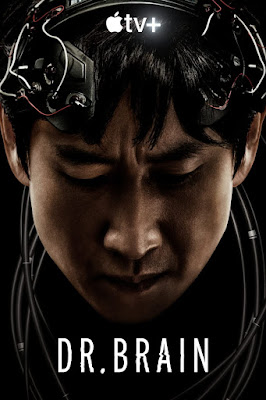
Brain scientists are often a little socially awkward, at least in movies and
TV, but Dr. Koh Se-won takes the brain biscuit. He can literally get inside
peoples’ heads, but it is almost impossible for him to open up to anyone, not
even his wife and son. However, when they are taken from him prematurely, he
just so happens to have technology to help him get answers, from other people’s
memories. Of course, as with any great innovation, his revolutionary process comes
with unforeseen side effects and complications in Kim Jee-woon’s six-episode Dr.
Brain, adapted from Hong Jac-ga’s web-comic, which is now streaming on
Apple TV+.
The
exact circumstances are not spelled out, but Koh was born with a different brain
structure that contributed to his intellectual brilliance, but also put him somewhere
on the spectrum. Despite his impassive emotional reserve, he marries Jae-yi and
they have a son, Do-yoon, who is very much like his father. Unfortunately,
Do-yoon was killed in a freak accident, from which Jae-yi never recovered—except
maybe he didn’t. Suddenly, Dr. Koh has reason to wonder.
Using
his handing-dandy brain-synching apparatus, Koh is able to transfer memories
from recently dead brains into his own. It is a process he is still refining. It
turns out he also inadvertently synchs many of their skills and instincts.
However, the process is dangerously erratic when attempted with a living brain.
Instead of true memories, Dr. Koh is flooded with images from their
subconscious. Regardless, each time he synchs, his brain absorbs another huge
download. If it were not for his atypical brain structure, he probably could
not handle it.
Dr.
Brain
follows in the tradition of psyche-plumbing thrillers like Spellbound,
Battle of Memories, and Dreamscape, where the subconscious is an equally
important setting for the drama to play out as the offices and homes of its
primary characters. It definitely plays to the strength of genre auteur Kim (Age of Shadows and I Saw the Devil), who brings a bit of a horror sensibility
to first installment (a la Flatliners), before setting into psychological-thriller
bag for the following five episodes. There are some devilishly inventive developments,
including a brain-synch with a cat. Yet, Kim always keeps the conspiracy-driven
tension and suspense cranked up high.
Lee
Sun-kyun (the “have” father in Parasite) does the nearly impossible. He scrupulously
maintains Koh’s emotional frozen nature, while making us care about his plight.
Lee also believably portrays the changes that come over the scientist as he continues
to transfer other people’s memories and feelings into his brain-basket. It is a
real challenge, but he totally pulls it off.
Yet,
the fan favorite of Dr. Brain is sure to be Park Hee-soon, who is
wonderfully sly and grizzled as private investigator Lee Kang-mu. He and Koh
come to collaborate together in an inventive way that would be spoilery to reveal.
Regardless, whenever he comes on-screen, everything kicks up several notches.
Seo Ji-hye does not get much backstory or character development as the cop
investigating the bodies that start to pile up, but she is appealingly
no-nonsense and quite credible in her action scenes.