Wednesday, October 06, 2021

Creepshow: The Last Tsuburaya & Okay, I’ll Bite


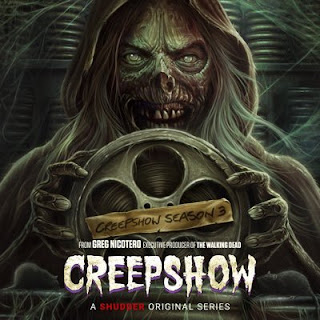
Generally speaking, adherence to a good Protestant work ethic will go a long way’s towards keeping you out of a horror anthology. On the other hand, the idle rich and lowlife thugs are tailor-made for uncanny comeuppance. That is certainly true of the extravagant wastrel and violent prison inmates appearing in this week’s episode of Creepshow, which premieres tomorrow on Shudder.

In “The Last Tsuburaya” (directed by Jeffrey F. January and written by Paul Dini & Stephen Langford), Wade Cruise gives conspicuous consumption a bad name. The fabled last painting of Tsuburaya, a notorious Japanese painter of the macabre, has just been discovered and Cruise is determined to have it all for himself. However, his unwise stewardship will come back to haunt him, somewhat literally.

This week’s opener is vintage
Creepshow, with a snappy visual style that truly represents the spirit of old school horror comics. The Tsuburaya paintings and the monster design work are also both really cool looking. As Cruise, Brandon Quinn chews the scenery like nobody’s business, while Gia Hiraizumi and Jade Fernandez provide engaging art world counterpoints as Dr. Mai Sato, his rival, and artist “Geesa,” his increasingly disenchanted lover. Genre fans might have a general idea of where it is all headed, but there are still a few zigs and zags that heighten the enjoyment.

Similarly, “Okay, I’ll Bite” (directed by John Harrison, who also adapted his short story) hews closely to the EC Comics template that inspired the franchise, but it is not as stylish or slyly subversive. On the other hand, it has spiders—lots of them. After Elmer Strick, a fundamentally decent pharmacist was convicted of his age-addled mother’s mercy killing, his only friends in prison are the spiders he shares his cell with. Unfortunately, the corrupt guard who forces him to cook up meth is out to get both Strick and his eight-legged companions. Of course, in horror anthologies, it is always a bad idea to bet against anything that creeps and crawls.

Nick Massouh is quite good as Strick, but obviously the spiders are the reason to watch “Bite.” Still, the tone is rather downbeat, so this segment is not nearly as fun as the one that came before it.

Nevertheless, the combination of ghoulish art and angry spiders makes this week’s episode a solid outing for the series. In fact, “Last Tsuburaya” is definitely a season highlight. Highly recommended for fans of the franchise
and the horror anthology format, the latest episode of Creepshow starts streaming tomorrow (10/7) on Shudder.


V/H/S/94, on Shudder

Never take collectors lightly, because they know how to get what they want. That is especially true of old school VHS collectors. Indeed, the framing device truly puts the “cult” in cult film fanatics when the V/H/S franchise returns with V/H/S/94, which premieres today on Shudder.

In Jennifer Reeder’s wrap-arounds, “Holy Hell,” a SWAT team thinks they are executing a search warrant on a drug den, but the industrial warehouse actually houses what appears to be the video-head equivalent of the Heaven’s Gate cult. There are lots of dead bodies seated in front of video monitors, where naturally, we will watch the constituent stories unfold.

Chloe Okuno’s “Storm Drain” consists of the footage shot by Holly Marciano, a local Ohio TV reporter, and her cameraman, when they ventured down into the titular sewer in search of a weird rat creature. It is pretty straightforward, but nicely executed and it ends on an amusing kicker. Also, Anna Hopkins probably delivers the film’s most memorable performance as the shallow, soon-to-be freaked out Marciano.

Arguably, Simon Barrett’s “The Empty Wake” is the most effective and economical installment, in which, per a grieving family’s odd request, a mortuary worker must record an overnight wake, even though nobody comes to mourn—almost no one. It really is creepy, because it is so grounded in the lonely, late-night setting.

If you have the opportunity to see
V/H/S/94 on a big-screen with audience, “The Subject” (directed by Timo Tjahjanto, one half of the Mo Brothers), might turn out to be the highlight instead, because it is so deliriously gory and unhinged. In this case an Indonesian SWAT (this is not a great film to elite squad cop in) raid a mad scientist’s lair in search of a kidnapped woman. What they find is a bit disturbing. Tjahjanto does his thing, but it plays better in a group. On your own, you might notice the thinness of the story, but the over-the-top splatter effects do their best to compensate.

Tuesday, October 05, 2021

Playing Frisbee in North Korea

One of the pleasures of traveling is the experience of exploring new cities and countries on your own and maybe even getting a little lost. That opportunity is not available in North Korea. Those who participate in state-run tours have to get on the bus and stay on the damn bus. Taking pictures out the windows is not an option either. As a result, filmmaker Savanna Washington was strictly limited in what she could film, even surreptitiously, but at least she was always aware her minders were minding her (and telling the regime’s propaganda lies) during the trip she documents in Playing Frisbee in North Korea, which releases today on DVD.

Washington understood she might be one of the first African Americans many of the North Korean locals had ever seen. Unfortunately, she would have relatively few chances to meet them, outside of scripted tour events. The minder/guides kept a tight rein on her group, while average North Koreans were too busy with the constant struggle of simply staying alive.

It is unclear what the other “tourists” were expecting from their DPRK experience, since they are only briefly seen in the margins of Washington’s field of vision. However, she states they were all eventually exhausted by the minders’ tight control. To her credit, Washington intersperses her tour footage with expert commentary and the testimony of defectors. They clearly establish the magnitude of the famines and the severity of the Yodok prison/concentration camps. They also conclusively dispel any misplaced faith in the standards of “free” medical care offered by Communist regimes. However, several talking heads also advocate for continued and increased humanitarian food aid, due to the dire living conditions endured by average North Korean.

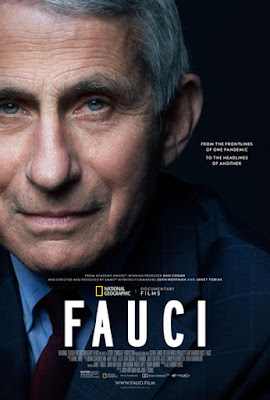
Fauci: The Commercial

It has all the stirring music, flattering lighting, and cherry-picked soundbites from strawman critics you would find in the sort of promotional videos they show during political party conventions. That prompts the question: what office is Dr. Fauci running for? Whatever it is, clearly filmmakers John Hoffman & Janet Tobias are eager to vote for him, based on their hagiographic treatment throughout Fauci, which hits Disney+ tomorrow.

Fauci has had an impressive career at the National Institutes of Health, serving since 1968. The film mainly focuses on his work combating AIDS and COVID, but also briefly touches on his efforts during the Ebola scare. However, in light of the current pandemic, it would have been interesting to hear more about his responses to SARS, Swine Flu, and MERS, because they are more closely related to COVID. Rather clumsily, the film tries to draw parallels between AIDS in the 1980s and COVID today, but whereas Fauci made a concerted efforts to de-stigmatize patients of the latter, his admirers seem to be doing their best to de-humanize the latter, at least if they are unvaccinated.

Frankly, the best segments of the film chronicle his involvement in Pres. George W. Bush’s landmark emergency AIDS relief for Africa (PEPFAR), which literally saved millions of lives. In contrast, the coverage of COVID is considerably problematic. Hoffman & Tobias allot zero time to his critics, aside from a few snippets from blowhards on talk radio, transparently selected to discredit anyone who would dare criticize their subject. Two words that are also conspicuously absent would be “gain” and “function.”

The truth is we can admire Fauci and still be critical of some of his decisions. We feel the same way about the late Sec. Donald Rumsfeld. Now imagine a Rummy doc that allowed his critics no say, only presented his finest career moments, and released in theaters days after the revelations of the Abu Ghraib abuses. Perhaps “film twitter” might have a problem with such a theoretical, but
Fauci is not appreciably different.

Monday, October 04, 2021

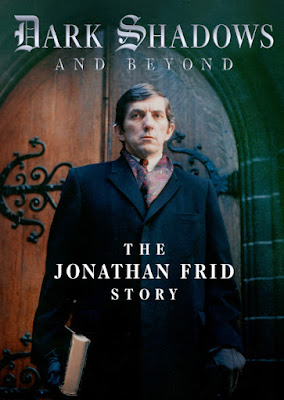
Dark Shadows and Beyond: The Jonathan Frid Story

It debuted the same year as Star Trek, but for a lot of 1960s kids, this show was their first experience of cult TV fandom. The vampire was a major reason why. In many ways, the classically trained actor was an unlikely teen idol, but he was the first brooding TV vampire, predating Angel and True Blood by decades. The fanbase is still out there and growing, so there should be plenty of interest in Dark Shadows and Beyond: The Jonathan Frid Story, directed by Mary O’Leary, his friend and co-producer of his one-man shows, which releases tomorrow on DVD and VOD.

Dan Curtis’s
Dark Shadows was on the brink of cancelation when he introduced a vampire storyline, mostly as a personal lark. Much to everyone’s surprise, Barnabas Collins caught on big, turning the struggling show into a hit and making Frid an overnight celebrity. It took him a while to get used to the run-and-gun production methods of a daily soap opera, but he was always popular with his co-stars. It also took him a while to adjust to his new fame, but there was no question he was the focus of fans’ attention.

Frankly,
Dark Shadows didn’t last so long during its initial run, but unlike just about every other soap opera, it enjoyed subsequent lives in syndicated reruns and through healthy multi-million copy sales of its DVD collections. Post-cancelation, Frid appeared in two horror movies (including Oliver Stone’s first film, Seizure), but he was unhappy with his agency, so struck out on his own, largely concentrating on the stage.

If you look at Frid’s IMDb page, there is not much aside from
Dark Shadows, but he constantly appeared in regional theaters. He also had a pretty big hit leading an all-star tour of Arsenic & Old Lace (co-starring WKRP’s Gary Sandy). (Actually, I remember enjoying the show as a kid, but I didn’t appreciate who Frid was at the time. We can only hope some long lost tape of the production eventually turns up.)

That sort of leads into what really makes this doc valuable for fans. Unless, you saw him perform readings at
Dark Shadows conventions, he sort of disappeared. On the other hand, he largely did things his way. In a way, it is both good and bad that we can’t watch him doing guest shots on Murder She Wrote and the like, because what we have of him on film is pretty high quality.

Sunday, October 03, 2021

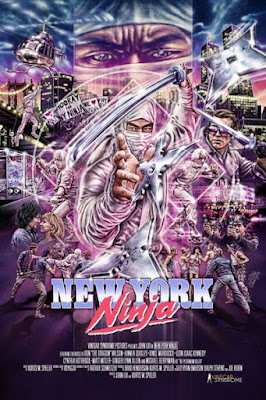
New York Ninja: The Return of John Liu

When Taiwanese-born martial arts star John Liu started filming his first American production, it captured the violent grittiness of early 1980s New York. It was roughly thirty-seven years before that film finally screened for audiences, but ironically, it currently feels just as representative of the lawless city, as it did then. We need his masked martial arts avenger now, more than ever. Fortunately, the new rights-holders at Vinnegar Syndrome restored and re-edited the unseen footage, recording an entirely new audio track. It might not exactly match Liu’s original vision, but he still cleans up the big apple in the re-conceived New York Ninja, now credited to directors Liu and Kurtis Spieler, which had its world premiere at this year’s Beyond Fest.

No scripts or records of any kind survived after the production was halted, apparently due to conflicts with the production company. All that was left was a pallet of film cans. However, what Spieler and his associates saw in there still had value to cult film fans, especially Liu’s signature high kicks and the street-level scenes of New York, in which viewers can often see the World Trade Center as Liu’s characters practices his moves along the waterfront.

The story, as re-written and re-edited by Speiler, follows John, a mild-mannered news crew sound tech, who happens to be highly skilled in the martial arts. Tragically, his pregnant wife is murdered by a gang of human traffickers when she witnesses the abduction of their latest victim. Enraged by his grief, John dons the white garb of a good ninja to do the dirty work the cops just won’t do. Soon, he breaks up enough of their kidnappings attempts to get the attention of the gang’s radiation-mutated boss, now known as the Plutonium Killer.

The acting and production values of
NY Ninja are not that different from what can be seen in Y.K. Kim’s The Miami Connection, but Liu’s high-kicking skills are still impressive. It is also cool to watch time-capsule-like footage of New York, including pre-Giuliani Times Square (where we see Ninja III: The Domination is playing—one of the hit Cannon Ninja films NY Ninja was clearly trying to cash-in on). If you check out NY Ninja for the right reasons, you should have fun, but if you are looking for sensitive drama and finely turned performances than maybe not so much.

Shrewdly, Spieler recruited a who’s who of genre favorites for the voice ensemble, starting with Don “The Dragon” Wilson, perfectly cast as John. Likewise, his old pal Cynthia Rothrock fittingly gives voice to the martial arts proficient cop, who gets kidnapped by the traffickers. For 1980s action fans, it is a real treat to hear
Penitentiary’s Leon Isaac Kennedy dubbing her detective colleague, who has been investigating the abductions (his last prior credit goes back a ways). Michael Berryman nicely suits the weirdness of the Plutonium Killer, while Linnea Quigley is so good as TV reporter Randi Rydell, the original actress, Adrienne Meltzer (one of the few identified cast-members) thought her audio had survived.

Indeed, Meltzer proves to be a good sport in the interview segments she recorded for Michael Gingold’s
Re-Enter the New York Ninja, the behind-the-scenes re-making-of featurette that screened with Ninja at Beyond Fest and will be incorporated in the film’s eventual physical release. Gingold’s experts provide a lot of useful background and context on Liu’s career. At the time, he really was a Kung Fu connoisseur’s favorite, so Ninja might have found a small but appreciative audience had it been released at the time. Instead, Liu went completely off the grid and his film was entirely forgotten, until now. It is a shame, because it obviously had a deranged spirit that plays well around midnight.

It might have been a crazy low-budget operation, but a lot of effort still went into
New York Ninja, so it is nice to see it finally get some attention. Despite its limitations, NY Ninja is far superior to Miami Connection and Liu himself is probably due for a resurgence of genre fan interest. At the very least, the film scratches your 1980s action nostalgia itch. Recommended for what it is (and what it might have been), New York Ninja has risen from movie purgatory, following its world premiere last night at Beyond Fest.

Saturday, October 02, 2021

The Laws of the Universe: The Age of Elohim

Religious parables used to share a thematic affinity with the fantasy genre, with all the swords and sandals. Increasingly, they are shifting to science fiction—and it isn’t just Battlefield Earth. The controversial Japanese religious fusion movement Happy Science has become a regular producer of anime features. The Mystical Laws happened to be a pretty entertaining sf-geopolitical-conspiracy thriller, but the conflict plays out on a more galactic scale in director-chief animator Isamu Imakake’s The Laws of the Universe: The Age of Elohim, which screens tomorrow at the Laemmle NoHo 7 (and opens October 22 in New York).

This is Earth, but you wouldn’t recognize the place 150 million years ago. Elohim, the God of Earth (formerly known as Alpha) benevolently rules over the planet, which offers sanctuary and the potential for reincarnation to all races of the universe. The Dark Side of the Universe does not appreciate such values, so the malevolent titan Dahar manipulates Evol, the ape-like military leader of Centaurus Beta into waging war on our planet.

Yaizel, the champion of planet Vega is dispatched to rally Earth’s defenses, just in the nick of time. As the forces of evil (and Evol) mass for an invasion, Sagittarius also sends reinforcements to Earth in the form of seven archangels, including Amor (who looks a heck of a lot like J.C.), Michael, and his brother Lucifer, who does indeed seem to be rather arrogant.

Frankly, it was hard to tell what
Mystical Laws was proselytizing, which is why it was so watchable. In contrast, it is easy to pick out the precepts and principles in Age of Elohim (how could you not?). The narrative, written by Sayaka Okawa, but based on the ideas of Happy Science founder Ryuho Okawa, is not exactly an origin story, but it is definitely an explain-how-things-came-to-pass parable. However, the animation looks first-class and there is still a lot of action.

Friday, October 01, 2021

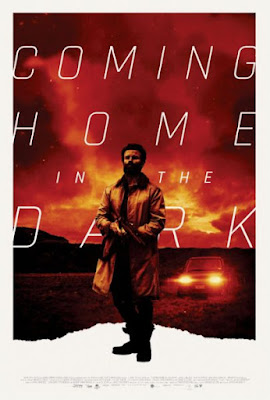
Coming Home in the Dark

It is the land where they shot The Lord of the Rings, but this ultra-violent NZ film will make you think twice about visiting as a tourist. “Hoagie” Hoaganraad thought he would take his family on a nice driving tour, but instead he finds himself in a grim abduction drama that agonizingly unfolds during James Ashcroft’s Coming Home in the Dark, which opens today in New York.

Alan’s step-kids can tell from a distance the two ominous drifters will be trouble, but the talkative Mandrake and Tubs, his socially-stunted companion, are even worse than they can imagine. They do not merely rob the family, they start inflicting real, lasting pain. “Hoagie” tries to be cooperative, but it soon becomes clear they are not to be reasoned with. Thus begins a desperate struggle to survive.

However, the psychopaths are especially motivated, because they seem to recognize Hoaganraad—and they carry a grudge against him, for some mysterious sin from the past. Even though only about nine years separate the actors portraying Hoaganraad and Mandrake, it looks more like a gap of fifteen or twenty, so we can easily guess their grudge. Instead of shocking, it is all quite predictable and frankly rather boring. That also means the audience is essentially left with only his wife Jill to root for and identify with.

The relentlessly depressing violence Ashcroft and co-screenwriter Eli Kent constantly serve up will remind horror fans of the grisly Australian grindhouse film,
Killing Ground, but at least Coming Home also incorporates some effective cat-and-mouse business for Hoaganraad and Mandrake. Nevertheless, the film is still much more focused on shock than suspense.

Thursday, September 30, 2021

The Haunted Museum, on Discovery+


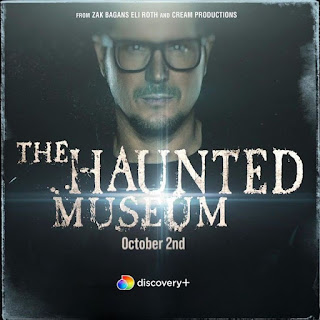
Instead of based on a true story,” these anthology tales are based on a “true” object. Each episode takes its inspiration from exhibits collected in the spooky Las Vegas museum curated by Discovery Channels’ resident paranormal investigator, Zak Bagans. He doesn’t claim the stories really happened, but they are consistent with the artifacts’ purported powers. For horror fans, the museum collection has a vibe similar to Friday the 13th: the Series and the Warrens’ occult collection in The Conjuring franchise. The concept still works pretty well in Discovery+’s rare foray into scripted drama, The Haunted Museum, produced by Bagans and Eli Roth, which premieres this Saturday.

Naturally, Bagans introduces each episode and provides some colorful background on the evil item viewers are about to witness in action. The dramas that follow have the sort of low-fi look that we have come to expect from reality show re-enactments, but they are definitely self-contained stories in their own right (at least this is very definitely true of the first three episodes provided to reviewers). In some cases, the grungy look actually serves the stories well.

Frankly, the series premiere, “Doll House of the Damned,” might even be scarier if viewers have not already seen
Creepshow’s thematically similar (and even creepier) “The House of the Head.” Nevertheless, screenwriter-director Justin Harding pulls off some clever sequences and the satanic imagery the grieving father finds in the titular doll house he unwisely purchases will definitely raise the hair on the back of your neck. However, the tone of this excursion into family madness and terror is more than a bit depressing.

The back-to-back premiere night also includes “Monster in the Machine” (directed by Ethan Evans and written by Evans and Jesse Bartlett), which is probably the best of the series, so far. It follows Esther Levin, a somewhat discredited academic, who has devised a series of machines (now in Bagans’ museum, of course) that can contact spirts from other dimensions. Initially, she believes she has reached a guardian angel, but when its voice falls silent, she starts to suspect she also contacted something much more sinister.

There is a bit of a Lovecraftian dimension to “Machine,” but it is more grounded and ultimately more disturbing. Evans masterfully controls the mood, milking tension from eerie settings, weird noises, and images half-seen out the corner of viewers’ eyes. Lawrene Denkers is also terrific as the brilliant but tragically flowed Levin.

Blush (short), on Apple TV+

In 1942, science fiction author Jack Williamson coined the term “terraforming” in his short story “Collision Orbit.” He never thought the process could be so easy for a space-faring horticulturalist like this young chap. The unnamed astronaut just needed the help of a pretty alien woman in Joe Mateo’s animated short Blush, which starts streaming tomorrow on Apple TV+.

Clearly, the astronaut’s defense system did not provide enough advance warning against asteroid collisions. As a result, he is stuck on a dwarf planet just marginally larger than the Little Prince’s, but it lacks handy features like an atmosphere or vegetation—until the alien girl also makes a sudden crash landing.

She looks very human, aside from a very flat nose. She also seems to magically supply oxygen and spurs the horticulturalist’s plants to take root and blossom on the formerly desolate rock. Soon, the planetoid is an oasis and the former travelers are happily in love. Naturally, they start a family, but eventually we see signs that the usual cycle of life must continue, even in paradise.

Arguably,
Blush is a more poignant and thoughtful depiction of humanity hitting the reset button than Apple’s Foundation. Although it holds great symbolic weight, it also represents a personal labor of love for Mateo, who was inspired by the passing of his own wife. It is accessible, but not dumbed-down. In fact, the absence of dialogue quite distinguishes it from the noisy pack (yet kids shouldn’t have any trouble with it, just like they could deal with Shaun the Sheep).

Wednesday, September 29, 2021

Cleanin’ Up the Town: Remembering Ghostbusters [Extended]

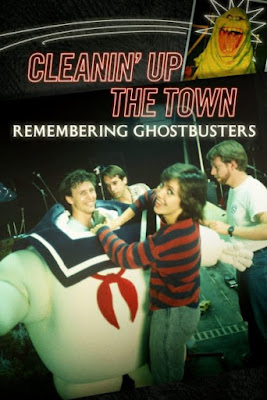
There are good reasons nobody has managed to recapture the magic of the original Ghostbusters. Bill Murray, Dan Aykroyd, and Harold Ramis were riffing at the top of their games, Koch-era New York was still gritty, but not too Dinkins-gritty, and the villain was an EPA regulator. Unfortunately, the studio tried anyway, but the woeful reboot is mercifully ignored and the so-so sequel is only mentioned in passing during the new extended cut of Anthony Bueno’s Cleanin’ Up the Town: Remembering the Ghostbusters, which opens this Friday in theaters.

Ghostbusters
is a prime example of why the 1980s were such a great decade for movies. In some ways, it was an unassuming buddy film, yet Ghostbusters broke new ground in its use of special effects in service of comedy and became one of the greatest box-office hits of all-time. Bueno talks to just about everyone involved in the making, except Bill Murray, but that is to be expected, given his rep for media-shy eccentricity.

Aykroyd and director Ivan Reitman trace the film’s origins, starting with Aykroyd’s initial off-the-wall, futuristic treatment that sounds almost like a ghost-busting version of
Starship Troopers. Eventually, Ramis sat down with Aykroyd to script out something more contemporary and grounded. Their writing flowed nicely, not that the stars always kept to the printed page. To Reitman’s credit, he also directly addresses the scaled-down role of fourth Ghostbuster Winston Zeddmore (probably the great Ghostbusters controversy), about which actor (and fan favorite) Ernie Hudson maintains a philosophical tone.

When watching
Cleanin’ you realize it is unlikely future filmmakers could make equivalent documentaries about the big superhero tentpoles of our current day. Whereas Bueno’s film is chocked full of clever work-arounds devised by the special effects team, contemporary CGI films would just have SFX artists on laptops and actors wearing motion capture suits. In contrast, an awful lot of the effects on Ghostbusters were practical—and they had to render them relatively cheaply and with a much faster turnaround time than was previously standard practice.

Tuesday, September 28, 2021

Creepshow: Skeletons in the Closet & Familiar


Horror fans are a lot like serial killers. They both like to collect. However, you want to be sure you’re not the one being collected. Viewers can see the dark side of the collecting impulse in the latest episode of showrunner Greg Nicotero’s Creepshow, which premieres Thursday on Shudder.

In “Skeletons in the Closet” (written by John Esposito and directed by Nicotero), Lampini’s late father was an avid horror movie prop collector, so he has turned the family collection into a museum on the Hollywood Strip. Just when he is poised to make a splash with an exhibit of actual human skeletons that appeared in classic films (this is a very real phenomenon that happens more often than you would think), his father’s old nemesis “Bateman” (sort of like “Newman!” in
Seinfeld) arrives to ask awkward questions of providence. However, that might turn out to be a mistake, given Lampini has an excuse to have a bunch of skeletons lying around.

“Skeletons” is another wonderful loving, yet drolly macabre love letter to horror fandom. Nicotero and Esposito incorporate some very funny visual homages to iconic films, such as
Psycho, The Shining, and Jason and the Argonauts. The latter is especially deranged, but somehow it makes perfect sense within the narrative. The great James Remar is terrific as the sleazy Bateman and Valerie Leblanc vamps it up entertainingly (and lives up to the pressure of a Hitchcock-inspired shower scene) as Lampini’s girlfriend, Danielle. Frankly, this is the sort ironic, fan-appreciating story Creepshow does best, along with segments like “Night of the Living Late Show” and “Public Television of the Dead.”

The vibe is more serious (at least by
Creepshow standards) throughout “Familiar” (written by Josh Malerman and directed by Joe Lynch), but it is still rather amusing to watch a yuppy lawyers and hipster artist deal with an uncanny stalker. Fortuitously, Jackson’s wife Fawn just happened to drag him in for a reading from Boone the psychic, as a lark, soon after a demonic familiar latched onto him. Boone has advice for dealing with the supernatural parasite—and conveniently, he accepts all major credit cards—but the correct execution will be a tricky matter.

Monday, September 27, 2021

Blithe Spirit, Remade Again

Everyone loves a good haunted marriage, especially when the living spouse has subsequently remarried, like in Dona Flor and Her Two Husbands, the highest grossing Brazilian film for decades (spawning the American remake, Kiss Me Goodbye). Noel Coward got there first, scoring a West End hit that became a classic David Lean film, before morphing into the moderately successful Broadway musical, High Spirits. Nobody sings “You’d Better Love Me” or any of those forgotten Broadway tunes, but the is plenty of old-fashioned farce in Edward Hall’s remake of Blithe Spirit, which releases tomorrow on DVD.

Charles Condomine is a slightly Bertie Wooster-ish mystery novelist, who still misses his late wife Elvira, even though he remarried the well-heeled Ruth, whose producer father is impatiently awaiting Condomine’s first screenplay. We soon learn he has not written a word since Elvira died, because she came up with all the best parts of his novels, like the plots, characters, and dialogue.

Condomine hatches an idea to break his writer’s block by hiring the discredited psychic Madame Arcati to conduct a séance in his home. It works better than he ever could have hoped when she inadvertently summons the spirit of the first Ms. Condomine, who is highly jealous of the second—so much so, she might take matters into her own spectral hands.

This
Blithe Spirit does not exactly reflect Coward’s dry-martini wit, but it is a lightweight puff of door-slamming slapstick. A writer like Sir Julian Fellowes might have better channeled Coward’s urbane sophistication, but at least screenwriters Nick Moorcraft, Meg Leonard, and Piers Ashworth (there are three of them to adapt one play) capture the boozy upper-crust vibe.

Sunday, September 26, 2021

Fantastic Fest ’21: The Sadness

These zombies are fast and angry. You might also call them bad touchers. It turns out the same virus over-stimulating the infecteds’ aggression centers has a similar effect on their sex drives. That means anyone they get their hands on is in for some rather nasty treatment in director-screenwriter Rob Jabbaz’s brutal zombie movie The Sadness, which screens during this year’s Fantastic Fest.

Jim a is a nice enough Taiwanese freelancer, who is trying not to screw-up his relationship with Kat—and he was probably failing. However, all bets are off this fateful day. After dropping her off the train station, a zombie apocalypse breaks out, both on the streets he must navigate and the subway car she is stuck on.

Apparently, the zombie outbreak is the result of the new Alvin virus mutating in unexpected ways. Those who are afflicted do not completely lose their consciousness. It just brings out the absolute worst in people, especially their grudges and sadistic tendencies. As a result, the pervy commuter zombie is just as eager to find Kat again as Jim is.

Jabbaz’s screenplay is a pretty standard zombie outbreak narrative—zombies suddenly attack and society reacts in confusion. What distinguishes it are the deranged extremes Jabbaz takes it to. Seriously, this film could never appear on network television, because there would be nothing left to broadcast. These are probably the most violent zombies in the history of zombie movies, but what makes them disturbing is how they reflect the former humans’ darkest impulses.

Saturday, September 25, 2021

Feng Xiaogang at Asia Society: If You Are the One

It was a 2008 blockbuster that helped herald the rise of Mainland China’s homegrown tent-poles, but being at the top of the domestic box-office was already a familiar place for Feng Xiaogang. After trying his hand at jingoistic spectacle, he returned to the sentimental melodrama that had been his bread and butter (yet his boldest work was still ahead of him). Millions of Chinese movie fans have seen it, but it feels a little dated thirteen years later and not just because of the flip phones. Nevertheless, it is easy to understand why Ge You would be so interested in Shu Qi when they meet on a blind date in Feng’s If You Are the One, which screens online for free this weekend, as part of the Asia Society’s Feng retrospective.

Qin Fen is a middle-aged rogue who never amounted to much, until he sold a gimmicky invention to venture capitalist with more money than sense. Now ready to settle down, he places a personal add, because that sort of thing had not completely gone online yet. He has many blind dates that are uncomfortable in uniquely shticky ways, but his meeting with flight attendant Xiaxiao “Smiley” Liang takes the cake.

First of all, she is obviously way out of his league. She also seems to radiate a sense of sadness. Qin quickly decides they have no future and she agrees, but both reveal much of themselves over the course of their boozy “what the heck” conversation. In fact,
IYATO might have been considered a masterpiece if it had ended after his riveting confession, around the half-hour mark.

Instead, fate brings them together again and again after that. Eventually, Liang even pretends she is serious about a relationship and marriage, even though he knows she still pines for her caddish married lover. They share a connection, but if it isn’t love, can it still be enough?

With Xi currently engaged in a weird crackdown on celebrity culture and the Chinese film industry, it is suddenly amusing to watch films from not so long ago to pick out the things that might be troublesome now. We wish no ill on her, but we have to wonder how long Taiwanese thesps like Shu Qi can continue to star in Mainland at the level they did during the pre-Xi Jinping era.

Feng also satirizes China’s go-go deal-making mentality in a way that maybe isn’t so funny in the wake of the Evergrande meltdown. Unfortunately, some of the film’s best parts could now be at risk, including Qin Fen’s great early monologue, which speaks directly about lack of legal and practical equality for women in China. He also has a notable scene with Vivian Hsu, portraying a Taiwanese blind-date, with whom he discusses his gratitude for the assistance Taiwan offered during the Shenzhen earthquake.

Friday, September 24, 2021

Foundation, on Apple TV+

Individuals have free will, so they can’t be predicted. However, the course of societies and civilizations can be projected with astonishing mathematical accuracy. Such is the contention of mathematician Hari Seldon, who pioneered the study and application of Psychohistory in Isaac Asimov’s Foundation novels. Seldon calculates the Galactic Empire will fall in roughly 500 years, but that is not a message the authorities want to hear. However, his followers believe they can drastically shorten the coming dark age if they implement his grand plan in showrunner David S. Goyer’s first season of Foundation, which premieres today on Apple TV+.

Young genius Gaal Dornick journeys from a backwater planet to the seat of the Empire on Trantor, at the invitation of the great Hari Seldon, unaware of his status as a dissident pariah (she was a man in the book, but whatever). Much to her surprise, Dornick is soon arrested along with Seldon, but the Imperial inquisition will offer him a deal, just like he expected. The Psychohistorians will be allowed to assemble their great encyclopedia of human knowledge, but they must do so in exile, on the most remote planet of the known universe: Terminus.

This tracks pretty closely with “The Psychohistorians,” the first part of the original
Foundation novel (you can hear William Shatner’s LP reading here), but as soon as the Foundation settlers leave on their journey, Goyer and co-writer Josh Freidman drastically depart from Asimov. In fact, it often feels like they were trying to adapt Dune instead, even though they lacked the rights.

Much of Apple’s
Foundation is devoted to the courtly intrigue surrounding the genetic clones of Emperor Cleon the 1st. The Foundation books only had two Cleons (appearing in the prequels) and the first was no great shakes, but in this re-envisioning, the Empire is up to its 13th Cleon, known as “Brother Day” who shares the throne with “Brother Dusk,” an older clone who can offer the wisdom of his experience, and “Brother Dawn,” a younger clone that will be groomed to succeed him. (These characters are original to the series, but the succession of clones over centuries is sort of reminiscent of the Duncan Idaho clones in God Emperor of Dune.)

Eventually, Brother Day will be drawn into an intrigue involving a powerful religious order that somewhat resembles the Bene Gesserit (without the overt powers). As they rule over Trantor, the Genetic Emperor[s] will have the wise counsel of Demerzel, who survived an ancient war against robots (sort of like
Dune’s Butlerian Jihad). Meanwhile, Salvor Hardin (also gender-switched) oversees the security of Terminus. It is a role she is uniquely suited to, since she is largely immune to the disorienting field that surrounds the mysterious “the Vault,” a “big dumb object,” in the science fiction tradition of 2001’s obelisk that never registered on any of their planetary surveys.

Thursday, September 23, 2021

Chernobyl 1986: The Abyss

Ironically, the heroes of this big Russian patriotic tearjerker are Ukrainian. That is what you call people who were born in Ukraine and subsequently lived there. Of course, at the time of the Chernobyl nuclear disaster, Ukraine was part of the Soviet Union, but not by choice. Regardless, a Ukrainian fireman saves the USSR from utter and complete catastrophe in Danila Kozlovsky’s Chernobyl 1986 (a.k.a. Chernobyl: Abyss), which opens tomorrow in New York.

Played by the director himself, Alexey Karpushin was a hot-shot Tom Cruise-ish fire-fighter, who just resigned from Pripyat fire department, so you know what that means. He hoped to finally figure out his relationship with local hairdresser Olga Savostina and the son he only recently learned he had. Instead, he rushes to extinguish the fires at Chernobyl reactor #4, in what turns out to be a doomed effort.

Unfortunately, the little Savostina ragamuffin was passing by the plant just when the initial explosions happened, so he received a dangerous dose of radiation. Karpushin tries to be there for the family that is not ready to acknowledge him, but he soon decides the best thing he can do is leverage his expertise to secure a place for his son in the special charter to Switzerland, for advanced radiation treatment. Wait a minute, the USSR sent priority patients to Switzerland instead of their close ally, the medical Mecca of Cuba? Surely, that can’t be right?

Kozlovsky’s
1986 absolutely pales in comparison to HBO’s gripping Chernobyl miniseries, in which writer-creator Craig Mazin masterfully documented every corrupt and incompetent step that led to the disaster and the iffy response, as well as the subsequent cover-up. In this case, co-screenwriters Elena Ivanova and Aleksey Kazakov call out some of the Party malfeasance (because how could they not?), but ignore the Soviets’ systemic efforts to obscure the truth.

Instead, we get plenty of the torturous (to watch) Karpushin-Savostina romance. It takes a full half-hour before disaster finally strikes, which is way too long in a disaster movie. Kozlovsky and Oksana Akinshina are both big-name Russian romantic leads, but they share less sexual chemistry than Trump and AOC (who are obviously both turned on by raw power). By the way, according to wiki, Akinshina referred to feminism as “the destiny of ugly women,” so it sounds like she got the memo from Russia’s boss of bosses.

Wednesday, September 22, 2021

Apache Junction

This crummy Arizona town is a safe harbor for outlaw and cavalry alike. However, the townsfolk have more to fear from those who represent the law than those who live outside it. It is all quite eye-opening for a proper aspiring journalist like Annabellle Angel, who finds herself sympathizing more with the prostitutes than the soldiers. That also means she will side with the somewhat notorious outlaw Jericho Ford in Justin Lee’s Apache Junction, which opens Friday in New York.

When a major San Francisco paper asked for volunteers to cover Apache Junction, Angel was the only one to raise her hand. She knows she is out of her depth, but it is the only way to get her foot in the door. Captain Hensley is openly dismissive of her, but his thuggish men are even worse. Fortunately for her, Ford just happened along at the right time, but leaving three of Hensley’s men dead in his wake ignites a war.

Again, it is just weird to see the bad guys wearing the Union Army uniform in a contemporary western, since they are the ones who beat the Confederates in the Civil War. In this case, Hensley’s men are really, really bad, but Oslo Pike, the scummy gambler-bounty hunter Hensley aligns with, is even worse.

Frankly, the whole idea of Apache Junction functioning as open city doesn’t make much sense and it is really tough to believe Hensley would respect it. However, the premise gives Thomas Jane a few interesting scenes as saloon-keeper Al Longfellow, who serves as the de facto mayor. He is fun to watch chewing the scenery, in a grizzled, drawling kind of way. Also, Danielle Gross is way better than the film deserves portraying Mary Primm, the you-know-what with a heart of gold.

Tuesday, September 21, 2021

Godspeed, Los Polacos

Pope John Paul II inspired his fellow Poles to fight for their freedom, wherever they were. He also probably saved an intrepid band of Polish kayakers, who otherwise might not have survived some of the more distrustful authoritarian regimes of Latin America, had they not been able to drape themselves under his protective mantle. They came for adventure but wound up speaking out in ways they couldn’t have under martial law. Their incredible story is chronicled in Adam Nawrot’s Godspeed, Los Polacos!, which releases today on VOD.

Initially, the kayaking club that came to call itself the “Canoandes” (for canoe and Andes) didn’t know much about white water, but club’s expeditions always gave them an excuse to be out of town during mandatory marches and the like. They were aware and sympathetic to Solidarity, but they recognized the Soviet strategy of projecting strength through athletics gave them an opportunity to exploit. By pitching an expedition to kayak unnavigated Latin American rivers—for the state’s great glory, of course—they managed to obtain highly coveted travel permissions and even some supplies.

rankly, the sleight-of-hand logistics that went into their expedition are an epic tale in themselves (that reveal the Kafkaesque nature of the socialist system). Nevertheless, the kayakers were still wildly unprepared for the waters and elements that greeted them. Yet, after a winter hiatus spent in Casper, Wyoming, they actual got pretty good at handling the wild rapids throughout Central and South America. Then they took on the waters of Peru’s Colca Canyon River, which was then considered the world’s deepest canyon (and still is, depending how you measure). However, the greatest danger they faced came afterward, when they spoke out on behalf of Solidarity and against martial law, which had been declared during their journeys. This did not endear them to violent element that would become the Shining Path terrorists.

Los Polacos
is an amazing story of adventure that is topped by a profile in courage. The hardy five who survived Colca risked even more by organizing demonstrations against the oppressive Communist regime, but they had a greater loyalty to their country and their own personal integrity. To a great extent, Los Polacos has been pitched as an outdoor sports doc, as it indeed is, to an extent. However, their experiences navigating and protesting the corrupt Soviet system are much more dramatic and inspiring—so much so that the film starts to play like a real-life thriller, briskly paced and tightly edited by Nawrot.

Monday, September 20, 2021

Magnolia at MoMA: Ong-Bak

The message of this action film is “don’t lose your head.” Unfortunately, that is what happens to Ting’s village when big city antiquity thieves steal the head of their Buddha statue. Ting learned the ancient Muay Boran discipline, a forerunner of Muay Thai, from the village priest. He has only practiced and sparred, but it turns out he really is a formidable in-real-life fighter when he sets off in search of the missing head in Prachya Pinkaew’s Ong-Bak: The Thai Warrior (Ong-Bak #1), which screens as part of MoMA’s 20th Anniversary celebration of Magnolia Pictures.

The Ong-Bak statue is far from the most imposing in Thailand, but without, the village is sure to suffer ill-fate, so they take up a collection and send Ting on his way. Once in the big city, he looks up his cousin Humlae, the village’s prodigal son. Humlae happens to be a gambling addict, who regularly loses money in the underground fights hosted by the nefarious crime-lord Komluan, whose most profitable business is the illicit trade of traditional Buddhist artifacts.

Right, so you can probably see where this all is headed. The path to recovering the Ong-Bak will definitely run through Komluan’s bare-knuckle matches. There is also one of the most over-the-top tuk tuk chases ever filmed. Of course, the narrative itself is pretty grungy and straightforward: country boy takes on slimy city slickers. However, Panna Rittikrai’s fight choreography and Tony Jaa’s stunt work will still impress the heck out of fans.

Creepshow: Mums & Queen Bee

Tonight's episode addresses two very real-world phenomena that pose serious risks to society. One is extremist militia secessionism. The other is brainless, brain-rotting pop. The latter turns out to be much scarier than the former in the first episode of showrunner Greg Nicotero’s third season of Creepshow, which premieres this Thursday on Shudder.

It might be based on a Joe Hill short story, “Mums,” but the standard comeuppance opener of episode S3E1 (adapted by Nicotero & David J. Schow and directed by Rusty Cundieff) is probably the worst of the entire series. Jack’s mother Bloom once had substance abuse issues, but his father Hank is the dangerous one. Sadly, he uses her history to create a cover story after accidentally killing her, while plotting an act of domestic terrorism. Jack suspects something is wrong, but when he plants the weird seeds she left behind, what sprouts might just lead him to the truth.

Right, we have Bloom, who gets buried and Jack planting seeds. The names are really on the nose in this episode. Everything else is just as paint-by-numbers. Hank’s grisly fate is obviously assured due to his unsavory ideology and Ethan Embry’s performance does nothing to elevate him above a base caricature. That means there is no suspense, since the ending is preordained and there is no humor, presumably because the themes are thought to be so serious. Only Malone Thomas stands out with some nice work as Beth, the conflicted babysitter and co-conspirator, supplying the sole element of complexity. As a result, “Mums” plays out like didactic score-settling, which makes it a chore to watch.

Fortunately, “Queen Bee” (written by Erik Sandoval & Michael Rousselet and directed by Nicotero) is better in every single respect. Trenice and her friends Debra and Carlos each believe they are pop idol Regina’s “number one fan.” Maybe Carlos isn’t so adamant about it, since he can countenance selling pictures of her soon to be delivered baby to the tabloids. Regardless, all three would be delighted to be present when she gives birth, so when Debra’s nurse mother lets slip Regina’s entourage has taken over a floor of her hospital, they are all off like a rocket.

Sunday, September 19, 2021

Copshop: Grillo vs. Butler

The drunk tank always looked like such a safe place when Otis crashed there on the Andy Griffith Show. Unfortunately, a rather unsavory character will avail himself of such hospitality at the Gun Creek police station. Nobody will be safe as long as he is there, but his competition is even worse in Joe Carnahan’s Copshop, which is now playing in New York.

Val Young is a cop who knows guns, but Teddy Murretto still manages to sucker punch her during a routine call. At least he apologized immediately after. The people who were chasing him are highly motivated, so his is happy to temporarily settle for the safety of a police cell and treatment for his minor gun-shot wound. Soon thereafter, Bob Viddick barrels into Murretto’s abandoned car, so the investigating troopers will book him into the station too. It was all part of his plan to get close to Murretto.


Viddick seems to operate according to some kind of hitman’s code, so Young might have been able to handle him. However, when Anthony Lamb, Viddick’s psychotic colleague also crashes the party, all bets are off.

Carnahan and co-screenwriter Kurt McLeod take the general situation of
Rio Bravo, add the confined Die Hard-style action set-pieces and give them a Guy Ritchie-esque treatment—and frankly it all works like a well-oiled machine. The film eventually hinges on the question whether Young should trust an admitted killer like Viddick or an exploitative wheeler-dealer like Murretto, but the film and the audience both know she can only really rely on herself.

Frank Grillo is terrific oozing slime as Murretto. He should be a name-above-the-title star by now and maybe
Copshop will bring him a step closer. Gerard Butler does usual tough guy thing as Viddick, but that is basically just what the doctor ordered. Grillo definitely brings more color and flamboyance, but they both more or less project an equal sense of danger. However, Alexis Louder out badasses everyone as Young, in what should turn out to be a star-making role.

In fact, the entire ensemble is quite distinctive, most definitely including Chad L. Coleman. He earns quite a bit of laughs as the overbearing Sgt. Duane Mitchell, but never at the expense of gritty cop cred. Toby Huss delivers a different sort outrageous gallows humor as Lamb, the off-the-rails assassin. It is quite a deep supporting cast, with memorable contributions also coming from Jose Cantillo, as Young’s buddy, Officer Pena and Ryan O’Nan, playing Huber, the mess-up on the Gun Creek PD.

Saturday, September 18, 2021

The Prisoner: The (Highly) Original Series

Your every need is taken care of in “the Village” and the scenery is lovely. All that is asked of residents is that they avoid “unmutual” behavior. Sadly, many people probably will not understand why the freshly arrived Number Six considers it such a miserable prison. Increasingly, his mantra “I am not a number, I am a free man” will fall on deaf ears. That makes the ground-breaking, head-tripping series created by lead actor Patrick McGoohan and George Markstein even more relevant today. The troublesome individualist of the title still refuses to conform in The Prisoner, which airs this weekend as Decade’s Weekend Binge.

A British agent who looks and acts a lot like John Drake, from McGoohan’s previous series,
Secret Agent has resigned, citing issues of principle. Shortly thereafter, he wakes up in a vaguely Mediterranean-looking village, supposedly organized along utopian communitarian lines. In practice, it is an open-air prison, where the wardens either safeguard people with too much information in their heads or extract their secrets. Just which side (of the Cold War) runs the Village is unclear. It might even be a joint venture. Regardless, Number Six is not talking. Nor is he willing to accept his captivity, but he quickly finds he can never out-run Rover, the giant surreal beachball that corrals runaways.

“The Arrival” and “The Chimes of Big Ben” (which some chronologies consider the second episode) are largely compatible with Number Six’s espionage origins, but it establishes the duplicitous tactics that will be employed by Village’s ostensive leader, Number Two. There will be many Number Twos, thanks in large part to Number Six’s stubbornness and resourcefulness, but the one played by Leo McKern in “Chimes” is probably the most iconic—he also returns for the last two episodes.

In episodes like “A, B, and C” and “The General,” Number Six does not merely play defense, foiling their schemes. He also plays offense, taking aim at the machinery of their dystopian apparatus. The computer hardware of “The General” might look dated now, but the questions it raises about artificial intelligence apply even more these days. Perhaps the most satisfying episode is “Hammer into Anvil,” wherein Number Six deliberately exploits the paranoia and distrust of a particularly brutal Number Two, to undermine him with the mysterious forces above him. This is about as much fun as subversive behavior gets.

Throughout the series, the Number Twos and their co-conspirators try to get inside Number Six’s head, in more ways than one. In many ways, the show picked up on the brainwashing motif of
The Manchurian Candidate, depicting its practice in subtler, more insidious ways. In “Schizoid Man,” Number Six is forced to confront his doppelganger, after having undergone extensive behavioral modification, making him appear to be the imposter. Ironically, it puts him in the position of asserting he is Number Six. Number Two stoops even lower in “A Change of Mind” by faking Number Six’s lobotomy and pumping him full of depressants, but he still can’t extinguish the prisoner’s inherent sense of self.

Friday, September 17, 2021

Kiyoshi Kurosawa’s Wife of a Spy

In 1940s Showa era Japan, wives were expected to be loyal to their husbands, but everyone was supposed to obediently serve the state. Consequently, Satoko Fukuhara finds herself feeling conflicted when she suspects her husband of conspiring against the militarist government in Kiyoshi Kurosawa’s Wife of a Spy, which opens today in New York.

Yusaku Fukuhara owns a prosperous trading company. That means he has always been a good provider, but it also brings him into contact with foreigners, like his American customer, Mr. Drummond, who will be expelled from the country after spending an inhospitable night with the police. Clearly, the significance of the incident registers more with Fukuhara than his wife. Shortly thereafter, Fukuhara leaves for Manchuria with his nephew Fumio Takeshita, hoping to find business opportunities. Instead, they witness wholesale atrocities.

Meanwhile, Satoko Fukuhara’s old torch-carrying school friend Yasuharu “Taiji” Tsumori starts nosing around. He returned to Kobe as an extremely rigid police intelligence officer. Tsumori was already predisposed to dislike her husband, even before his investigations turn up reasons to suspect the trader/traitor. However, he hopes she will be a different case entirely. Indeed, the question of just where her loyalties and motivations lay is what this film is all about.

Wife
is part thriller, part tragedy, and part historical indictment. In terms of genre, it represents a departure for Kurosawa, but the tone of restrained, almost suffocating foreboding is not unlike some of his finer horror films. It is not exactly a classic nail-biter, but there are several shocking developments.

Yu Aoi, who has been something like Japan’s national sweetheart after emerging as a child-star, is instrumental to this film’s success. She looks innocent, but she can certainly surprise viewers. Ultimately, she takes her character to some very dark places, especially during the third act. Similar praise goes to Issey Takashi playing her husband. These are two very intriguing performances, because they convince us both spouses are smarter and more complicated than they appear.

Thursday, September 16, 2021

Lady of the Manor

Lady Wadsworth is not nearly as fun as the freewheeling married couple that haunted Cosmo Topper, but she is more progressive than the sea captain haunting Mrs. Muir. That is actually something, considering she lived and died in late 1800’s Savannah. Her home is now literally a museum that she expects to be kept just so. She therefore haunts the new slacking stoner tour guide pretty hard, until they develop an unlikely friendship in director-screenwriter-brothers Justin & Christian Long’s Lady of the Manor, which releases tomorrow in theaters and on-demand.

Wadsworth Manor is still a source of pride and revenue for Savannah Mayoral candidate Grayson Wadsworth, but his entitled son Tanner is not. To finally start pulling his weight, Tanner must assume management of the Manor business during the campaign. Unfortunately, that leads him to fire the current costumed tour guide when she turns down his advances. Needing a quick replacement, he hires Hannah Daniels, who just happened to be boozing on the barstool next to him.

Initially, Daniels makes it clear any advances Tanner might make will be completely welcome. However, she also starts to feel some attraction to Maxwell Plumm, the local college professor, who mercifully agrees not to call her on the liberties she takes with history. Unfortunately, the ghost of Lady Wadsworth is not so indulgent when it comes to Hannah’s messy housekeeping and hard-partying lifestyle.

Manor
is an ultra-lightweight comedy, but it is still amusing. Judy Greer is perfectly cast as the prim and proper ghost, whom the film contrives ways to make sympathetic to modern viewers. Even though her character is often annoying as heck, Melanie Lynskey still gets a lot of big laughs as Daniels. She also has decent chemistry with Justin Long as the otherwise too-bland Prof. Plumm (yes, they make that joke).

INFF ’21: The Cemetery of Lost Souls

Combining a knock-off Necronomicon-style book of evil with carny folk always means trouble. In this film, some of the nicest people happen to be part of a cannibal tribe. Sorry, that should have been “alternative cuisine connoisseurs.” (The on-set sensitivity coach wasn’t particularly diligent on this Brazilian horror movie.) Regardless, an ancient band of demonic zombies starts feeling their farofa in Rodrigo Aragão’s The Cemetery of Lost Souls, which screens (online) during the 2021 Inffinito Brazilian Film Festival.

It all starts during the early era of Portuguese colonialism, when a priest succumbs to the temptations offered by an infernal book of demonology, adopting the name of the infamous sorcerer Cipriano as his own. During a freak storm, he uses his powers to save a small platoon of conquistadors from certain death, at the mere cost of their souls. They wreak havoc on the indigenous tribes in a weirdly Transylvanian-looking district of Brazil, until a freak series of events binds them to the anachronistic Dracula’s castle.

For years, Jorge, a shy modern-day carnival laborer has seen in his dreams Ayra, an indigenous woman held in thrall by Cipriano. One fateful day, the carnival pitches their tent outside the imposing castle. Of course, Cirpriano and his horde are still lurking inside and they intend to feast on Jorge’s company.

Cemetery
throws all kinds of horror elements into the blender, but there is clearly a heavy Evil Dead influence. The modest budget is equally evident. For instance, the castle practically looks like it was painted on a bed sheet. However, Aragão is not afraid to go way over-the-top gory, mostly to gleefully comedic effect.