Showing posts with label Brazilian Cinema. Show all posts

Wednesday, February 04, 2026

Animation First ’26: Heart of Darkness

Joseph Conrad’s Heart of Darkness typically formats into about 100 pages, but Francis Ford Coppola adapted it into the epic Apocalypse Now, which runs anywhere from two and a half to three hours, depending on which of the half dozen cuts you watch. Brazilian filmmaker Rogerio Nunes’ new 77-minute animated adaptation is much more concentrated and manageable. Transferring Conrad’s Congo setting to Rio (instead of Vietnam), Nunes finds ways that Conrad’s themes resonate with contemporary Brazil in Heart of Darkness, which screens as part of this year’s Animation First.

Conrad was Polish-British, born in Ukraine, and Nunes is Brazilian, but somehow
Heart of Darkness qualified as a Brazilian-French co-production, so here it is. Although never specifically identified, Marlon (formerly Marlow) is clearly a member of a paramilitary police organization, in the tradition of BOPE, a.k.a. the Elite Squad. So was Captain Kurtz (demoted from Colonel), formerly a decorated officer, who is now suspected of defecting to a drug cartel operating in the Guanabara Bay.

Ironically, but not surprisingly, Marlon must rely on locally-posted Sgt. Medeiros, who brazenly cooperates with various drug gangs. Awkwardly, Medeiros lets Marlon know he is well aware of the existentialist cop’s reputation as a holier-than-thou critic of police corruption, which has badly damaged his career. In fact, the top brass stated in no uncertain terms this mission could be his last chance for redemption. Yet, Marlon naggingly suspects they would prefer Kurtz dead—and wouldn’t mind if he became collateral damage.

Without question, Nunes captures the spirit of Conrad’s novella—arguably even better than Coppola classic, which steamrolled into entirely its own beast. Indeed, evenhanded commentators should admit the corrupt symbiosis of the paramilitaries and the cartels better parallels Conrad’s critique of colonialism than the Vietnam War.

The animation also vividly captures the atmosphere of tropical darkness. Yet, Nunes still gives his
Heart of Darkness a distinctly Brazilian flavor, incorporating a setting inspired by the Jardim Gramacho landfill, as well as references to evil Umbandista (voodoo) orixas (or deities). This is definitely animation for adults, but the violence is never exploitative for its own sake.

Tuesday, September 16, 2025

A Mother’s Embrace, on Screambox

Firefighting must be incredibly hard work in Rio. Presumably, favelas are highly combustible. Plus, it just gets hot there in general (trust me on that one). However, Ana and her team of firefighters would have been better of fighting a favela fire on the hottest day of the year, then responding to a call to this decrepit nursing home during a historic deluge. The creaking old building is not structurally sound, but something worse lurks underneath in Cristian Ponce’s A Mother’s Embrace, which premieres today on Screambox.

The final days of Ana’s mother were a little weird—and sinister. There was an impulsive trip to carnival funhouse. She then woke up as flames engulfed their apartment. She survived, but her mother did not—or so she always assumed. Lately, she has been seeing visions of her mother at inopportune times, including during a fire call. This will be her fist night back in thee field. She should have waited one more day.

It is not exactly clear whom, but someone called in a complaint claiming an unregulated old folks’ home was on the verge of collapse. Frankly, the callr was not exaggerating by much, but none of the residents seems to care. In fact, they are downright hostile. They seem to be a cult in thrall to the slithery, vaguely Lovecraftian beneath the house, or something like that.

Frankly, it is not entirely clear what Ponce and co-screenwriters Gabriella Capella and Andre Pereira (who co-wrote
The Trace We Leave Behind) think is going on during the course of the film. Is Ana’s mother part of the cult, or not? Just what kind of thing is the tentacle creature? Viewers will be hard pressed to explain, even after watching.  Yet, it is all undeniably creepy. As luck would have it, A Mother’s Embrace was filmed during a real-life gale, so a lot of the wind and precipitation were legit and “free,” courtesy of mother nature.

Friday, September 15, 2023

Elis & Tom: The Artists and the Recording

To a large degree, Antonio Carlos “Tom” Jobim’s career was defined by collaborations: albums recorded with Stan Getz, Astrud Gilberto, Frank Sinatra, Edu Lobo, and Miucha as well as songs co-written with lyricist Vinicius de Moraes. One of his greatest collaborations nearly didn’t happen, but fortunately, there was a meeting of minds and hearts that resulted in an absolutely classic album. Filmmakers Jom Tob Azulay & Roberto de Oliveira explain the respective career arcs of Elis Regina and how they worked together on their eponymous Bossa Nova record in Elis & Tom, which releases today in Los Angeles.

It all started with record label executive Andre Midani, who wanted to do something special for Regina’s ten-year professional anniversary. At that time, she was far more commercial in Brasil than Jobim (thanks to her MPB records), but he was still Jobim, a worldwide jazz superstar and godfather of the Bossa Nova movement.

Initially, Regina and Midani merely intended Jobim to be a “special guest” on an album of his songs, but that is not how Tom Jobim rolled, Instead, started exerting far more control over their sessions than Regina expected. She nearly abandoned whole project, as her surviving colleagues explain in detail. Happily, for listeners, Regina and Jobim made peace with each other and Jobim made peace with Regina’s arranger, Cesar Camargo Mariano.

The film begins and ends with “Waters of March,” which seems fitting. Probably no more inscrutable song was ever penned, yet it is endlessly evocative of imagery and memories. Of course, Regina and Jobim caress it perfectly.

Azulay and de Oliveira incorporate restored 16mm footage of the rehearsals and recording sessions that are often revelatory. In some cases, the rehearsals might be even better than the final product. Despite being looser and rougher, they have that in-the-moment spark, reflecting Jobim’s jazz grounding.

Tuesday, January 31, 2023

Through the Shadow, on Globo (Brazil)

How do you adapt Henry James’ Turn of the Screw for Brazil? You make Peter Quint look somewhat like Coffin Joe and give him the name “Da Silva.” It truly is a scary combination. As you would hope and expect, a naïve governess finds problem children and gothic horror in Walter Lima Jr.’s Brazilian coffee plantation take on Henry James in Through the Shadow (Atraves da Sombra), which airs tomorrow night on Brazilian Globo.

Laura is an innocent convent-trained teacher, who has seen little of the world. She is a bit freaked out by Afonso, the uncle and absentee-guardian of his brother’s two children, but she still accepts the position as their guardian. Elisa still lives in their late parents’ remote plantation manor, while Antonio is enrolled in a prestigious boarding school, but we can all predict an imminent expulsion in his future, right?

Although Elisa is welcoming, the newly returned Antonio is seriously bratty. He is a bit younger than many film versions of brother Miles. However, he is a serious Hellion, especially since there seem to be a sexual component to his mischievous gaze. It turns out he had a close relationship with Bento Da Silva, the former groundskeeper, who corrupted Laura’s predecessor. Rather alarmingly, Laura seems to be seeing the top hat-wearing cad on the roof and in the shadows, but only she seems to see him. The isolation and her weird behavior give the other servants cause to start questioning her sanity.

The James novella inspired scores of adaptations, including Jack Clayton’s classic
The Innocents, Dan Curtis’s popular TV movie, and the not-so memorable The Turning, so there is always room for one more, especially from Brazil. In this case, the coffee plantation, with its heat and the openly lusty field hands, make for an appropriately evocative setting.

Monday, January 03, 2022

King Car, from Brazil

The Fiat Uno is one of the most reliable and affordable cars you can buy in Brazil. Uno was born in one—hence his name. Unfortunately, a lot of older models will be taken off the road due to a new green anti-junker policy. As usual, environmentalism does no favors for the working class. Uno grew up around such vehicles. He can even talk to them, sort of like Dr. Doolittle, so he empathizes and helps with a scheme to save them from their bureaucratic fate, but things get way out of hand in Renata Pinheiro’s King Car, which opens this Friday in Los Angeles.

Uno always used to play in one of his father’s taxis, because it always looked out for him. Sadly, his mother had a fatal accident driving it, when it swerved on its own to avoid him. His grieving father then mothballed the damaged cab and banished it along with Uno’s wacky mechanic Uncle “Ze Monkey” to the family junk yard.

After high school, Uno defies his father by enrolling in an agricultural program, but their produce pick-up is over fifteen years-old and therefore prohibited. On the outs with his dad, Uno starts hanging with Uncle Ze, whom he helps retrofit his old car pal. After their refab, it looks like an unusually fast and furious Uno, which they dub “Carro Rei” (King Car). It still has a life of its own. In fact, it can seduce a pole-dancer
Titane-style and brainwash Uncle Ze and other mechanics into an ominous zombie army.

That probably makes
King Car sound like more fun than it really is. The tone is moody as heck and the leftist politics are in your face. Frankly, Luciano Pedro Jr is so sulky as Uno it is hard to engage with him. His chemistry with fellow student Amora (played by Joelma Martins) is also pretty flat.

However, Matheus Nachtergaele (the best-known cast-member, sort a Brazilian cross between Christopher Walken and Steve Buscemi) is pretty amazing as Uncle Ze. He is weird and squirrely, while mastering simian body movements nearly as well as Terry Notary in
The Square.

Monday, December 13, 2021

Bob Spit: We Do Not Like People

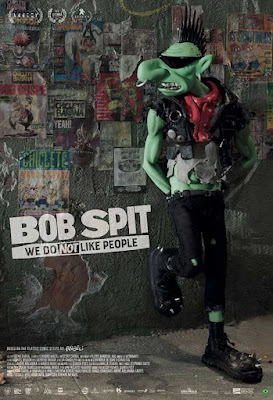
Punk is not dead and neither is Bob Spit (a.k.a. Bob Cuspe). Brazilian cartoonist Angeli thought he had killed off his creation in the pages of his underground comix Chiclete com Banana, but a punker like Spit is hard to kill. When word reaches him of his creator’s attempt to do him in, Spit sets off to give him a piece of his mind in Cesar Cabral’s ultra-meta and super-rude stop-motion animated feature, Bob Spit: We Do Not Like People, which opens this Wednesday in Los Angeles.

Spit is your basic hardnosed, unreconstructed punker. (He is also a bit phlegmy, hence his name.) Ever since Angeli thought he killed off his best-known creations, Bob Spit and feminist icon Re Bordosa (who maybe isn’t completely dead either), he has been somewhat blocked creatively. Maybe because everyone keeps talking about his iconic characters, including his closest colleague, transgender cartoonist Laerte, who is quite a fan of Bordosa.

Supposedly, Spit was killed by a horde of mutant Elton Johns, who symbolize the pestilence of pop music. However, the perennially angry punk seems to handle them just fine in the cartoon wasteland he stalks through. Inadvertently, he saves the goonish Kowalski Brothers, who have been piecing together “prophecies” regarding him from the pages of
Chiclete com Banana. When they show Spit the death Angeli wrote for him, it makes him mad, so he intends to teach the “old cartoonist” a lesson. Meanwhile, the animated Angeli has weird dreams and visions of Bordosa and Laerte, who appears to him as a Roma fortune-teller.

Cabral takes viewers on a bizarre post-modern animated ride that features the real voices of Angeli and Laerte, appearing as themselves. It is sort of like an animated cross between
The Young Ones and Wes Craven’s New Nightmare, but the feral Elton John mutants have no precedent. This is a crazy, self-referentially Borgesian film, but it stays true to the defiantly anarchic spirit of the original Bob Spit.

What unfolds is near-total bedlam, but the stop-motion animation is quite masterfully rendered. The movement and facial designs are reminiscent of Adam Elliot’s
Mary and Max, but thematically, the two films could not be more dissimilar. Bob Spit has no interest in personal growth or moral uplift, but he just might have some insights into the nature of art and the creative process.

Thursday, September 16, 2021

INFF ’21: The Cemetery of Lost Souls

Combining a knock-off Necronomicon-style book of evil with carny folk always means trouble. In this film, some of the nicest people happen to be part of a cannibal tribe. Sorry, that should have been “alternative cuisine connoisseurs.” (The on-set sensitivity coach wasn’t particularly diligent on this Brazilian horror movie.) Regardless, an ancient band of demonic zombies starts feeling their farofa in Rodrigo Aragão’s The Cemetery of Lost Souls, which screens (online) during the 2021 Inffinito Brazilian Film Festival.

It all starts during the early era of Portuguese colonialism, when a priest succumbs to the temptations offered by an infernal book of demonology, adopting the name of the infamous sorcerer Cipriano as his own. During a freak storm, he uses his powers to save a small platoon of conquistadors from certain death, at the mere cost of their souls. They wreak havoc on the indigenous tribes in a weirdly Transylvanian-looking district of Brazil, until a freak series of events binds them to the anachronistic Dracula’s castle.

For years, Jorge, a shy modern-day carnival laborer has seen in his dreams Ayra, an indigenous woman held in thrall by Cipriano. One fateful day, the carnival pitches their tent outside the imposing castle. Of course, Cirpriano and his horde are still lurking inside and they intend to feast on Jorge’s company.

Cemetery
throws all kinds of horror elements into the blender, but there is clearly a heavy Evil Dead influence. The modest budget is equally evident. For instance, the castle practically looks like it was painted on a bed sheet. However, Aragão is not afraid to go way over-the-top gory, mostly to gleefully comedic effect.

Friday, September 10, 2021

INFF ’21: Chico Mario—A Melody of Freedom

Everyone has heard of the girl from Ipanema, but not as many Gringo ears are familiar with the tradition of guitarists from Ouro Preto, in the state of Minas Gerais. João Bosco is one and Chico Mario was another. Both have documentaries that screen (online) during the 2021 Inffinito Brazilian Film Festival—and they both have some lovely guitar playing.


Pedro Pontes’s
João Bosco e Aldir Blanc: That’s Partnership is a short doc that features Bosco reminiscing with Blanc, his longtime lyricist, who could be considered his Bernie Taupin. It’s pretty straight-forward filmmaking, but it is great fun for Brazilian music fans to listen to Bosco play some of their songs for his partner—one of which he had not yet heard in its current form.

Alas, Francisco “Chico” Mario is no longer with us, so he deserves a more substantial feature treatment in Silvio Tendler’s
Chico Mario: A Melody of Freedom. Perhaps during his lifetime, Mario was somewhat overshadowed by his illustrious brothers, Betinho the sociologist and Henfil the artist. The trio were not just mutually accomplished. They also all inherited the hemophilia that ran in their family.

Mario’s time was limited, but he still inhaled Brazilian music, from choro to samba to classical, synthesizing all his influences within his own songs. Fittingly, we hear several of Mario’s solo performances and several more from Minas guitarists he influenced. Yet, in a something of an irony, the absolute standout musical segments feature the Ouro Preto orchestra playing symphonic orchestrations of his songs. They sound fantastic and they prove just how rich his work is, by transposing it into a radically new setting.

Even though Tendler sometimes lets the talking heads soundbites extend a bit too long, he gives the doc a very cinematic vibe by the inventive way he incorporates striking family photos and motion-comic-style pastel art. As a result, the film is visually pleasing and truly an audio treat.

Wednesday, September 01, 2021

Yakuza Princess, from Brazil

Brazil is home to the largest Japanese population outside of Japan, mostly concentrated in Sao Paulo and some of the rural provinces. That makes it a logical place for the daughter of the assassinated Kawa Yakuza clan leader to hide in plain sight. Initially, Akemi does not know of her heritage, but she will learn soon enough when killers come looking for her in Vicente Amorim’s Yakuza Princess, which opens Friday in select theaters and on-demand.

Akemi has just turned twenty-one, so she stands inherit the Kawa mantle, such as it is. However, her kendo sensei and surrogate father has kept her in the dark regarding her Yakuza legacy. As we see in the prologue, her father’s rivals viciously gunned down the entire family. Only his lieutenant Takeshi survived by conveniently (but suspiciously) switching allegiances, and as an infant, she was also somehow lost in the shuffle.

Suddenly, the Osaka underworld is highly interested in the Liberdade neighborhood in Sao Paolo. In addition to her, the rival Yakuza clan is looking for a rare Muromachi samurai sword. So is a mystery gaijin referred to as “Shiro” in the credits. He has amnesia, but questions about the sword still resonate for him. Weirdly, he has a habit of showing up just in time to help Akemi even the odds against her attackers, even we (and mostly likely he) can assume his original business with her was drastically different.

Seriously, how can you go wrong with hack-and-slash Yakuza action in Brazil? Amorim certainly doesn’t, adapting Danilo Beyruth’s graphic novel (with a battery of co-screenwriters). His action sequences are slickly stylish, ranking up with the films of genre masters like Kitano. Amorim has a good affinity for the history and tradition of the Japanese Brazilian community, having previously helmed the excellent
Dirty Hearts. In Princess, he adds the violent genre sensibilities of Mottorad (fortunately, we cannot see much of his stylish but muddled English language film, Good).

Tuesday, December 29, 2020

Submitted by Brazil: Babenco Tell Me When I Die

Hector Bebenco was born to Jewish immigrant parents in Argentina, but he pursued a career in filmmaking after moving to Brazil. Occasionally, he still lapsed into Sportuguese, but Brazil often embraced him as a representative of their national cinema, with good reason. Nevertheless, Babecno often never really felt like he wholly belonged in either Brazil or Argentina (even though the latter is really just a Spanish-speaking colony of the former, at least as it has been explained to me). Regardless, Brazil has made an unconventional but defensible choice submitting his wife Barbara Paz’s documentary profile of her late husband, Babenco: Tell Me When I Die, as their official international feature Oscar contender (they used to call it the “foreign language” category).

Babenco is still best known for his English-language productions,
Ironweed, At Play in the Fields of the Lord, and Kiss of the Spider Woman (for which he was nominated for best director), but his final film could well be his most personal. My Hindu Friend thinly fictionalized his own final days before succumbing to cancer and clearly serves as a companion film to Paz’s doc. Its star, Willem Dafoe also served as a producer of her documentary. Although she clearly had sharp editorial differences with her subject, his aesthetic still informs each frame.

In part, Paz’s film serves as an impressionistic survey of Babenco’s filmography, but it also becomes a meditation on the act of dying. Somewhat, ironically, Babenco had a great deal of time to organize his thoughts on mortality, because he was first diagnosed with cancer during the shooting of
At Play, nearly thirty years ago (allowing him to fast-forward past at least three Kubler-Ross stages).

Sunday, August 23, 2020

Fantasia ’20: At Midnight I’ll Take Your Soul

If his funereal top hat and cape were not enough to make you suspect Ze do Caixao, a.k.a. “Coffin Joe,” was capable of some serious villainy, his devilish beard and long creepy finger nails should have been a dead giveaway. He was the sinister anti-hero of Brazil’s first horror movie, who became an international horror icon. In tribute to Jose Mojica Marins, the man who created and portrayed Coffin Joe, three of his most notorious favorites are screening as on-demand selections of the 2020 Fantasia International Film Festival, including the original, At Midnight I’ll Take Your Soul.


Coffin Joe is the undertaker of a small post-war Brazilian town, who always makes sure he has a steady stream of business. He does not look particularly imposing, but he terrorizes his neighbors through the sheer sinister force of his will. (In subsequent films, we also learn he is uncannily hard to kill.) He is legally married, but he is openly scornful of his barren wife (and the passive-aggressive hostility is mutual). Obsessed with the idea of reproducing his “superior” bloodline, Coffin Joe covets Terezinha, the fiancée of Antonio, who happens to be the only villager that considers him a friend (like that matters to Ze).

When Antonio invites old Joe to visit a Roma fortune-teller, the villainous undertaker plans to murder him afterward. Of course, the old crone (very much in the tradition of Maleva in the old Universal monster movies) can see Coffin Joe’s intentions and foretells his eventual doom. Naturally, this just makes Ze scoff in her face. However, Coffin Joe will not be laughing so hard when things start to take a supernatural turn during the third act, which will indeed culminate at midnight.

Frankly, it blows the mind to think a film this twisted was let loose upon the world in 1964, the year of saccharine songs like “Chapel of Love” and “People [Who Need People].” It isn’t the just the brutality of CJ’s murders, but also the militant vehemence of his philosophical nihilism. He definitely thinks he is a superman (in the Nietzschean sense), so he has no qualms about acting accordingly. Yet, the film itself is ultra-atmospheric, rendered by cinematographer Giorgio Attili in a super-spooky black-and-white. In terms of look, it is a lot like dreamy vintage Val Lewton, but thematically,
Midnight can hang with the New French Extremity.

Monday, July 27, 2020

Shine Your Eyes: From Lagos to Sao Paulo

Aptitude for music and mathematics come from the same part of the brain, so it rather follows Ikenna Igbomaeze was good at both. In Lagos, he played in an Afrobeat band with his younger brother Amadi, but he came to Sao Paulo to teach advanced statistics. Or so he told his family. With no communication from his older brother in over a year, Amadi has arrived to track him down. However, instead of a respectable academic, he learns his older brother turned into either a con man or a mad, delusional genius. Either way, Ikenna seems to be avoiding a reunion with his brother in Matias Mariani’s Shine Your Eyes, which launches globally this Wednesday on Netflix.

As the eldest brother, Ikenna is the one expected to assume responsibility for the Igbomaeze line. Yet, from Amadi’s perspective, his mother’s favoritism goes beyond the culturally-based expectations for the first-born. Regardless, Ikenna’s long absence is painful to her, so Amadi has come to dutifully collect him. Unfortunately, he quickly learns his brother faked his professorship. Instead, he spent a good deal of time at the horse track, where he apparently had a “system.” It is there he meets one of Ikenna’s cronies, Miro Kuzko, a Hungarian-Brazilian (and supposed university provost), who offers Amadi a place to crash.

Pursuing leads from Ikenna’s social media and abandoned laptop, Amadi manages to retrace his steps. However, a disturbing portrait starts to emerge of a mathematical mad man, who started to believe he could predict the underlying equations governing reality. You can definitely think of it in terms like
The Matrix.

A lot of media descriptions play up
Shine’s immigration angle and the fraternal Cain and Abel theme, but the film morphs into something like Aronofsky’s Pi, albeit a less science fiction-driven version. Still, Ikenna’s ferocious mania almost has us believing he cracked the universe’s code. It is a rather drastic change of pace from the last film Mariani co-directed (with Maira Buhler, who co-wrote Shine, along with Igbo screenwriter Chika Anadu), the mysterious post-modern documentary, I Touched All Your Stuff, but these two films certainly prove he has a knack for surprising viewers.

Sunday, May 31, 2020

BFF ’20: Macabre


They are still in the state of Rio, but villagers residing on the other side of those iconic mountains live in a whole different world from the cosmopolitan city of Rio de Janeiro. Yet, many of their hardscrabble problems are maybe not so different from that of Rio’s famous (and feared) favelas. Regardless, it is always bad news when the BOPE (the cops from the Elite Squad movies) show up. In this case, villagers hope they will finally capture the notorious “Necrophil Brothers” who are terrorizing the countryside, but the assignment will get complicated and horribly personal for Sgt. Teo in Marcos Prado’s Macabre, which screens (virtually) as part of the (online) 2020 Brooklyn Film Festival.

Teo needs to redeem himself, because he is responsible for the death of an innocent civilian during a favela operation. His captain promises to sweep the incident under the rug, if he captures Inacio and Matias, who murdered a dozen women and subsequently desecrated their bodies. Teo should have an advantage because he was raised in this mountainous community, but he left on bad terms with his family (and nearly everyone else).

As Teo launches his investigation, it becomes immediately apparent one of the brothers is just as guilty and sadistic as he has been made out to be. The culpability of the other is a little murkier, but locals do not want to waste time with such fine distinctions. Unfortunately, their next crimes will strike closer to home for Teo, re-igniting long-simmering tensions and resentments.

Macabre is a gritty serial killer thriller in the James Patterson tradition that also incorporates the social commentary of the Elite Squad films and their brethren. Both the favela incident and the hunt for the Necrophil Brothers are based on real life BOPE cases, but in real life, the former event happened much later and involved different officers. However, screenwriters Lucas Paraizo and Rita Gloria Curvo fuse them together quite seamlessly. Of course, that means they really put the screws to woeful Sgt. Teo as a result.

Saturday, May 23, 2020

CFF ’20: Skull—The Mask


Forget about getting Medieval. Vengeful Pre-Columbian gods are way more hardcore than that. Tahawatinsupay is one of the hardest-cored, but it is his executioner you really have to worry about. That would be whoever happens to be wearing the skull-like Mask of Anhanga. Unfortunately, it finds its way onto someone’s head in modern-day São Paulo, resulting in a trail of fresh corpses. A disgraced police detective is out of her depth working the uncanny case in Kapel Furman & Armando Fonseca’s Skull: The Mask, which screens (virtually) as part of the (online) 2020 Chattanooga Film Festival.

The film starts way back in 1944, when a sinister military expedition tried to harvest the power of the Mask of Anhanga. It ended badly for them. The mask next resurfaces in our time, when the Brazilian branch of a sinister Chinese conglomerate unearths it in an Amazonian construction site. It turns out Tack Waelder, the CEO was hoping to find it. In fact, he already abducted three Bolivian immigrant kids to sacrifice in his planned ceremony. That is the case Det. Beatriz Obdias is currently working, but making no progress on.

Unfortunately, the young gothy lover of Waelder’s deputy cannot resist performing her own ritual with the mask. This is obviously an extraordinarily stupid decision that ends just as badly for her. It also launches the mask into the world and onto the streets of São Paulo, where it does what it does best—kill people. Obdias and her partner have no idea what they are tracking, but Manco Ramirez does. He has sworn to protect the world from the mask, but as a classic loner-type, he is not good at making friends and influencing people.

Basically, Skull is about as micro as a budget can get. However, its admirable energy level, intriguing use of Pre-Columbian lore, and gleefully gory practical effects make it a highly watchable overachiever. It is important to emphasis the latter, because Furman & Fonseca have blood splattering and body parts flying everywhere. Yet, despite the supernatural elements, Skull often functions like a slasher movie and a procedural.

Monday, May 11, 2020

O Pai (Curta): Esperando Que Seja Exibido Em Breve Em Um Festival Perto De Você [Portuguese Translation]


Tiago Abubakir & Luiz Humberto Campos are clearly talented young Brazilian filmmakers, so I’m happy to make my review of their latest short film, The Great Father, available to Portuguese-speaking audiences, thanks to a translation courtesy of Angelica Sakurada. (You can find the original below here.)
 
O ano de 1755 marcou um momento de virada para Portugal. Era o ano do Grande Terremoto de Lisboa e da indicação de Sebastião de Melo como primeiro ministro. Mesmo hoje, a administração do de fato chefe de estado permanece controversa. Algumas liberdades são tomadas com nomes e eventos históricos, mas o espírito da época se mantém o mesmo no curta O Pai do diretor-produtor-editor-co-roteirista brasileiro Tiago Abubakir e do co-roteirista-co-produtor-co-ator Luiz Humberto Campos, que estaria sendo exibido no circuito dos festivais de cinema neste momento, se não fosse a pandemia de  Xi Jinping.

O fogo e o terremoto sacudiram Lisboa. Entretanto, para a rainha Maria Victoria (originalmente uma princesa espanhola antes do casamento com o rei José I) e sua filha princesa Maria I, a emergência real é a doença do rei e o seu afastamento da governança do dia-a-dia. Enquanto “o Pai” está doente, o “Barão Negro” comandará Portugal, com mãos de ferro. Claro que a rainha e a princesa estão mais preocupadas com o seus lugares no palácio do que o bem-estar dos seus súditos.

É bem impressionante quanto o jovem Tiago Abubakir atingiu com o micro-enxuto orçamento, com a colaboração de Luiz Campos e seus familiares. Foi realmente algo de trabalho em família, pois a tia de Tiago Abubakir, Ivone Biscaia, atua como a rainha e o pai de Luiz Campos, Humberto Campos, atua como o Barão Negro. Todo mundo faz sua parte, mas sinceramente o elenco é muitas vezes ofuscado pela locação maravilhosa do filme, incluindo o Convento do Carmo, uma abadia do século XVIII, e o Museu da Misericórdia de Salvador na Bahia.

Sunday, May 10, 2020

The Great Father (Short): Hopefully Coming Soon to a Festival Near You


1755 marked a turning point for Portugal. It was the year of the Great Lisbon Earthquake as well as Sebastiao de Melo’s appointment as prime minister. Even today, the administration of the de facto head of state remains controversial. Some liberties are taken with names and historical events, but the spirit of the era remains the same in Brazilian director-producer-editor-co-screenwriter Tiago Abubakir & co-screenwriter-co-producer-co-star Luiz Humberto Campos’s short film The Great Father, which would be screening on the festival circuit right now, were it not for Xi’s pandemic.

The fire and earthquake have shaken Lisbon. However, for Queen Mariana Victoria (originally a Spanish princess before her marriage to King José I) and her daughter Princess Maria I, the real emergency is the King’s illness and withdrawal from day-to-day governance. While the “Great Father” is sick, the “Black Baron” will rule Portugal—with an iron hand. Of course, the Queen and Princess are more concerned about their place in the palace than the well-being of their subjects.

It is quite amazing how much the teenaged Abubakir achieved on a micro-shoestring budget, with the collaboration of Campos and their families. It really was something of a family affair, since Abubakir’s aunt, Ivone Biscaia, plays the Queen and Campos’s father, Humberto Campos, plays the Black Baron. Everyone does their part, but frankly the cast is often overshadowed by the film’s amazing locations, including the Covento do Carmo, an 18th Century Abbey, and the Museu da Misericordia in Salvador, Bahia.

Saturday, May 09, 2020

Festival Tribeca 2020: Pacificado [Portuguese Translation]


The 2020 Tribeca Film Festival has been drastically curtailed, but the selected films still deserve attention and coverage, so I’m thrilled to be able to post a Portuguese translation of my Pacified review for potential viewers, both in the United States and in Brazil, courtesy of Angelica Sakurada (you can find the original below here):
 
As vistas das favelas do Rio valem milhões de reais, mas nenhum incorporador imobiliário pensaria em se arriscar no seu interior. Periodicamente, o BOPE (dos policiais de Tropa de Elite) lançam incursões na favela, mas eles nunca ficam muito tempo. No lugar, o líder do tráfico funciona como lei. Na favela da Tati, o seu quase estranho pai Jaca era conhecido por arbitrar as disputas da comunidade de maneira justa. Seu sucessor jovem e revoltado, nem tanto. Por esse motivo, todos estão ansiosos para que ele retome o papel de liderança que ele não quer mais no filme Pacificado do gringo Paxton Winter, falado em português e produzido por Darren Aronofsky, que seria exibido este ano no Festival de Cinema de Tribeca, se este não tivesse sido cancelado devido a triste falta de respeito pela vida humana pelo Partido Comunista da China, junto com a cumplicidade da OMS.

Tati é mais temperamental e mais alienada do que a maioria dos adolescentes, mas sua mãe fica falando a ela que as coisas vão melhorar com a saída da prisão logo mais de seu “pai”, que se chama José Ferreira. Os Jogos Olímpicos já terminaram e todo mundo está voltando a vida normal. Entretanto, os grandes chefes do morro estão contentes com a truculência que Nelson está dirigindo a favela e Jaca também está perfeitamente ok com isso. Mesmo assim, os residentes da comunidade continuam vindo até ele com seus problemas.

Francamente, Jaca tem bastante problemas dele mesmo. Seu irmão Dudu pisou na bola feio na gestão de uma das bocas de Nelson, enquanto também sofre com o abuso de drogas e depressão. A mãe da Tati, Andrea, é provavelmente até mais viciada. Entretanto, ele está começando a apreciar a inteligência e resiliência da Tati, apesar dos rumores sobre sua paternidade.

Mesmo Paxton Winters sendo um ianque, Pacificado definitivamente segue a tradição dos dramas realísticos de favelas, melhor exemplificados para audiências internacionais com Cidade de Deus e Cidade dos Homens. Ainda assim, o filme também possui as características de muitos filmes de gangsteres de Hollywood das décadas de 40 e 50, em que as estrelas como George Raft sempre aprendiam que voltar para casa é uma proposta complicada para ex-bandidos.

Tribeca ’20: Pacified


The views from Rio’s favelas are worth millions of Reais, but no developer would think of venturing inside. Periodically, the BOPE (the cops from Elite Squad) launch incursions, but they never stay long. Instead, the local gang leader functions as the law. In Tati’s favela, her semi-estranged father Jaca was known for arbitrating neighborhood disputes fairly. His young, punky successor—not so much. That is why everyone is looking forward to him reclaiming the leadership role he no longer wants in Gringo filmmaker Paxton Winters’ Portuguese language film, Pacified, produced by Darren Aronofsky, which would have screened at this year’s Tribeca Film Festival, had it not been canceled due to the CCP’s deceit and disregard for human life, along with the WHO’s complicity.

Tati is even moodier and more alienated than most teenagers, but her mother keeps telling her things will get better with the impending release of her “father,” real name Jose Ferreira. The Olympics Games are over and everyone is getting back to normal. However, the big bosses are content with the ruthless Nelson running the favela and Jaca is also perfectly okay with it. Nevertheless, residents keep coming to him with their problems.

Frankly, Jaca has plenty of his own troubles. His brother Dudu has badly mismanaged one of Nelson’s bocas, while also struggling with drug abuse and depression. Tati’s mother Andrea is probably even more addicted. However, he is starting to appreciate Tati’s intelligence and resilience, despite the rumors regarding her true parentage.

Even though Winters is a Yank, Pacified definitely follows in the tradition of realistic favela dramas, best exemplified for international audiences with City of God and City of Men. Yet, it also shares a kinship with many 1940s and 1950s Hollywood gangster movies, in which stars like George Raft always learned going home is a tricky proposition for reformed racketeers.

Thursday, March 05, 2020

Bacurau: Não indicado pelo Brasil


If only this film were as good as Angelica Sakurada’s translation. Once again, she has volunteered a Portuguese translation of my Bacurau review as a service to expats and Brazilian readers (original here).

O nordeste brasileiro é uma região sofrida, com uma história de insurreição armada. Se um grupo de elite de caçadores do estilo “Zaroff, O Caçador de Vidas” (Most Dangerous Game) estiver vasculhando o território, eles provavelmente passariam direto por essa região equatorial selvagem. Claro, que o conceito integral de pessoas caçando pessoas já é um clichê barato que vem sendo reciclado constantemente, embora o filme O Alvo (Hard Target) já tenha estabelecido o padrão do conceito no início dos anos 90. Deste vez, os co-diretores-roteiristas Kleber Mendonça Filho e Juliano Dornelles tentam reinventar o artifício para retratar ângulos políticos e ideológicos em Bacurau, que estreia nesta sexta-feira em Nova Iorque.

Theresa regressou à Bacurau para o enterro de sua avó, mas decide ficar mais alguns dias para se reconectar com uma antiga paixão, Pacote, uma ex-atirador conhecido, com toda uma fama no YouTube contando as mortes atribuídas a ele. Sinceramente, não é ele que os gringos invasores deveriam temer no local.

Liderado por um misterioso alemão conhecido como Michael, os caçadores gringos (e seus dois cúmplices de São Paulo) conseguiram bloquear todo o sinal GPS e remover a cidadezinha do mapa do Google. A ideia é lentamente ir eliminando os locais um a um. Entretanto, como bons descendentes de rebeldes da tradição de Lampião, os residentes de Bacurau tem habilidades de sobrevivência no seu DNA.


Bacurau
é um pecado da junção do cinema arte e filme de exploração que falha em satisfazer ambos públicos. O filme demora para engrenar, mas pelo menos as belas cenas do enterro ajudam a apresentar a comunidade local e seu lugar no ecossistema brasileiro. Entretanto, quando os gringos aparecem, o filme se reduz a um aspirante a suspense-retrô sórdido, mas os forasteiros são tão dramaticamente ultrapassado, que não existe nenhum suspense sobre os acontecimentos. Ao invés disso, o público vai ficar olhando o celular, esperando pelo final inevitável para finalmente concluir.

Monday, March 02, 2020

Bacurau, Not Submitted by Brazil


The Northeast of Brazil is hardscrabble country, with a history of armed insurrection. If a wealthy group of “Most Dangerous Game” style hunters were scouting territory, they would probably skip this unruly equatorial region. Of course, the entire notion of people hunting people is a shopworn cliché that keeps getting recycled over and over, even though John Woo’s Hard Target set the standard in the early 1990s. This time, co-director-screenwriters Kleber Mendonca Filho & Juliano Dornelles try to repurpose the gimmick to score political and ideological points in Bacurau, which opens this Friday in New York.

Theresa has returned to Bacurau for her grandmother’s funeral, but decides to stays a few days to reconnect with an old flame, Pacote (“the Package”), a former reputed hired gun, with a whole YouTube highlight reel of hits attributed to him. Frankly, he isn’t even the local the invading gringos should be worried about.

Led by the mysterious German known as Michael, the gringo hunters (and their Sao Paulo accomplices) have successful blocked all GPS and removed the town from Google maps. The idea is to slowly pick off the locals one by one. However, as the descendants of rebels in the Zapatista tradition, the residents of Bacurau have survival skills in their DNA.

Bacurau is an unholy merger of art cinema and exploitation movies that fails to satisfy either audience. The film is slow to get started, but at least the leisurely funeral scenes help establish the local characters. However, once the gringos show up, the film down-shifts into a wannabe sleazy retro-thriller, but the outsiders are so dramatically outclassed, there is never any suspense regarding the outcome. Instead, viewers will just be watching their cellphones, waiting for the obvious inevitable conclusion to finally wrap itself up.