Showing posts with label Ghost movies. Show all posts

Wednesday, February 25, 2026

How to Shoot a Ghost (short), on Criterion Channel

There are scary ghosts like The Changeling and The Haunting, funny ghosts like Topper and Blythe Spirit, and sad, regretful ghosts like Casy Affleck in A Ghost Story. These two ghosts are definitely the latter. You could almost call them depressing, but they deserve a little slack, since they are newly dead. Sadly, their lives did not work out as they hoped. Spending their afterlives in a strange city also seems like a tough break, but they find some kind of companionship with each other in Charlie Kaufman’s short film How to Shoot a Ghost, which premieres Sunday on Criterion Channel.

He is a translator and she is a photographer, but both were profoundly unhappy. (According to the closing credits, they are Anthi and Rateb, but you wouldn’t know that from listening to their monologues). It seems vaguely implied they both also self-medicated through the hedonistic Athens nightlife, which may have in some ways led to their demise. They were expats largely unfamiliar with the city, but now they are evidently stuck there. Apparently, ghosts can’t travel.

Rather logically, the ancient city has many ghosts (whose pictures Anthi constantly snaps—call it ghost photography), but you’d want to give a lot of them a wide berth. Maybe those are the one screenwriter Eva H.D.’s anti-American narration blames on “CIA torture chambers.” In contrast, she expresses no such sympathy for those assassinated by Communist paramilitaries, like journalist Nicholas Gage’s mother Eleni Gatzoyiannis (as documented in the film
Eleni).

Maybe Kaufman’s short should have talked less, because Ella van der Woude’s score is quite expressive, especially the eloquent tenor, alto, and bass clarinet solos contributed by Hristo Goleminov. Jesse Buckley and Josef Akiki voiceovers for the photographer and the translator are appropriate meditative and mournful, as well. The disembodied rendering of their voices is initially distracting and distancing, but it is also admittedly quite ghostly.

Friday, August 15, 2025

Went Up the Hill: A Ghost Story

When you reach a certain age, nursery rhymes start sounding creepy. Jack and Jill are definitely old enough, so maybe the irony of their names should have been their first warning. He journeyed to New Zealand’s least populous South Island to mourn his long-estranged mother, but maybe she isn’t really gone, at least not completely in Samuel Van Grinsven’s Went Up the Hill, which opens today in theaters.

The late Elizabeth’s grieving wife Jill is surprised to see Jack at her wake, while Jack is surprised that she is surprised, because Jill called him, asking him to come—or so he thought. Nevertheless, Jill immediately agrees he should be there and runs interference with Elizabeth’s inhospitable sister Helen. Jack never really knew the mother who gave him for adoption at a very young age. Yet, he and Jill quickly bond in their radically different forms of grief.

Jack yearns for answers from his mother, which Jill helps facilitate when Elizabeth’s spirit (call it whatever you prefer) takes possession of her body. The supernatural communication works both ways, allowing Jill to talk to Elizabeth when she possesses her son, in turn. The process just requires both son and wife to be asleep, allowing Elizabeth to jump from one body to another. Initially, the ghostly encounters are consoling, but viewers soon start to suspect the deceased profoundly mistreated both Jack and Jill.

Went Up the Hill
is an unusually elegant and austere ghost story—so much so, some critics argue it isn’t really horror. Yet, Van Grinsven’s film is far scarier than supposed horror movies like Get Out or Bodies Bodies Bodies. Those films have their merits, but they aren’t really scary. In contrast, there are moments in Hill that will chill you to the bone and make your hair stand on end. In terms of tone and potency, it compares favorably (but does not surpass) Assayas’s Personal Shopper.

Tuesday, July 22, 2025

Kensuke Sonomura’s Ghost Killer

Its a ghostly buddy comedy, sort of like All of Me, but with some seriously “anti-social” behavior. Hideo Kudo was an elite hitman with a shadowy syndicate—with the emphasis on the “was.” Now he is dead, murdered by his former associates. However, he still has his deadly skills, when he borrows Fumika Matsuoka’s body. He is an extremely angry ghost, but their partnership makes him a more decent soul in Kensuke Sonomura’s Ghost Killer, which releases today on digital.

Kudo was hard to kill, but eventually they got him. The operation is perfectly executed, but the clean-up crew misses the cartridge casing. When Matsuoka, a distressed college student, picks it up, her resentments combine with Kudo’s grudge to produce a haunting. To get rid of him, she must allow him to take over her body, to extract his vengeance. However, he first spends a good deal of time beating the snot out of her would-be abusers.

In fact, things get so messy, Kudo must call in help from his protégé Toshihisa Kagehara, to tidy up all the moaning and groaning bodies. Of course, Kagehara has only one method of cleaning, which poor Matsuoka does not want to think about. Regardless, Kagehara is way too edgy to fully trust.

You often see the me-and-my-ghost premise in comedies, but
Ghost Killer is surprisingly dark. It also kicks tons of butt. Sonomura served as his own fight director and he did not pull any punches. It is one gritty but spectacularly cinematic beat-down after another.

Friday, July 18, 2025

Bury Me When I’m Dead

New Age hokem is always a headache, but that will be especially true for Henry Samsa. His terminally ill wife Catherine made him promise to bury her in the woods with acorns embedded within her body, so she could blossom into a tree, or something like that. Instead, he brings her back to civilization for a proper burial, so now she is apparently haunting him in director-screenwriter Seobald Krebs’ Bury Me When I’m Dead, which releases today on VOD.

Samsa has a lot to brood over and brood and brood and brood. He cheated on his wife with their floral shop employee Rebecca Gregor, but she let him off the hook for that. She only asks for her natural burial (which probably violates multiple laws, as well as health and environmental regulations). However, her powerful father, Gary Higdon, secretly lays down the law with Samsa—bring her body home, or else. So he does, but Higdon does the “or else” anyway.

Basically, Higdon financially ruins Samsa out of spite. To make matters worse, the bereaved husband starts having visions that lead him to suspect his wife is haunting him. However, it is a subtle, quiet haunting.
 At least Samsa never turns into a bug, like his Kafkaesque namesake.

Remember when horror movies were fun? Clearly, Krebs aimed for an “elevated” “post-horror” kind of vibe, but the results are acutely angsty and often downright dreary. This is no
Don’t Look Now, not by a long shot. Honestly, watching this film felt like homework.

Thursday, June 12, 2025

Detective Kien: The Headless Horror

Miss Moon’s village is like the Sleepy Hollow of Vietnam. The decapitated victims of the sinister “Drowning Ghost” keep washing up on the shore of the river. Supposedly, her niece (whom she raised as a daughter) was the exception. The waters only returned one of poor Nga’s shoes. Since the useless village chief refuses to investigate Miss Moon petitions the Judge’s Detective. That would be Kien, who conscientiously answers the call in Victor Vu’s Detective Kien: The Headless Horror, which is still playing in select theaters.

Kien an analytical but empathetic investigator, who represents the full authority of the [unseen] Judge, so Chief Liem Quan must cooperate. The good detective soon learns Nga was tragically inconvenient. Her father resented Nga, because he suspected she was her mother’s illegitimate daughter, with the lover she later absconded with. Similarly, Liem and Lady Vuong, his Lady Mabeth-ish wife, harbored ill will towards Nga, because their entitled daughter Tuyet’s arranged fiancé, Thac, fell in love with her.

Of course, Kien wants to maintain the integrity of his investigation, but Miss Moon insists on joining him—and she is the sort of person who is hard to say no to. That is especially true as the romantic attraction between them grows. Ominously, the Drowning Ghost also apparently takes an interest Kien, appearing in dreams and visions—and maybe even real life, at inopportune times.

Perhaps by Vietnam’s standards,
Detective Kien might be a horror movie. For American audiences, it is more of a mystery with some genre elements, but either way, it is wonderfully atmospheric. There is a lot of sneaky skullduggery and 19th Century detective business afoot.

Tuesday, September 17, 2024

Last Shadow at First Light, on IndiePix

Not eveery ghost wears sheets and rattles chains in the attic. When you think about it, nearly everyone is haunted by something. Those are our ghosts. Young Ami is haunted by more ghosts than the teenaged girl deserves. By far, her presumed dead mother is her most persistent ghost, either figuratively or literally, in Singaporean-based screenwriter-director Nicole Midori Woodford’s Last Shadow at First Light, which premieres this Friday on IndiePix Unlimited.

When the 2011 Tsunami struck Japan, Ami’s mother Satomi rushed to the coast, hoping to save her parents (Ami’s grandparents), who were tragically lost to the waters. For a year, Satomi stayed, trying to make amends and hopefully find her parents, while Ami stayed with in Singapore with her father, Wen Yong. For a while, Satomi sent little Ami audio tapes, before falling silent.

For years, her father told Ami her mother had died. However, the uncertainty torments her, especially when her fragmentary spectral visions of her mother increase in frequency. Eventually, Wen Yong realizes Ami’s profound need to resolve the truth of her mother’s fate in Japan, but since he must care for her other ailing grandmother, he arranges for her Uncle Isamu (his brother-in-law) to accompany her. Isamu is not exactly welcoming, but they share a kinship, because he is similarly haunted by his late wife, who was also swept away by the tsunami.

If ghosts exists, which is doubtful, then they most likely resemble the way Woodford [largely, but maybe not exclusively] depicts them—as memories and regrets that are so potent, they manifest themselves into ghostly visions. Nobody needs an exorcist in
Last Shadow Arguably, Ami sorts of hopes to do the opposite. Regardless, the film’s examination of grief will absolutely devastate most viewers, especially those who have recently suffered a loss.

Monday, December 05, 2022

The Scottish Play

Is Shakespeare's Macbeth cursed? Ask Kelsey Grammer. According to legend, a coven of witches enraged by Shakespeare including their genuine rituals in his text placed a curse on the play that endures to this day. Sydney can ask the Bard himself, when he appears to her while she is rehearsing a production of you-know-what in screenwriter-director Keith Boynton’s The Scottish Play, which releases tomorrow on VOD.

You could maybe compare Sydney to Laura Linney. She is no longer a starlet, but she has a big name and a reputation for classy work, so it is a coup for Adam, an up-and-coming theater director, when she agrees to star as Lady Macbeth in his production of “The Scottish Play,” opening a Massachusetts Shakespeare festival. She wanted to get away from the movie business for a while, but they also just seem like they are on the same wave-length.

On the first day of production, Adam gives a nice curse-schmurse speech, after which weird things start to happen. The weirdest has to be William Shakespeare visiting Sydney in ghostly form. He rather empathizes with Adam’s struggles staging
Macbeth, so he promises his help to Sydney. However, the “help” he offers up will be rather difficult to explain.

Honestly, I am totally shocked how good
The Scottish Play is, given how little fanfare has surrounded it. Basically, the entire industry and the media covering it has been sleeping on this film. Boynton has a nice ear for the iambic pentameter Shakespeare speaks in. Granted, I’m not a Shakespearean scholar, but I reviewed Macbeth twice on-stage and four times on film. At least for non-professional ears it sounds legit. Yes, people did not speak that way during everyday Elizabethan times, but now that he is dead, Shakespeare can indulge himself—or so he explains.

Wednesday, October 26, 2022

Terror-Fi ’22: The Civil Dead

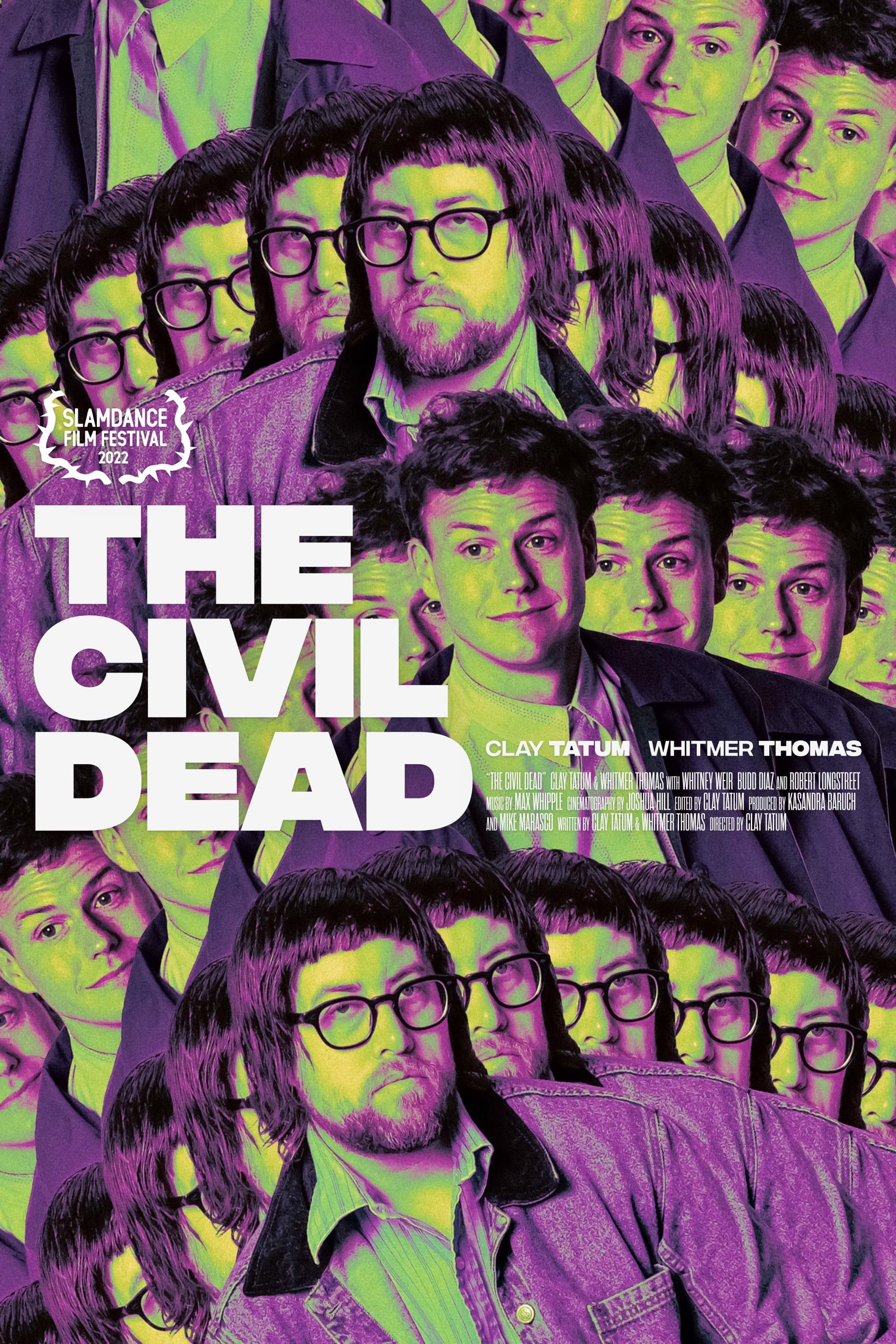
Neither your parents or your teachers probably ever taught you the etiquette of hauntings, either for the haunted or the haunter. Maybe the Church and horror movies gave us a clue, but that was only for really adversarial hauntings. It is therefore rather understandable that Clay would be confused when his old friend Whit starts haunting him in Clay Tatum & Whitmer Thomas’s The Civil Dead, which screens during this year’s Terror-Fi.

Clay is an under-achieving photographer, who fortunately lives with his gainfully employed wife. Whit was a struggling actor, who apparently will never make it, because he is now dead. Clay is rather surprised to run across him in the park, but Whit is even more surprised, because he had resigned him self to being a spectral ghost nobody can see.

It takes a little convincing, but eventually Clay concedes nobody else can see Whit, so it sures seems like he most be dead. It is a lot to process, but Whit still latches on hard, because his is so relieved to finally have company. Somewhat ironically, Whit had ghosted Clay during their senior year of high school and Clay had largely ghosted him back after they both moved to LA, where Whit was desperate for some sort of social support, so their relationship was already awkward. Death and haunting will start to realty make it weird.

Civil Dead
is the sort of hipster horror comedy some of Onur Tukel’s darned-near unwatchable films were supposed to be, but weren’t. The screenplay, co-written by Tatum & Thomas is intensely neurotic, but there are also some genuinely creepy moments.

Sunday, August 28, 2022

The Woman in Black: The New Hammer Adapts Susan Hill

Arthur Kipps' assignment sounds like a nightmare from Hell: one solid week of paperwork. He is supposed to organize the ratty old papers of the late Alice Drabow, the former owner of Eel Marsh House. Frankly, the visitation of a vengeful ghostly woman sounds like a welcome distraction from such drudgery, but unfortunately, her appearances are a harbinger for yet another child dying in the beleaguered local village. Despite the tragedies, poor Kipps still has to get all those blasted papers in order in James Watkins’ Hammer-produced The Woman in Black, which airs Thursday on Comet.

Kipps’ beloved wife died in childbirth, leaving him to raise their son Joseph on his own. The senior partner of his proper Edwardian firm says he is sympathetic to Kipps’ situation, which means he really isn’t. Regardless, Kipps must sort out the Drabow estate if he is to have a future with the firm. Unfortunately, the local solicitor has been decidedly uncooperative, so Kipps must go to Eel Marsh House and process all the paperwork, so they can clear the title for the prospective heirs.

Of course, he receives a nasty welcome from all the locals, except the wealthy and skeptical Sam Daily. Yet, he too lost his young son in an incident attributed to the Woman in Black. According to legend, whenever she is seen, a child dies through an act of self-destruction. As a result, Kipps only makes things worse for himself in the village when he asks about the strange woman he has seen around the Eel Marsh grounds. Children do indeed start dying, which is especially alarming to him, since Joseph and his nanny are scheduled to visit over the weekend.

Woman in Black
is an entertaining gothic throwback, which made it an altogether fitting production for the relaunched Hammer Films. As well as channeling vintage Hammer, Watkins also picked up a step or two from films like Bayona’s The Orphanage, using the full frame to tease viewers with shadowy figures, half-seen from down long hallways. Yet, the wonderfully lush and decaying set designs are pure vintage Hammer. Plus, the isolation of Eel Marsh House, built atop a rise in tidal basin that is inaccessible during high tide, lends the film additional claustrophobic creepiness.

Since Daniel Radcliffe now shuns J.K.
Rowling as a heretic who should be burned at the stake, this could be his new favorite film. It is the second screen adaptation of Hill’s novel, following a 1989 BBC production, and the first to spawn an original sequel. It is refreshingly atmospheric and suggestive, rather than bluntly gory.

Monday, September 27, 2021

Blithe Spirit, Remade Again

Everyone loves a good haunted marriage, especially when the living spouse has subsequently remarried, like in Dona Flor and Her Two Husbands, the highest grossing Brazilian film for decades (spawning the American remake, Kiss Me Goodbye). Noel Coward got there first, scoring a West End hit that became a classic David Lean film, before morphing into the moderately successful Broadway musical, High Spirits. Nobody sings “You’d Better Love Me” or any of those forgotten Broadway tunes, but the is plenty of old-fashioned farce in Edward Hall’s remake of Blithe Spirit, which releases tomorrow on DVD.

Charles Condomine is a slightly Bertie Wooster-ish mystery novelist, who still misses his late wife Elvira, even though he remarried the well-heeled Ruth, whose producer father is impatiently awaiting Condomine’s first screenplay. We soon learn he has not written a word since Elvira died, because she came up with all the best parts of his novels, like the plots, characters, and dialogue.

Condomine hatches an idea to break his writer’s block by hiring the discredited psychic Madame Arcati to conduct a séance in his home. It works better than he ever could have hoped when she inadvertently summons the spirit of the first Ms. Condomine, who is highly jealous of the second—so much so, she might take matters into her own spectral hands.

This
Blithe Spirit does not exactly reflect Coward’s dry-martini wit, but it is a lightweight puff of door-slamming slapstick. A writer like Sir Julian Fellowes might have better channeled Coward’s urbane sophistication, but at least screenwriters Nick Moorcraft, Meg Leonard, and Piers Ashworth (there are three of them to adapt one play) capture the boozy upper-crust vibe.

Thursday, September 16, 2021

Lady of the Manor

Lady Wadsworth is not nearly as fun as the freewheeling married couple that haunted Cosmo Topper, but she is more progressive than the sea captain haunting Mrs. Muir. That is actually something, considering she lived and died in late 1800’s Savannah. Her home is now literally a museum that she expects to be kept just so. She therefore haunts the new slacking stoner tour guide pretty hard, until they develop an unlikely friendship in director-screenwriter-brothers Justin & Christian Long’s Lady of the Manor, which releases tomorrow in theaters and on-demand.

Wadsworth Manor is still a source of pride and revenue for Savannah Mayoral candidate Grayson Wadsworth, but his entitled son Tanner is not. To finally start pulling his weight, Tanner must assume management of the Manor business during the campaign. Unfortunately, that leads him to fire the current costumed tour guide when she turns down his advances. Needing a quick replacement, he hires Hannah Daniels, who just happened to be boozing on the barstool next to him.

Initially, Daniels makes it clear any advances Tanner might make will be completely welcome. However, she also starts to feel some attraction to Maxwell Plumm, the local college professor, who mercifully agrees not to call her on the liberties she takes with history. Unfortunately, the ghost of Lady Wadsworth is not so indulgent when it comes to Hannah’s messy housekeeping and hard-partying lifestyle.

Manor
is an ultra-lightweight comedy, but it is still amusing. Judy Greer is perfectly cast as the prim and proper ghost, whom the film contrives ways to make sympathetic to modern viewers. Even though her character is often annoying as heck, Melanie Lynskey still gets a lot of big laughs as Daniels. She also has decent chemistry with Justin Long as the otherwise too-bland Prof. Plumm (yes, they make that joke).

Monday, March 09, 2020

Rendez-Vous ‘20: Burning Ghost


Love is the most persistent ghost, because it can haunt you forever. A twentysomething man and a thirtysomething woman will prove just how true that is. Technically, he died about ten years ago, but they still have powerful romantic chemistry in Stephane Batut’s Burning Ghost, which screens during the 2020 Rendez-Vous with French Cinema.

Juste died through some sort of misadventure, but Kramarz, the gatekeeper to whatever comes next, allows him to stay in the realm of mortals, to guide recently deceased souls to her. He lives with a foot in both planes of existence. He can interact with mortals, as long as he never gets too involved. However, caution goes out the window when he crosses paths with Agathe.

She knew him when he used a different name, but he still looks exactly the same. Juste initially tries to deny it, but their passion for each other has also remained unchanged. Soon, he tries to pick up where they left-off, but that will somehow upset the cosmic balance of his supernatural existence.

Burrning Ghost could be the best ghost movie since Personal Shopper. Fans of Assayas’s foray into the supernatural should also appreciate the elegant tone Batut achieves, even though his film is not the slightest bit horror, while also being far less ambiguous. Instead, it is an exquisitely melancholy meditation on love and death, the two most fundamental themes art can address.

Tuesday, March 03, 2020

Extra Ordinary: Ghost-Talking in Ireland


Rose Dooley has the Irish equivalent of the Shine. Her father Vincent called it “The Talents” on his low-budget 1980s In Search of-style television show, until she accidently killed him with her powers. She now works as a driving instructor, constantly turning away ghost-hunting customers. However, a desperate father with a bewitched teenaged daughter will convince Dooley to return to her paranormal calling in Mike Ahern & Enda Loughman’s gentle (but still kind of sinister) supernatural comedy, Extra Ordinary, which opens this Friday in New York.

Despite the encouragement of her single but mega-pregnant sister Sailor, Dooley is rather sad and lonely. When the eligible looking widower Martin Martin books a driving lesson, she is immediately interested. Yet, when he admits it was all just a ruse to get her to talk to the ghost of his henpecking late wife, she still initially refuses. However, when Martin’s daughter Sarah mysteriously falls into a supernatural coma, Dooley comes around.

The culprit is Christian Winter, a notorious one-hit-wonder, who intends to sacrifice a virgin to Satan, in exchange for a comeback. Sarah Martin would be the virgin. Dooley manages to cast a holding spell to keep her from floating away, but she and Martinx2 must hustle to complete some crazy supernatural business to break the spell. You should really just see it for yourself.

In terms of tone, Extra Ordinary is not so different from audience-pleasing Irish comedies like Waking Ned Devine¸ but it also cheerfully sprays around a fair amount of goo and a little bit of gore. Somehow, Ahern & Loughman make it work. Without a doubt, a lot of the credit goes to the rapport of their co-leads Maeve Higgins and Barry Ward. They play off each other well and their halting, goofball romantic chemistry is sweetly appealing.

Yet, perhaps the best parts are the perfectly recreated VHS playback scenes from her father’s old television show, featuring the pitch-perfect scenery-chewing Risteard Cooper as the turtleneck wearing Dooley. The humor of these sequences is totally nutty, but they still manage to establish the supernatural rules that the film plays by.

Monday, December 03, 2018

Clara’s Ghost: Chris Elliott’s Haunted Family


Which is scarier, the horror of the supernatural or the family variety? In this case, we are definitely going with family. The Reynolds clan is especially disturbing, because they are presented as unambiguous meta analogs of the director’s own famous fam in screenwriter-director Bridey Elliott’s Clara’s Ghost (trailer here), opening this Friday in Los Angeles.

Clara Reynolds never had much luck in the business, so she is used to being ignored and belittled, particularly by her husband but also by her daughters. Currently, Clara’s daughter Julie is the biggest star in the family, much to the burning resentment of her sister Riley, with whom she co-starred in an Olsen Twins style sitcom during their youth. Even their father Ted is jealous of Julie’s success. He was once a big TV star, but he just talked himself out of a potentially recurring role on her current show with his unreasonable demands.

With her wedding (to the producer who fired Dad) fast approaching, Julie has even more license to be high-strung and high-maintenance. Frankly, only Ollie, the family dog, and Joe, the family drug-dealer (the sisters’ old high school classmate) exert any kind of rational, calming influence, especially when Clara starts seeing the ghost of Adelia, a former resident of their old New England-style Connecticut home.

Bridey Elliott is more concerned with family dysfunction than hauntings, but the former is so excruciatingly uncomfortable, it approaches the downright terrifying. Yet, the business involving Adelia’s increasing spectral control over Clara is surprisingly creepy. Indeed, it is just impossible to ever feel comfortable during the film, for a host of reasons.

Nevertheless, it is all still archly amusing. Chris Elliott probably does his funniest work since There’s Something About Mary as the vain, arrogant, self-centered Ted Reynolds. His daughters Abbey and Bridey really do seem like siblings with all kinds of rivalry and baggage souring their relationship. The casting of Haley Joel Osment as likably schlubby Joe is downright inspired (and it also gives the film one degree of separation from The Sixth Sense). However, Paula Niedert Elliott, the Elliott matriarch, is the show-stopper as Clara, the Reynolds matriarch. It is a carefully layered performance, with her outward passivity masking all kinds of neuroses, under which we can see hints of even deeper, darker simmering emotions.

Outsiders might wonder why the Elliott family would make a film that is sure to stir all kinds of gossipy speculation, but it is painfully obvious why the Reynoldses would. They must abide by what fame demands. As an added bonus, the film also stirs all kinds of 1980s nostalgia, starting with the awesome retro-looking one sheet. Cinematographer Markus Mentzer gives it an eerie, hazy look reminiscent of “prestige” horror from the early years of the decade. Of course, the mere presence of Chris Elliott brings a flood of memories from his glory Eighties years on the Letterman Show, back when it was still funny (remember this one?).

It is hard to describe the vibe of Clara’s Ghost, but it is deeply unsettling, precisely because Bridey Elliott has the scathing family comedy and supernatural elements working in concert rather than at cross-purposes. If you had to live with these people, you would probably go nuts too, just like Clara maybe sort of does, or perhaps not. Equally outrageous and insidious, Clara’s Ghost is very highly recommended when it opens this Friday (12/7) at the Arena Cinema in Los Angeles and the Highlands Ranch in Colorado.

Tuesday, November 13, 2018

Touched: The Things That Haunt Us


This is why we have to pay last month’s rent whenever we move into a new apartment. One of Gabriel Tillman’s tenants has disappeared under mysterious circumstances, but he just can’t let it go. Unfortunately, the socially stunted landlord is completely unsuited for amateur sleuthing in Karl R. Hearne’s Touched (trailer here), which opens this Friday in Toronto.

Tillman is not good with people, but it is not his fault. Apparently, he had a difficult childhood that he will probably never fully recover from. Nevertheless, he was able to plug along as a super, eventually inheriting the building when the owner died. Alas, he is afraid the missing Caitlyn has also shuffled off the mortal coil, but he failed to adequately investigate when he had a chance. Tillman already fears the worst when he starts to be haunted by visions, hallucinations, or the actual ghost of a young girl, who may in fact be Caitlyn, or rather a younger version of herself.

Routine is important for Tillman. Every Friday he visits the same bakery to buy a fresh-baked loaf of brown bread. Gumshoe snoopery could be unhealthy for him in more ways than one, but he still starts tracing her previous whereabouts. It turns out they might have abusive childhoods in common. Tillman could also be losing his grasp on reality, but even if he is, she still could very well be the victim of foul play.

“Haunting” is indeed the right word for Touched. It is a subtle and frequently ambiguous film, but its truths ring with crystal clarity. Frankly, it makes a strong case genre cinema is better equipped than straight, preachy melodrama to deal with some subject matter, because of the flexibility and latitude the [possible] fantastical elements provide.

Regardless, Hugh Thompson is absolutely riveting as Tillman, despite the quiet, low-key nature of his breakout performance. You can just feel the depth of his emotional pain and ill-ease. It really is some remarkably assured work. Chimwemwe Miller also nicely grounds the film with his humanistic portrayal of the unnamed bakery clerk, which sounds like a nothing-part, but is actually quite significant.

Touched is truly a delicately calibrated film. If it had been a few degrees off in any respect, it could have been a tonal train-wreck (or at least a big “so what?”), but Hearne gets the balance just right. As a result, the film really sticks in viewers’ heads, haunting them, so to speak. Very highly recommended, Touched opens this Friday (11/16) in Toronto, at the Carlton Cinema.

Tuesday, October 09, 2018

I Still See You: The Post-Ghost World

Ghosts can’t hurt us. They are just kind of creepy and in some cases awkwardly embarrassing. That is the general premise of this adaptation of Daniels Waters’ YA novel, Break My Heart One Thousand Times. Technically, they are called remnants or rems and they are more like holograms on a daily repeat cycle than tradition chains-in-the attic ghosts. The important point is they can never interact with living human—or so we are assured in Scott Speer’s I Still See You (trailer here), which opens this Friday in select theaters.

Following a cataclysmic disaster at a Promethean research lab (following in the tradition of the Flashforward TV show), a large swath of Chicagoland land was killed instantly, but came back as rems. It was thought that they recreate important events in their lives, but there really seems to be no rhyme or reason to it all. For instance, Veronica Calder’s father appears every morning, sipping coffee at the breakfast table.

Calder is convinced rems are proliferating at an increasing rate, but the government denies such rumors, so set your mind at rest. Still, she does have some compelling anecdotal evidence, like the punk rem that just started appearing to her in the bathroom, making vague but ominous threats.  He seems to be breaking the rules governing rems, or at least bending them like Gumby. Naturally, when confronted with this world-shaking phenomenon, she seeks the help of her local Holden Caufield wannabe, rem-obsessed transfer student Kirk Lane.

ISSY has a handful of inventively spooky scenes that were presumably lifted straight from Waters’ source novel. However, the way it plays fast and loose with the nature of rems is frustrating. Ultimately, it is unclear whether there is more to the ghostly projections than previously assumed, or Jason Fuchs’ adapted screenplay is just rather sloppy.

At the risk of issuing fate praise, it should be stipulated Bella Thorne carries the silliness quite well. She also builds up some nice energy with Richard Harmon’s Lane in their scenes together. However, the supposedly secret villain is so obnoxious and conspicuously suspicious, it damages the credibility of the other major characters, for being so slow on the up-take.

If the post-ghost world had been more fully established and fleshed out, it would have made ISSY a much more effective film. There are intriguing bits, but much of its feels cribbed from The Sixth Sense, Flashforward, and weirdly, Morel’s Invention (which probably gives it too much credit). This is one of those frustrating films that has enough promising stuff to make us want to recut it and film some reshoots, but as it currently stands, we cannot recommend I Still See You when it opens this Friday (10/12).

Friday, August 31, 2018

The Little Stranger: Abrahamson Adapts Waters


The Ayres family could be the Ushers of the British interwar period. Their once great manor, Hundreds Hall, has fallen and it can’t get up. Yet, the dour new doctor remains fascinated by the house and the family, because of his experiences as an impressionable youth. The corrosive past is never past enough in Lenny Abrahamson’s The Little Stranger, adapted fairly faithfully from Sarah Waters’ novel, which opens today in New York.

Dr. Faraday’s interest Hundreds Hall started with his mother’s stories of her years spent in-service there. However, he became fully obsessed when he visited the estate in its heyday, for a children’s fair the Ayres family hosted. He was probably even more struck by the wild young Ayres daughter Susan, whose untimely death shortly thereafter was the initial spark of the family’s rapid decline.

Years later, Faraday (nobody calls him by his Christian name) returns to the village to join the local GP’s practice. One of his first house calls is the now dilapidated Hundreds Hall, where Roderick (not Usher) Ayres is technically head of household, but most of the practical matters fall to his sister, Caroline. When the villagers (including Faraday’s partner) talk about her, they say condescending things like: “she’s not pretty, but she has a good head on her shoulders.” In contrast, neither Roderick’s head nor his body healed properly after his return from WWI. He is also somewhat haunted by the death of sister Susan, as are the rest of Ayreses, which at this point only amounts to Caroline, and their imperious mother, Mrs. Ayres (again, no Christian name giveth).

So, is the ghost of Susan Ayres haunting Hundreds Hall? It very likely seems so, unless she is just a loud unnerving metaphor for her family’s profound dysfunction. Either way, Faraday still wants in, so he pursues Caroline like he never could before the Great War.

Obviously, the film and its source novel have a lot to say about class, as well as gender roles and maybe even the treatment of veterans, circa Downton Abbey. However, it still functions as an intriguingly suggestive ghost movie—not in the scare-the-pants-off-you tradition of The Conjuring, but in a what-the-heck-did-I-just-see-out-of-the-corner-of-my-eye kind of way.

There is also an eerie resemblance between Domhnall Gleason and Oliver Zetterström, who plays the youthful but still uptight Faraday, seen in fateful flashbacks. As a character, Faraday is a cold fish, who has let his covetousness warp his entire life, but he is only too credible. Ruth Wilson plays Caroline Ayres with an appropriately British stiff upper lip, but she still conveys a sense of a myriad of neuroses barely contained beneath her public façade. Of course, the great Charlotte Rampling is terrific as the regal yet haunted (in maybe more ways than one) Ayres matriarch.

The stately Hundreds Hall is also a terrific trump card for the film. It is endlessly atmospheric, whether seen in its heyday or its shabby nadir. This is a locale that cries out to be haunted, if it isn’t already. Even though it is not intended as a straight horror film, there is still some spooky stuff going on, particularly the business involving the servants summoning bells. It is subtle, but effective. Highly recommended as a genre film for viewers of PBS’s Masterpiece and equivalent British period dramas, The Little Stranger opens today (8/31) at several New York theaters, including the Regal E-Walk.

Thursday, July 19, 2018

Fantasia ’18: Room Laundering


Call it karma fraud. Japanese law requires prospective tenants receive notification of a recent death in a rental unit, but it does not stipulate how far back that regulation applies. Goro Ikazuzi provides a work-around. He supplies a short-term resident to establish a buffer between future tenants and the deceased, rendering the flat “laundered.” His niece Mika Yakumo might either be the best or worst person for such a job, because she sees dead people. Usually, Yakumo resolutely resists any form of personal connection, but she will uncharacteristically find herself getting involved with two ghosts and maybe even a living human during the course of Kenji Katagiri’s Room Laundering (trailer here), which screens during the 2018 Fantasia International Film Festival.

Yakumo’s father died when she was five years old and her mother mysteriously vanished a year later. It is now just her and angle-working uncle. He is a bit of a sleaze, but he seems genuinely protective of her. Most of the time, Yakumo easily ignores the ghosts in the apartment she launders, but she rather starts to enjoy the goofy personality of Kimihiko Kasuga, a punk rocker who now regrets committing suicide. In fact, she is somewhat sorry when she is reassigned to her next flat.

This could be her toughest case yet—her first murder site. Yuki Chikamoto was a cosplaying business executive, who was brutally stabbed by an intruder. She would very much like Yakumo to help bring her killer to justice. Kasuga would too. Much to her surprise, he has also moved with Yakumo, because he is attached to an object she removed from his former home. There also happens to be a somewhat geeky but presentable young chap next door who is quite interested in Yakumo—again, much to her surprise.

In many ways, Room Laundering is a dark film, but it also manages to be absolutely charming. Katagiri and co-screenwriter Tatsuya Umemoto never water down Yakumo’s emotional issues and anti-social tendencies, which is why it is so satisfying when she finally starts to come out of her shell. Fundamentally, this is a story about growing up and learning to process pain, but the room laundering premise and the attendant ghost subplots are wickedly clever.

Elaiza Ikeda is terrific as Yakumo. It is a restrained and disciplined performance that never takes the easy way out, but still pays off in a big way. Likewise, Joe Odagiri is endlessly surprising as Ikazuzi. This isn’t his splashiest or most important role, but it is likely to become a fan favorite. Kiyohiko Shibukawa earns all kinds of bittersweet laughter as Kasuga, while former AKB48 member Kaoru Mitsumune is quite poignant as Chikamoto.

First time helmer Katagiri takes his time establishing his characters and the rhythm of their lives, but his third act is an endlessly inventive parade of revelations. This is an undeniably eccentric film, but it should be described as soulful rather than quirky. Very highly recommended, Room Laundering screens again on Saturday (7/21), following its North America premiere at this year’s Fantasia up north.

Monday, March 05, 2018

Rendez-Vous ’18: The Lion Sleeps Tonight

Jean-Pierre Léaud is probably the most recognizable French actor—maybe ever—thanks to his performances in classic Truffaut and Goddard films, as well as The Last Tango in Paris, which people keep watching assuming it will be something it isn’t. This time around, he follows in John Malkovich’s footsteps playing a meta version of himself, who plays a meta version of himself in an amateur film produced by a group of school children on vacation. They do not recognize old “Jean,” but the creaky house he is staying in certainly looks haunted to them, because it really is haunted by his former lover in Nobuhiro Suwa’s The Lion Sleeps Tonight (trailer here), which screens during the 2018 Rendez-Vous with French Cinema.

Léaud was supposed to be reuniting with a celebrated co-star, but her diva behavior put the production on hold. Frankly, that is fine by him. He had been struggling with an upcoming scene would have forced him to confront his mortality. However, he will do exactly that, in a more oblique way when he takes advantage of the hiatus to visit the mothballed home of a deceased lover, Juliette de Garron. It is not clear whether it was an accident or suicide, but either way, the net result was her premature death in the early 1970s. Yet Jean finds that she has been waiting for him in that house, all that time.

In a twist of fate, a group of local children had been drawn to the house as the setting for their scrappy haunted house film. At first, Jean scares them away, but he welcomes them in soon thereafter. They rather amuse him and their youth is a healthy influence for someone regularly conversing with the dead.

If Olivier Assayas’s Personal Shopper had been reconceived as a children’s film halfway through production, it might have a vibe similar to Lion Sleeps Tonight. There really are not any scary moments in the film, but the scenes in which Jean faces de Garron’s ghost have a breathlessness that is quite arresting.

Frankly, Suwa struggles to marry up the evocative stillness of the haunted passages with the spirited interactions with the Goonie-style children. It is a bit frustrating, because they both have their merits. The one constant is a world-weary but still rather game Léaud. He is definitely a good sport and he has moments that would do his old mentor Truffaut proud. Many of those come opposite the ethereal-looking and altogether extraordinary Pauline Etinene, as the ghostly de Garron.

Lion Sleeps Tonight is an uneven film, particularly in terms of tonal shifts, but it is just too interesting to miss. It will be impossible to survey his storied career without substantially analyzing this film. Cinematographer Tom Harari makes it one of the sunniest ghost movies ever, but he nicely differentiates the twilight meetings shared by Jean and de Garron. Recommended for patrons of French cinema, who will appreciate Léaud’s legacy, The Lion Sleeps Tonight screens this Friday (3/9) and the following Thursday (3/15), as part of French Rendez-Vous ’18, at the Walter Reade.

Tuesday, February 13, 2018

The Housemaid (The Vietnamese Gothic Ghost Movie)

It all starts like a Vietnamese Rebecca or Jane Eyre, but the master’s late first wife is not about to let any floozy marry her husband. He also happens to be a Frenchman from a socially prominent family, in 1953 French Indochina. The naive servant girl and the frog officer are quite an unlikely couple, but their passion will not be denied, at least not by scandalized mortals in Derek Nguyen’s deliciously gothic The Housemaid (trailer here), which opens this Friday in New York.

Having been orphaned and left homeless by the war (the French one), Linh travels hundreds of miles from her village to apply for the only opening she has heard of: the housemaid at the Sa Cat rubber plantation estate. However, there is a reason the position has been vacant so long, which she learns only after accepting housekeeper Ba Han’s probationary offer. Rumor has it, Sa Cat is haunted the ghosts of the hundreds of workers killed by the plantation’s brutal overseers. Even more ominously, the black clad ghost of Captain Sebastien Laurent’s widow also stalks the grounds—and she is a jealous ghost.

Much to the dismay of Mrs. Han, a powerful mutual-attraction develops between Linh and Laurent while she nurses him following an unsuccessful assassination attempt. However, it is safe to say from the supernaturally-charged in media res prologue, their romance will not end well. Eventually, we will learn what happened that fateful night, but Nguyen first rewinds to the beginning, as part of the investigating officers’ interrogation.

It is a shame the Vietnamese state film authorities hold perverse biases against supernatural horror, much like their Mainland Chinese counterparts, because they sure seem to have a knack for it, at least judging from The Housemaid. The nation also has a taste for the genre, given its standing as Vietnam’s third highest grossing film of all time, having somehow slipped past the censors. Some of the twists and turns are not spectacularly original, but the atmosphere and settings are to die for. This is one ominous looking manor house and the surrounding rubber trees are as spooky as any of the forest locales in Twin Peaks (then or now).

Kate Nhung is terrific as Linh, perfectly modulating her naivete, earthiness, and yes, sensuality. Jean-Michel Richaud is a bit stiff as Laurent (in all fairness, he spends at least half the film lying prone in bed), but he still develops some believable chemistry with Nhung. Kim Xuan would do Mrs. Danvers proud as the severely scoldy Mrs. Han, while Phi Phung turns some nice moments as the shrewder-than-she-looks cook, Mrs. Ngo.

Who knew one of the most enjoyable gothic yarns to come along in years would hail from Vietnam? Nguyen masterfully controls the foreboding vibe and his cast broods and swoons like Hammer Horror veterans. It is mostly eerie rather than gory, which makes it all jolly fun, in a throwback kind of way. Highly recommended for fans of old school gothic horror, The Housemaid opens this Friday (2/16) in New York, at the IFC Center.