What will soak your butt faster, the storm outside the cabin, or the
moonshine inside? The mason jar of “old mule” (it has a kick) comes courtesy of
your unstable and standoffish host. He is a rather crusty cuss, who must have a
reason for isolating himself in the Smoky Mountain woods in Lucky McKee’s Old
Man, which releases tomorrow in theaters and on-demand.
At
least for now, the old man will simply be known as “Old Man.” When Joe, the
lost hiker, knocks on his door, he introduces himself with a shotgun in his
face. The Old Man is distrustful, especially considering how vague Joe’s story
is. However, he would not turn out a traveler in need, especially with a storm
approaching.
As
they settle in over some ‘shine, the old man tells violent anecdotes that may
or may not be true and Joe confesses to some of the personal problems he was
hoping to escape. Eventually, things veer into folkish horror territory, when
their conversation turns towards local native lore, which may or may not
explain what is going on.
Experienced
cult film fans might have a general idea where the film is headed, but McKee brings
it all together pretty effectively. This has to be his best film since he
contributed to the anthology film Tales of Halloween. The film is
largely two people talking, but McKee maintains the claustrophobic tension
nicely.
Of
course, the key to it all is Stephen Lang’s riveting performance as the Old
Man. He is definitely building on his cranky old horror guy persona established
in VFW and the Don’t Breathe films, but he covers a much broader
and more intense emotional spectrum as the Old Man. He goes to some dark
places. Frankly, it is easy to imagine this film depended on getting him,
because it is hard to picture anyone else in the role.
LANCASTER is an intelligently organized documentary about the British WWII bomber (their equivalent of the "Flying Fortress"), the operations it flew, and the men who served as its crew. EPOCH TIMES review now up here.
The music of Charles Mingus is so rich and rewarding, there are three repertory
ensembles dedicated to performing it: the Mingus Big Band, the Mingus
Orchestra, and the seven-piece Mingus Dynasty, all of whom operated under the
watchful eye of his widow, Sue Mingus, until her death earlier this year. It will
be the Big Band who have the opportunity to introduce Mingus’s music to PBS
viewers hoping to get a little hipper. Their concert celebrating the Mingus
centennial (4/22/1922-1/5/1979), Let My Children Hear Mingus airs this
Friday, launching PBS’s newest performing arts showcase, Next at the Kennedy
Center.
Despite
some interview segments featuring bassist Christian McBride, Jason Moran, and
Robert Glasper, the Mingus Big Band performs most of the music, which makes
sense, since they are the experts. However, they are joined by one legendary
guest, alto saxophonist Charles McPherson, who was a long-time Mingus sideman,
as well as a leader in his own right. Clint Eastwood relied on McPherson perform
the original alto solos for his Charlie Parker bio-picture Bird, so you
know he is the real deal—and he still sounds great.
“Boogie
Stop Shuffle” is an appropriately up-tempo opener for the Big Band on their own
and “Peggy’s Blue Skylight” is a beautiful showcase for McPherson. Reflecting the
preoccupation at PBS for social issues, we get not one but two renditions of
Mingus’s scathing segregation protest song, “Fables of Faubus,” one from the
Big Band (featuring Frank Lacy’s vocals) and another from Moran, in a duet with
vocalist Georgia Anne Muldrow, laying electronic supplements over his piano.
Moran and Muldrow also interpret “Goodbye Pork Pie Hat,” Mingus’s elegy to
Lester Young.
However,
the Big Band and McPherson are a better fit for Mingus’s “So Long Eric,” a more
rousing but equally mournful tribute, aptly written in honor of his lifelong
friend, Eric Dolphy. You have to give bassist, music director Boris Kozlov
credit for nailing the bass intro, while McPherson plays with the kind of
passion Mingus always demanded of his band.
In
fact, this is by far, the best number included in the broadcast. It really
captures the excitement of live performance, especially when McPherson and the
rest of the sax section take turns soloing. It ends with an archival Mingus
performance of “Don’t Let It Happen Here,” again, emphasizing Mingus’s political
themes. (Of course, viewers cannot simply enjoy music, they have to be assured
of its “relevancy,” right?)
Looking elegant is often a requirement for giallo characters and Diana is definitely stylish
in her dark sunglasses. Tragically, they are now part of her mandatory uniform,
after she was blinded during a stalker’s attack. As she acclimates to her new
reality, she must also fend off the obsessive serial killer in giallo-master
Dario Argento’s Dark Glasses, which premieres Thursday on Shudder.
In
a bit of foreshadowing, Diana irritates her eyes while observing a solar
eclipse. Remember kids, keep making those pinhole cameras. Unfortunately, Diana’s
chosen field of sex work often attracts psychopaths, both movies and real-life.
The man with a black van has already slashed several of her colleagues to
death. That will be a white van, after he transfers some paint during his latest
escape.
Diana
was supposed to be his next victim, but she technically escaped with her life
when he rammed her car into incoming traffic. Not only was she blinded, young
Chin’s Chinese immigrant father was killer and his mother was rendered
comatose, with little hope of revival. Initially, he resents Diana, but they
soon form an unlikely bond. He will be part of her support system, along with Rita,
a volunteer counselor for the newly blind, and Nerea, her new guide dog—especially
Nerea.
Dark
Glasses is
a decent psycho-stalker horror film, but it feels remarkably similar to Argento’s
Do You Like Hitchcock in its tone and intimate scoop. However, the
former film also knowingly riffed on and channeled Hitchcock, which gave it a
more distinctive identity.
In
the case of Glasses, Argento gives viewers a blind woman and a young
orphan in jeopardy, for double the manipulation. However, it represents a
return to his signature style, after the much-maligned gothic horror of Dracula 3D. Honestly, it still looks cool. The bloody violence pops off the screen,
just as it does in his best films. It is based on a past screenplay that was
mothballed due to the production company’s insolvency, but it feels like a
deliberate effort to get back to basics.
You have to give the University of Toronto Press credit for their faith in
Ukraine. Even for “instant books” it takes weeks, more likely months, to
acquire, edit, design, sell-in, and print a new title. Ukraine now appears to
be winning back territory (so of course, Putin has responded with more war
crimes), but the prognosis for the invaded nation was probably not as
optimistic when this title started the publication process. However, it had an
urgent point to make, which is still valid. Former Ukrainian participants in a
Swedish program for migrant policy specialists (SAYP) react to the initial
horrors of Putin’s invasion in Gregg Bucken-Knapp & Joonas Sildre’s graphic
novel Messages from Ukraine, which is now on-sale at online booksellers.
When
Putin launched his full-scale war, Bucken-Knapp and his co-workers immediately reached
out to their Ukrainian colleagues, offering them shelter in Sweden, if they
could somehow reach the Scandinavian safe haven. Many of the initial responses
they received have been collected here, illustrated by Sildre (who also took an
active curatorial role). Some decided to stay and fight, while others decided
to flee—in a few cases carrying their pet cat or gerbil with them. For those under
siege in Mariupol, it was already too late to leave. Some expats considered
returning to fight, while others continuing applying their training to assist
their own migrant countrymen in Romania, or other surrounding countries.
Frankly,
the short Messages (30-some pages of art, plus supplementary text) probably
would have had more power if it had more fully developed two or three survivors’
narratives, rather than telling multiple sketches. People really need story and
character development to move them to action. There are some viscerally
expressive images in Messages, but its fragmentary nature limits its
power.
Presumably,
Bucken-Knapp & Sildre felt compelled to represent as a variety of voices,
which we can respect. The results still have great value and timely
significance documenting the shock and horror of Putin’s war—and the proceeds
go the Canada-Ukraine Foundation, so it is an altogether worthy endeavor.
Special operators (a.k.a. professionals) are a lot like teachers or economists.
Some are good and some are bad. Only lawyers and government bureaucrats are mostly evil. The Swann
Corporation happens to have both good and bad operators on the payroll. Visionary
genius Peter Swann has the good ones and his half-sister Zora has the bad ones.
Initially, he is not sure Zora realizes how bad her lover’s outfit truly is.
Regardless, he needs protection from his rivals in showrunners Michael Colleary
& Jeff Most’s 10-episode Professionals, which premieres tomorrow on
the CW.
Swann
had a grand ambition to launch a revolutionary satellite that would give his
lover Dr. Graciela Davila advanced warning of global pandemics. Their goal
would be to prevent them rather than profit off them. Unfortunately, that won’t
be happening, since the rocket exploded on take-off.
As
luck would have it, Davila happens to know someone with the skillset Swann
needs. She was once involved with Vincent Corbo in a previous war zone. Of
course, Corbo immediately figures out the explosion was sabotage, but it had to
be an inside job. It does not take long to connect the dots to Luther Bruhn,
who has apparently charmed Swann’s half-sister, Zora.
Clearly,
Swann has trouble with his board, which ill-advisedly includes at least one
Russian gangster. He also has to worry about his rebellious daughter Jane, who
is not being treated right by her wannabe gangster-rapper boyfriend. Corbo must
also contend with his own family distractions, supplied by his angry carjacking
brother Danny. To protect his screw-up sibling, Corbo waylaid Europol officer
Kurt Neumann, stealing damning evidence against Tariq Basari, the eurotrash
crimelord Danny was indebted to. Inconveniently, that means Neumann will be
coming for the Corbo brothers.
Professionals
is
largely conventional, but it features some really crisp action scenes. It might
not sound like a CW show, but it stars Tom Wellin (all grown-up from Smallville)
as Corbo. This is definitely a departure from young Clark Kent, but he is
believably rugged and hardnosed. Wellin also develops a decent odd couple rhythm
with Brendan Fraser’s Peter Swann. This is obviously an older, heavier Fraser compared
to his Mummy glory days, but he well-suits the sheltered but brilliant
tech mogul.
As
Davila, Elena Anaya convincingly mediates between them while their buddy-relationship
blossoms. Of course, for teenage boys, the real star of the show will be Tanya van
Graan, playing Corbo’s subcontractor Romy Brandt, who certainly looks like she
belongs in a South African-European co-production. Corbo’s crew, including her,
Nick Rasenti as Jack “Hacksaw” Smythe, and Stevel Marc as Tyler “Trig” Raines,
bring a lot of energy and human dimension to the series beyond mere comic
relief and sex appeal. It is a likable crew that inspires confidence, which is critical
to hooking weekly viewers.
He is sort of the newer, hipper, deadlier version of the Slender Man. Fittingly
for Halloween season, he is also the latest creepy internet meme to get his own
horror movie. Naturally, he likes to kill kids it targets on the internet, but
its power comes from an ironic source in John Ross’s Grimcutty, which
premieres today on Hulu.
Asha
Chaudry’s younger brother Kamran is a talented jazz musician, so he is
understandably her parent’s favorite, especially after she quit the track team
to focus on posting ASMR videos. Still, they freak out like concerned parents
should when they read reports of the Grimcutty phenomenon. They aren’t quite
sure what it is, but apparently someone or something using the Grimcutty online
persona has convinced several teens to cut themselves and even commit suicide.
Judging from the prologue, one little boy even stabbed his mother, because of
his Grimcutty visions.
Initially,
Asha and her friends are convinced this is merely the Satanic Panic of the 2020’s.
Unfortunately, her father is particularly susceptible to this kind of paranoia,
because he was already insisting on phone-free family outings. However, when
Grimcutty starts attacking her, she realizes the urban legend is a very real
threat to her life. Along with her school’s online queen bee, she will try to
trace the Grimcutty hysteria back to its source.
Grimcutty
has
a clever wrinkle that will probably make a lot of teens sit their parents down
to watch it, like a reverse afterschool special. Frankly, it arguably writes a
new set of survival rules, just for the film, which it scrupulously adheres to.
The problem is Grimcutty looks too much like an old school Syfy original movie
bogeyman.
Given current cultural fixations, it shows unusual restraint on the part
of the writers to wait until the fourth episode to have Dr. Ben Song leap into
a woman’s body. By leaping him into the early 1980s, the algorithm chose a time
when men were men and women were women, who sometimes met each other in hip
night clubs like The Whiskey a Go Go. However, Song’s latest host, Eva Sandoval
is there on business: bounty-hunting. Song must track a skip while navigating
her workplace romance with her partner in the latest episode of Quantum Leap,
“A Decent Proposal,” premiering tonight on NBC.
It
is 1981, when the entire world was watching the Royal Wedding. Jake wanted to
start planning one of his own with Sandoval, but his proposal caught Sam off
guard. According to Addison Augusitne, his holographic companion (and lover
before the leap), the two bounty-hunters never tied the knot, which doesn’t sit
well with Song. However, Augustine is convinced the leap is more about Tammy
Jean, who skipped out on her parking ticket hearing and was never heard from
again.
Again,
the 1980s details are smartly chosen for quick nostalgia value. Director Rachel
Talalay (who helmed Tank Girl) does a nice job conveying Eva and Jake’s
romance, without leaning into in-your-face gender-bending possibilities. She
and the cast just make us root for the couple to get their act together.
The thing about prequels is that we know where it’s going better than the
characters do. Fans of Supernatural have seen the sacrifices John Winchester
will make for his sons, but he did plenty of hunting before that. Much like his
sons, Winchester has father issues of his own, not that he had much opportunity
to spend time with his absent father. That is not all bad, because it gives him
a commonality to bond over with his future wife, Mary Campbell, whose dad is
also missing. The family that hunts together first gets together in the pilot
episode of The Winchesters, which premieres Tuesday on the CW.
On
his first day home from Vietnam, Winchester meet-cutes Campbell in a DNR-kind
of way. Of course, cute does not last long in horror. The next time he
encounters Campbell, she is saving him from a demon. As it happens, they were
both following up leads regarding their fathers. Apparently, Winchester’s old man
was part of “The Men of Letters,” a secret society dedicated to fighting
supernatural threats. Presumably, Winchester Sr. largely cut ties with his wife
and son to protect them from his business. In contrast, Campbell’s father
trained her to be a “hunter” ever since she was a child.
Together
with Campbell’s Scooby-Doo-Mystery-Incorporated fellow hunters Latika Desai
(the shy one) and Carlos Cervantez (the cocky one), the future Winchesters
follow demonic clues to New Orleans (they even have a similar van). Obviously,
Winchester is keenly interested in Campbell, whereas she wants to spare him the
chaos her father forced upon her. Yet, the mutual attraction is already
evident.
Frankly,
Drake Rodger and Meg Donnelly have better chemistry in the pilot (as Winchester
and Campbell) than co-leads Jensen Ackles and Jared Padalecki exhibited in the
only Supernatural episode we’ve seen, “Crossroads Blues” (S2E8)—but its depiction
of Robert Johnson was pretty hip. So far, showrunner Robbie Thompson nicely
balances their courtship with the monster-hunting.
If the lyrics “get your kicks on Route 66” don’t mean anything to you, the
idea of roadside attractions will probably be lost on you too. Regardless,
there used to be one next to this fleabag motor inn. Since it burned down, the motel
has become a vortex of bad karma. Several visitors get caught up in it during
director-screenwriter Mel House’s Mystery Spot, which is now available
on VOD.
Rachel
just checked into the room next to Nathan, who films endless audition videos in
his room, for a project that apparently will never be fully cast. It is
strongly implied that each hungry thesp disappears after they record their
videos, but it is unclear whether he is responsible or if the blame lies with
the shadowy production company that hired him. Leon definitely suspects Nathan
is guilty of something, which is why he has the motel under constant
surveillance. Apparently, the cop is on extended leave, or he might have possibly
left the force after his partner was killed in the line of duty, at this very
same motel.
Partially
to her own surprise, Rachel sort of-kind of befriends Nathan, Leon, and Max,
the owner-front desk clerk, who manages to be creepy and kindly simultaneously.
Like Rachel, he is also mourning his late husband. Usually, nobody really goes
there, unless they are “auditioning” for Nathan. However, she feels an affinity
for the “Mystery Spot,” the burned-out shell of the next-door roadside
attraction that featured furniture on its walls and ceilings, because the laws
of gravity supposedly did not apply there.
Mystery
Spot looks
cheap, but House’s screenplay is impressively ambitious. It is questionable whether
it all becomes clear at the end, but the head games are deeper and more
sophisticated than those of the average Christopher Nolan-knock-off. House’s
characters and their motivations are so ambiguous and nuanced, it is hard to
make snap assumptions.
Believe it or not, Marvel’s dirty little movie secrets are mainly horror films.
In the 1970s, they integrated many public domain movie monsters into Marvel
Comics, with titles like The Tomb of Dracula. Subsequently, licensing
the Marvelized monsters to Japanese anime producers might have seemed like a
good deal in the early 1980s, but now they pretend Dracula, Sovereign of the
Damned and The Monster Frankenstein never existed. Later, Man-Thing
premiered as a Syfy movie in 2005, just as the MCU franchise was about to
take off. Since then, Marvel has been gun-shy with respects to its old monster
characters. However, for this year’s Halloween season, they have produced a
one-hour special featuring two of their 1970s era monsters. The good news is
Man-Thing gets some redemption in Michael Giacchino’s Werewolf by Night, which
premieres today on Disney+.
Ulysses
Bloodstone is dead, so his custody of the mystical Bloodstone must pass to
another. It should have been his estranged daughter Elsa’s birthright, but she
must also participate in the ceremonial contest devised by her spiteful stepmother
Verussa, along with the other monster hunters. They are mostly a nasty,
sadistic lot, except Jack Russell, but he doesn’t really belong there. He is
actually a monster (the original “Werewolf by Night” and friend of all
terriers), who infiltrated their ritual gathering.
We
soon learn Russell’s good friend Ted Sallis, a.k.a. Man-Thing, was abducted by Verussa
to serve as the quarry in their competitive hunt. Russell does not want to kill
anyone—and he shouldn’t have to since the moon is not yet full, but the other
hunters are perfectly willing to slay their competition, including him and Elsa
Bloodstone, for the sake of the prize.
Somewhat
counter-intuitively given the title, Bloodstone is the focal protagonist of Werewolf
by Night, rather than Russell. Maybe they should call here “Elsa the
She-Wolfhunter of the MCU,” to attract Nazisploitation fans. Regardless, throughout
most of the special, the aloof, mercenary Bloodstone is much harder to root for
than the loyal and affable Russell.
In
fact, the screenplay credited to Heather Quinn and Peter Cameron has several
conceptual problems. Most fundamentally for a Halloween special, it refuses to
be a satisfying monster-hunting horror movie, instead becoming a deadly Kumite/Most
Dangerous Game-style thriller, with supernatural characters involved. After
watching the special, we’d really like to see Russell and Man-Thing take on a
demonic Jack the Ripper in New Orleans and the surrounding bayous (Disney+,
email me if you’d like a treatment).
Alas,
Werewolf by Night is never scary, but the opening sequences designed to
evoke vintage Universal monster movies are very cool. The black-and-white
cinematography (with spot-red for the Bloodstone) is nostalgic in the right
kind of way. Depicting Russell’s transformation in silhouette is a similarly
clever through-back device. The detailed design work of the Bloodstone trophy hall
is also terrific. Everything looks great, the story is just underwhelming.
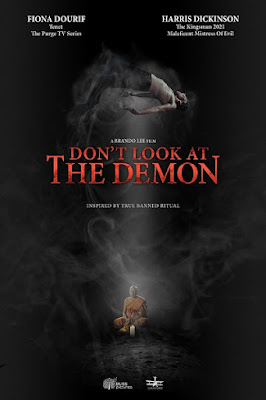
In horror movies, you scoff at secretive, long-practiced rites at your own
peril. That is especially true of protective rituals, because chances are, you will
need them later. This small reality TV crew on-location in Malaysia certainly
will. There is something profoundly evil terrorizing the house they are about
to investigate in Brando Lee’s Don’t Look at the Demon, which opens in
today in theaters nationwide.
Jules
wants to cancel the painful tattooing ceremony her Skeleton Crew team are
filming, but the Thai Buddhist Monk basically tells her to cowboy-up, since she
is an American. Besides, he knows she has the “gift,” so her mind she be more
open to such phenomenon.
Jules
uses that sensitivity he detected to select their next case. Expat couple Ian
and Martha Benchley are convinced they are being tormented by poltergeists in
the fashionable Fraser Hill manor, but initially, Jules cannot pick up on
anything. Just when they are about to dismiss the Benchleys as
attention-seeking cranks, something big and uncanny shocks them out of their
dismissiveness. This case is genuine and it will be extremely dangerous.
We
get the usual reality horror ritual of setting up cameras around the house, but
the Skeleton Crew crew is in way over the head. Quickly realizing the
danger, Jules turns to the old monk for help. However, the baggage she carries
from her own childhood encounter with the demonic makes her especially vulnerable
to the entity threatening the Benchleys.
Reportedly,
Don’t Look at the Demon is the first Malaysian-produced film to get a reasonably
commercial theatrical distribution in America, beyond a few art-houses.
Initially, it seems relatively conventional, even though Lee’s execution is
tense and atmospheric, right from the start. However, the more it delves into
local ritual and lore, the feeling of dread also deepens and intensifies. In
many ways, Demon compares very directly to Banjong Pisanthanakun The Medium, but it is more accessible for general audiences—and not merely due
to the predominantly Western cast.
If you never saw and heard Savion Glover’s collaborations with McCoy Tyner,
you missed something great. The dancer’s upcoming “duet” with a past-his-prime
rock drummer looks far less promising, especially to the exasperated gala
director who paired them together. The resulting verbal confrontation (with tap
accompaniment) took on a life of its own for director-screenwriter Sally
Potter, who spun it off from the film it was originally part of, to stand alone
as the short film Look at Me, which screens this weekend in New York.
You
can tell Adam’s gala concert will be nauseatingly didactic, because he plans to
have Savion Glover (playing himself) and Leo performing on-stage in cages. It
is to benefit the “wrongly incarcerated,” as if Manhattan’s DA prosecuted
criminals anymore. You can really tell Look At Me was not made by a New
Yorker, once you take a gander at the apartment Leo shares with his lover. Who
might that be? Take a guess.
The
problem is Leo only seems to know one speed. He can’t help playing harder and
faster than Animal from the Muppets. However, this isn’t his gig. When Adam not
so gently reminds him of that fact, it unleashes a torrent of resentment from
the drummer.
Frankly,
the way Potter and actor Javier Bardem depict Leo just does not match the way
most musicians I know conduct themselves. In the real world, Leo would have
already reached some kind of consensus plan with Glover and would improvise
accordingly. Working musicians are professionals. Yet, Potter has Bardem
explode, so his rage can express predictable grievances rooted in identity
politics.
However,
it is interesting to see Chris Rock in a role requiring him to “stand his
ground,” in some respect, after that thing that happened. It is a nice performance
and quite the contrast to his established image.
Given the cast and
Potter’s reputation, Look at Me will probably reach several hundred
times the audience average shorts manage to garner. It is debatable whether that
is a good thing for actual gigging musical artists, because the film reinforces
the negative stereotype of musicians being unreliable, self-destructive
head-cases. At least viewers can hear Glover’s percussive feet and guitarist
Fred Frith on Potter’s soundtrack. Not recommended, Look at Me screens with
Orlando, Friday through Monday (10/7-10/10), at the Metrograph.
Amongst their many sins, the Weinsteins were irresponsible stewards of the Hellraiser
franchise. After the lackluster Hellraiser: Judgement, rebooting and
retconning away some of the accumulated lore wasn’t such a bad thing. There is still
plenty of gore, but the S&M fetishism is somewhat dialed down in David
Bruckner’s Hellraiser (2022), which premieres today on Hulu.
Quite
fittingly, Selena Menaker acquired the notoriously evil puzzle box for her wealthy
boss, Roland Voight, in the sinister-looking city of Belgrade, during the
prologue. Despite his desire to master its infernal secrets, he disappeared
from the world under mysterious circumstances and his estate was mothballed. A
few years later, Riley McKendry, a recovery drug addict, agrees to help her
low-life boyfriend Trevor steal the last remaining box in his old storage unit.
Of course, that holds the Rubik’s cube from Hell, which she accidently
activates.
However,
it draws the blood of her infinitely more responsible brother Matt instead of
hers. When he inevitably disappears, to suffer the demonic Cenobites’ torments in
their Netherworld (known as the Lament Configuration in previous films), she
immediately makes the connection with the box. However, Trevor and Matt’s
boyfriend Colin assume it is the crazy junkie in her, coming out again.
Nevertheless, she convinces Trevor to help her research Voight’s lurid past,
starting with the infirm Menaker.
The
reboot got a lot of cheerleading publicity from the announcement a woman had
been cast as the Hell Priest (a.k.a. Pinhead). Jamie Clayton is certainly makes
a scarier, more interesting Pinhead than Paul T. Taylor in Judgement,
but she still cannot match Doug Bradley regal wickedness as the original.
To
compensate, Goran Visnjic contributes some colorful human villainy as Voight,
while Haim Abbas performance as the guilt-wracked Menaker is unusually complex
for the horror franchise. In general, the Cenobites look more Giger-esque this
time around—so British action star Selina Lo is nearly unrecognizable as “The
Gasp.” The real trouble is Odessa A’zion and Drew Starkey have to carry a large
portion of the film, but their portrayals of Riley and Trevor completely lack
charisma and common sense. It is hard to picture a less appealing on-screen
couple.
Traditionally, vampires were tall, dark, and handsome, lustily populating hot-blooded,
sexually-charged gothic horror stories. Then Tomas Alfredson’s 2008 film
adaptation of John Ajvide Lindqvist’s novel introduced viewers to a tiny, pale
vampire leading a lonely existence in a bleak, frigid Scandinavian suburb. Now,
Showtime’s series adaptation relocates its story to New York City. So much for
that distinctive vibe. At least there is still a twelve-year-old (looking) vampire
in creator Andrew Hinderaker’s Let the Right One In, which premieres tomorrow
on Showtime.
Eleanor
Kane and her father Mark move around a lot, because she is a vampire. They have
finally returned to New York (which always reminds people of Blackeberg,
Sweden), because her dad hopes finding the vampire who attacked and turned
Eleanor a decade ago will hopefully lead to a possible cure.
Of
course, “young” Kane will be home-schooled and kept safely locked inside the
apartment. He will do all her hunting, just like Eli’s old familiar in the
film. Despite his caution, she still manages to befriend Isaiah Cole, the
bullied little boy living next door. That inevitably alarms her protective father,
especially when he learns Cole’s mother is a NYPD detective. Yet, he is also
happy to see her finally making friends and enjoying herself.
Big
Daddy Kane believes he might have stumbled across a lead during his
blood-hunting, after he kills a junkie exhibiting vampire-like symptoms. For
background on the new designer drug, the desperate father targets a low-level
pusher, who just happens to be Isaiah’s dead-beat dad. Small world, right? This
is all somehow connected to Claire Logan, a brilliant medical researcher, who
just learned a few months prior she had a shocking connection to the undead.
Right,
there is a lot here fans of the Swedish Right One (or the American Los
Alamos-set remake) will not recognize. Look, I do not want to always be the “Remake
Cop,” but what made Alfredson’s film and the St. Ann Warehouse theatrical
production so special was the chilly, austere vibe (it snowed on stage and it
was magical). That is not here. Yes, it incorporates the outsider friendship
that blooms between Eleanor and Isaiah, but her relationship with her father takes
precedence in the series. By calling it Let the Right One In, Hinderaker
is inviting these comparisons, so why not create something entirely new, or at
least call it From the World of Let the Right One In or Let Another
Right One In or whatever.
That
would have better served the series, because once fans get past their
disappointment over how the urban chaos that squeezed out all the original’s Spartan
intimacy, they might appreciate the things that works. Demian Bichir is
terrific as Kane, especially the way he portrays how the desperate father holds
on to his Catholic faith. Based on the first five episodes, Right One is
surprisingly faith-friendly, without ever getting preachy.
Young
thesps Madison Taylor Baez and Ian Forman are quite professional and appealingly
sympathetic playing Eleanor and Isaiah. Anika Noni Rose and Jimmie Saito (as
Cole and her partner Ben Jones) also have good cop chemistry together doing all
the police procedural business.
Shota Rustaveli's The Knight in the Panther’s Skin is sort of like the
Georgian Troilus and Criseyde. Like Chaucer’s heroic verse, it
chronicles lovers separated by war and strife, but Rustaveli’s epic poem is
arguably of far greater importance to Georgian literature than Chaucer’s epic
is to English letters. It spans years and oceans, so it is maybe not so surprising
the first film adaptation of the modern age is animated. If Prince Tariel and
his beloved Nestan are not reunited, the good knight Avtandil will at least die
trying in Mirza Davitaia’s The Knight in the Tiger’s Skin, which opens
tomorrow in Los Angeles.
Rustaveli’s
epic is often referred to as The Knight in the Panther’s Skin, but
Davitaia’s film and his graphic novel before it drapes the knight in “Tiger’s
Skin.” The tiger print must be slimming. It is definitely the same classic story.
When we first meet Tariel, the Prince dutifully serves his king, whose daughter
he ardently loves and is loved in return. When the king repays their loyalty by
marrying her off as part of a diplomatic alliance, both react badly.
As
a result, Nestan’s aunt angrily sells her into slavery, but is almost
immediately overcome by such remorse, she commits suicide. Tariel soon sets off
in search of his distressed love, but as the years pass, he also seemingly disappears
from the world. It will be the herculean task of the brave knight Avtandil to
find them both, before he will be allowed to marry his own great love.
It
is easy to see many heroic archetypes Tiger’s Skin shares with other
great epic poems, but Davitaia’s adaptation also expresses pronounced themes of
martial comradery and manly fellowship. Eventually, it comes down to three
friends storming a Dungeons & Dragons-worthy stronghold to rescue
the Princess.
Davitaia’s
animation incorporates rotoscoping techniques that are surprisingly effective.
It intensifies the vibrancy of the colors and the contrasts between them. The
exotic scenes of the various royal courts and palaces pop off the screen,
almost like Peter Max paintings. The animation also conveys the chaos and
intensity of the battle scenes, which have appropriately epic scope.
Like many people today, Abby and Liam Walker have left the corruption of
Massachusetts in search of opportunity in Texas. Unfortunately, the corruption
has followed them. Liam was supposed to be the town’s new sheriff, but he was
murdered on the trail. She was also left for dead, but leaving-for-dead works
just about as well in westerns as it does in horror. Naturally, she wants
revenge and the suspicious new replacement sheriff goes to the top of her list
in the pilot episode of Anna Fricke’s Walker: Independence, which
premieres tomorrow on the CW.
After
she and her husband were gunned down in the dead of night, Walker wakes up in
an Apache camp. For understandable reasons, the noble (and rugged jawed) Calian
is reluctant to walk her all the way into town, but he will be her first ally.
Shortly thereafter, she will have an awkward first meeting with irresponsible
outlaw Hoyt Rawlins, but they will also forge a weird alliance of convenience.
According
to Calian, the town’s deputy is a decent fellow, but newly installed Sheriff
Davidson gives off seriously villainous vibes. It turns out he is also from
Boston, but he was part of the corrupt machine there. Cautious about announcing
herself, Walker finds temporary employment with Kate Carver, a showgirl of some
repute and Kai, an immigrant Chinese laborer. At the end of the episode, we
also learn one of them has a secret sideline that should wear well throughout
the first season.
Independence
is
a Yellowstone-like prequel spinoff to the CW’s rebooted Walker.
None of the characters from the contemporary series could credibly guest-star,
since there is roughly one hundred and forty years separating their timelines,
so fans of the original Chuck Norris series could pretend it is a prequel to it
instead.
Indeed,
they might want to, because Independence shows all kinds of potential.
Comparing pilot to pilot, Independence might represent the rare spinoff
that far surpasses the quality its parent series. Whereas Walker presented
itself as the corporate diversity seminar version of the Texas Rangers, Independence
is nicely setting itself up as an old school western. It is very clear Abby
Walker intends to get justice or revenge, which ever comes first.
Nobody ever had fun on a ship in the movies and they probably never will,
unless the Love Boat eventually gets adapted to the big screen. There
will certainly be no love, fun, or safe spaces on this cruise. The Korean
Justice Department procured a cargo ship to secretly ferry ten highly dangerous
extradited criminals from the Philippines. The bad news is the bad guys have a
plan to hijack the ship. The worse news is there just so happens to be someone
more dangerous than them on board. Things will get spectacularly messy in Kim
Hong-sun’s Project Wolf Hunting, which opens Friday in theaters.
There
was an “incident” at the airport the last time the cops brought back a group of
extraditees, so they want to keep this one on the down-low. Unfortunately, the
sinister, serpent-like Park Jong-doo managed to replace several crew-members
with his thugs, who will easily take control of the ship. The surviving cops
think they are merely facing a Die Hard-type situation, but it gets
worse.
Unbeknownst
to the cops and criminals alike, a strange and savage humanoid is also somewhere
on the ship. The shadowy cabal pulling all the strings brought a replacement
doctor on-board to keep it safely sedated, but in all the confusion, it
inevitably rouses, proceeding on an awesomely gory rampage.
It
bears repeating there are absolutely no safe spaces in this movie. Wolf
Hunting is the kind of film in which people are bludgeoned to death with
their own limbs. It is all about action, energy, and adrenaline. Yet, there are
a few characters that are sufficiently vivid, most viewers will feel bad when
they meet an unfortunate end. Seriously, don’t get too emotionally involved.
Sadly, too many Vietnam veterans could relate to the indifferent and sometimes
hostile homecomings these Austrian POWs experienced after WWI. In retrospect,
this turned out to be a terrible long-term social policy. Fully cognizant of
the scars he carries, former Lt. Peter Perg is skeptical he can transition back
to civilian life, but the ex-cop agrees to help his former colleagues hunt for
a serial killer preying on his fellow army veterans in Stefan Ruzowitzky’s Hinterland,
which releases Friday on VOD.
This
is 1920 Vienna, but it looks a lot like Tim Burton’s Gotham. Using digital technology,
Ruzowitzky immerses his cast in a highly expressionistic urban jungle, inspired
by Dr. Caligari and other silent films of the era. It looks amazing,
like film noir from Hell, in a good way.
However,
Hinterland also has a narrative of some substance to go with its stunning
visuals, unlike many would-be dazzlers that forget the other elements that
produce a worthy film. Perg has a real case to investigate and macabre clues to
uncover, as further horrific murders are discovered.
Initially,
the only one who really wants him involved in the case is Dr. Theresa Korner, a
woman as you might have guessed, whom the police commissar reluctantly promoted
to her current medical examiner position during the War, simply because there
were no qualified men at the time. Yet, she also remembers first-hand Perg’s
brilliance during previous cases.
Ruzowitzky
does not ring this bell obsessively, but it is pretty easy to see from their
treatment from interwar society why many of Perg’s fellow veterans would be
radicalized by the National Socialists. Ruzowitzky also nicely shows the not-so
cold war being waged between the Communists and various nationalists in the
city’s streets and back alleys. Ironically, even though a great deal of the
picture was digitally generated, Hinterland has a keen sense of time and
place.
If you seek attention in a horror movie, you will get attention, but not
the kind you want. Shawn Ruddy, a live-streaming un-fluencer agrees to spend
the night in a haunted house for followers and sponsors, but the nasty spirits
he riles up are far more dangerous than he anticipated in Joseph & Vanessa
Winter’s Deadstream, which premieres Thursday on Shudder.
The
disgraced Ruddy really screwed-up with some kind of ill-conceived bum-fighting
video. Freshly re-platformed and re-monetized, he is hoping his haunted
escapade will launch his comeback. Knowing what a scaredy-cat he is, Ruddy
chucks his car’s spark plugs into the woods and drops the key to the front door
through a grate in the floor. Obviously, he will soon regret doing this.
Evidently,
Mildred, a frustrated Mormon Emily Dickinson hanged herself in the house. Subsequently,
several kids also met untimely ends in the spooky manor, all of whom start scaring
the heck out of Ruddy, which he duly live-streams. That is why he is so surprised
when Chrissy, one of his “followers,” crashes the party, even though the evil
house is completely locked and boarded up.
Deadstream
shares
a similar premise with several previous movies, such as The Deep House
(and the graphic novel Creeping), but the execution is so energetic, it
often reaches heights of true mania. Granted, Ruddy is a total jerkweed, but co-director-lead
thesp Joseph Winter defiantly leans into his cowardly, self-absorbed
shortcomings. He also plays off the weirdness Melanie Stone brings as Chrissy
quite effectively.
Bugs and worms tend to grow large out in the desert, like in It Came from the Desert or the Tremors series. At least that franchise had some
humor to help the wacky premise go down easy and some survivalists, who were
properly supplied for a siege. Unfortunately, the Barstow cop at the center of
this film gets caught flat-footed in Dale Fabrigar’s They Crawl Beneath,
which releases today on VOD and DVD.
Danny
Moritz has been crashing with his slacker Uncle Bill, while he and his
girlfriend Gwen Bishop have been fighting about everything and nothing.
Inconveniently, old Bill did not have a proper jack, so when the mutant worms
attack while they are working under a vintage muscle car, Bill gets crushed to
death, leaving Moritz alone, precariously pinned underneath, and potentially at
the mercy of the toxic worm-things.
Frustratingly,
the film is stuck right there with Moritz, trapped under a car, in Uncle Bill’s
garage, which is sealed up like a prison, for unlikely reasons. Of course, Moritz
passes in and out of consciousness right when his colleagues from the force
come to check on him. Indeed, nearly everything about Tricia Aurand’s screenplay
will have viewers slapping their foreheads, especially when Moritz starts
arguing with his mental projection of Uncle Bill. It might be time to temporarily
retire this device, considering how effectively Panhandle and The Flight Attendant recently employed it.
It
is too bad the narrative is manipulative to the point of annoying, because the
practical creature effects are really cool. It shows a low budget
creepy-crawler film get look professional. Sadly, the quality of writing is not
much better than drive-in staples like Kingdom of Spiders.
Apparently, vampires aren’t so woke after all, since they happen to be such nasty
fat-shamers. If you don’t have six-pack abs, you’re not getting turned.
Reginald Andres is the exception. His sire did not plan on turning him, but it
was the only way to save the nebbish Andres in executive producer-showrunner
Harley Peyton’s Reginald the Vampire, which premieres Wednesday on Syfy.
Andres
is a nice guy, but he never had a chance to fulfill his potential. Stuck
working at the Slushy Shack, he carries a torch for his co-worker Sarah Kinney,
but he lacks the confidence to recognize she kind of likes him too. However, Maurice
Miller can see it.
Having
just arrived in Akron, the vampire has already become a regular at the Slushy
Shack (these vamps can still consume regular human food). Since he is a cool
vampire, Miller “glamours” Andres to ask out Kinney. When she says yes, he
agrees to tutor the now fully cognizant and somewhat panicked Andres for his
big date. Unfortunately, that is why Andres happened to be with Miller when
vampire enforcers from Angela Hibbert (the local vampire queen bee) came to
deliver a violent message. They couldn’t resist feasting on Andres, so Miller offers
him a choice (after the resulting carnage). Die and stay dead or die a few seconds
earlier and come back reborn.
Of
course, it is not quite that simple. The vampire Reggie is locked into his old
schlubby human body, which definitely makes him an outlier among vampires. In
fact, they consider him a freak that should be eliminated, especially Hibbert,
who was originally Miller’s sire, but is now his deadly rival.
There
is a lot of vampire intrigue in Reginald, but it is the characters that
really wear so well over the course of the first five episodes. Arguably, Peyton’s
adaptation of Johnny B. Truant’s novels perfects the balance between fannish
humor and vampire peril better than just about any film or series since Buffy
and Angel.
Jacob
Batalan (Ned Leeds in the Spider-Man movies) portrays Andres as a
genuinely likeable loser, while Mandela Van Peebles is super-cool and smooth as
Miller. Frankly, the latter looks so much like his father in his younger days,
the show almost makes us wonder if Mario Van Peebles might be a vampire
masquerading as his own son. Em Haine is sweet and quirkily off-center enough
to be a good match for Andres, but never to an annoying extent.
Even if it is not wildly popular when it airs on Syfy, it would be great
if this sequel inspired more mature straight-to-DVD franchises to reinvent themselves
in the horror genre. The Sniper and The Marine could fight
zombies, The Cutting Edge could feature stalkers on ice, and the steamy Wild
Things thrillers could easily accommodate a Carmilla-like vampire. However,
the long-running Bring It On did it first, when a mysterious slasher starts
killing the Diablos cheer squad in Karen Lam’s Bring It On: Cheer or Die,
which premieres this Saturday on Syfy.
Twenty
years ago, one of the Diablos cheerleaders died during an aerial stunt,
partially due to jealous sabotage from within the squad. Abby Synger’s estranged
mother was one of the guilty cheerleaders. Now, she is on the Diablos cheer
squad, but strict Principal Simmons has flatly banned any aerial moves. That
means they always finish dead last (so to speak) in competitions. However, this
year Synger wants to be different. She and her co-captain convince the squad to
give up their Halloweens, so they can secretly train their prohibited routines,
to surprise everyone at the state meet.
Conveniently, the newest team member can get the key to the old shuttered
high school, because she is Simmons’ adopted daughter, but she assures everyone
she is no snitch, including her sister, who is also on the team. Inevitably, once
they are in the spooky old building, someone dressed as the Diablos mascot
starts knocking them off, one by one.
There
is no doubt Cheer or Die will be too restrained for most slasher fans. This
film is not so scary, but neither is A24’s critically anointed Bodies Bodies Bodies either. Halina Reijn’s screenplay got more laughs out of its chaotic
premise, but screenwriters Rebekah McKendry and Dana Schwartz scribbled out
some reasonably clever, appropriately attitude-heavy dialogue. Alten Wilmot
gets most of the laughs as vain Mateo Adamos, one of the guys who throws the
girls into the air and catches them, at least if he were allowed to.
In the previous series, Dr. Sam Beckett often jumped into a body just about
as it was about to be clobbered by a haymaker. Sooner or later, the new leaper,
Dr. Ben Song was bound to get similar treatment. He is somewhat fortunate his chin
music comes from a mere sparring partner at the start of tonight’s Quantum
Leap episode, “Somebody Up There Likes Ben.”
Obviously,
the writers of the current continuation series are somewhat familiar with the classic
Paul Newman boxing film, so give them points for cinematic literacy. The 1970s
vibe is also pretty cool, but unexpected. The big non-spoilery development of
this episode is the fact Song somehow managed to leap beyond his own lifetime.
There will be other technical difficulties for the team that might have a
bearing on the ongoing mystery as to why Song was compelling to leap without
warning.
Obviously,
winning Danny Hill’s title fight will most likely factor into Song’s efforts to
set things right. However, he also must help the fighter’s manager-brother start
dealing with his PTSD. To its credit, this episode demonstrates great empathy
for Vietnam vets like Daryl Hill, who is indeed callously called a “baby-killer”
during the hour-long drama.
Normally, Tales from the Crypt’s Crypt Keeper is our host for horror stories. This
time he is the guest star, when Terry and Jesse, the two younger pro-Halloween
aliens from Planet Shlorp, mad scientist him out of a purloined corpse as a way
to celebrate the scary season. Chaos and foul language ensue in A Sinister
Halloween Scary Opposite Solar Special (a.k.a. Solar Opposites S3
E12), which premieres tomorrow on Hulu.
As
fans of the series know, Korvo dislikes Earth, but he really, really hates
Halloween. Yumyulack isn’t too crazy about either, but he is less emotional and
more contemptuous expressing his distaste. However, Terry and Jesse, who act
like the kids of the space-expedition-turned-family are totally down for it.
Frankly, they show us why Halloween, which very much is a nostalgic throwback
to small town Americana, can never be canceled (outside of pandemics or inclement
weather)—because an army of kids would rise up in arms.
Excited
to participate in the neighborhood house decorating campaign, Terry and Jesse plunder
a grave, reviving and mutating the body into an EC Comics like horror host, who
constantly spouts off little macabre anecdotes—in the voice of John Kassir,
from the long-running Tales from the Crypt franchise. Naturally, the
Crypt Keeper drives Korvo to distraction, but Yumyulack is not around to be
annoyed, due to a rather unfortunate misadventure.
If
you have not seen Solar Opposites before, it is easy to pick up the gist
of it from the Halloween special. Think of it as My Favorite Martian with
cussing and oral sex jokes. It is raunchier than The Simpsons but it
also has a sharper edge, while being far less didactic. Just about anyone
across the political and cultural spectrums can laugh at the Solar Special without
ever feeling attacked.
In the future, the Blumhouse production company might have their own
episode in talking head horror documentaries like this. They do not toot their
horn so much in their own survey, but a lot of their comentators’
talking-points sound very much like the same old stuff we’ve heard before.
However, Robert Englund’s narration definitely gets you in the mood to rewatch a
lot of the films discussed in showrunner James Buddy Day’s five-part Blumhouse’s
Compendium of Horror, which premieres tomorrow on Epix.
Blumhouse
and Day break down horror by general chronological periods, starting in the
1930s, with the classic Universal monsters. This is generally the best episode,
as long as you won’t wonder where the silent German expressionists are. Next, “Atomic
Nightmares” episode does a pretty good job chronicling the rise of Japanese kaijus
and their low-budget American mutant cousins. However, the pejorative use of
the term “red scare” to describe the themes of films like Invasion of the
Body Snatchers is not entirely appropriate, given what we now know about
Soviet covert activity at the time. At this point, nobody seriously denies the
US Communist Party was wholly controlled by Moscow and actively abetted Soviet
agents engaged in espionage.
Bizarrely,
Hammer, Universal’s British successor, is almost completely ignored in “Unholy
Dreams,” which largely focuses on 1960s and 1970s horror as an expression of
the counter-culture’s interest in exoticism and the occult. Even more troubling,
it completely misrepresents Friedkin’s classic The Exorcist as a
subversive attack on conventional Christian values. The truth is William Peter
Blatty, who adapted the screenplay from his own novel, was a devout Roman
Catholic, who believed the Church was our last, best, and possible only defense
against evil. If you were to compile a list of the great Catholic films of the
20th Century, The Exorcist would rank towards the top—very possibly
#1. To so badly misunderstand and distort its significance reveals the
problematic biases of the critics who appear in Compendium.
The
next episode is somewhat better, discussing 1980s slasher films in the context
of the sensationalistic media coverage of real-life serial killers. The final
fifth episode was not yet provided for review, but there is a good chance it misses
an important point. As a genre, horror is at a turning point. It has never had
greater prestige. Yet, as Compendium often points out, in the past,
horror has often reflected society’s anxieties, sometimes without consciously intending
to do so. Recently, many horror films have stopped reflecting widely held fears,
opting to tell viewers exactly what they should fear instead. There have been
dozens of climate change horror movies, but really none of them amounted to
much.
Yat Boon jai (a.k.a. “The Man with No Name”) is right about one thing when
he accepts this dodgy courier gig. It would indeed be a last chance to see the
real Hong Kong as it truly was before the 1997 handover, which turned out to be
a national tragedy for Hongkongers. Unfortunately, the naïve Asian American with
a taste for flashy cowboy apparel will be in over his head navigating the HK underworld
in Wayne Wang’s Life is Cheap … But Toilet Paper is Expensive, which also
had a rocky reception when it was originally released in 1989. Ripe for reappraisal,
a new, slightly revised and freshly restored print of Wang’s film is now screening
at the BAM cinema.
The
unnamed courier, who actually seems to have a name on imdb and other online
sources, has no idea what is in the briefcase he carries for his boss’s
colleague. He doesn’t want to know, as long as it is not drugs. He is supposed
to give it only to “Big Boss,” but apparently it is not important enough for
the senior Triad to make time to see the Courier. As a result, he is left with
too much time on his hands. His boredom leads to danger when the Courier starts
hanging with Big Boss’s femme fatale mistress, Money.
Life
is Cheap generated
controversy when it was originally refused an “X” rating, eventually becoming
one of the first films to carry an NC-17. It is hard to fathom why. Admittedly,
there is a hand-chopping motifs that often recurs, but it looks cheesy compared
to modern gore. Wang also captures some duck butchery that might disturb some
viewers, plus it all builds towards a truly scatological punch line, but it
still seems tamed compared to its reputation.
Frankly,
Wang’s pseudo-documentary style, often incorporating long monologues resembling
interview segments, might have been ahead of its time in 1989. Fifteen years
ago, Life is Cheap might have suffered in comparison to other Jia
Zhangke docu-hybrids and the like. However, in post HK “National Security” Law
2022, it feels like a sad elegy to a ruckus Hong Kong and a vibrant local
culture that no longer exists. Gone are the days when the son of American
immigrants from Hong Kong can return to their homeland, to film a gritty,
experimental gangster movie, guerrilla-style on the city’s streets.
In
fact, the film reaches true heights of elegiac lyricism when martial arts legend
Lo Lieh appears in one of the docu-interludes, portraying a former pianist, who
cut off his own arm rather than compromise his integrity during the Cultural
Revolution. Life is Cheap might be getting a new lease on life here in
America, but there is no way you could screen it in Hong Kong today.