Charlie
Chaplin was the Jerry Lee Lewis of silent cinema—several times over in fact.
Fortunately, he lived in an era when men could simply marry the under-aged girls
they might have impregnated and sweep the whole business under the rug. Of
course, it was all dashed uncouth for J. Edgar Hoover to use that sort of thing
against him. Chaplin’s loyalists keep up the PR fight, but it feels rather awkward
in the post-Jerry Lee, post-Cosby era. At least, there is also a fair amount of
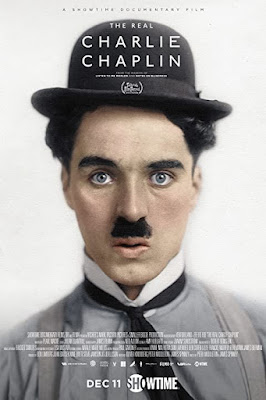
old school Hollywood history in Anne Le Boulc’h & Frédéric Martin’s Chaplin—Legend of the Century, which premieres
this Thursday on Chicago’s WWTW.
Presented
by co-writer-narrator Laurent Delahousse, Legend
was originally produced as part of France 2’s Une Jour, Une Histoire documentary series. The production’s Gallic crew
and perspective probably helped secure the participation of Chaplin’s
Francophone grandchildren. In fact, the film opens with the elderly Chaplin
about to return to Hollywood to accept an honorary Academy Award after twenty
admittedly comfortable years of exile in Switzerland. However, we are told J.
Edgar was also gnashing his teeth ominously in his Federal Triangle lair.
After
the bittersweet triumph of the Oscar ceremony, Delahousse and co-writer Laurent
Seksik flashback to Chaplin’s early Dickensian years in late Victorian London.
His father, such as he was, had once attained a measure of fame as a vaudeville
performer. Clearly, his absence and failings and his mother’s subsequent mental
health breakdowns had a formative influence on the young lad. Based on his
stand-out clowning in a touring British variety show, Chaplin was signed by
Keystone Studios, where he would eventually develop his celebrated “Tramp”
persona.
Chaplin,
Hoover’s bête noire, would become the first motion picture star to earn a
million dollar contract. He would also marry two women under the age of
eighteen, under rather hasty circumstances. The Laurents and the Chaplins try
to dismiss this as part of his parental baggage, but it is tough for
contemporary viewers to shake off the creepiness of it all. At least, his third
marriage to eighteen year-old Oona O’Neil (playwright Eugene O’Neil’s daughter)
would be the one to last.
Nobody
will deny Chaplin’ cinematic genius. He even a few great talkies in him,
including The Great Dictator, which slyly
capitalized on the toothbrush style of moustache he shared with the rising
Adolph Hitler. However, the narrative of victimization Delahousse and Seksik
try to spin gets tiresome quickly. Still, Le Boulc’h, Martin, and editor
Florent Maillent shrewdly incorporate vintage clips from his talking pictures
that speak directly to each stage of his life.
Viewers watching Legend will get a sense of the sweep of his life, which is
something. It is rather amazing how much Horatio Algerish success he attained.
However, he was undeniably a complicated, highly imperfect individual. There
might be documentary profile that better convey his complexities, but this is
the one will be programmed on participating PBS stations in the coming months.
It moves along at a good clip, but it obviously has it axes to grind, making
more of a partisan piece than a documentary to recommend and engage with.
Regardless, it airs this Thursday (11/14) on WTTW, repeating several times over
the next three days.