Showing posts with label French Television. Show all posts

Wednesday, July 01, 2026

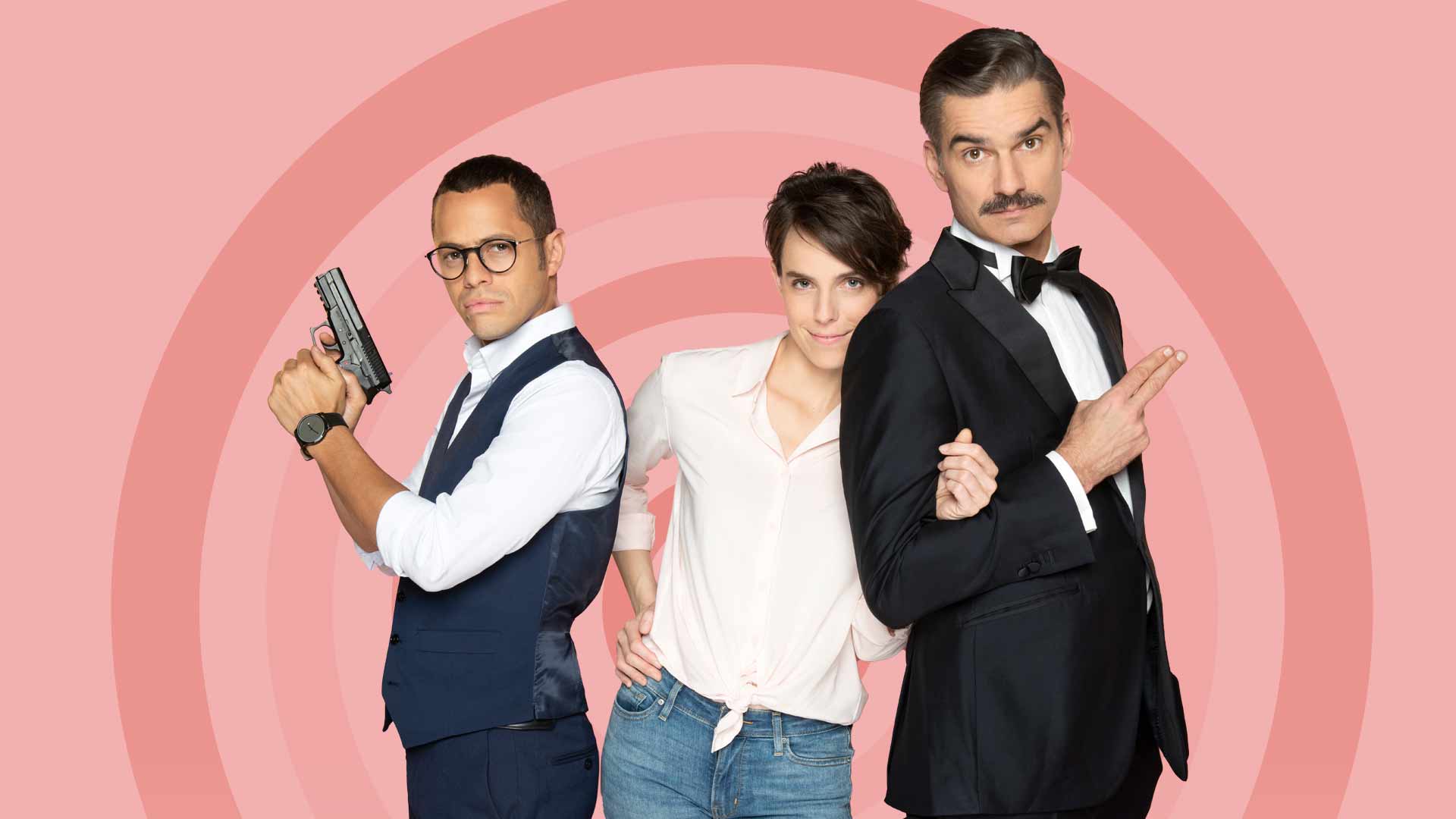
Zorro, on MHz


He fights injustice wearing fetish gear. So, you can either play Johnston McCulley’s Zorro dark and moody, or rather silly and randy. Many versions have opted for the latter. Remember George Hamilton in Zorro: The Gay Blade? At least Martin Campbell’s first movie with Antonio Banderas kept the mood light without getting too silly (but maybe not so much the second). In contrast, the short-lived newspaper comic strip really explored the darker side of Don Diego’s psyche. However, the new French-speaking swashbuckler leans back into broad farce throughout co-creators Benjamin Charbit & Noe Debre’s eight-episode French-language Zorro, which just released on MHz Choice.

Don Diego de la Vega has hung up his whip, retiring from Robin Hood-style vigilantism. Instead, he concentrates on boring public works projects he hopes to implement once he succeeds his father as alcalde of [Old] Los Angeles. Unfortunately, Don Alejandro has no confidence in his supposedly clumsy, over-intellectual son, so he refuses to transfer power, until he leaves office feet-first. Yet, he still bedevils Don Diego as a very judgmental ghost.

Of course, the old man never knew Don Diego was Zorro, the notorious “Fox.” Similarly, Don Diego never knew Don Alejandro had completely mortgaged Los Angeles to sly Don Emmanuel, who now intends to collect. As the crooked villain exploits the people with impunity, Don Diego once again assumes the guise of Zorro. As usual, he steals the hearts of women, including, much to his own consternation, his wife Gabriella’s. Given their marriage’s recent doldrums, Don Diego cannot help seducing her as Zorro, but then he feels the pain of betrayal as Don Diego.

Indeed, a more serious treatment might have made considerable psychological hay out of Don Diego’s split persona. However, Charbit, Debre, and writer Emmanuel Poulain-Arnaud largely play the situation for naughty laughs. Frankly, in terms of tone, this Zorro often feels like a Mission-flavored prequel to Jean Dujardin’s
OSS 117 spy spoof franchise.

In contrast, Audrey Dana is terrific navigating her unusual love triangle, with sensitivity and passion. Weirdly, Gregory Gadebois is also quite memorable, as Sgt. Cristobel Garcia, of the Los Angeles garrison. Unlike the portly soldiers who were weekly fat-shamed on the Disney-Guy Williams series (which remains one of the more successful Zorro productions), Garcia comes to self-consciously embrace Zorro as the nemesis that gives meaning to his existence.

Wednesday, March 04, 2026

The Hunt, on Apple TV+

Sure, Franck and his cronies are French, but they own guns, hunt, and drink heavily, all at the same time. They are not the only ones. During a Sunday hunting excursion, a rough, somewhat legally questionable hunting party opens fire on Franck’s friends, so they shoot back, killing one of them. It was self-defense, but it ignites a feud worthy of hill country in writer-director Cedric Anger’s six-part The Hunt, which (finally) premieres today on Apple TV+.

The Hunt
was delayed several months due to legal issues when the rights holders of Douglas Fairbairn’s novel Shoot and the 1976 film adaptation (starring Cliff Robertson and Ernest Borgnine) objected to similarities. Yes, they share common elements, but if they were truly actionable, hundreds of films should have paid clearance fees to Richard Connell’s estate for The Most Dangerous Game, before it fell out of copyright in 2020.

Regardless, Franck, Xavier, Simon, and Gilles all find themselves in a fire-fight that fateful day. The gang shot first, giving a Xavier a profusely bleeding trump-like bullet wound to the ear, but apparently Franck’s group are more accurate shots. Fearing the consequences of their actions, the ambushed hunters hope to return to their lives and pretend it never happened. However, the outlaws soon start stalking and threatening Franck and friends.

Clearly, Franck is the alpha male of their pack, so the well-heeled hardware store owner takes the lead sleuthing out their rivals. In contrast, Xavier, Simon, and Gilles are all quite sad and rather passive. Leo is easily the next most formidable member of their circle. He did not accompany them on that particular trip, but he immediately rallies behind them. As a medical doctor, he can also treat Xavier’s wounds off the books.

Logically, Franck also has the most to lose, starting with his more sophisticated wife Krystel, Leo’s medical partner. They also have a young son with discipline problems and a teen daughter who just started dating a suspiciously older boyfriend. However, Franck’s greatest vulnerability might be the mistress he has kept out of sight.

Anger’s non-adaptation is a presentable thriller, but a tighter, shorter presentation would have thrilled even more. Frankly, this could and probably should have been a feature, because Anger gives us more than enough scenes of Franck driving on endless errands and tripping around the thugs’ roadhouse. However, the subplot following Krystel’s efforts to find a missing runaway teen pay-off better than expected.

Wednesday, April 30, 2025

Carême, on Apple TV+

Marie-Antoine Careme is considered the first celebrity chef, who greatly shaped French cuisine as we still know it with his recipes for the so-called “mother sauces.” During the aftermath of the French Revolution, Careme was also one of the first chefs who had to worry about getting “chopped.” Whether he likes it or not, the culinary prodigy caters to some of France’s most powerful leaders, even including Emperor Shorty, in co-creators Ian Kelly & Davide Serino’s eight-episode Carême, which premieres today on Apple TV+.

Careme was never particularly political, but his mentor and adopted father Sylvain Bailly was a little too free with his ant-Bonaparte sentiments. As the cops drag Bailly off, he urges Careme to seek out Prince Talleyrand, the Machiavellian foreign minister and sleazy Clark Clifford-like behind-the-scenes power broker.

Unfortunately, seeking Talleyrand’s help is like jumping out of the frying pan into the fire. Reluctantly agreeing to be Talleyrand’s spy in the Tuilieries, Careme steals Napoleon’s itinerary, which the old schemer uses the stage a false flag assassination attempt that he conveniently foils. Consequently, the deeply compromised Careme finds himself at Talleyrand’s mercy, especially with Minister of Police Joseph Fouche connecting the dots.

Fouche represents a dangerous choice of enemies. He is an unrepentant Jacobin, who literally sent thousands of his countrymen to their death. Fouche’s political allegiance might have switched to Napoleon (ostensibly, much like Talleyrand in that respect), but his true loyalty is to the guillotine. Indeed, it is important to remember the Jacobin’s blood-thirsty authoritarianism laid the foundation on which modern socialism was built.

Careme would rather just cook, but he must navigate Talleyrand’s feud with Fouche. Of course, he cannot trust either, as he quickly figures out. At least Henrietta, the maid serving Talleyrand’s consort, Catherine Grand. has her charms. Agathe, Careme’s chief deputy in the kitchen, also finds him quite interesting too, but it is not clear whether the brilliant but distracted chef notices.

Although based on Kelly’s nonfiction book, the series appears to use a healthy amount of artistic license. Fortunately, it results in some intriguing drama. The bounteous secret alliances and double-crosses are all quite entertaining. Indeed, it is all quite French—as in the France of boudoirs, but not excessively so. In terms of explicitness,
Careme probably lands somewhere between NY Blue and vintage HBO.

Maybe Careme’s food really was delicious, but we’re all beater off eating in an era when chefs never double-dip their tasting spoons. Regardless, Benjamin Voisin’s Careme really isn’t the star, even though he is the title character and has the most screentime. Instead, Jeremie Renier takes complete ownership of the series with his wonderfully sly and devilishly charismatic performance as slippery old Talleyrand.

Friday, December 06, 2024

Paris Has Fallen, on Hulu

When you are a Secret Service Agent appearing in a string of action movies, like Gerard Butler in the Has Fallen franchise, chances are good you will have to take a bullet for the President, sooner or later. That is bad news for Vincent Taleb, the former protective services officer for the French president. Technically, he is no longer her bodyguard, but can’t quite break off their secret on-again-off-again love affair. As of episode one, he has been re-assigned to the defense minister, who becomes the first target of a massive terrorist conspiracy in creator Howard Overman’s 8-episode Paris Has Fallen, which premieres today on Hulu.

Minister Bardin is a bit sleazy, but Taleb could not be choosy after requesting a transfer from Pres. Levesque’s detail. Bardin will be lucky to have him when highly disgruntled former French Legionnaire Jacob Pearce takes the British embassy hostage. Bardin is his prime target, but Taleb is unusually resourceful. MI-6 agent Zara Taylor is another wildcard Pearce did not expect. Nevertheless,
Paris Has Fallen is the sort of series where just when the good guys think they have won a victory, something goes boom.

Paris
is the first of several planned international TV spin-offs from the film franchise, but they are mostly thematically related, rather than sharing characters and specific in-world history. Of course, protecting a head of state will most likely factor prominently in them all.

Frankly, Oveman and company never quite convincingly sell Taleb’s relationship with Levesque, but the French agent has solid personality-clashing chemistry with Taylor, who joins the response team as the official unofficial UK representative. Tewfik Jallab and Ritu Arya play off each other well, delivering banter with a sharp edge. They also both acquit themselves well in the many, many fight scenes.

Sean Harris seethes with conviction as Pearce. This is familiar terrain for him, having played super-villain Solomon Lane in the
Mission Impossible franchise. Yet, his portrayal still feels fresh and unflaggingly intense. Jeremie Covillault projects rumpled integrity as Matis, the chief of French intelligence. However, Emmanuelle Bercot is so cold and charmless as Levesque, it is almost impossible to buy into her relationship with Taleb.

Tuesday, August 20, 2024

TouTouYouTou, on MHz Choice


In the 1980s, France still had Yves Saint Laurent, but America had leg-warmers and spandex. They had Mitterand, but we had Reagan and contrary to what you might have heard, America in the Eighties offered far more professional opportunities for women. Consequently, an American spy reluctantly posted to France on an industrial espionage assignment has two potent weapons at her disposal: aerobics and feminism. French aerospace hardly stands a chance in co-creators Geraldine de Margerie & Maxime Donzel’s ten-part TouTouYouTou, which premieres today on MHz Choice.

Karine Lurdou could have been a great airplane designer, but instead she married pompous Didier, who treats her like a live-in maid, while he flails about hopelessly as a clueless executive at the Blagnac aeronautic company. Their daughter Laura hates them both—but her mother really can’t blame her. She pretty much hates herself too. Jane, the super-fit American expat uber-cougar who moves in next door does not exactly boost her self-esteem either.

Yet, that is ironically what Jane seems determined to do. She convinces Lurdou to try her aerobics classes at the community center. The 1980s craze had yet to reach Blagnac, so the moves and the style are all new to Lurdou and her friends. Her best friend, Mapi (who also happens to be the mistress of the aerospace company director) is skeptical, but Lurdou is receptive. Frankly, she gets the most of Jane’s message of physical and emotional empowerment, but she is also the only one who starts to suspect their aerobics instructor is a spy.

Obviously, there is an anti-American bias baked into
TouTouYouTou. However, Alexia Barlier is so terrific as the jazzercizing Mata Hari, she almost single-handedly flips the audience’s nationalistic loyalties. It isn’t just her wardrobe. Barlier is enormously charismatic and caustically droll. Watching her scheming and skulking about is highly entertaining.

Claire Dumas is also very good as Lurdou, convincingly portraying both her outer and inner transformations. In fact, the strength of their two performances makes the somewhat ambiguous conclusion so counter-intuitively satisfying.

Thursday, July 11, 2024

High Intellectual Potential, on Hulu

Forget lawers—happily. Cleaning ladies are the new go-to profession for TV series. This one is working on the right side of the law. Morgane Alvaro is also about the make the step up to lucrative consultant gigging when she helps point a police investigation in the right direction. Getting respect of her reluctant partner will be harder in co-creators Stephane Carrie, Alice Chegaray-Breugnot, and Nicolas Jean’s French series High Intellectual Potential, which premieres tomorrow on Hulu.

Alvaro has a high IQ, but her EQ is questionable. That is why she constantly gets fired from dead-end jobs. As the pilot episode, “West Wind,” opens, she is cleaning the Lille police station, where she notices Adam Karadec’s investigation is way off-base. Having a compulsive need for order, she ill-advisedly re-organizes his bulletin board. At first, he and his boss, Celine Hazan, throw her in jail, but of course, she is right.

Jeanne Levasseur was Karadec’s prime suspect, but Alvaro deducts from a quick perusal of the crime scene photos that she is a victim—and presumably in grave peril. Obviously, this makes Karadec look like an idiot, so he resents working with Alvaro when Hazan hires her.

Even after the third (of three episodes provided for review), Karadec and Alvaro still aren’t clicking as a team and she keeps showing him up. For their second case, “Malagasy Customs,” the bickering pair face a locked hotel room mystery, once they eliminate the victim’s lover, the last person seen leaving his room, as a suspect.

Once again, Karadec is woefully unobservant and not so inclined to reflect on his failings. However, the procedural takes sone interesting turns and it showcases Alvaro’s empathy. Far from unfeeling, she just has problems with authority, anger management, and impulse control. So, maybe she would not be super-fun to work with.

The second episode also introduces what will presumably the first season’s continuing story-arc, when Hazan agrees to investigate the disappearance of Alvaro’s first husband. The world assumes he absconded, but she believes he was the victim of foul play. As it happens, Karadec turns up something suspicious that hits close to home for Alvaro in the third episode, “Blind Man’s Bluff.”

The episode’s primary investigation focuses on the abduction of two young girls. The mother’s well-heeled parents initially suspect her ex-husband, but Alvaro quickly clears his name when she discovers his dead body. Lucky him. Regardless, the actually procedural and criminal business in the installment, written by the trio of creators, are probably the most suspenseful of the first three episodes.

Friday, December 15, 2023

Bardot, on CBC Gem

In the late 1950s and early 1960s, Brigitte Bardot movies probably contributed more to France’s trade balance than Peugeot and Citroen combined. She is still France’s most iconic celebrity, even though she hasn’t made a new film since 1973 (and her politics are a bit awkward). Mother-son writer-director-creators Daniele and Christopher Thompson lean into the sex and scandal of the movie star’s life in the six-part Bardot, which premieres today on CBC Gem, up in Canada, where a lot of people like to pretend they speak French.

Bardot was raised in a strict, upper-middleclass household, but her conservative father Louis could never really control her. At the age of fifteen she started making movies and commenced an affair with twenty-one year-old screenwriter Roger Vadim. That sounds creepy, but they were French, right? However, her parents did not see it that way. Yet, they eventually allowed him to marry their daughter when she turned eighteen, after several years of strict supervision.

Their first project together was …
And God Created Woman, which would be a breakout movie for both, especially her. Even though she was not yet a full-fledged star, the paparazzi swarmed her during the chaotic production (which is nearly the exclusive focus of the second episode) and their ferocity only intensified after the film became a scandalous sensation.

The Thompsons start with Bardot’s Lolita-esque teen years and take her through the tabloid-fodder aftermath of her work on Henri Georges Clouzot’s
The Truth. A lot of fans will be disappointed the Thompsons do not stretch the timeline further, to reach Jean-Luc Godard’s Contempt, which many cineastes must consider her best film.

In many ways, the Thompsons and lead thesp Julia de Nunez reinforce all the sex-kitten-in-a-state-of-arrested-development cliches about Bardot. Throughout all six episodes, she seems incapable of making good relationship decisions and displays a marked aversion to accepting responsibility for her life. While the treatment of Vadim is sympathetic, they essentially suggest Bardot ruined the career of her second husband Jacques Charrier. Perhaps not coincidentally, several episodes also end with the observation that Charrier and their son successfully sued Bardot for the way her memoir portrayed their marriage and her attempts at parenting.

Frankly,
Bardot the series lays waste to just about all the celebrities who crossed Bardot’s path, including her musical lovers Sacha Distel and Gilbert Becaud, producer Raoul Levy, and the “love of her life,” Jean-Louis Trintignant. Clouzot also comes off a bit rough at times, but he is redeemed at the 11th hour—Louis Do de Lencquesaing’s gruffly charismatic performance also helps tremendously in this respect.

It is hard to pass judgement on the Franco-Argentine de Nunez (a newcomer who won the role of Bardot in a nationwide casting call reminiscent of that for Scarlett O’Hara), because she is always so impishly kittenish and naively immature. Yet, we feel for her in later episodes, as the overwhelmed Bardot’s privacy is constantly violated and she is repeatedly betrayed by those around her.

Tuesday, June 13, 2023

Agatha Christie’s Criminal Games: The 1970’s, on MHz Choice


Few writers have been ripped-off as much as Agatha Christie. Seriously, how many And then There Were None clones have you seen? With that in mind, who could blame the Christie estate for cutting some licensing deals that are rather distantly related to her printed words? Swedish television developed a series based on Sven Hjerson, the meta creation of Hercule Poirot’s occasional companion, mystery writer Ariadne Oliver. Similarly, French TV has very loosely adapted some of Christie’s mysteries, with completely original characters in the ongoing series Agatha Christie’s Criminal Games. After seasons set in the 1930s and 1960s, the mysteries shift to the “Me Decade” when the ten-episode Agatha Christie’s Criminal Games: The 1970’s premieres today on MHz Choice.

In some ways, Captain Annie Greco is a feminist trailblazer, but she is also a tough cop, freshly assigned to city of Lille. Most of her insubordinate subordinate detectives are both sexist and incompetent, but Max Baretta has promise. His deductive instincts are not bad, but he has been banished to file room, because of his anger management issues.

Greco assigns Baretta as her partner, but his career resuscitation will come at a price. He must attend sessions with Rose Bellecour, the extremely fashionable psychologist they meet on their first case. Thanks to her parents’ cosmetic company, Bellecour has become the confidant of actress Anna Miller, whose co-star (and abusive ex) has just been murdered.

As the only episode of the season largely “inspired” by a particular Christie novel,
Endless Night, it is not surprising the like-titled episode is one of the most successful of the 1970’s. It also has one of the best guest-starring turns from Romane Portail as Miller. Those who prefer to watch rather than read Dame Agatha might know the 1972 film with Britt Eklund and George Sanders. If so, they can surely guess the killer, but that means Flore Kosinetz and Helene Lombard rather faithfully adapted it for Criminal Games.

The other episodes, which are almost wholly original, are more hit or miss. However, it is worth noting “The Mice will Play” incorporates elements of
The Mousetrap, with a mystery that hinges on an unwanted baby given up years prior. Poor Baretta also has a rare chance for healthy romance with Flore, an up-scale” “hospitality worker,” nicely played by Aude Legastelois.

Unfortunately, the bickering cats-and-dogs chemistry between Arthur Dupont and Chloe Chaudoye as Baretta and Bellecour gets very tiresome. Emillie Gavois-Kahn wears much better on viewers’ nerves over time as the no-nonsense Greco. However, her supposed obliviousness to the romantic interests of Jacques Blum, the coroner, also starts to wear thin. Furthermore, the hippy-dippiness of her new residence, the Nirvana Hotel, really gets shticky.

Monday, December 26, 2022

Alter Ego, on MHz


Inspector Dea Versini’s imaginary friend is sort of like Harvey, but instead of a big white rabbit, “Jimmy” looks like a slightly cheesy James Bond knock-off. She knows he really doesn’t exist, but he is a helpful sounding board when she faces problems in her investigations or in her personal life. That happens often, particularly with the latter. Of course, she tries not to advertise his existence (in her head), especially not to her by-the-book partner in MHz’s new French series Alter Ego, which premieres tomorrow.

Single-mom Versini is a highly intuitive detective and a total mess in nearly every other way. Fortunately, her long-suffering Captain (or whatever the French equivalent) usually lets her work alone. However, he insists she partner up with Matthieu Delcourt, a fast-tracked detective temporarily assigned from above. The chaotic Versini and the meticulous Delcourt mix like oil and water, but there is also a mutual attraction neither wants to admit. Yet, they wind up rolling together in the back seat of Versini’s car late in the first episode, not that Jimmy judges her for it.

It is also obvious right from the start Delcourt has his own secret agenda. However, he and Versini will still manage to clear new cases by the end of each episode—judging from the pattern established by the first two.

The pilot episode is surprisingly clever, using viewers’ expectations against them when a muck-raking environmental journalist is murdered. Their second case hits pretty close to home for Versini when a doctor is murdered at the hospital where her husband works. That is how he refers to himself. Versini prefers the term “ex-husband.” However, they still work together pretty well as parents.

The whole imaginary friend thing sounds pretty shticky, like an early 1980s Tim Conwy sitcom, but creators Stephane Drouet, Lionel Olenga, and Camille Pouzol lean more towards neurotic deep dives into Delcourt’s subconscious, sort of like
Play It Again Sam, but Jimmy is a lot goofier than the Bogart Jerry Lacy played in Woody Allen’s mind.

Tuesday, September 06, 2022

The Rope, on Topic

Ironically, nobody mentions String Theory in this series, even though it follows a group of scientists studying the origins of the universe, who become obsessed with a mysterious length of cord. Somehow, it just appeared, but it appears to stretch unendingly through the forest surrounding their research institute in co-creators Dominique Rocher (director of The Night Eats the World) & Eric Forestier’s three-part French series The Rope, which premieres Thursday on Topic.

Bernhardt Mueller is the director of a remote astronomical observatory. Its equipment is old, but still powerful and the sudden vogue of theories he and his wife Agnes hypothesized are poised to give the institute a new lease on life. Weirdly, a week before their critical “data harvesting” Serge Morel, the facility manager literally stumbles across a length of rope in the forest. Ulrik, Agnes Mueller’s colleague and secret lover, manages to bang up his leg trying to follow it, so he will not be available the next morning for Bernard’s rope-following hike. He will be the lucky one.

Days later, Mueller’s party remains unaccounted for. Of course, he and Morel managed to recruit the most angsty group possible, including terminally ill research director Sophie Rauk, Leila, an anxiety-ridden data scientist and her increasingly frustrated husband Joseph, and visiting scholar Dani Johannes, whose work explores the relationship between science and her lost religious faith. Out of all of them, Morel is the only you would want to be lost in the wild with. Yet, the rope seems to exert an obsessive hold over some of them, driving them forward, despite the risks and the dead bodies they start to encounter.

The premise of
The Rope is a bit like other suddenly-in-Hell-or-Purgatory films, like the endless stairs in Black Ops, but it also shows the perspective of those not stuck in the fantastical Sisyphean situation. In fact, it is even more compelling watching Agnes and Ulrik trying to fathom the depths of the universe than Morel’s crew compulsively following the rope. Still, the contrast between the mysteries of science and the mysteries of the cosmically inexplicable distinctively bifurcates and dramatically distinguishes The Rope from its predecessors.

Monday, September 05, 2022

UFOs, on MHz


The French Space administrations office for UFO investigations, known as GEPAN, developed such a flaky reputation, it rebranded several times, changing its acronym to SEPRA and then to GEIPAN. Didier Mathure was maybe part of the problem. The closed-minded director of CNES assigned him to be the interim head, in order to clear its cases and shut it down. However, Mathure ill-advisedly develops Fox Mulder-like tendencies in creators Clemence Dargent & Martin Douaire’s UFOs (a.k.a. OVNIs), which premieres tomorrow on MHz.

Mathure was an elite scientist at CNES until the rocket he dedicated the better part of his career to exploded after take-off. As penance, the slimy agency director transfers Mathure to GEPAN, with the clear expectation he will close it down, stifling all talk of UFOs in the process. However, the perverse combination of Mathure’s spectacularly bad PR skills and his naïve misapplications of scientific method have the opposite effect. Interest in UFOs boom, along with reports.

Mathure does not necessarily believe one way or the other, but veteran French Air Force officer Valerie Delbrosse does. In fact, she encourages (blackmails) Mathure to make his findings public. However, that would hurt his ex-wife Elise Conti’s prospects of securing a high-level appointment at the European space agency. Still, he is starting to admit there might be something to a handful of select cases his predecessor started investigating, before disappearing on a sudden leave of absence.

UFOs
plays a lot of its X-Files-style business for laughs, particularly an alien-abducted flamingo and the bawdy postcards Mathure’s missing predecessor sends the staff, which they assume are clues. However, the underlying conspiracy narrative is still sufficiently interesting that it would probably still hold up if the tone were more serious. The late 1970s milieu adds a lot of funky texture (the references to the under-appreciated The Invaders are especially on-point), but the series sometimes fudges a little. Technically, Albert Barille’s Once Upon a Time…Space aired after Giscard’s presidency, but whatever.

Regardless, Melvil Poupaud, radically playing against type, is the engine that drive the show’s comedy. He is a lot like Fraser Crane—often painful to watch, but somehow, we keep rooting for him. He also has terrific chemistry with Geraldine Pailhas, who is highly entertaining when cutting him down to size. On the other hand, the shtickiness of Vera Clouseau (as the hippy dippy GEPAN receptionist-case interviewer) and Quentin Dolmaire (as the Trekker computer specialist) gets a little tiresome.

Wednesday, June 09, 2021

Moloch, on Sundance Now


It is the most important part of fire and brimstone. You can’t have apocalyptic wrath without the fire and a messianic lunatic appears to have the uncanny power to control it. The shadowy figure with the demonic moniker instills fear and paranoia throughout Paris in Arnaud Malherbe’s six-part Moloch, which premieres tomorrow on Sundance Now.

Louise Joli is an intern going nowhere at a French newsweekly, until she uncovers some fresh information on the unexplained combustion of a merger & acquisitions hotshot. It turns out he was a patient of Dr. Gabriel Matthieu, a psychiatrist who will also treat the traumatized young son of the second immolation victim. It turns out the doctor also has a horribly tragic backstory that must be relevant in some way.

Joli and Matthieu start off badly when she clumsily tries to trick him into revealing confidential patient information. However, as the killer continues to ignite new victims, the shrink and the aspiring journalist agree to work together. Most of the responsible French society is gripped with fear, but the anarchist protestor demographic starts to embrace mystery fire-starter dubbed “Moloch” as a cult hero. Tensions really explode when Moloch torches a thug who controlled a housing project the media refers to as a “sensitive neighborhood.”

Moloch
could have leaned into its horror elements much more heavily, but Malherbe and co-writer Marion Fetsaets emphasize the investigational and psychological dynamics just as the fantastical premise. There are definitely eerie moments, but the genre ambiguity is one of the things that makes it so intriguing.

Sunday, April 25, 2021

Wonderland, on MHz Choice


Sometimes, it isn't just the music. We miss the clubs themselves once they are gone, so we want to recreate them (and the memories they facilitated). We realize this only too well now in New York, after news of the Jazz Standard’s closing. Hopefully, they can successfully relaunch themselves in the future. Tony Beliani never lived to meet his son, but Beliani junior still tried to recreate his father’s swinging 1960 Biarritz nightclub in modern day Paris. Somehow, a luckless loser manages to travel back in time from the new club to the original in writer-director Herve Hadmar’s 6-episode time-travel fantasy Wonderland (a.k.a. Romance), which is now streaming on MHz Choice.

Jeremy has been underachieving since failing out of medical school. After his wife divorced him, he has been living with his sister and her kids. Frankly, getting a job at the rebooted Wonderland club is a step up for him. Beliani was skeptical, but he managed to talk himself into a job, through his knowledge of jazz and retro mixed drinks. On his first night, he is struck by a photo of a beautiful woman on the beach with her back turned to the camera. While cleaning up, he puts a vintage Odetta record on the turntable and finds himself transported back to the 1960 club.

The confused Jeremy wanders the beach, until he happens across a party, just in time to save a reveler from drowning. She is the younger sister of entitled Chris Desforges, who happens to be engaged to the mysterious Alice, the very woman in the photograph. The Desforges immediately welcomes him into their circle, but as Jeremy (assuming the identity of his old, cranky med school teacher) observes their group dynamics, he realizes he has been sent back in time to save the moody Alice from the ominous fate hanging over her. He also falls for her hard, which makes things increasingly awkward around her violently jealous fiancé.

Wonderland
is a terrific time-travel romance that incorporates strong mystery-thriller elements. It takes a decidedly dark turn when it reveals Alice’s secret, but it makes perfect sense in light of France’s 20th Century history. Admittedly, the ending does not make much sense (it probably should have concluded five or ten minutes sooner), but most of the time travel stuff is quite effective—especially the frequent reappearances of the fateful Odetta album. The selection of her haunting “Deep Blue Sea” is also tonally perfect.

Wednesday, November 18, 2020

No Man’s Land, on Hulu

This is a good series, but we would have survived without it. Unfortunately, in our haste to withdraw from Iraq, we created a vacuum ISIS/Daesh was delighted to fill. From there, they advanced into Syria. However, the Kurdish Women’s Protection Units (the YPJ, previously documented by Bernard-Henri Levy) shocked Daesh and the world with their tenacious resistance. They are particularly feared by Daesh, because death at the hands of a woman does not entail martyr status—hence no paradise and no virgins. Average Frenchman Antoine Habert suspects his estranged sister Anna has joined the YPJ, so he ill-advisedly travels to Syria to find her in co-creator-writers Amit Cohen, Ron Lesham, Eitan Mansuri & Maria Feldman’s 8-episode No Man’s Land, which premieres today on Hulu.

Habert kept trying to reach out to his sister after she fell out with the family, until she was killed in a random terrorist attack in Cairo. He always had his suspicions about the official story, but Habert still went on with his life. Then he happened to see some footage of YPJ soldiers in Syria. Something about the body language of a western volunteer reminded him of his sister, even though her face was not visible. He becomes so obsessed, he crosses over the Turkish border into Syria, making him a target for Daesh and opportunists who would sell him out.

Meanwhile, three British Daesh recruits, Nasser Al-Shammri, Iyad Bel Tagi, and convert Paul Wilkins are steadily building their reputations within the terror group’s ranks. The latter two are blind believers, but Al-Shammri is more skeptical of their brutal excesses. Yet, as British military veteran, his skills are more valuable to the organization. Further complicating the unstable mix, “Stanley,” a suavely British secret agent with clandestine ties to several players, is also operating in the region.

The deeper Al-Shammri penetrates into the heart of Daesh’s so-called caliphate, the scarier it looks. Cohen and company do not sugarcoat the horrific implications ISIS-occupied territory.
No Man’s depiction of Islamist terror is not as viscerally intense as Sissako’s Timbuktu, but the series is intended as an entertaining thriller (and it is rather grabby).

Monday, August 31, 2020

Pieges, on MHz

Elsa Aubry is about to receive an Indecent Proposal, but it won’t jeopardize her marriage—just her soul. Some unknown benefactor will offer her one million Euros, ostensibly as an inheritance, if she simply kills someone, who supposedly really deserves it. The dedicated wife and mother is not a murderer, but she desperately needs the money. Of course, the offer is also not as straight-forward as it is initially presented in creator-co-writer Chris Lang’s two-part French drama Pieges, which premieres tomorrow on MHz Choice.


Clearly, murder is not an enforceable contract item, but the lawyer Dugard maintains willful ignorance. He merely schedules a meeting with Aubry and gives her a flashdrive with a video file to be watched in his absence. If she refuses, Aubry still pockets 5,000 Euros for her troubles. However, if she returns in three days, she will learn who she must kill and when.

Aubry’s first instincts were to go to the police. However, her husband Marc convinces her to at least take the 5K. They are already struggling to make ends meet, even before her Leukemia-survivor daughter Zoe suddenly suffers a relapse. Ordinarily, Aubry would never entertain such an offer, but when Zoe’s only hope is an experimental treatment in Chicago not covered by insurance, Marc is willing to consider it for her.

The format of
Pieges is relatively unusual these days, consisting of two hour-long installments, but it divides quite evenly, both in terms of narrative break and emotional tone. In fact, Pieges is quite effective and compelling, because Lang and co-writers Julien Teisseire, Claire Lemarechal, and Simon Jablonka go micro rather than macro when they reveal the truth behind the secret conspiracy. Instead of an international internet cabal, what is going on is actually deeply personal.

The likable and sympathetic Aubry family dynamics further raise the stakes. It is rather notable and refreshing that Marc is Aubry’s second husband, but Zoe fully accepts him as her father figure. As a result, we can credibly accept any decision they might and still root for them.

Thursday, December 19, 2019

Iskander: Shadow of the River, on Shudder


The last time most viewers saw French Guiana on screen, either Steve McQueen and Dustin Hoffman or Charlie Hunnam and Rami Malek were escaping from a French penal colony in their respective Papillons. Neither film exaggerated the steamy climate. The French overseas department borders Brazil and Suriname, but it is as frog as the Champs-Elysees or French Algeria until 1962. As such, the same Gendarmerie and National Police are responsible for the law enforcement. It is a tough posting, but Chloe Bresson is a tough cop, but not exactly a diplomatic or politically shrewd one. Her first case in the tropical region turns into a nightmare with supernatural dimensions in the four-episode Iskander: Shadow of the River, directed by Olivier Abbou, which premieres today on Shudder.

Bresson’s new boss has no illusions how she ended up in Guiana. Her career is in freefall, but she still refuses to change her hard-charging ways. Although they clash initially, she just might be the perfect partner for Det. Joseph Dialo. He is much better equipped to deal with the indigenous population (just about anyone would be), but he is just as driven. In fact, he will become even more obsessed with their latest (and first case), for personal reasons that will be revealed over time.

The bodies of a Western couple are found brutally murdered and strung up on the mast of their small yacht. There is also the body of an exsanguinated sloth, but their six-year-old-ish son is missing. Given the hallucinogenic properties of the sloth’s blood and the word “Iskander” carved into the victims’ chests, the detectives quickly conclude the crimes are the work of a voodoo cult. Bresson follows up references to Iskander in previous case files, while Dialo simultaneously pursues his own leads, from more personal sources.

Iskander is loaded with atmosphere, dread, foreboding, and an especially keen sense of place, but the narrative could have benefited from a little tightening. Frankly, it might have been better conceived as a two-hour feature than a three-hour-and-change limited series. Be that as it may, it is cool to see such a dark, Conrad-esque exercise in genre storytelling. Even though Abbou and creator-co-screenwriter Aurelien Moras are careful to respect all Guianese ethnicities (except maybe the temp-working Euro French), it still pretty impressive they have the guts to build a horror story around voodoo rituals and indigenous lore.

Monday, January 11, 2016

Chaplin—Legend of the Century

Charlie Chaplin was the Jerry Lee Lewis of silent cinema—several times over in fact. Fortunately, he lived in an era when men could simply marry the under-aged girls they might have impregnated and sweep the whole business under the rug. Of course, it was all dashed uncouth for J. Edgar Hoover to use that sort of thing against him. Chaplin’s loyalists keep up the PR fight, but it feels rather awkward in the post-Jerry Lee, post-Cosby era. At least, there is also a fair amount of old school Hollywood history in Anne Le Boulc’h & Frédéric Martin’s Chaplin—Legend of the Century, which premieres this Thursday on Chicago’s WWTW.

Presented by co-writer-narrator Laurent Delahousse, Legend was originally produced as part of France 2’s Une Jour, Une Histoire documentary series. The production’s Gallic crew and perspective probably helped secure the participation of Chaplin’s Francophone grandchildren. In fact, the film opens with the elderly Chaplin about to return to Hollywood to accept an honorary Academy Award after twenty admittedly comfortable years of exile in Switzerland. However, we are told J. Edgar was also gnashing his teeth ominously in his Federal Triangle lair.

After the bittersweet triumph of the Oscar ceremony, Delahousse and co-writer Laurent Seksik flashback to Chaplin’s early Dickensian years in late Victorian London. His father, such as he was, had once attained a measure of fame as a vaudeville performer. Clearly, his absence and failings and his mother’s subsequent mental health breakdowns had a formative influence on the young lad. Based on his stand-out clowning in a touring British variety show, Chaplin was signed by Keystone Studios, where he would eventually develop his celebrated “Tramp” persona.

Chaplin, Hoover’s bête noire, would become the first motion picture star to earn a million dollar contract. He would also marry two women under the age of eighteen, under rather hasty circumstances. The Laurents and the Chaplins try to dismiss this as part of his parental baggage, but it is tough for contemporary viewers to shake off the creepiness of it all. At least, his third marriage to eighteen year-old Oona O’Neil (playwright Eugene O’Neil’s daughter) would be the one to last.

Nobody will deny Chaplin’ cinematic genius. He even a few great talkies in him, including The Great Dictator, which slyly capitalized on the toothbrush style of moustache he shared with the rising Adolph Hitler. However, the narrative of victimization Delahousse and Seksik try to spin gets tiresome quickly. Still, Le Boulc’h, Martin, and editor Florent Maillent shrewdly incorporate vintage clips from his talking pictures that speak directly to each stage of his life.

Viewers watching Legend will get a sense of the sweep of his life, which is something. It is rather amazing how much Horatio Algerish success he attained. However, he was undeniably a complicated, highly imperfect individual. There might be documentary profile that better convey his complexities, but this is the one will be programmed on participating PBS stations in the coming months. It moves along at a good clip, but it obviously has it axes to grind, making more of a partisan piece than a documentary to recommend and engage with. Regardless, it airs this Thursday (11/14) on WTTW, repeating several times over the next three days.

Wednesday, October 01, 2014

NYFF ’14: Li’l Quinquin

It’s not Broadchurch and it’s certainly not Gracepoint, thank heavens. Murder will plague a provincial northern seaside village and deep secrets will be revealed, but everyone largely takes it in stride. This is especially true of the young troublemaking protagonist of Bruno Dumont’s Li’l Quinquin (trailer here), a four part French miniseries that screens in its entirety as a special presentation at the 52nd NewYork Film Festival.

The small but forceful Li’l Quinquin is more Napoleon than Huck Finn, but he is sweet and gentle with his girl friend Eve. She certainly appreciates the attention, because most of the town is focused on her teenaged sister’s audition concert for a French reality show. At least that was the big story around town, until a dead cow was improbably found in a remote WWII bunker. It happened to be a mad cow, with people parts inside it. That person was Madame LeBleu, the wife of a well to do farmer, who was having an affair with Bhiri, a kosher butcher for the local Muslim immigrant community. He too soon turns up dead, under similar circumstances, but he will not be the last to meet a premature end.

Captain Van Der Weyden will investigate the crime as best he can, but it is hard to imagine a flatfoot who inspires less confidence. A twitchy, socially dysfunctional bumbler prone to Tourrete-like squawking, Van Der Weyden is out of his depth, but he never passes up a chance for an annoying Colombo-like confrontation. Naturally, Li’l Quinquin rubs him the wrong way—and the feeling is mutual.

Anyone who has seen Dumont’s last four or five films would not have thought comedy was part of the severe auteur’s skill set, but he uncorks a genuine surprise with Li’l Quinquin. Of course, by comedy, we mean humor that is very dark and very dry (isn’t that the best kind?), punctuated by moments of almost slapstick absurdity. Yet, it still bears hallmarks of Dumont’s signature style, such as the lonely windswept vistas, the striking long takes, and the unsettling feeling that evil exists and its proximity is uncomfortably close.

As the title character, Alane Delhaye is hilarious, scary as heck, and more than half credible as a leading man. He is unusually expressive—you might even say his expressions are bizarre, but he commands the screen. Frankly, the film/mini-series would have been a train-wreck without him. However, Bernard Pruvost is almost just as weirdly effective as Van Der Weyden, a veritable bundle of tics and inappropriate comments, whose face appears to be about ninety percent eyebrows.


Despite its length (a mere two hundred minutes), Li’l Quinquin is Dumont’s most accessible work, by a country mile. The vibe roughly feels like he remade Hors Satan (his best recent prior film) with the Little Rascals. While some heavy-handed statement making regarding the town’s racist attitudes towards their unassimilated immigrant population adds a bit of unnecessary clunkiness, Dumont’s idiosyncratic humor still makes the considerable running pass quite swiftly. Highly recommended for fans of slightly surreal mysteries in the Twin Peaks tradition, Li’l Quinquin screens tomorrow (10/2) at the Beale, as part of this year’s NYFF.

Tuesday, February 18, 2014

Dolmen: Getting Blood from a Druid Stone

It must be one of those island prejudices. They do not think much of cops on Ty Kern, even when one of them is Marie Kermeur, the belle of the isle. She has returned home from Brest to marry her childhood sweetheart, but when dead family members start piling up, she insists on getting all detectivey in the six-part French miniseries Dolmen, which is now available on DVD from MHz Network.

The Kersaint and Le Bihan families are like the Montagues and Capulets of Ty Kern. The Kermeurs are civil with both, but you would not say they are close. Something happened way back when that tied the island families together. Everyone seems to know about it, except Marie, le flic. Her family is delighted to have her back on Ty Kern for her wedding to racing skipper Christian Bréhat, but they are just as eager to see her on her way. However, when her brother Gildas has a fatal misadventure near the island’s druid stone circle, Kermeur smells a rat.

Indeed, the circumstances surrounding his death are quite suspicious. For instance, one of the menhir stones starts bleeding his blood shortly after the murder (as foul play is soon established). Kermeur is also slightly agitated by her nightmare that sort of presaged his death. Initially, Kermeur is pulled from the case, for obvious reasons.  Of course, she quickly insinuates her way back into the investigation, because none of the locals will talk to Maj. Lucas Fersen, the hotshot officer dispatched from Brest.

In terms of tone, Dolmen is something of a throwback to the if-I-had-only-known novels of Mary Roberts Rinehart. Frankly, the series’ willingness to kill off Kermeurs is quite impressive, a bit like Game of Thrones in that limited respect. There is no getting around the melodrama of a bride-to-be mourning a brother and learning no end of deep dark family secrets. Still, series writers Nicole Jamet and Marie-Anne Le Pezennec make the most of the eerie Breton locales, incorporating supernatural legends and purported cult activity into the mix. In fact, for most of the series, it is an open question whether the happenings really are of an occult nature or whether there will be a tidy Scooby-Doo explanation for it all.

Teenage boys should keep in mind Dolmen is the product of French television, because Marie Kermeur is the sort of cop who can give men interrogation fantasies. Popular TV star Ingrid Chauvin truly has supermodel looks and soap opera thesp chops, but Dolmen arguably plays to her strengths in both respects. She also works out some decent chemistry with Bruno Madiner’s Festen, who steadily grows on viewers as he sheds his by-the-book stiffness.

Like a Twin Peaks off the Brittany coast, Dolmen is chocked full of colorfully cranky supporting characters, but by far the most intriguing is Patrick Ryan, an Irish mystery novelist and expert in Celtic lore, played with flair and gravity by Yves Rénier. French cinema connoisseurs will also be surprised to see Hippolyte Girardot appears as the churlish Kersaint heir apparent, but does not get his name in the opening credits. In fact, he is totally on the money as the resentful Pierre-Marie, but his character is not given much to do besides glower and sulk until episodes five and six. Likewise, Nicole Croiselle makes a great villain as Yvonne Le Bihan, somewhat looking and sounding like Cloris Leachman in Young Frankenstein, but always playing it scrupulously straight. On the downside, Chick Ortega’s portrayal of the developmentally disabled Pierric Le Bihan is pretty darn cringey.

Dolmen has enough mystery, intrigue, and windswept longing to seduce even the snobbiest viewers. Technically, there is even a ripped bodice, which is appropriate considering the series’ romantic mass market appeal. It is definitely really fun stuff (tailor made for binge viewing), like a slightly more gothic and popcorn-ish Broadchurch, with way more attractive leads. Recommended for those who enjoy French scandal, Dolmen is now available on DVD from MHz Networks.

Tuesday, October 29, 2013

Antigone 34: Anne Le Nen Takes Care of Business

Hard charging police captain Léa Hippolyte is not inclined to talk to the department’s resident psychologist, but she might be one of the few colleagues she can trust. Dr. Victor Carlier is a different story.  Hippolyte opens distrusts the ex-con, but she cannot ignore the suspicious circumstances surrounding his daughter’s murder.  It is a case Hippolyte will indirectly pursue throughout the French television series Antigone 34 (trailer here), which releases today on DVD from MHz networks.

Dr. Hélène de Soyère has just cleared Hippolyte to return to work following the suicide of her former partner.  It was an inexplicable tragedy her rival, the reptilian Perez, uses to undermine her standing among their colleagues.  Teaming up with the youthful Ravel, Hippolyte is called to the city’s medical college, where an attractive student has been killed in a hazing incident.  During the course of the official investigation, it is determined Mademoiselle Carlier was actually an inadvertent victim of a drug-related misadventure.  However, her recently released father turns up evidence of a wider conspiracy, involving the very same people who framed him for his wife’s murder.  Hippolyte is receptive to his claims, up to a point.

During the subsequent five episodes, Hippolyte works cases that are not directly related to the Carlier murders, but precipitate developments in the series-driving investigation.  Antigone 34 (sort of Montepellier’s equivalent of One Police Plaza) favors procedural grit over cleverly constructed mystery puzzles, but it is a well written show, deftly teasing out character development and revelations in the wider plot through the course of each episode’s casework.

The three cast members featured in the opening credits are all quite strong, but Anne Le Nen is truly the star.  A real life, fully certified Krav Maga instructor, she brings genuine street cred to her action scenes. Frankly, Antigone does not capitalize on her chops enough.  In the future, they ought to allow her to choreograph a few extended hand-to-hand sequences.  Regardless, her mature but sultry presence further distinguishes Antigone’s straight dramatic moments.

As the tightly wound Carlier, Bruno Todeschini (recognizable to some as Audrey Tatou’s inappropriate boss in Delicacy) broods quite nicely.  Of the primary trio, Claire Borotra probably gets the least to do episode-by-episode, but at least her de Soyère is convincingly smart and sensitive.  However, it is Bruno López who makes the strongest impression, following Le Nen.  If ever anyone just looked like a corrupt cop, it would be him.  As Perez, he serves as an effectively slimy foil to Hippolyte.

Although the DVD box says it is the “complete series,” mystery viewers will hope there is more Antigone 34 to come.  Episode six delivers some satisfaction for those who have invested in the Carlier case, but it is clear there is plenty of work left for Hippolyte.  It is a stylish series that capitalizes on the picturesque Montepellier locations, which are hardly over-exposed for American audiences. An entertaining showcase for the city and Le Nen, Antigone 34 is enthusiastically recommended for cop show fans when it releases today on DVD from MHz Networks, the international crime drama specialists.