Showing posts with label East German Cinema. Show all posts

Wednesday, August 20, 2014

Strange Lands: In the Dust of the Stars

Would you travel halfway across the galaxy to check out a prank call? Supposedly, that is exactly what this star-faring crew has done. However, once they arrive on TEM 4, they are assured there is nothing to see here, so please move along. Thanks to the brainwashing, most of them are inclined to agree. Of course, there is a sinister scheme afoot in Gottfried Kolditz’s In the Dust of the Stars (trailer here), which screens during the Film Society of Lincoln Center new series, Strange Lands: International Sci-Fi.

Say what you will about the locals, but they throw a smashing party. The entire crew is quite taken with their psychedelic hospitality, except Suko the navigator, who stayed behind to nurse his suspicions about the “accidental” distress call that brought them to this swinging planet. As a result, he is the only one not to get dosed by their sonic mind-blocking device. Rather put out by his fellow crewmembers’ giddy compliance, Suko will single-handed uncover the truth on TEM 4. However, it is not like his comrades would be much help, even under the best of circumstances.

Frankly, the Cynro crew inspires even less confidence than Peter Davison’s Doctor Who—and it starts right at the top. In 1978, a woman space captain might have been considered a progressive symbol, but Akala is no Janeway, not by a long shot. She is indecisive, gullible, and conspicuously frustrated by her unconsummated longing for Suko. Clearly, he shares her lust, but he makes do with a willing subordinate instead, presumably out of respect for the chain of command.

The entire Cynro crew looks like a wish fulfillment fantasy, consisting of a couple middle aged dudes and half a dozen hotties in mod jumpsuits. Indeed, Dust features some of the most flamboyant costumes this side of The Fifth Element. In terms of narrative, it is sort of like a middling Star Trek episode in which Yeoman Rand performs a naked interpretive dance, but Dust is really about its candy-colored sets and costumes, as wells as its free-loving melodrama.

It is hard to believe this was a co-production of the GDR and Romania. One can only imagine the expressions of bewilderment on the scoldy state censors’ faces as they watched the Temer dancers Vogueing through the “Boss’s” Henry Moore sculpture garden, but since the oppressed eventually rise up against their oppressors, Dust was apparently safe as houses.

The general hamminess of the ensemble hardly matters either. Arguably, Alfred Stuwe fares the best as Suko and Jana Brejchová (the one-time Mrs. Miloš Forman) gets by okay as Akala. On the other hand, Ekkehard Schall and Milan Beli bring extra cheese as the boss and his chief enforcer, Ronk.

Dust is a ton of fun in a trippy retro kind of way. Karl-Ernst Sasse’s groovy soundtrack is a classic of its kind and production designer Christa Helwig truly crafted a strange land. Recommended as a lava lamp curio from the DEFA filmography, In the Dust of the Stars screens this Saturday (8/23) at the Walter Reade Theater, as part of the Strange Lands film series.

Tuesday, August 19, 2014

Strange Lands: Eolomea

Eolomea is sort of like utopia or Erehwon, except it really might exist—maybe. It is one of the great debates of Prof. Maria Scholl’s age, but she is more concerned with the recent rash of vanished cargo ships. As she pursues her investigation, she will need the help of her summer fling in Hermann Zschoche’s Eolomea, which screens during the Film Society of Lincoln Center new series, Strange Lands: International Sci-Fi.

In a case of rotten timing, yet another space freighter loses contact with space station Margot just as Scholl is giving her report to the UN-like council of interplanetary busybodies. Strangely, her toughest critic, Prof. Oli Tal, seems to know all the details already, including the presence of his daughter on the latest missing vessel.

Tal was not always such a bureaucratic boor. He was once a hotshot flight officer, who was keen to initiate an expedition to Eolomea. Unfortunately, he could never entirely prove its existence, so no mission was ever authorized. Ironically, Tal becomes one of Scholl’s friendlier associates, as she diplomatically probes him for the truth. At least, he will meet her for lovely picnics and a spot of witty repartee. Still, he is no substitute for Dan Lagny, the disgruntled moonbase crewmember, whom she met during a recent seaside holiday. Although Lagny wanted to resign (and perhaps pursue a serious relationship with Scholl), he is too talented for Scholl to approve his release. Indeed, she will be quite glad to rendezvous with him when she lights off to Margot herself.

Of the major science fiction films produced by the East German studio DEFA, Eolomea is the critical redheaded stepchild, but it is really the best of the lot. Frankly, its withering depiction of a risk-averse bureaucracy stifling space exploration feels more John Galt than Erich Honecker (but perhaps the space station was a hat tip to his wife Margot). It also presents a rather crummy, dysfunctional vision of the future, not so very different from the GDR’s crummy, dysfunctional socialist present.

Yet, in subtle ways, it portrays how mankind has yet to emotionally acclimate to the interstellar age. This is particularly acute in the case of Pilot Kun, Lagny’s grizzled old comrade. Surprisingly, Eolomea is quite touching, serving as an elegy to the relationships and connections that were ultimately not meant to be.

As Scholl, Dutch actress Cox Habbema carries the film with grace, smartly playing off Rolf Hoppe’s Tal and Ivan Andonov’s Lagny. Hoppe (seen in Volker Schlöndorff’s English language Palmetto and a raft of German television productions) is a standout as the exasperating but charming Tal, while Vsevolod Sanayev nicely embodies the film’s increasingly confused human element as old Kun.

Arguably, Eolomea is a deceptively simple story, but it captures the romantic spirit of space exploration. Fans will also appreciate Günther Fischer’s groovy soundtrack, which sounds more in keeping with some of its trippier DEFA counterparts. Granted, the over abundance of temporal shifts is counterproductive, but it still has a unique vibe that sticks with you weeks after watching it. Recommended as the class of DEFA science fiction, Eolomea screens this Saturday night (8/23) at the Walter Reade Theater, as part of Strange Lands.

Monday, November 01, 2010

Wende Flicks: The Mistake

The personal should not have to be political, but it always was in the former DDR, often with tragic consequences. As a still attractive woman of advanced years, Elizabeth Bosch ought to be able to pursue a September romance with a handsome visitor to her provincial town in relative peace and privacy. Yet, since he is West German (a Hamburger), their affair attracts the wrong sort of attention in Heiner Carow’s The Mistake, the best and final film of the Anthology Film Archives’ Wende Flicks retrospective, which concludes at the landmark East Village theater this coming Wednesday.

Elizabeth Bosch has always cleaned up after other people, yet she does not even have hot running water in her modest pre-Wende East German home. That means she and her visiting grandchildren must take their baths in the yard, which catches the eye of the wandering Jacob Alain. Though he starts off on the wrong foot, he quickly wins over Bosch. It is not as if he has much competition, aside from Bosch’s boss Reimelt, a small man unfortunately blessed with a measure of power. The town’s slovenly mayor, he blusters about the hard work of building socialism unaware that it sounds like a punch-line to the weary Bosch.

While Bosch and Alain might ordinarily prefer to take things slowly, they simply do not have the time. For a while they make do with letters and all-too brief rendezvouses in East Berlin, but the situation is clearly not sustainable. When Bosch’s older Party loyalist son announces his promotion, it further complicates matters. Now family contacts with the West will come under increasing scrutiny.

Mistake is a sad but wise love story that also serves as a pointed reminder of what life was like under Communism. Bosch does not even have hot water, yet the Stasi still takes an active interest in her romantic affairs. It also pays tribute to those who stood up to injustice in the DDR, bringing together Alain, Bosch, and her younger son Holger at a candlelight Christmas prayer service for East German dissidents. Yet, it all has remarkable emotional heft thanks to finely nuanced work of its leads.

Angelica Domröse and Gottfried John look like an attractive, warts-and-all couple who we would like to see together. Yet, we know the system is stacked against them. Domröse is especially compelling, finely balancing strength and vulnerability as Bosch. It is one of the great unsung performances of world cinema.

One of the best cinematic depictions of mature romance, Mistake is an outstanding film. It is also a heartrending and infuriating document of life under the oppressive Communist system, yet its inescapable political implications never eclipse the human drama. Highly recommended, it screens this Wednesday (11/3) in New York as the concluding film of the Anthology Film Archives’ Wende Flicks retrospective of the East German DEFA film studio’s final productions.

Sunday, October 31, 2010

Wende Flicks: Burning Life

Thanks to the reunification process, the former DDR was spared most of the “Wild East” lawlessness that some former Soviet satellites had to work through (and has since been institutionalized in Russia). Despite the orderliness of Germany’s transition, two East German women bandits could still be embraced as cult heroes in Peter Welz’s Burning Life, which screens next Wednesday during the final night of the Wende Flicks retrospective of post-Fall of the Wall films from the East German DEFA studio at New York’s Anthology Film Archives.

Anna Broder is the outgoing one. A could’ve been jazz singer, she is seriously scuffling, with only a vintage Soviet Chaika sedan to her name. Always the quiet type, Lisa Herzog hardly reacts to her father’s suicide. Instead, she decides to take her pains and frustrations out on a bank. When Broder just happened to be there to provide a timely assist, it starts something bigger. Suddenly, they are on the lam with Herzog’s pet rat (named Nikita in honor of old Khrushchev), playing Robin Hood after each bank job. Of course, it is all rather embarrassing for the reconstituted post-Wende local authorities striving to re-assert their legitimacy.

Considering Burning’s unambiguous riffs on Ridley Scott’s Thelma and Louise, it is difficult not to draw parallels between the two films. However, Welz keeps the tone lighter, down-playing the feminist victimization themes that defined its American predecessor. By Hollywood standards, it is a decidedly apolitical film, aside from its cynical regard for authority.

Rather than document the still lingering decay of the East, Welz does his best to mask it, primarily going for humor instead, using Nikita in several gags and staging some musical numbers that stretch the boundaries of credible verisimilitude. If seen in conjunction with some of the other Wende Flicks that combine gritty naturalism with surreal absurdity, Burning will feel like an easygoing respite.

In fact, it is pleasantly amusing, in large measure due to the chemistry between leads Anna Thalbach (not playing her namesake) and Maria Schrader (who is an appropriately okay but not great vocalist). Though deliberately intended as a commercial road movie, Welz twists the genre enough to be interesting to American audiences. While it might be one of the slighter films of the Wende Flicks series, it was one of the more popular of its day. A likable diversion, Burning screens this Wednesday (11/3) at Anthology Film Archives.

Saturday, October 30, 2010

Wende Flicks: Latest from the Da-Da-R

A small school of late East German filmmakers came to embrace the anarchic surrealism of dada as the only logical artistic response to life under Communism. After the fall of the wall, the movement’s leading light was not about to go bourgeoisie. Produced in 1990, Jörg Foth’s Latest from the Da-Da-R puts East Germany (pre- and post-Wende) into an absurdist blender, invoking Beckett and Brecht in equal measure. Highly political but resolutely anti-ideological, Foth’s Da-Da-R screens next Monday as part of the Wende Flicks retrospective of post-Fall of the Wall films from the East German DEFA studio at New York’s Anthology Film Archives.

The humor of Steffen Mensching and Hans-Eckardt Wenzel was always edgy. The poet-singer-actors had adopted the clown personae for their provocative stage shows. Their clear debt to Brecht might have been a reason the DDR authorities tolerated their act, but their friends in high places (with impeccable “anti-Fascist” credentials) surely did not hurt. Yet, their iconoclasm must have raised brows. In Foth’s film, they essentially reprise their stage roles, as Meh and Weh, two clowns recently released from prison, set loose on Wende-era Germany. Have white-face, will satirize.

Trying to impose an ideology on their lunacy will result in migraines, but it is fair to say the old regime takes its lumps. Particularly cutting is a send-up of an old style Soviet medal ceremony that degenerates into a scene worthy of the Three Stooges. There are also pointed references to the extreme shortages endured under Communism. Yet, the new reality is also highly problematic. Indeed, Da-Da-R unmistakably questions whether it is truly merciful to free them from their apparently benign prison. All the while, Foth and cinematographer Thomas Plenert capture the DDR’s blighted landscapes and dilapidated public housing in all their depressing glory.

There are indeed moments when Mensching and Wenzel’s physical comedy is legitimately funny and some of their songs are actually quite catchy (albeit bizarrely so). Yet, Da-Da-R is hardly light comedy. There is a profoundly dark edge to their antics, which are clearly intended to disturb more than amuse.

Some interpret Da-Da-R’s journey and ultimate conclusion in hopeful terms. However, the most optimistic aspect of the film was probably the mere fact that it was allowed to be produced. Uncompromising in its Dadaism, it is a pointed summing-up of the DDR experience. Like most of the Wende Flicks selections, it is a film of tremendous historical importance that ought to be more widely seen and debated by cineastes. It screens this Monday (11/1) at the Anthology Film Archives, with an introduction from Foth, the filmmaker, who will also be in attendance for the screening of Miraculi.

Thursday, October 28, 2010

Wende Flicks: The Land Beyond the Rainbow

Arthur Koestler and his fellow apostates from Communism called the ideology “The God that Failed.” One can see how apt a term that was in Herwig Kipping’s The Land Beyond the Rainbow, a scathing critique of the secular religious fervor mandated by Stalinism. A selection of the 1992 Berlinale, Beyond remains a scorching critique of Communism, which screens next Tuesday as part of the Wende Flicks retrospective of post-Fall of the Wall films from the East German DEFA studio at New York’s Anthology Film Archives.

It is hardly a coincidence Beyond takes place during the eventful year of 1953. Of course, that was the year Stalin died. Three months later, Soviet troops invaded East Germany to suppress an outbreak of strikes and demonstrations. However, life appears peaceful in the fictional provincial collective of Stalina. Both Hans and Rainbowmaker have eyes for Marie, the film’s ethereal narrator. However, Rainbowmaker’s grandfather, a strict Party leader, brings the isolated community to grief.

From his cowl-looking cloak to his prayer-like invocations to the recently deceased Stalin, Rainbowmaker’s grandfather is an unambiguous figure of orthodox faith. He also appropriates whatever he pleases from the collective and purges members at will. However, his greatest specialty appears to be encouraging children to inform on their parents. Unlike more allegorical films produced behind the Iron Curtain, there is absolutely no question what he represents. In fact, Stalin’s apologists are probably watching Beyond in Hell for the rest of eternity.

Yet, the blistering Beyond cannot be dismissed as mere post-Wall score-settling, given the eerie rendering of the hyper-Communist community and Kipping’s occasional flights of surrealist fantasy. This is an angry film, but an artful one as well. It also features some surprisingly compelling turns from the then young trio of Stefanie Janke, Thomas Ewert, and Sebastian Reznicek, as Marie, Hans, and Rainbowmaker, the pre-pubescent love triangle.

There may truly be no more viscerally anti-Communist film than Beyond. However, Kipping’s in-your-face Christ-like imagery might put off some Christian audiences. Indeed, there are strong visuals throughout the film, the cumulative effect of which is a damning indictment of the DDR. Accordingly, anyone with a scrap of interest in the Communist and immediate post-Communist eras should make a special effort to see Beyond when it screens next Tuesday (11/2) as part of Wende Flicks at Anthology Film Archives.

Wednesday, October 27, 2010

Wende Flicks: Miraculi

Filmmakers working behind the Iron Curtain had a natural affinity for the absurd and the surreal. Given their experiences under Communism, they could easily relate to such Kafkaesque cinemscapes. It also behooved them to keep their social critiques obscured by layers of allegory and symbolism. A passion project only made possible by the fall of the Berlin Wall (or the epochal “Wende”), Ulrich Weiß’s Miraculi represents the culmination of such cinematic strategies. Finally produced in 1991, Miraculi screens next week as part of Wende Flicks: Last Films from East Germany (series trailer here), a retrospective of the East German DEFA studio’s final years (1990-1994), presented at Anthology Film Archives in conjunction with the Goethe-Institut New York.

In the Czech Republic, one of the few annoying holdovers from the Communist era are the plain clothes transit inspectors looking to fine riders who cannot produce their appropriately punched tickets. Evidently, East Germany had these transit narcs as well. Through a series of chance circumstances, Sebastian Mueller, a mild mannered juvenile delinquent, joins the ranks of the volunteer transit inspectors. In truth, he is not very good at his duties, but he takes them very seriously, alienating his father, who labels him a traitor to the workers.

Episodic and trippy, Mueller’s story defies pat description. In a strange way, Weiß invests Mueller’s reviled voluntarism with strange and cosmic dimensions. Yet, one can easily glean the power dynamics at work. As one character explains, stiffing the tram is truly the only safe method of rebellion available to her, so who cares if she is caught.

Miraculi’s dense layers of meaning are thought to be fully grasped only by those who experienced the oppressive drabness of the GDR. That may well be so, but there are plenty of signifiers astute westerners should be able to catch. Indeed, the significance of an abnormal psychology lecture delivered to Mueller and his fellow inspectors is hard to miss, if viewers have any familiarity with the Soviet bloc’s record of institutionalized psychiatric abuse.

Undeniably both subversive and demanding, there is no possible way Miraculi could have been produced under the Soviet-dominated GDR regime. It is a world away from Soviet Realism, even though it scrupulously captures the depressed grunginess of industrialized East Germany. It is a rich, challenging work, recommended to viewers who do not have to “get” everything they see, to appreciate a film. It screens this coming Monday (11/1) at Anthology Film Archives as part of the remarkable Wende Flicks series. Truly a cinematic event, many of the Wende selections have never been subtitled or shown outside of Germany, until now. Yet, films like Miraculi are both historically important and fascinating in their own right. The Wende Flicks series runs in New York from November 1st through the 3rd.

Friday, January 15, 2010

NYJFF ’10: The Axe of Wandsbek

Despite their rigid internal censorship, the East German state-owned DEFA movie studio occasionally slipped up and accidentally produced a film that ran afoul of their Soviet masters. Given the skepticism openly expressed for central state planning in Frank Beyer’s Trace of Stones, it is easy to understand why it was banned by the Communist government. The ideological sins committed by Falk Harnack’s The Axe of Wandsbek were less obvious. Dutifully casting the underground resistance to National Socialism as ardent Communists in a convenient act of revisionist history, Harnack seemed to touch all the right propaganda bases. However, when the authorities deemed the psychologically realistic anti-hero-protagonist too sympathetic, Axe was quickly yanked from theaters after its 1951 opening. Fortunately, the film survived to enjoy the new vogue for DEFA’s films, with a newly restored print screening this Sunday as part of the New York Jewish Film Festival.

It is 1934 in the Wandsbek district of Hamburg. In five year’s time, Germany and the Soviet Union will sign the Molotov-Ribbentrop non-aggression pact, dividing Poland between the two regimes. However, as Axe opens, there are four Communist prisoners in Hamburg the Fuhrer wants executed, but there is no executioner available to get the job done. As long as the “Reeperbahn Four” still draw breath, the Fuhrer refuses to grace the city with his presence, which is most distressing to the shipping magnate and local SS enforcer, Peter Footh. Times are also tough for Albert Teetjen, a local butcher losing business because he cannot afford modern extravagances, like refrigeration. However, when the desperate Teetjen seeks the help of his old army comrade Footh, he gets an offer he never expected. It involves his grandfather’s axe, made of the finest Sheffield steel.

Teetjen does indeed stand-in for the absent executioner, earning 2,000 marks for his efforts. Initially, everything seems to work out swimmingly. Customers flock to buy Teetjen’s refrigerated meat while celebrating Hitler’s triumphant tour of the city. However, when word leaks out about Teetjen’s grim freelance work, he is shunned by the community and hounded by the Communist underground.

Axe is a strange film. Though loosely based on an actual incident, the film’s central premise, that the Third Reich would have difficulty executing four prisoners, seems bizarre. It is also a somewhat odd selection for the New York Jewish Film Festival, because it never addresses the Holocaust. Aside from an anti-Semitic remark here and there, it suggests the Nazis were chiefly concerned with persecuting the Communists (with whom they would ally themselves during the early years of the war.)

DEFA was most certainly in the propaganda business, so it is important to keep that in mind while screening Axe. Still, it is worth parsing the ideology for Harnack’s stylish film noir elements, particularly the visual flourishes of his scene transitions. Erwin Geschonneck, a former concentration camp prisoner, does in fact humanize Teetjen, conveying his desperation and rather guileless nature. He emerges as a protagonist much in the tradition of Socialist Realism, who is forced by economic circumstances to commit a heinous crime and is then crushed by the same heartless world for his sins. Indeed, the film could be deconstructed into a critique of the fickleness of “the masses,” those that first cheered for Hitler and then turned against his loyal executioner.

In and of itself, Axe is a terrible history lesson, but as a controversial product of the DEFA studio, it is film of great historical importance. It is also a surprisingly entertaining dark thriller for those able appreciate it in the proper context. It screens Sunday afternoon (1/17) at the Walter Reade Theater, where the 2010 NYJFF continues through January 28th.

Monday, December 17, 2007

Trace of Stones

Trace of Stones
Directed by Frank Beyer
First Run Features

“The plan is a sacred cow,” says a party bureaucrat. Yet everyone knows the plan is hopelessly flawed, and questioning it can lead to a reprimand. Welcome to East Germany, circa 1966, as reflected in a scene from Frank Beyer’s industrial drama, Trace of Stones. If that sounds like risky material for East German cinema, one would be correct. Despite being produced as a prestige picture by the GDR studio DEFA, and heavily promoted as such, the East German authorities stepped in at the last minute, disrupting its premiere and then banning it outright. After twenty five years, it was finally given a proper premiere at the Berlin Film Festival, and is now available on DVD in America.

Trace is told in flashback through testimony at a party inquiry into Werner Horrath, the idealistic party secretary appointed to Schkona, a fictional behemoth of socialist engineering. The charges against him include: “immoral behavior as well as personal career-mindedness and political and ideological failures.”

At first, Horrath makes waves by openly questioning the flawed site plans and challenging the authority of Hannes Balla, the hard-living, rule-breaking boss of the Balla gang, the most productive work group on the site. (That the Ballas bear a certain resemblance to western cowboys probably did not help the film with GDR ideological authorities.) At first viewers root for the straight-laced Horrath as he stands up to the bullying of the anarchic Balla, but their relationship becomes much more nuanced as the film progresses and more of Balla’s character is revealed.

The married Horrath and the rebellious Balla both fall in love with a party engineer, Kati Klee, played by Polish actress Krystyna Stypulkowska (and dubbed by German actress Jutta Hoffman). As the love triangle unfolds, the Communist party apparatus looks increasingly grim, with the pregnant but unwed Klee facing a party star chamber seeking the identity of the father.

Ostensibly, Trace does not assail Communism—not directly, at least. Horrath and Klee remain loyal to the party throughout their travails. Balla however, is an antinomian wild card. While he and his entire crew are union members, only one belongs to the party. Though he might be reckless, he does live by a certain moral code, which appears to preclude party membership. He seems to even say this directly, in an off-hand comment to Horrath’s wife late in the film.

Perhaps the greatest surprise of Trace is the humor. As Balla, Manfred Krug at times shows a deft touch for comedic situations. He also convincingly conveys both the sensitive and loutish facets of Balla’s complex personality. Indeed, Trace is very well acted by all involved, including Eberhard Eshe as the well-meaning but timid Horrath.

It might not be Miracle on 34th Street, but as a good portion of Trace occurs during the Christmas season, this might be an appropriate time to screen it. It will definitely stand out. Though it is starkly naturalistic and ends a bit abruptly, it is a very satisfying film for its performances and honesty.

Eventually, Beyer would be allowed to direct again, bringing East Germany its only Academy Award nomination for Jakob, the Liar. He would later deal directly with the legacy of Communism in work for German television until his death in 2006. Based on the quality of Trace, one hopes his post-Communist work will also be released in America eventually

Tuesday, January 30, 2007

Coming Attraction (and Oscar Nominee): The Lives of Others

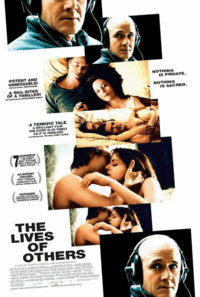
This year’s crop of Oscar contenders has been an underwhelming lot, but there is a bright spot. One of the nominees for best foreign language film, The Lives of Others (Das Leben der Anderen), offers profound insight into the nature of totalitarian systems and the human desire for freedom—and it actually comes from Germany.

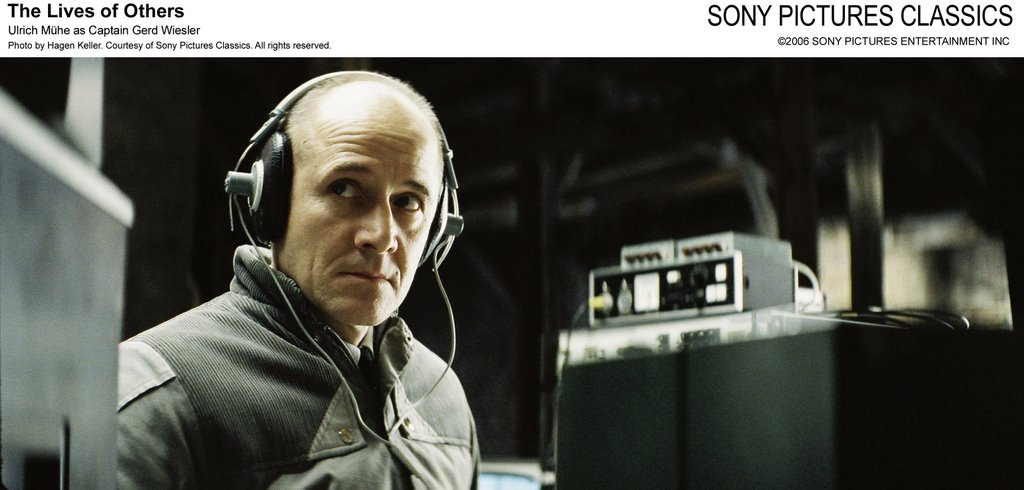
It is 1984 in East Berlin. The Communist Party rules through fear, using the Stasi, the State Security force, as their instrument of terror. Those of an artistic bent are most likely to be targets of Stasi surveillance, which usually leads to interrogation and internment in the feared Normannenstrasse headquarters. Ulrich Mühe plays Capt. Gerd Wiesler, a faceless Stasi functionary, who excels at his duties. However, during a routine assignment watching writer Georg Dreyman and his actress girlfriend Christa-Maria Sieland, played by Sebastian Koch and Martina Gedeck respectively, Wiesler experiences a gradual awakening of his conscience. As Dreyman, a former darling of the Cultural Ministry, conspires to write an expose for the western press, Wiesler takes tentative steps to protect his would be quarry.

Much has been said about Hannah Arendt’s concept of the banality of evil. Lives essentially portrays the converse: a cog in the wheel of an evil system, who comes to the realization that he can no longer actively participate in the Stasi’s crimes.

Writer-director Florian Henckel von Donnersmarck visited the GDR on several occasions as a child, and clearly the experiences had a lasting impression. His story is also well informed by the samizdat literary tradition. No aspect of Socialist (and it is explicitly identified as such) rule is romanticized—the atmosphere of fear is unrelenting. He truly captures oppressive environment of East Berlin, from the washed out colors to the Brutalist architecture, fitting for a brutal system.

On one level, Lives is quite effective as a kind of spy thriller, creating quite a bit of suspense. It is also a story of tragedy compounded, in which suicide is an important theme. Yet FHVD’s moving script concludes on an elegant note. The acting is first rate, particularly Mühe and Koch. Gabriel Yared’s score, including the crucial “Sonata for a Good Man,” perfectly fits the on-screen action. Appropriately, it was recorded by the Prague Symphony Orchestra.

This is an exceptional film, and clearly the class of the Oscar field. Whether the Academy concurs is another matter, but this is a film that deserves a campaign on its behalf. Released by Sony Pictures Classics, it opens in New York (at the Angelika) and in Los Angeles on February 9, unrolling around the country later. Viewers who seek it out will be well rewarded for their efforts.

(Welcome Gateway Pundit readers, you won't be dissapointed when Lives rolls out nationally.)