Showing posts with label Stasi. Show all posts

Sunday, September 25, 2022

1989: a Spy Story, on MHz

Before 1989, if you were named in Stasi records as a mole or an informant, you could count on that intel staying secret. After 1989, you were potentially in a heck of a lot of trouble. That is the position Saskia Starke finds herself in as a mole in America’ West German embassy in Sven Bohse’s 1989: a Spy Story (a.k.a. Wendezeit), a film produced for German television, which premieres this Tuesday on MHz.

Actually, Starke is not the original name she was born with. However, as the daughter of a high-ranking Stasi agent, she had to do her duty, assuming the identity of a West German leftist, who defected to GDR. The real Starke had been estranged from her former National Socialist parents, so it was easy for her imposter to re-start her life fresh in West Berlin.

Eventually, she married her husband, a diplomat in the West German embassy and wormed her way into an in-country analyst gig with the CIA. Yet, it was only by luck that her colleague Betsy Jordan blabbed during a dinner party about an operation to pick up a Stasi defector who could burn her. Starke manages to liquidate him before his rendezvous with the CIA, but that tips off the Agency that they have a mole in the embassy. It will be Jeremy Redman’s job to find the deep-cover Stasi agent. Supposedly, he is the one who sleuthed out the Walker spy ring—and he immediately suspects Starke.

She was once a true believer in Socialism, but Starke's faith has been shaken. However, she still ardently believes in staying alive and at liberty. Given her circumstances and shifting beliefs, her reactions to current events in the GDR are quite conflicted, but she has to put on a happy face at work. She also totally freaks when she learns her rebellious daughter has been secretly seeing an East German punker, for so many reasons.

1989
is a really smart and sophisticated espionage thriller (written by Silke Steiner) that has a lot of le Carre-esque betrayals and shifting loyalties, but is consistently critical of the Communist experiment in misery. It definitely looks and feels like 1989 (wasn’t that a great year) and Bohse keeps building the suspense as Redman gets closer and closer to uncovering Starke’s secret mission.

Wednesday, October 12, 2016

NYFF ’16: Karl Marx City

Michael Tucker often serves as the d.p. on the documentaries he co-directs with his wife and creative partner Petra Epperlein, but he has an unusual co-cinematographer on their latest project: the dreaded East German Stasi. Archival surveillance footage from the bad old days of socialism eerily supplement and illustrate Epperlein’s painful family history in Karl Marx City, which screens during the 54th New York Film Festival.

Although she came from a loving family, it is hard for Epperlein to feel nostalgic for her childhood in what was then called Karl-Marx-Stadt. The city changed its name back to Chemnitz as soon as it could in 1990, but the painful legacy would live on, especially for her parents. Epperlein gives us the run down on the scope of the Stasi’s operations at the time of the Fall of the Wall: 90,000 active agents and over 200,000 registered informants. The latter is particularly relevant to the Epperleins, because her father started receiving poison pen letters accusing him of being a snitch shortly after reunification.

Eventually, the stress, guilt, resentment, or depression became too much for Mr. Epperlein to bear, so he committed suicide after burning all his letters and photos. Indeed, the extent to which he tried to erase all traces of himself is especially disturbing for his daughter, so she launches an investigation into her father’s relationship with the Stasi, if any. She will find her answers and they will be a bitter pill to swallow, but maybe not in the way we expect.

KMC is an unusually moving documentary that could even be called revelatory. However, it takes viewers a bit of time to adjust to Epperlein’s aesthetics. The black-and-white cinematography—stark and stylish in the case of Tucker, but just plain stark as far as the Stasi is concerned—is certainly apt and fittingly evocative. However, the rather surreal scenes of Epperlein carrying oddly large boom mics seem distractingly absurd until we realize the exaggerated filmmaker persona is part of a defense mechanism. Slowly, Epperlein lowers her mask, allowing us to viscerally experience her family’s pain—and it stings.

Tellingly, Epperlein takes great pains to call out Florian Henckel von Donnersmarck’s The Lives of Others for creating a fictional good agent who protected his target, something that never happened in real life. While we generally take her point, it should be noted the purpose of Ulrich Mühe’s character was not to absolve the Stasi, but to indict it. This is what those 90,000 agents might have chosen to do, but they didn’t.

Regardless, KMC offers an absolutely fascinating look into lives of relatively average GDR citizens and documents how the Communist system continues to generate bad karma for everyone it touched. It is challenging on many levels, but immediately accessible. It is definitely one of the head-and-shoulders highlights of this year’s NYFF, along with I Called Him Morgan and Two Trains Runnin’. Very highly recommended, Karl Marx City screens this Friday (12/14) and Saturday afternoon (12/15) as part of the Spotlight on Documentary section at the 2016 New York Film Festival.

Friday, September 28, 2012

NYFF ’12: Barbara


Intimacy is based on trust, so is it ever really possible in police state like Soviet-era East Germany?  Obviously, that is not the Stasi’s problem.  They are out to do everything possible to isolate and demoralize a dissident doctor.  Yet, in spite of her better judgment, she will develop ambiguously complicated feelings for her minder in Christian Petzold’s Barbara (trailer here), Germany’s official best foreign language Academy Award submission, which screens during the 50th New York Film Festival.

As soon as Dr. Barbara Wolff applied for an exit visa, her brilliant career was effectively over.  Transferred from a prestigious East Berlin hospital to a provincial backwater, Dr. Wolff is all too aware of the eyes on her.  The most obvious set belongs to Andre, Barbara’s ostensive supervisor, whose role as the designated Stasi snitch is an open secret.  He has a surprisingly convincing good guy act though and he definitely seems to care about their patients, particularly Mario, a young man suffering from a mysterious head trauma that defies diagnosis.  Yet, the case that resonates deepest with Dr. Wolff is that of Stella, a recaptured prison camp escapee suffering from meningitis.

Wolff is not inclined to meekly submit to the Stasi’s mounting harassment.  Having hatched an escape plan with her West German lover, she believes her time in East Germany is limited, which is why she is so surprised by her growing attraction to Andre and her emotional investment in their patients.

Barbara has been described as Petzold’s response to Florian Henckel von Donnersmarck’s brilliant The Lives of Others.  That is true to an extent, but not in a polemical sense.  There is no nostalgia here for the Honecker regime, let alone a defense.  Petzold’s parents made the flight to freedom Dr. Wolff is anticipating, so he is understandably sensitive to the everyday tribulations endured by East Germans.  Indeed, the film is best at conveying the guarded nature required for even the most prosaic of conversations and the jarring sound of that dreaded knock in the night.

Barbara Wolff easily represents Nina Hoss’s best performance to reach our shores.  Outwardly diffident but profoundly uneasy beneath her facade, the good doctor might be the best woman’s lead role of the year (and most years prior).  It is a tricky proposition to convey her character’s roiling inner turmoil as well as her concerted efforts masking it from the world, but Hoss pulls it off remarkably.  Former East German Ronald Zehrfield also helps complicate audiences’ emotional responses as the flawed but perhaps still idealistic Andre, who might also be a victim himself, in that manner unique to captive citizens of police states.

Exercising a masterful control of mood and ambient sound, Petzold vividly recreates a sense of life in the GDR, in all its oppressive austerity.  It is a lean, tense narrative, yet Petzold derives much of the suspense from within his characters rather than through external cloak-and-daggering.  A very accomplished film featuring Oscar-worthy work from Hoss, Barbara is very highly recommended when it screens this coming Monday (10/1), next Saturday (10/6), and the following Tuesday (10/9) as a main slate selection of the 2012 New York Film Festival.

Thursday, October 04, 2007

Opening Soon: Terror’s Advocate


What do Pol Pot, Klaus Barbie, Carlos the Jackal, the Red Army Faction, and the Popular Front for the Liberation of Palestine (PFLP) have in common, besides violent ideologies? They had the same attorney: Jacques Vergès, the subject of a new documentary, Terror’s Advocate.

Directed by Barbet Schroeder, Advocate includes extensive interview footage with its cooperative subject and many of his past associates. Vergès gained worldwide notoriety for his defense of the Nazi war criminal Barbie, the Butcher of Lyon, essentially using the proceedings to establish a moral equivalence between Barbie’s crimes and those of French colonialists in Algiers. However, Vergès is a Zelig of evil, turning up with nearly every violent extremist group of the last fifty years.

Advocate presents the framework of a unified theory of collectivist evil, tracing connections between German National Socialism, Communism, and Islamic Fascism. The film sketches out links between Vergès and François Genoud, a Swiss Nazi who became a champion of Palestinian causes, Waddi Haddad of the Maoist PFLP, Johannes Weinrich of the Red Army Faction, and the KGB recruited Carlos the Jackal.

The interrelations between the various factions of terror are fascinating. It is clear from voluminous STASI records that East Germany authorities allowed Carlos and his PFLP and Red Army Faction allies to operate within their country, where Vergès would visit them. They were under constant STASI surveillance, but their operations were not disrupted.

Genoud was converted to the Palestinian cause through his dealings with the Grand Mufti of Jerusalem on behalf of the National Socialists. In 1969 he picked up the tab for Vergès’ defense of the notorious PFLP Zurich El-Al hijackers. Years later, he would underwrite Vergès’ defense of Barbie.

Advocate is strongest when illustrating these alliances between the malignant ideologies of the twentieth and twenty-first centuries. It certainly does no favors for the image of France. On one hand, Vergès and his allies pillory France’s record on Algerian, while from the other perspective, we see a feckless Mitterand government kick loose Anis Naccache, a Vergès client convicted of an attempted assassination of a former Shah minister at the Ayatollah’s bequest, for political expediency, in an episode the film dubs the birth of Islamic terrorism against the west (and Vergès was there). (The film’s website is quite helpful providing some crib notes on the various satellites of terror in orbit around Vergès.)

However, the film’s approach to Vergès as an interview subject is not as successful. Schroeder follows the same strategy he employed with his 1969 film on Idi Amin, relying on his subject to damn himself with his own words. What may have worked with a dictator of questionable sanity is far less successful with an experienced (one might say deceptive) trial attorney.

To be sure, Vergès’ words can be absolutely chilling, as when he minimizes the extent of the mass murders committed by his friend Pol Pot. Unfortunately, Vergès is never directly challenged by Schroeder in any of his assertions. Those unfamiliar with the crimes of the Khmer Rouge or the Butcher of Lyon might find his slick evasions convincing, as a result. Consider how many have fallen for Ahmadinejad’s media campaign (and Vergès even gives that audience a variation on the “Bush-is-worse-than-Hitler” line, which of course, the studio put in the trailer).

Vergès is not just deceptive in interview segments, he is also dull. Granted, the advocate may be slick, sophisticated, and smart to be sure, but he is also the personification of the banality of evil. Advocate is fascinating when exposing the world of terror Vergès faithfully serves, but less so when recording his unquestioned dissembling. (It opens October 12 in New York at the Lincoln Plaza.)

Sunday, February 11, 2007

Stasi Cinema


Two recent films coming out of Germany will make ex-Stasi agents uncomfortable, and they both opened in New York this weekend. Not exactly a multi-plex picture, The Lives of Others (previewed here last week) opened on nine screens Friday, according to boxofficemojo, but with an impressive average take of $24,777 per screen. It is definitely worth searching out. Also playing a limited run at the Film Forum is the 2003 German documentary The Decomposition of the Soul directed by Nina Toussaint and Massimo Iannetta. In addition to awkwardly translated titles, both films expose the brutal tactics of the East German Stasi State Security Agency.

While Lives is a gripping fictional drama that will draw in any moviegoer giving it a chance, Decomposition is more demanding of viewers. It consists largely of tracking shots through former Stasi interrogation rooms and torture chambers as two former prisoners, Hartmut Richter and Sigrid Paul tell their harrowing stories. Filmed over ten years after the fall of the Berlin Wall, the cells and interrogation rooms still retain their oppressive menace.

Although most of the Stasi’s devices for decomposing souls described in the film were psychological and spiritual, Paul relates a chilling episode in which she is ordered to clear human blood and excrement from the floor of the “rubber room.” In recounting her experiences, Paul explained a mental defense strategy she used, visualizing a wall protecting her from her tormentors. Ironically, after the fall of the Wall, she repeatedly tried to confront one such Stasi agent, only to be told he had “walled himself off.”

The filmmakers of Decomposition succeed in conveying some sense of what it was like to be a prisoner within those particular walls. It is not pleasant. That Richter and Paul survived and were willing to return to make the film is amazing. In their flyers, Film Forum recommends seeing Decomposition and Lives in conjunction with one another. Both worthy films certainly expose the viciousness of the East German socialist state (and both films explicitly label it as such). Decomposition will be at the Forum through Feb. 13.

Hopefully, Lives is just starting a long run here in New York. It is a riveting and ultimately beautiful film.

Tuesday, January 30, 2007

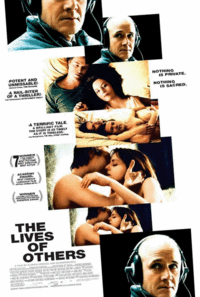
Coming Attraction (and Oscar Nominee): The Lives of Others

This year’s crop of Oscar contenders has been an underwhelming lot, but there is a bright spot. One of the nominees for best foreign language film, The Lives of Others (Das Leben der Anderen), offers profound insight into the nature of totalitarian systems and the human desire for freedom—and it actually comes from Germany.

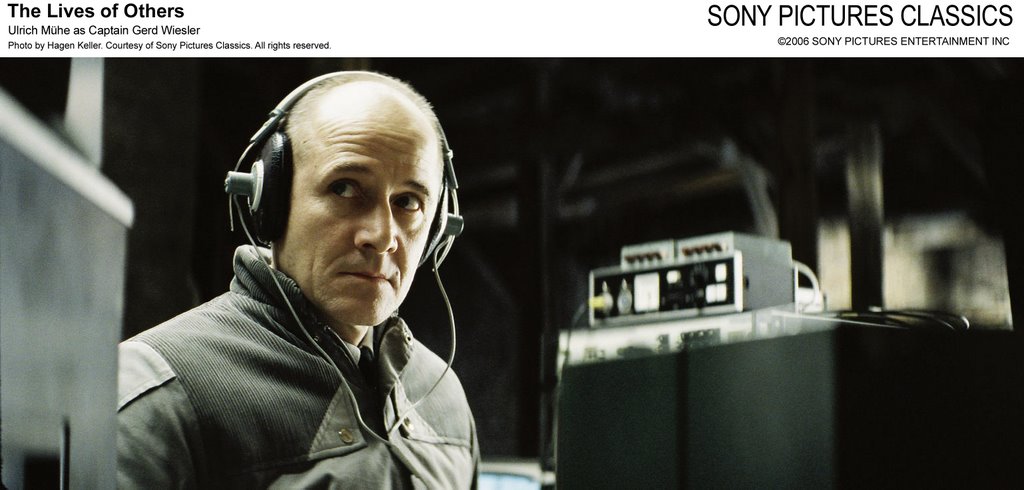
It is 1984 in East Berlin. The Communist Party rules through fear, using the Stasi, the State Security force, as their instrument of terror. Those of an artistic bent are most likely to be targets of Stasi surveillance, which usually leads to interrogation and internment in the feared Normannenstrasse headquarters. Ulrich Mühe plays Capt. Gerd Wiesler, a faceless Stasi functionary, who excels at his duties. However, during a routine assignment watching writer Georg Dreyman and his actress girlfriend Christa-Maria Sieland, played by Sebastian Koch and Martina Gedeck respectively, Wiesler experiences a gradual awakening of his conscience. As Dreyman, a former darling of the Cultural Ministry, conspires to write an expose for the western press, Wiesler takes tentative steps to protect his would be quarry.

Much has been said about Hannah Arendt’s concept of the banality of evil. Lives essentially portrays the converse: a cog in the wheel of an evil system, who comes to the realization that he can no longer actively participate in the Stasi’s crimes.

Writer-director Florian Henckel von Donnersmarck visited the GDR on several occasions as a child, and clearly the experiences had a lasting impression. His story is also well informed by the samizdat literary tradition. No aspect of Socialist (and it is explicitly identified as such) rule is romanticized—the atmosphere of fear is unrelenting. He truly captures oppressive environment of East Berlin, from the washed out colors to the Brutalist architecture, fitting for a brutal system.

On one level, Lives is quite effective as a kind of spy thriller, creating quite a bit of suspense. It is also a story of tragedy compounded, in which suicide is an important theme. Yet FHVD’s moving script concludes on an elegant note. The acting is first rate, particularly Mühe and Koch. Gabriel Yared’s score, including the crucial “Sonata for a Good Man,” perfectly fits the on-screen action. Appropriately, it was recorded by the Prague Symphony Orchestra.

This is an exceptional film, and clearly the class of the Oscar field. Whether the Academy concurs is another matter, but this is a film that deserves a campaign on its behalf. Released by Sony Pictures Classics, it opens in New York (at the Angelika) and in Los Angeles on February 9, unrolling around the country later. Viewers who seek it out will be well rewarded for their efforts.

(Welcome Gateway Pundit readers, you won't be dissapointed when Lives rolls out nationally.)