Despite Canada's reputation for politeness, it turns out many of their satanic
cults are quite inconsiderate. Their nemesis, one-time reality TV star and
self-appointed cult-buster Dale Domazar can even be downright rude. He is also
a total idiot, but Domazar means well, mostly. Regardless, he has a chance to
redeem himself after the People’s Temple-like incident that ended his TV career
in Jesse T. Cook’s Cult Hero, which received the Silver Award for Best
Canadian Feature at the 2022 Fantasia International Film Festival.
Technically,
Domazar was right about Theoren the Shepherd, but as we see in the prologue, he
handled the situation badly. “Karen”-ish realtor Kallie Jones will give him a
chance anyway, because he is the first cult deprogrammer she finds on a Craigslist-like
site, but she is a demanding customer. In fact, her husband Brad was eager to
stay at Master Jagori’s not-so-innocent New Age spa, to get away from her nagging.
Unfortunately,
Jagori has some sort of body-part harvesting operation going on, as Brad comes
to suspect. Yet, he still appreciates the peace and quiet. That is something his
wife and Domazar will have little of, as they hide out in the creepy old Gothic
Victorian house she has been unable to sell.
The
initial sequences of Cult Hero appear as the VHS recordings of his
reality show, but fear not. The rest of the film is presented as a proper
movie. This is not a deliberately distressed-looking retro-grindhouse flick
that tries to make a virtue of its minimal production values. Granted, Cult
Hero is often meatheaded, but it is no Ninja Badass. In fact, under
all the manic acting out, there is a sly sense of humor at work.
Whittling in wood is definitely a grandpa kind of thing to do, but Rosa’s
grandfather was a little different. He carved demons. It turns out, they
represented the sins and regrets of his life. After his death, Rosa returns to
his village, where she must exorcize his old demons, most metaphorically, in
Nuno Beato’s My Grandfather’s Demons, Portugal’s first stop-motion
animated feature, which screened at the 2022 Fantasia International FilmFestival.
It
is quite a shock to Rosa when she learns her grandfather was the mean old man
nobody liked. She had lost touch with him after she moved apartments, because
she was consumed by her work. As a result, she was already carrying a load of
guilt when she arrived. Then she learned his village blamed him for its
misfortunes. At first, she dismisses their peasant superstitions, but her
dreams are plagued by visions of the demonic figurines he carved.
Beato
starts the film in the mode of traditional cell animation, but transitions to
stop-motion when Rosa arrives at her grandfather’s farmhouse. The former is kind
of quirky, but the clay-based animation creates a richly realized world,
informed by local lore. Screenwriters Possidonio Cachapa and Cristina Pinheiro flirt
with the fantastical, while maintaining an evocative sense of the mysterious.
Of course, Rosa is definitely haunted, but in how many senses of the word?
Regardless,
Rosa has a richer character development arc than most live action characters. Her
struggles to come to terms with her grandfather’s legacy and atone for his
mistakes is some pretty heavy, archetypal stuff. Plus, the music is lovely and
the clay landscape looks ruggedly beautiful. It is hard to believe this is
Beato’s first feature or Portugal’s first full-length stop-motion film, because
it is so impressively realized.
Aleksey Tolstoy died in 1875, but he is on a roll right now. Recently, his novella
The Vampire has inspired a feature film, an excellent graphic novel, and
now an animated short. As vampire experts know, the Vurdulak (or Vourdalak,
spellings vary) is particularly sinister, because it specifically preys on its
former family members and loved ones. Fortunately, the traveling Marquis is
hard to love, but it is still dangerous for him to encounter one in Sam Chou’s animated
short, VRDLK: Family of Vurdulak, which screened at this year’s Fantasia International Film Festival.
While
in route to a diplomatic confab in Budapest, the Marquis D’Urfe gets lost in
the woods somewhere in Serbia. This is Vurdulak country, so everyone warns him
to get off the road after sundown, but, of course, he will not listen.
Eventually, the horny braggart winds up at the cottage of old man Gorcha, where
he is quite taken with the absent man’s daughter Zdenka. He arrived just before
dark, so is shocked when the family refuses to let the freezing Gorcha in.
VRDLK’s throwback style
of animation has its quirky charms, but it gets even more humor from the
sarcastic frat boy attitude of D’Urfe. Hammer-style horror derived from classical
European sources is usually pretty serious, so it is entertaining to watch Chou
and screenwriter Ellery Vandooyeweert mine some humor from Tolstoy’s vampire
tale, especially considering how angsty and tragic it is. Yet, they still stay pretty
faithful to the original story.
How many interlocking stories can there be in a nearly post-human dystopian
future? Apparently, there are at least four, but the one most anime fans will
really what to see is the tale contributed by the animator of the Cowboy
Bebop and Macross Plus franchises. Conveniently, Shinichiro Watanabe’s
A Girl Meets a Boy and a Robot screened on its lonesome during the 2022 Fantasia International Film Festival.
Somehow,
the girl managed to stay alive in a desert wasteland, without any
companionship. One day, a robot with amnesia falls out of an automated supply
train. He sort of resembles the Taika Waititi droid from The Mandalorian,
but is less annoying, and has more personality. With his help, they hitch a
train hobo-style to the nearest big city. It is empty too, except for a young man,
who gives her a crash course in evading the robotic tank that outlived its
programmers. He also introduces her to some lore that does not sound very
science fiction-ish, but will motivate the grandly tragic third act.
At
first, Girl Meets appears like a deceptively familiar post-apocalyptic
world, but it takes on big, cosmic dimensions. Watanabe handles the slow
blossoming quite dexterously and many of his visuals are quite compelling,
While the character designs are not wildly original, they definitely resonate
with viewers.
Clearlly, anyone who
appreciates the major anime series (especially those of Watanabe) should enjoy Girl
Meets. Maybe it is even richer when viewed together with the other stories
of Taisu, but as a Chinese production, there is a good chance the
Chinese contributions are compromised from a propaganda standpoint. After all,
the Mainland film industry is closely aligned with the oppressive CCP. Therefore,
seeing Watanabe’s contribution separately at festivals is probably the most
ethical strategy for his fans to watch it. Recommended under these
circumstances, A Girl Meets a Boy and a Robot had its Canadian premiere
at this year’s Fantasia.
Waste, corruption, and mismanagement all hallmarks of every government program known
to man. Why would we expect anything different from a mecha-kaiju defense
initiative? It turns out the Philippine Giant Monster Defense Institute (PGMDI)
is just as dysfunctional as any other state-run enterprise. A documentary
camera crew exposes the truth in Miko Livelo & Mihk Vergara’s short film, Mighty
Robo V, which screened during the 2022 Fantasia Film Festival.
The
cameramen will actually be following the crew of Mighty Robo V 2, because their
predecessors just got killed by a kaiju. Unfortunately, Dr. Rody Rodriguez has
been using the PGMDI’s budget to cover his online cock-fighting gambling
losses, so he has solicited sponsors for each of the giant mecha-robot’s weapon
systems. To rebuild public support, he has recruited a team of online
influencers to be the new crew. Frankly, his corruption has driven his competent
deputy, Laser Panganiban to drink—heavily.
Mighty
Robo is
a razor-sharp satire that persuasively applies James Buchanan’s Public Choice
Theory to Ultraman-style bureaucrats. This film has bite, especially the unhinged
diatribes of the country’s president, whose growling tone very much resembles
that of Duterte (who was still in office at the time of the film’s production).
Regardless, it makes one thing clear. Government employees will always put
their own interests first, even when giant monsters are rising out of the
Pacific Rim. By the way, the PGMDI can’t call them “kaiju” anymore, because
that term is deemed an offensive slur.
It is a good name for a jazz club, because it implies musical dialogue.
According to posters, Chet Baker and the fictional jazz musician “Singleton” will
perform there. An aspiring guitar and a competing piano player also want to
play there, but first they will have to pass an audition in the animation
collective Morgane Duprat’s short film Call and Response, which screened
during the 2022 Fantasia Film Festival.
Call
and Response really
is a short short, but it is loaded with style. Basically, the busking guitar
player and a piano stylist stuck in a depressing bartending gig audition for a
chance to play on a bill with Singleton. They start out interrupting each
other, but they find a groove when they start playing together.
The
musicians, including Raphael Faigenbaum
on piano and Paul de Robillard on guitar, give us some swinging up-tempo bop
that sound very 1960s-era appropriate. When they come together, the film
explodes in color, but somewhat ironically, the early noirish black-and-white
sequences look cooler and jazzier.
Regardless, any film that proclaims a love of jazz deserves a call-out,
no matter how short, especially when the animation has so much flair.
Recommended for jazz and animation fans, Call and Response screened at
this year’s Fantasia.
Instead of wire-fu, this martial arts epic uses glove-fu and CGI animation. The
art of Budaixi, Chinese glove puppetry, is alive and well in Taiwan, where Pili
Puppetry has been a television hit since the mid-1980s. It turns out some
of the world’s best wuxia comes from the independent nation of Taiwan. Su
Huan-jen is one of its great heroes. Fans get his stand-alone origin story in
Huang Wen-Chang’s Demigod: The Legends, which screened during the 2022 Fantasia International Film Festival.
As
the film opens, Su Huan-jen is still young and slightly irresponsible. Yet, he
still manages to help a big Wookie-like animist god win his battle against his
more reptilian rival. Su is already deeply in debt to library, so he jumps at
the chance to heal its patron, the Lord of Globe Castle. Unfortunately, this
provides a perfect opportunity to frame the young apprentice for the Lord’s
murder.
The
Lord’s adopted son knows Su didn’t do it. The Princess isn’t so sure, but the
Lord’s sinister brother is thrilled to finally have access to the book of
cosmic knowledge Su had been searching for. All the chaos is an open invitation
for rival Lord of the Evil Kingdom to invade, so Su will have a real war on his
hands.
Huang
really is one of the best martial arts filmmakers working today. He just works
with puppets rather people. Screenwriters Huang Liang-hsun and He Yuan-yu give us
a story worthy of vintage Shaw Brothers, if they could have afforded the giant
kaiju special effects. Demigod even manages to surprise us with a couple
twists. The sets, costumes, and design work are spectacular, especially the
library. Of course, the puppetry martial arts are totally cool. That’s what the
Huang family does best.
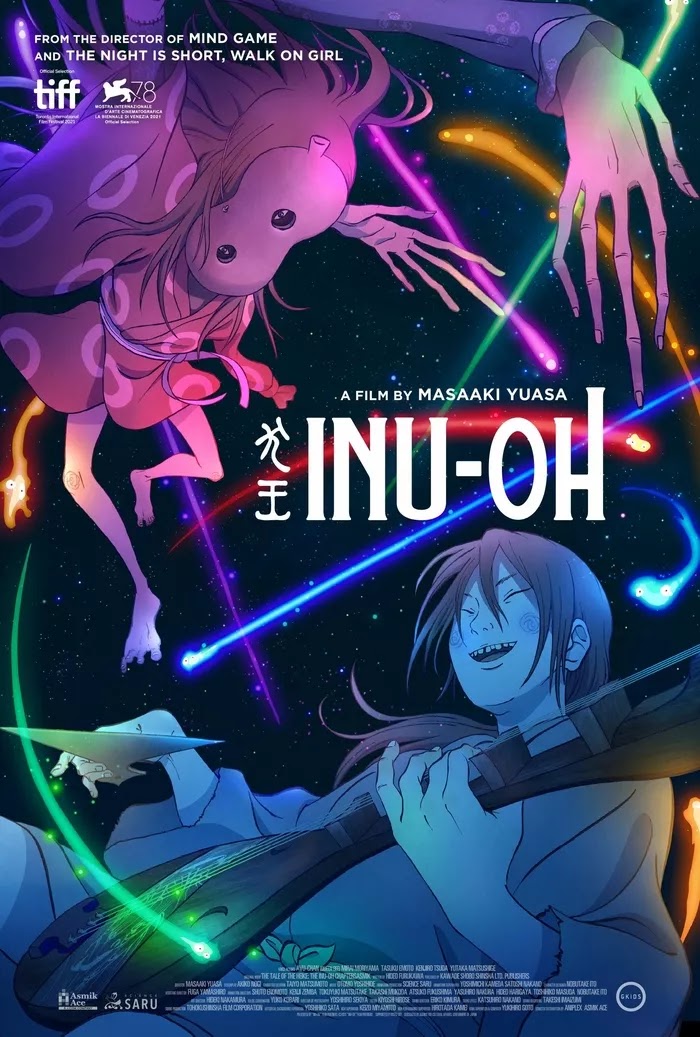
How does some heavy biwa sound to you? To the Shogun, it sounds disruptive
and dangerous. He is also not very appreciative of the “new” stories from the Tales
of the Heike that have made two itinerant performers a sensation in divided
Muromachi-era Japan. Art and authority do not mix well in Masaaki Yuasa’s
future cult-classic, Inu-Oh, which screened at this year’s Fantasia International Film Festival.
As
is often the case in Japanese history, the Heike clan lost their war with the
Genji, but they got all the glory (albeit tragic glory). Supposedly, you can
still hear the voices of their samurai murmuring from the river where their
fleet drowned. Tomona is the kind of sensitive artist who can pick-up their
whispers.
As
a boy, his father died and he was blinded when the Shogun retained their diving
services to retrieve a politically sensitive relic from the river. Having
little conventional prospects, the now-sightless teen apprenticed to become a
biwa troubadour-priest, but he rejected the traditional shaved head and monks’
robes, in favor of a rock & roll style. That appeals to Inu-Oh’s
sensibilities. The frustrated actor and dancer was disowned by his father, a celebrated
Noh performer, because of his physical and facial deformities. Even while
bizarrely masked, Inu-Oh is a crowd-pleasing performer, especially when he
teams up with Tomona. Inevitably, their popularity stirs the jealous ire of the
Shogun and Inu-Oh’s arrogant father.
Tomona
follows in a long line of sight-challenged Biwa players in films, starting with Hoichi in the classic Kwaidan
and continuing with the one-eyed Kubo in Kubo and the Two Strings.
Neither of them played like Tomona. Jethro Tull fans in particular should really
dig the fusion of hard rock with traditional (almost pastoral) instrumentation.
The musical sequences are extensive, to the point of defining the film’s
character and vibe, rather than incidental or episodic. You just can’t miss Tomona
wailing on his biwa, like Pete Townsend in his prime.
The high-flying Miami Vice-style partying of the 1980s crashed back
down to earth during the far-less-fun 1990s. That was especially true for
French Canadian bush pilot and drug-runner Luc Langelier, who fatally wrecked
while flying his regular Colombia-to-Montreal run. Neither his body or his
cargo were ever recovered, but not for a lack of looking (at least for the
drugs). A burned-out journalist (is there any other kind) starts investigating his
cold case in Renaud Gauthier’s Punta Sinistra, which screened at the
2022 Fantasia International Film Festival.
As
a fellow French Canadian, Marcotte feels an affinity with the picaresque
Langelier, or so he claims. Regardless, the boozy wash-out certainly fits the
hazy, debauched atmosphere of Punta Sinistra. Supposedly, he is writing a book
on Langelier, but nobody wants to talk to him, least of all the mysterious Claudine,
who regularly swims the surf around Langelier’s crash site. Marcotte must also
contend with bad tarot readings and frequent beatings from a gang of surfer-thugs.
Fortunately, the shaggy journalist is used to waking up in pain.
Although
it uses genre elements, Gauthier’s film has a trippy, experimental heart, very
much akin to Ossange’s 9 Fingers. It is a druggy, sun-drenched mood
piece and exploration of Marcotte’s psyche—but there isn’t much to the latter
to delve into. There are some clever moments (especially when the soundtrack “pays
homage” to Jan Hammer’s Miami Vice themes), but long, deliberately
baffling scenes of tarot readings and incomprehensible telephone calls really
start to drag, which is a real problem for a film barely longer than an hour.
This will be John Hawkins’ final case as Lone Crow’s chief of police, so you
know it will be a rough one. It is also a pretty interesting one too. Things
get pretty wild along the Porcupine River, an offshoot of the Yukon that eventually
empties into Alaska, but Hawkins usually expects earthly dangers rather than
the uncanny and eldritch that await him in Rodrigo Gudiño’s The Breach,
which screened at the 2022 Fantasia International Film Festival.
The
body that washed downriver aboard a canoe is about as grizzly as they get. It
even shuts up coroner Jacob Redgrave. Typically, he has a lot to say to
Hawkins, knowing the police chief was his ex-girlfriend’s rebound. Since then,
Hawkins broke up with Meg Fulbright, the local charter-boat tour guide.
Super-awkwardly, Hawkins will have to travel with both of them up to the remote
cabin where the extremely-late Dr. Cole Parsons was staying.
The
cabin looks considerably more decrepit and distressed than Fulbright remembers from
ferrying Parsons up a few months ago. It definitely looks like the physicist
was conducting some very strange experiments, under less than pristine
laboratory conditions. However, it is hard for Hawkins to get a full picture,
because a mysterious force is clearly toying with them. It also quickly keys-in
on Redgrave.
The
Breach is
based on an audio-original novel written by Nick Cutter (an open pen-name of
Craig Davidson), which might make it something of a cousin to podcast adaptations,
like Homecoming. Its audio roots make sense, in a good way, given Breach’s
atmospheric setting and intriguing slow-build. Davidson and co-screenwriter
Ian Weir keep revealing eerie genre elements at a steady pace, thoroughly
hooking and creeping out viewers.
It is a lot more intense growing up in Japan. Think of it this way: how
many of your friends went to cram school? In Japan, it would have been 100% of
those whose parents could afford it. Tomoya Sugisaki is definitely one of them,
but he hates every minute of it. He and two other frustrated teens seek out a perspective
from beyond the grave in Loundraw’s Summer Ghost, which screened during
the 2022 Fantasia International Film Festival.
According
to urban legend, the ghost of a beautiful young woman appears when the curious
set off fireworks on a summer evening. Although he is a loner, Sugisaki
connected online with two other teens who share his fascination with the
so-called “Summer Ghost.” An abandoned airstrip looks like the perfect place to
summon her, which indeed it turns out to be.
The
girl was Ayane Sato. Contrary to popular belief, she did not commit suicide.
Instead, she was killed in a hit-and-run, by a driver who subsequently dumped
her body in an unknown location to cover-up the crime. Sato explains it is not
just fireworks that are necessary to see her. Seekers also need to be mentally
closer to death. Indeed, Sugisaki and the bullied Aoi Harukawa are having
distressingly dark thoughts, while Ryo Kobayashi is dealing (badly) with a
fatal diagnosis.
Sato
is definitely a ghost in the tradition of When Marnie was There, rather
than a horror-style apparition. It is enormously sad and tragic, but also
ultimately humanistic and life-affirming. The teens’ drama is totally grounded
and true-to-life, while the ghost business is quite tragic, in a lovely kind of
way.
Maise Higa feels like a towny working in her parents Okinawa resort hotel, but
a lot of teenagers would probably consider it a pretty cool summer job,
especially when attractive Ichiro Suzuki checks in. He is not the baseball
player, but Higa is sure he is famous from somewhere. Regardless, she is
definitely interested in him, despite the weird events that start happening
around him in Ushio Taizawa’s 13-mini-episode micro-series, which screened in
its entirety during the 2022 Fantasia International Film Festival.
Higa
is embarrassed by her family (except her grandmother), because she is a
teenager. She can’t help noticing Suzuki has that brooding James Dean thing
going on, but she just can’t place him. Nevertheless, she must respond to some
unusual room service calls when the hotel first floods like a fish bowl and
then becomes entwined in a giant Jack-and-the-beanstalk-like tree. In both
cases, she traces the fantastical source back to his room.
Fortunately,
these incidents never disrupt the hotel’s service for long. They must have some
fantastic insurance. Higa also starts developing ambiguous feelings for Suzuki,
even though he seems to be somehow causing all the hassle. Something about his melancholy
touch her.
Ultraman was the king of “tokusatsu” superhero television universes, years before
either Marvel or DC had enough shows to claim such a title. There have literally
been dozens of series about Ultraman, his colleagues, and the kaiju they
battle. Often, they culminated with a theatrical feature film capstone, so
Ultraman on the big screen is nothing new. The filmmakers behind Shin Godzilla
got a rare opportunity to reboot the franchise outside the ongoing
continuity. Wisely, director Shinji Higuchi and screenwriter Hideaki Anno still
respected everything that made fans embrace the series through Shin Ultraman,
which screens during the 2022 Fantasia International Film Festival.
Mysteriously,
giant kaiju have been wreaking havoc on Japan (and only Japan), so logically
the government formed the S-Class Species Suppression Protocol (SSSP) to
hopefully figure out a way to stop them. Shinji Kaminaga was one of their
officers, until he was accidentally killed by a friendly alien superhero, who
arrived just in time to defeat an invisible, electricity-consuming monster. The
giant red and silver humanoid code-named “Ultraman” fuses his consciousness
with that of the late Kaminaga, bringing him back to life and continuing his
work at SSSP.
Of
course, his partner, Hiroki Asami, quickly grows suspicious of the way Kaminaga
disappears like Clark Kent during times of crisis. Unfortunately, more
dangerous and hostile alien entities are also on to Kaminaga’s secret identity.
Somewhat
like what they did in Shin Godzilla, Higuchi and Anno spend a lot of
time skewering the counter-productive infighting of Japan’s governmental
bureaucracy. The kaiju always reach perilously close to the outskirts of Tokyo,
by the time SSSP files the proper reports in triplicate. However, Shin
Ultraman is not quite as incisive and it is much more episodic.
Fortunately,
you will not hear accusations of “toxic fandom” with respects to Shin
Godzilla, because Higuchi and Anno stay true to the classic spirit of Ultraman
and employ a great deal of the traditional elements and motifs. This Ultraman
looks exactly like the Ultraman fans have known since 1966. He is just a little
shinier. Ultraman has similar crazy moves and the kaiju are as outlandish as
ever.
Don't worry about Chan-woo’s rear window. It is the dividing wall separating
him from his noisy, disruptive neighbor that concerns him. He does not know Ko-hyun,
but he certainly hears her and her boyfriend. It therefore comes as quite a
shock when he wakes up in her flat, beside a lifeless body in Yeom Ji-ho’s Next
Door, which screened at the 2022 Fantasia International Film Festival.
After several failed attempts, Chan-woo is studying for what will probably be his last chance to
pass the police academy entrance exam. Unfortunately, he is scuffling so badly,
he needs to borrow the ten-dollar registration fee. The poor guy is forced to
hit up an old drinking buddy for the meager loan. Of course, he first drags
Chan-woo out for a quick round of drinks, which turns into a messy, sloppy
night.
The
next morning, Chan-woo comes to next to what he assumes to be the corpse of
Ko-hyun’s boyfriend. He has no idea how he got there or what happened, but as
soon as he leaves, he realizes he must get back in, to clean up the evidence of
his presence.
Naturally,
everything that can go wrong for Chan-woo is absolutely sure to go wrong. Yeom
makes clever use of the spartan, claustrophobic sets (aside from the brief
drinking scene, the entire film unfolds in the two apartments or the hall and
ledge outside). The film also keeps one darned thing coming after another, at a
pretty good clip.
When the Earth is faced with some kind of monstrous attack from space, everyone’s
first choice to lead the defense would be an officer played by Kenneth Tobey.
As fate would have it, the aliens target mid-1960s South Korea. Don’t despair,
my late grandfather (who fought in the Korean War and was stationed there
afterwards) always said the Koreans were some of toughest warfighters he’d ever
seen, so the Earth could be in worse hands. Unfortunately, downtown Seoul is
still in for the kaiju treatment in Gwon Hyeok-jinn’s Space Monster
Wangmagwi, Korea’s second-ever Kaiju movie, which screens (unembargoed) in its
freshly restored glory at the 2022 Fantasia International Film Festival.
Earth
is a nice-looking planet, so the aliens (sporting tin foil radiation suits,
sort of like silver versions of Marvel’s A.I.M. Troopers) intend to take it.
Basically, they are using the Plan 9 from Outer Space playbook, but
instead of raising the dead, they release Wangmagwi (“Big Devil”), a fierce
kaiju that will grow to a monstrous size once it enters the planet’s
atmosphere.
Wreckage
and carnage ensue, but worst of all, Ahn Hee might have to postpone her wedding
with Captain Oh Jeong-hwan, because all Air Force officers are recalled to
base. She also must deal with an unwanted suitor, Wangmagwi, who scoops her up
during his rampage. Arguably, that is a good thing, because it only leaves him
one arm free to topple buildings. The Korean Air Force does what they can, but
a bratty street urchin with a kitchen knife climbing in and around Wangmagwi’s
auditory canal and nasal passage is much more effective.
Supposedly, fairy tales are written for children, but you would never want to be a
kid in one of them. Shiva’s case is no exception, but at least she has a
mysterious protector. In their divided world, he is considered a monster, but
he often exemplifies the best of humanity in Yutaro Kubo & Satomi Maiya’s
animated feature, The Girl from the Other Side, adapted from Nagabe’s manga
series (and produced by WIT Studio), which screened at the 2022 Fantasia International Film Festival.
Like
a zombie’s bite, a mere touch, skin-on-skin, from an Outsider will turn an “Insider”
human into a [so-called] monster too. Humans remain inside the “city,” except
when they venture out to conduct military campaigns against the “cursed”
Outsiders. The latest excursion has gone tragically wrong, leading the destruction
of a borderland village. Only a lone girl survives, but the soldiers are not
interested in her.
Yet,
the forlorn sight of Shiva stirs something inside one mysterious Outsider. Presumably,
he was turned relatively recently. Although he no longer remembers his previous
life or his name, the former human she calls “Sensei” still clings to some ties
to his past, like a locket. He also treats Shiva with humanist patience and
compassion. While caring for her wounds, he scrupulously avoids any physical
contact. Thinking more long-term, Sensei also worries for her future education
and socialization.
Other
Side is
a darkly stylish fable that sounds like a heavy-handed allegory, but it plays
out on-screen as something much more sophisticated and engaging. The animation evokes
the look of traditional watercolor painting more than typical manga-derived
anime, but some of the Outsider figures appear somewhat reminiscent of Belladonna of Sadness.
For fantasy fans, princesses and dragons always go well together, as Anne
McCaffrey proved in dozens of books. Frogs are also pretty archetypal, but in
this case, the ribbiting comes from a sorceress. Humans, animals, and dragons
mix uneasily in Jean-Jacques Denis & Anthony Roux’s animated fantasy Princesse
Dragon, which screened at the 2022 Fantasia International Film Festival.
This
fantasy world is definitely inspired by Medieval Europe, but the constant
threats of war and pestilence have been sanitized. As a dragon, “Dragon” (yes,
that’s also his name) sits atop a mountain of treasure, but he yearns for
offspring, so he makes a Faustian bargain with Frogceress. She sort of facilitates
three magical test-tube eggs for him, but one of them turns out to be a human
girl. Dragon does not like mortal men, but “Bristle” has the heart and
fire-breath of a dragon, so he eventually accepts her.
One
day, while running wild through the forest, Bristle meets the mortal Princess. Despite
their differences in socialization, they become fast friends. The Dragon girl
even saves the Princess twice, first from a giant bear and then from her
father. Unfortunately, Dragon’s warning that humans will inevitably come
looking for them will soon be born out by the rapacious king.
This
film is right about one thing. No matter how much gold the state has, whether
it be personified by a king or the dictatorship of the proletariat, it is never
enough. Frankly, Roux’s screenplay gets a little lecturey arguing for royal
benevolence, but the animation is lovely. It is also refreshing to see absolute
classic fantasy tropes rendered without irony or apology.
America had Universal Monsters and Roger Corman. The UK gave us Hammer. Spain is
known for Jess Franco and Paul Naschy, amongst others. However, until the
emergence of the New French Extremity movement, the French really only had Jean
Rollin—and they didn’t think very of him at the time. Nevertheless, Rollin persevered,
building a cult following (largely outside of France). Dima Ballin & Kat
Ellinger chronicle his life and films in the documentary, Orchestrator of Storms:
The Fantastique World of Jean Rollin, which screens during the 2022 Fantasia International Film Festival.
Rollin
always took pride and inspiration from his artistic Bohemian mother and her
surrealist friends, with whom she was somewhat scandalously associated. He should
have perfectly placed to ride the wave of popularity for lesbian vampire films
after Hammer hit it big with The Vampire Lovers, but his erotic vampire
films were not sufficiently bloody and often too romantic or artsy to click
with international distributors. Yet, French critics largely dismissed his
films as trashy schlock during his lifetime.
Ballin
& Ellinger nicely explain all of Rollin’s career hurdles and setbacks, including
the inconvenient opening of Le Viol du Vampire during the May ’68 protests/riots/mass
tantrums. They interview most of Rollin’s surviving inner circle, including his
frequent co-star/muse, Brigitte Lahaie (who is still probably best known for
her adult films).
In the movies, cars are supposed to be driven fast and then smashed to
bits. Jang Eun-ha is just the person to do so. She is a special driver for a delivery
service of dubious legality. She is not very welcoming, but when you absolutely
have to be somewhere alive and in one-piece, Jang is your best bet in Park
Dae-min’s Special Delivery, which had its North American premiere at
this year’s Fantasia International Film Festival.
Jang
also happens to be a North Korean defector, who now works for the chop
shop-auto-resale-special delivery business owned by Baek Sa-jang, her former
cross-border transporter. They are both pretty grouchy, so they get on well, in
a bickering kind of way. She might lack charm, but she has skills behind the
wheel. By now, she is to making regular late-night runs to the docks, so she
doesn’t think much of her latest pick-up. However, the gangster disgraced
baseball player Du-sik is fleeing is not just the mastermind of a sports-betting-points-shaving
ring. Jo Kyung-pil is also a cop.
Tragically,
Du-sik will miss his ride, but Jang still manages to pick up his son Seo-won,
who happens to be holding a special banking flashdrive. Jang is not the
touchy-feely type, but she recognizes a responsibility to keep the boy safe.
Obviously,
there is a whole lot of flashy stunt driving going on in Delivery. The
rev-and-go action is a bit of a departure for Park, whose previous films were
the period mystery Private Eye and the Joseon con caper Seondal: The Man Who Sells the River. All the fast-and-furious stuff is very well executed,
but the dramatic elements cribbed from The Client are annoyingly manipulative.
Regardless,
Park So-dam (probably best-known as the daughter in Parasite) is steely
and amusingly sarcastic as Jang. If this were a Hollywood movie, the ah-men
press would be all over themselves praising her as a “rare” female action hero,
but Delivery is Korean, so its just business as normal over there.
Break out the Nongshim noodles and prepare to meow like kittens. Frankly, nobody
really knows what cats have to do with the Fantasia International Film Festival, but for
longtime fans, it is still a pre-screening tradition nonetheless. They also
have a tradition of screening some of the best new horror, science fiction,
action, and animated films from across the world, especially Asia. There will
be plenty to look forward to when this year’s Fantasia opens this Thursday,
in-person, the way it was meant to be.
You
might have seen several remakes of the Spanish film The Invisible Guest,
like the Hindi Badla, but Confession from Korea promises to be
different, because it will be different. While keeping the locked-room mystery
structure, they have changed the ending, which alters the implications of
everything else.
It
is always worth horror fans time to check out the latest from Italian horror
master Dario Argento, especially since his last film, Dracula 3D from
ten years ago, was not nearly as bad as critics made it out to be. Giallos are
always well-accessorized, which should certainly sounds like the case for Dark
Glasses.
Considering
the dismal state of civil society in China and Hong Kong, it is important to
support freely created Chinese-language cinema from Taiwan. The martial arts puppetry
of Huang Wen-chang’s Demigod: The Legend Begins also looks very cool,
just like his previous film, Arti: The Adventure Begins.
Frankly,
a serious documentary treatment of horror auteur Jean Rollin is long overdue,
so fans revisit and reevaluate his work with Orchestrator of Storms: The Fantastique
World of Jean Rollin.
Sadako
films have been coming to Fantasia since the original Ring in 1999. The
2019 not-exactly-reboot Sadako was pretty good Sadako DX could
breathe new life into the franchise with its new take: knowing humor. If it
works, it could be the best of the lot, like Wes Craven’s New Nightmare.
Of course, Fantasia
will be screening plenty more, so look here for frequent reviews.