Showing posts with label Taiwanese Cinema. Show all posts

Friday, July 29, 2022

Fantasia ’22: Demigod, the Legend Begins

Instead of wire-fu, this martial arts epic uses glove-fu and CGI animation. The art of Budaixi, Chinese glove puppetry, is alive and well in Taiwan, where Pili Puppetry has been a television hit since the mid-1980s. It turns out some of the world’s best wuxia comes from the independent nation of Taiwan. Su Huan-jen is one of its great heroes. Fans get his stand-alone origin story in Huang Wen-Chang’s Demigod: The Legends, which screened during the 2022 Fantasia International Film Festival.

As the film opens, Su Huan-jen is still young and slightly irresponsible. Yet, he still manages to help a big Wookie-like animist god win his battle against his more reptilian rival. Su is already deeply in debt to library, so he jumps at the chance to heal its patron, the Lord of Globe Castle. Unfortunately, this provides a perfect opportunity to frame the young apprentice for the Lord’s murder.

The Lord’s adopted son knows Su didn’t do it. The Princess isn’t so sure, but the Lord’s sinister brother is thrilled to finally have access to the book of cosmic knowledge Su had been searching for. All the chaos is an open invitation for rival Lord of the Evil Kingdom to invade, so Su will have a real war on his hands.

Huang really is one of the best martial arts filmmakers working today. He just works with puppets rather people. Screenwriters Huang Liang-hsun and He Yuan-yu give us a story worthy of vintage Shaw Brothers, if they could have afforded the giant kaiju special effects.
Demigod even manages to surprise us with a couple twists. The sets, costumes, and design work are spectacular, especially the library. Of course, the puppetry martial arts are totally cool. That’s what the Huang family does best.

Wednesday, November 03, 2021

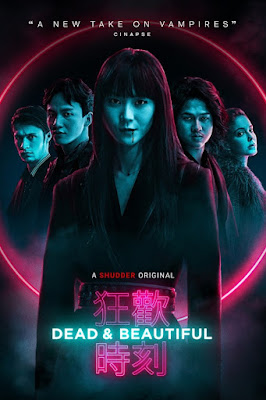
Dead & Beautiful, on Shudder

Apparently, the only thing that brings out an individual’s true inner nature more than mutant superpowers is vampirism. That is what Lulu Wong discovers when she and her beautiful and entitled friends suddenly wake up with fangs following a bizarre ritual in David Verbeek’s Dead & Beautiful, which premieres tomorrow on Shudder.

Who needs New York or Hong Kong when the exclusive clubs of Taipei are so lavish and alluring? Yet, her fab five still inevitably grow bored with their constant partying. To liven things up, they establish a weekly tradition, in which each member takes their turn orchestrating some kind of surprise. However, when Anastasia Rublov arranges for a Shamanic ritual in the rainforest, they get more than the New Agey nature vibes she anticipated—perhaps due to influence of the original aboriginal people that maybe still haunt the land.

They obviously now have the fangs, but they do not know how many other traditional vampire tropes apply to their new conditions. Alexander Tsai, who still jealously carries a torch for Wong, is eager to embrace the vampire undead-style. In contrast, having recently embraced a half-baked version of Buddhism, Mason Van Der Bilt is hesitant to give up on their humanity. Shallow Lo Bin-ray falls somewhere in the middle, enjoying goofy shtick of vampires, whereas Rublov is confused on how it all affects her Instagramming influence.

D&B
is super-stylism, filled with neon-lit clubs and glowing Taipei nightscapes, but it also has some interesting thoughts in its pretty head. Verbeek’s screenplay uses the vampire phenomenon to make some sly allegorical points regarding class and gender. (Anastasia’s talk of “transitioning” rings with current significance, without beating viewers over the head.) Yet, more than anything, their new undead state really seems to bring out who they really are. Unfortunately, in the case of the confused Wong, she still doesn’t seem to truly know herself.

Sunday, September 26, 2021

Fantastic Fest ’21: The Sadness

These zombies are fast and angry. You might also call them bad touchers. It turns out the same virus over-stimulating the infecteds’ aggression centers has a similar effect on their sex drives. That means anyone they get their hands on is in for some rather nasty treatment in director-screenwriter Rob Jabbaz’s brutal zombie movie The Sadness, which screens during this year’s Fantastic Fest.

Jim a is a nice enough Taiwanese freelancer, who is trying not to screw-up his relationship with Kat—and he was probably failing. However, all bets are off this fateful day. After dropping her off the train station, a zombie apocalypse breaks out, both on the streets he must navigate and the subway car she is stuck on.

Apparently, the zombie outbreak is the result of the new Alvin virus mutating in unexpected ways. Those who are afflicted do not completely lose their consciousness. It just brings out the absolute worst in people, especially their grudges and sadistic tendencies. As a result, the pervy commuter zombie is just as eager to find Kat again as Jim is.

Jabbaz’s screenplay is a pretty standard zombie outbreak narrative—zombies suddenly attack and society reacts in confusion. What distinguishes it are the deranged extremes Jabbaz takes it to. Seriously, this film could never appear on network television, because there would be nothing left to broadcast. These are probably the most violent zombies in the history of zombie movies, but what makes them disturbing is how they reflect the former humans’ darkest impulses.

Sunday, August 15, 2021

Fantasia ’21: Night Bus (short)


This will be the last bus of the night. Its route runs from the end of the line to the end of someone’s life. It will be a bumpy ride, but don’t buckle up, because some of the other passengers are suspect. Beware of the monkeys too in Joe Hsieh’s remarkable Taiwanese animated short Night Bus, included in the Things that Go Bump in the East shorts block, which screens as an on-demand selection of the 2021 Fantasia International Film Festival.

It is late, so there are few passengers on the provincial bus headed back to the big city. The two laborers are used to traveling this way. The rich elderly lady is not, but since luxury car boke down, she is forced to make do. The pregnant woman and her husband also look like they are accustomed to better traveling accommodations, but here they are. They also do not appear to be very affectionate with each other. Everyone’s fate will become with that of another solitary traveler inside the bus and a mother monkey with her baby on the outside.

Night Bus
is one of the best film noirs, of any length, that you could hope to see all year. It is basically a tightly concentrated thriller in the Alfred Hitchcock Presents tradition, but the incorporation of the monkeys gives it added genre dimensions. You could even call it horror without much fear of contradiction.

Sunday, June 06, 2021

The Tag Along: Devil Fish

What goes better with possessed fish, some nice lemon rice or creamy kale? Regardless, a well-to-do businessman does indeed eat such a fish while enjoying a mountain vacation. Subsequently, he murders his entire family. The perp is so unnatural, the cops themselves take him to Master Tiger priest Lin Chi-cheng. Ordinarily, a fish would be no match for a big cat like Master Tiger, but the ancient demon-battling spirit has not entered Lin’s body since he lost his faith. Unfortunately, mere mortal exorcism techniques will not be enough in David Chuang’s The Tag Along: Devil Fish, which releases Tuesday on DVD.

Lin still manages to banish weaker evil spirits, as two boys working on a school film project happen to witness. They are still there when the freaked-out cops bring the possessed Hung to the Master Tiger temple. Lin thought he managed to transfer the nasty archdemon back into a fish, but foolish young Chia-hao manages to save it, or rather the smaller fish it expells in a pool of blood. Presumably, he thought it could dramatically enhance his exorcism film, but any or horror fan knows this is a bone-headed move. Chia-hao learns that for himself when the demon takes possession of his fragile single mother, Huang Ya-hui.

Things really get messy when the pianist Huang plays a demonic maelstrom of a recital for Chia-hao’s music class. With chaos and panic spreading, Lin and his cop contact try to sleuth out why Hung was such easy prey for possession. It turns out there is indeed a skeleton in his closet (almost literally), but there is also an ancient grudge match playing out.

Right, so obviously it is safer to stick with red meat or pork. Even though
Devil Fish is technically the third installment of the Tag Along franchise, it is considered a prequel to the second film and has few obvious ties to the first, so it easily stands alone. Like its precursors, the best elements of the film are those drawn from Taiwanese urban legends and its Taoist and animist folklore.

The resulting atmosphere is amazing, but the pacing is somewhat less so. Yet, it all still works, because like its Catholic possession movie brethren,
Devil Fish maintains a conviction that demonic evil is a very real, tangible, and terrifying force.

Tuesday, May 18, 2021

Midi Z & Wu Ke-xi’s Nina Wu

The late Kim Ki-duk made some great films (like Pieta and Moebius), but if Woody Allen can be cancelled without proof, you have to wonder how much longer we will be able to find his films. For Kim, there are court cases and investigations that conclude the allegations were most likely factual. Although not expressly identified, the Kim case seems to have partly inspired Midi Z’s Nina Wu, written by and starring his long-time collaborator Wu Ke-xi, which releases today on DVD.

After eight years trying to make it as an actress in Taipei, Nina Wu only has a handful of credits in commercials and short films. She lives a solitary, hand-to-mouth existence, getting by on tips as a non-pornographic web-cammer. Suddenly, that could all change when she is called out of the blue for a major audition. The catch is the part involves nudity, explicit sex, and humiliating situations—but it is a significant role.

How she lands it will be fully revealed over time—maybe sort of. However, she continues to endure emotionally abuse throughout the shoot. The director and crew instinctively treat her like dirt and occasionally justify it on method grounds, after the fact. Yet, the festival-bound film could be transformative for her career and life. So much so, there could be someone out there who is already out to get her. Or perhaps not. Wu’s perspective is definitely not a “reliable narrator.”

However, she represents a powerhouse international star-making turn from Wu Ke-xi. It is a quiet performance, but frequently a terrifying one, both for her ferocious intensity and her painfully exposed vulnerability. There are times when this film is hard to watch. Yet, those scenes are some of most powerful (and purposeful) that you will see in a year of new releases. By the way, everything said about Wu Ke-xi also applies just as much to Hsia Yu-chiao as her rival (“#3”), if not more so.

Saturday, February 13, 2021

Slamdance ’21: Taipei Suicide Story

Service at this hotel is excellent, but it is hard to say Michelin or Zagat would rate them. Guests never stay a second night—there or anywhere else, for that matter. It is a suicide hotel and the night receptionist is about to break a cardinal rule when he starts to form ambiguous feelings for a guest in director-screenwriter-co-editor Keff’s Taipei Suicide Story, which screens during this year’s (online) Slamdance Film Festival.

Usually, Zhi-hao ends his day after the cleaning crew has finished bagging the bodies and conducting Buddhist last rites ceremonies. However, this day one of the cleaners has some annoying news. Jun-ting has not vacated her room after five days. Zhi-hao goes to roust her, one way or another, but is surprised to himself attracted to the shy, sensitive young woman.

When he is back on duty, he makes a point of apologizing for his rudeness when he sees her again. As the conversation stretches out, Zhi-hao clearly starts to feel conflicted. Even his boss can tell—and he knows it can’t end well for the employee.

Indeed, a film called
Taipei Suicide Story (presumably a nod to Edward Yang’s Taipei Story, which was all about intimacy issues) simply can’t be a laugh-a-minute. However, it is an exquisitely humanistic film. At times, the tone feels akin to the films of Kore-eda, especially thanks to the delicate but still distinctive acoustic guitar themes performed by Yang Tzu-ting.

Friday, December 18, 2020

Tsai Ming-liang’s Goodbye, Dragon Inn

At least Taipei's Fu-Ho theater had a final night. That is more than dozens of movie theaters will be able to say, having shuttered during the CCP-virus pandemic. Whether the sparse patrons and two remaining employees make the most of it is debatable, but there is something special about the last screening that flickers during Tsai Ming-liang’s 4K-restored Goodbye, Dragon Inn, which opens virtually today, via the Metrograph.

The Fu-Ho’s final film will be King Hu’s classic
Dragon Inn, a film that continues to grow in significance. Tsui Hark’s produced Raymond Lee’s remake, [New] Dragon Inn, and then helmed his own pseudo-remake-reboot, The Flying Swords of Dragon Gate. In between, Tsai gave viewers a chance to watch a good chunk of the 1965 original, over the shoulders of his characters, as the camera tours through the theater.

He definitely takes a minimalist approach to narrative, but there is a lot implied about the characters’ backstories and circumstances that is left expressly unstated. Throughout the film, the lonely manager limps through the theater, looking for the projectionist, to give him a steamed bun. Meanwhile, a Japanese tourist wanders through the theater’s stairwells and passages, in search of a hook-up. Instead, he finds the projectionist, who tells him the theater is haunted, which is surely true figuratively and perhaps even literally, given the weird behavior of one noisy patron. However, at least three ticket buyers are there to really watch the wuxia masterpiece: two of the original stars, Shih Chun and Miao Tien, as well as the latter’s grandson.

At times,
Goodbye, Dragon Inn could almost pass for Slow Cinema, but it is more accessible than that, due to film noir-ish atmosphere and the hint of the supernatural (not to mention the martial arts action of Dragon Inn). Liao Pen-jung’s nocturnal street-light and projector-lit cinematography is absolutely gorgeous. Plus, the appearances of Shih and Miao really crank up the nostalgia. They were terrific in the 1965 film and they are great again here.

Sunday, December 06, 2020

Taiwan B-Movies: On the Society File of Shanghai

It wasn’t called “Scar Literature” for no reason. This adaptation of the Mainland stories that chronicled the crimes of the Cultural Revolution during the brief respite of the “Beijing Spring” period literally turns on the source of one of the protagonist’s scars. Technically a “B-movie,” Wang Chu-chin’s On the Society File off Shanghai is also loaded with wider historical and cultural significance, as viewers can see for themselves, now that it is currently screening online (for free) as part of Anthology Film Archive’s Taiwan B-Movies series.

F
ormer respected military nurse Li Li-fang has been arrested for the most likely fatal attack on Wang Hai-nan, the black sheep son of a high-ranking PLA officer. Public security inspector Shung is under pressure to simply find Li guilty and close the case. However, he insists on mounting an investigation to uncover her motives. Shung always has been politically unreliable like that, but he is really pushing his luck this time around.


During the course of the investigation, Shung discovers Li and Wang were lovers, who recognized a shared aversion for the Maoist madness underway in each other. Unbeknownst to both, Wang’s mother (long divorced by his ambitious father) was Li’s mentor at school, but the disgraced principal tried to keep her connection to her son secret, for his own protection, after she was denounced during the Cultural Revolution. In fact, Shung has to win a staring contest with the Red Cadres still tormenting her, just to ask her a few brief questions about Li.

Society File
is one of the films that made Liu Hsiao-fan a star, specifically in the Taiwan Black Movie subgenre of female revenge films. Li Li-fang is not exactly the sort of avenging angel she would eventually become, but she is certainly intense—especially her classic, career-making scene, in which she stabs her chest, just to prove how fearless she is. When you watch her, you can see how she could become a Taiwanese exploitation icon.

Sunday, November 29, 2020

Taiwan B-Movies at AFA: Taiwan Black Movies

Before Hou Hsiao-hsien and Tsai Ming-liang, there was Woman Revenger and Lady Ninja. Starting in 1979, there was an explosion of ROC exploitation filmmaking that not so coincidentally coincided with Taiwan’s super-charged economic growth and the development of the democratization movement. Hou Chi-jan surveys the films and their cultural significance in Taiwan Black Movies, which screens as part of Anthology Film Archive’s free online retrospective, Taiwan B-Movies.

Sort of euphemistically (but maybe not really), the Taiwanese “Black” or B-movies are referred to by critics as the “social realism” films. In fact, the film that launched the genre,
Never Too Late to Repent, was a very realistic depiction of prison conditions. Those that followed cranked up the violence to levels previously unseen in local cinema, while pushing the sexual envelop as much as they could at the time.

Back then, the KMT was still anti-Communist (whereas it is now infamous as Taiwan’s pro-CCP party), so adaptations of Mainland “Scar Literature,” novels chronicling the horrors of Mao’s regime, could count on a little slack from the KMT censors. Ironically, the awkwardly titled
On the Society File of Shanghai would give rise to a major Taiwanese exploitation subgenre: the women’s revenge film. Indeed, a number of the clips seen in TBM look like they could have come from a dingy print of Lady Snowblood, or something even tougher.

Hou’s talking heads represent a fairly wide spectrum of film criticism. Collectively, they probably express just as much disdain for these films, as they do admiration and nostalgia. Each point is also vividly illustrated with relevant film clips, but sadly, a number of these films are obviously not well preserved.

Sunday, August 30, 2020

Fantasia ’20: Detention

During Taiwan’s “White Terror,” the KMT ruled over a one-party authoritarian regime. Despite formerly professing an anti-communist ideology, the KMT is now well-known as the Taiwanese political party most closely-aligned with Beijing and opposed to formal independence. You would think the Taiwanese would stop voting for the KMT—and they have. Pres. Tsai Ing-wen overwhelmingly defeated KMT candidate Han Kuo-yu, who was subsequently turned out of his mayoral office in a decisive recall election. Such election results would please the students in Wei Chong-ting, if they could live to see them. Tragically, it appears most of them are trapped in purgatory, as a result of the torture they endure in John Hsu’s Detention, which screened at this year’s Fantasia International Film Festival.


The popular Mr. Chang and the very serious Miss Yin both supply books and guidance to Wei’s underground book club. Not surprisingly, a “model student” like Fang Ray-shin is not a member. Since her father is a high-ranking officer, she is about the only student who is not constantly under the microscope of Instructor Bai, the school’s military advisor. Yet, it is Chang whom Fang pines for.

Clearly, someone informed on the group, leading to disastrous consequences for them all, but Fang’s involvement is not exactly clear, even though she seems to share a similar fate as the others. She and Wei must figure it out together, when they suddenly awake in a surreal, nightmarish version of their school.

It is probably safe to say
Detention is the best film based on a video game produced so far and most likely superior to any that might come in the future. Adapted from the horror adventure game of the same title, Detention is deeply steeped in Taiwanese history and also considerably informed by Buddhist teachings. Yet, the imagery is old school supernatural horror, all the way.

Friday, August 28, 2020

Fantasia ’20: The Weather is Lovely (short)


It turns out we can even blame millennials for bad weather. In this case, the irresponsible party is Claude, a rookie cloud-maker. When he drops his cloud-maker, it causes a potentially apocalyptic storm in Lien Chun-chien’s charming animated short film, The
 Weather is Lovely, which screened at the 2020 Fantasia International Film Festival.


Claude is a bit of a careless goof-off. The same cannot be said of Yin, the diligent young meteorologist conducting research in the observatory below him. When Claude’s device shorts out, it releases a thunderous cyclone. Although Claude tries to remain out of site, he will need her cooperation to avert catastrophe as the storm gains in size and severity. He will also have to cowboy up.

Visually,
Weather is indeed a lovely sight that bears comparison to vintage Studio Ghibli studio films (particularly The Wind Rises, given some thematic similarities). There is a mildly steampunky vibe to the film’s tech, but Claude’s cloud conveyance also has an old school sci-fi aesthetic, in the tradition of The Rocketeer. It is also appealing to see two STEMmy young people working together and developing a romantic affinity (naturally enough).

Wednesday, February 20, 2019

Who Killed Cock Robin?—Taiwanese Noir


Surveys show journalists consistently rank near the bottom of society’s pecking order of respect, right down there with politicians and used car dealers. Bottom-feeding reporter Wang Yi-chi and his colleagues are about to set an all new low for their profession. Yet, somehow, the bad guy manages to be even worse—much, much worse in Cheng Wei-hao’s Who Killed Cock Robin?, which opens this Friday in San Francisco.

Wang thought he scored a scoop when he landed frontpage pictures of a prominent politician caught in a traffic accident with his swimsuit model mistress. The problem is that was no lady, that was his wife. Suddenly, Wang is unemployed. However, he rather stumbles onto a major story from his past. Back when he was a cub scandal-monger, Wang grabbed some pictures of a another, even more horrific traffic accident. That brought him to the attention of the newsroom director and the editor-in-chief, but when he reexamines his old photo-drive, he discovers someone deleted some of his pictures.

To get some answers, Wang and Maggie, his prospective lover and now former colleague track down Hsu Ai-ting, the sole survivor of the crash, who subsequently disappeared from the hospital. Unfortunately, Wang’s investigation will bring Hsu to the attention of the one person she wanted to avoid. Presumably abducted, Hsu is now in grave peril—and it is all Wang’s fault.

Cheng has already enjoyed a good deal of success with the Tag-Along horror franchise, but he takes a big step up in terms of quality with Cock Robin. Arguably, the main antagonist is so sinister and psychotic, the film should still appeal to a lot of horror fans. However, the screenplay (surprisingly credited to the small army of Cheng, Yuli Chen, and Chen Yen-chi, with Cheng Ze-qing and Dorothy Chen acknowledged for the original story) has some really twisted twists and a witheringly cynical depiction of the revolving door between government and journalism.

At times, the game Kaiser Chuang almost makes viewers believe Wang is not such a bad guy—almost. As Maggie, Hsu Wing-nei manages to be equal parts Lois Lane and femme fatale. Mason Lee (Ang Lee’s son) is massively creepy as the psycho-villain, while Christopher Ming-shun Lee (the Malaysian Christopher Lee) oozes sleaze as Wang’s dubious mentor, Chiu Ching-kai. Yet, it is Ko Chia-yen who truly takes ownership of the film with her achingly intense, profoundly vulnerable performance as Hsu Ai-ting.

Chen Chi-wen’s “noir visible” cinematography about as dark as film can get and still be easily viewable by human eyes, which perfectly suits the milieu of murky morality. This film just radiates cynicism, but it is hard to argue it is too hard on journalists who cover-up for the powerful rather than exposing them. Highly recommended for fans of dark and stormy thrillers, Who Killed Cock Robin opens this Friday (2/22) in San Francisco at the Lee Neighborhood 4-Star Theatre.

Friday, January 18, 2019

First Look ’19: Turning 18


It is an awkward milestone. Young adults start to take on legal responsibilities at the age of eighteen, but they are still just kids. Usually, the eighteenth birthday is a cause for celebration, but there will be much more frustration than joy in the lives of two Native Taiwanese girls. Ho Chao-ti follows the teenagers as they navigate their late teen years in Turning 18 (trailer here), which screens during this year’s First Look at MoMI.

Chen and Pei are not really close. They just happened to meet during a summer vocational training program, but they both have been dealt a tough hand by life. This is especially true for Chen, who has been sexually abused by her father and other male family members. She struggles to maintain a close relationship with her mother, but the older woman’s alcoholism and health problems make matters difficult.

In contrast, Pei has arguably contributed to her difficult situation by making some questionable decisions, most definitely including shacking up with her deadbeat boyfriend Wei. Of course, there must be reasons she would so passively accept her bad situation, but we do not learn very much about her backstory.

Regardless, viewers will quickly come to ache for poor, struggling Chen. In addition to having the more compelling life-drama, she is also a hugely charismatic figure on-screen. Plus, her narrative arc covers considerably more territory, especially when she comes out of the closet and begins to openly experience romance and heartache.

In many ways, Turning 18 is a perfect example of how documentaries often serve as the snobby cineaste’s version of reality TV. Ho definitely incorporates issues of discrimination against Native Taiwanese, but there are scenes of Chen pining for an unfaithful lover and Pei arguing with Wei that would not be out of place on MTV’s old Real World voyeurism festival.

Regardless, Ho’s commitment is impressive. She clearly earned her subjects trust, even becoming a confident over the years that she filmed Chen and Pei. There are plenty of social issue justifications to be made for the doc, but it still often feels intrusive and even exploitative (for the record, the same is true of Grey Gardens, for the same reasons). Recommended for patrons of up-close-and-personal documentaries, Turning 18 screens this Sunday (1/20), as part of First Look at MoMI.

Friday, July 06, 2018

NYAFF ’18: On Happiness Road


You could say Lin Shu-chi came of age with her country. She was a student democracy activist during the period of martial law, but she expatriated to America just when democratic reforms took root. Having returned home for her grandmother’s funeral, Lin is not sure what she now thinks of herself or Taiwan in Sung Hsin-yin’s wistful animated family drama, On Happiness Road (trailer here), which screens during the 2018 New York Asian Film Festival.

Lin’s family still lives at 168 Happiness Road. It sounds precious, but it has always been a bustling working-class neighborhood. During her early childhood years, Taiwan is still a rather poor and isolated country. In fact, she has quite a fateful birthdate: April 5, 1975, the day Chiang Kai-shek died.

As you might expect, there are not a lot of blonde little girls in Lin’s class, which makes it quite intimidating for Betty Huang. However, Lin befriends the bullied blonde when she needs it most. In fact, their friendship, renewed after Lin’s return to Taiwan, is unquestionably one of the most endearing aspects of the film. She also has quite a special relationship with her aboriginal grandmother, who continues to offer sage tough love advice, even after her death.

Sung gets the balance of bitter and sweet just about right in Happiness, while still staying true to the messiness of life. Lin makes all kinds of mistakes and has plenty of regrets, but it is easy for us to understand how she got where she is (even if she’s rather confused about it herself). Her relationships with her parents and aunts are realistically complicated, but her friendship with Huang is downright redemptive.

Viewers also get a keen sense of the Happiness Road neighborhood and the tenor of each era Lin lives through. Sung manages to integrate quite a bit of Taiwanese history into the film, in ways that always feel organic. Arguably, Sung’s only missteps are Lin’s dreams and reveries, which somewhat overdo the trippy flights of fancy in such and emotionally grounded film, but that is really a minor mistake.

Gwei Lun-mei gives a terrific vocal performance as the adult Lin, who happens to bear some resemblance to the Taiwanese superstar. Sung’s animation is also warm and nostalgic, in the right kind of way. Viewers might expect a predictable narrative arc, but Sung constantly surprises us with unexpected tragedies and poignant references back to her childhood. It is a lovely little film that real people anywhere can relate to. Very highly recommended, On Happiness Road screens Sunday (7/8) at the Walter Reade, as part of this year’s NYAFF.

Thursday, July 05, 2018

NYAFF ’18: Missing Johnny


If you want to see this film, you’d better catch it while you can. The Chinese Communist Party has already denied it permission to screen in Mainland theaters and it is probably only a matter of time before they start censoring films on airlines providing Chinese flights. After all, they recently mandated all airlines and hotels refer to Taiwan and Tibet as part of the one oppressive China. In this case, the controversy directly bears on Taiwan’s sovereignty. Lead actor Lawrence Ko expressed support for Taiwanese independence, as is his right as a citizen of a democracy. Of course, Beijing found that unacceptable and banned his latest film. The irony is there is absolutely nothing political about this debut film from a Hou Hsiao-hsien protégé. It is all about the difficulty of forging and maintaining human bonds (something the Chinese CP isn’t helping any little bit). Nevertheless, three young people will make connections in Huang Xi’s Hou-executive produced Missing Johnny (trailer here), which screens during the 2018 New York Asian Film Festival.

In this profound threat to Peoples’ Republic’s delicate self-esteem, a handyman living out of his car, an autistic son craving more independence, and a young woman working part-time in youth hostel try to navigate modern life in Taipei as best they can. Nobody is more disappointed in Hsu Zi-qi than she is. She lives in a flat mostly paid for by an arrogant boyfriend she rarely sees. Most of her time is spent with her parrots and answering frequent wrong numbers for a mysterious Johnny, until Chang Yi-feng starts working on her landlady’s next-door building.

Chang mostly crashes in his car, but he frequently eats with the family of a former teacher, who consider him part of the family. Unfortunately, it is a roaring dysfunctional family, whose meals often end in arguments between the aging mother and father. Nothing like that happens with Lee Li and his controlling mother, but he starts rebelling in quiet ways.

Admittedly, it takes a bit of time for Missing Johnny to get in gear, but that arguably makes its subtle payoffs all the more rewarding. It is tough to really connect, so if Hsu and Chang can do so, even to a modest degree, that is still something.

Needless to say, you can see Hou’s influence all over the film. In fact, one scene looks very much like a deliberate homage to the striking opening of Millennium Mambo. Yet, despite the characters’ past disappointments and Huang’s generally naturalistic approach, they film instills optimism and warm feelings, which are hard to find in any kind of cinema these days.

One thing can be said with certainty: Rima Zeidan is going to be an international mega-star. She has already justly won several awards for her luminous but acutely sensitive debut as Hsu. Ko, the trouble-maker, also gives a wonderfully understated yet richly complex performance as Chang (okay, he is a nice guy, but he’s more than that). Sean Huang gets much less screen-time in comparison, but he admirably avoids shtick, cliché, and theatrics, making Lee a fully dimensional person.

Missing Johnny is a deceptively simple, deeply resonant film. Banning such a humanistic work is truly an act of folly. There are no pat takeaways and not a great deal of closure, but Huang leaves us feeling like we can find meaning in the world—not a lot, but enough. Affectionately recommended for admirers of Hou and the cinema of the great independent nation of Taiwan, Missing Johnny screens this Saturday afternoon (7/7) at the Walter Reade, as part of this year’s NYAFF.

Monday, July 02, 2018

NYAFF ’18: Gatao 2

Back in the day, it meant boss or community leader, or so the president of the North Fort crime syndicate tells it. Those days are gone. Now “Gatao” means gangster and the thugs from the upstart Jian Company intend to live up to everything the word entails in Yen Cheng-kuo’s Gatao 2 (trailer here), which screens during the 2018 New York Asian Film Festival.

As the operational leader of the North Fort syndicate, Ren would very much like to take over the turf of the North Town gang, but President Gui insists they must honor the agreement he made with North Town’s late president. Jian Lui, Ren’s sworn brother from their school days is under no such constraints. Suddenly in the gangster business, he moves quickly to consolidate the Taipei narcotics trade.

Ostensibly, he offers to cut North Fort in on the action, but he knows neither Ren or Gui wish to be involved in the dirty business. Shrewdly, he acts like the offended party, as he moves to undercut North Fort’s support. Gui even insists on restraint when the Jian outfit kills one of Ren’s men. The loyal Gatao tries to toe the line, but it is not long before gang wars erupt on the streets of Taipei.

We’re talking about those crazy street fights, where they hang out the baseball bats and machetes and then just charge at each other. There is in fact plenty of action in Gatao 2, but there is also a clash of codes and strategies. Whatever it is that you like in gangster movies you can find here. Fans should also rest assured, no prior knowledge of Gatao 1 is required to enjoy the self-contained sequel. However, it is worth noting 1 featured former child star Yen Cheng-kuo (who appeared in The Sandwich Man), while he helmed 2. His involvement with the Gatao duology happened after he served ten years in prison for a kidnapping-extortion conviction. So yeah, maybe he can relate to the subject matter. Regardless, he can stage a heck of a street brawl.

Gatao 2 is the sort of grand gangster im/morality tale we haven’t had for a while. Jack Kao (one of the few holdovers from the previous film) sets the tone from the top as the stubbornly principled President Gui. Collin Chou (from The Matrix and The Four franchises) is spectacularly villainous as the snappy dressing Jian. Chang Zhang-xing memorably stirs the pot even further as Ren’s troubled soldier, Po, but it is Wang Shih-hsien who really anchors the film as the flinty Ren, who temperamentally stands equidistance between the fiery Jian and the reserved Gui. Wang also plays it understated, but you can always see the gangster in him.

For regular patrons of NYAFF, Gatao 2 should be a no-brainer. It has veteran Taiwanese screen actors, large-scale beatdowns, shadowy conspiracies, and multiple betrayals. In other words, it is a lot of good clean fun. Very highly recommended, Gatao 2 screens on the Fourth of July at the Walter Reade, as part of this year’s NYAFF.

Saturday, May 19, 2018

SIFF ’18: The Bold, the Corrupt, and the Beautiful


Nothing drives corruption like government land use policy. Of course, if you throw in some illicit sex and jealousy, things can really get explosive. The Tang family will find themselves in the eye of a brewing storm when their loves and lusts exacerbate a political scandal in Yang Ya-che’s shamelessly entertaining The Bold, the Corrupt, and the Beautiful (trailer here), which screens during the Seattle International Film Festival.

Madame Tang is ostensibly just an antiquities dealer, but she has leveraged her position as the widow of a revered general to become a behind-the-scenes political power broker. She has essentially given up grooming her oldest daughter Tang Ning, whose disgust at her mother’s amoral machinations manifests in various forms of self-medication (sex, booze, pills, awkward scenes in public). Instead, her youngest daughter, fourteen-ish Tang Chen most often assumes co-hostess duties.

In anticipation of a major developed project, Madame Tang has guided her political associates to buy up parcels in an otherwise sleepy rural district, using shell companies. Her circle of influence includes the regal wife of the speaker and up-and-coming legislator Lin, whose family is the Tangs’ nearest neighbors. However, the deal starts to fall apart when the Lin family is mysteriously massacred in their home. Only their teenage daughter Lin Pien-pien survives, but only just barely, in a comatose state. Tang Chen will be assigned her bedside vigil, even though her relationship with the somewhat older teen is complicated—just like everything else having to do with the Tangs.

Like Yang’s Girlfriend Boyfriend, Bold is set in Taiwan during the 1980s, but they feel like they are worlds apart. While his previous film is unabashedly earnest, Bold is dark, twisted, and maybe even a little lurid, but it sure is fun to watch the Tang family and their associates behave spectacularly badly. There is always another shoe left to drop, but Yang primary and over-riding concern is always Madame Tang’s dysfunctional relationships with her daughters. Gosh, this would be such a nice film for Mother’s Day viewing.

Speaking of mothers, the great Kara Wai [Hui] (amid her latest career renaissance) knocks it out of the park as the sly, string-pulling Madame Tang. One knowing look from her is worth more than a mountain of CGI effects. Of course, we always knew she was awesome. Probably the biggest surprise is Wu Ke-xi, who is best known for her remarkably bold but naturalistic work in Midi Z’s docu-like films. As the hot mess sister Tang Ning, she proves she can preen, seduce, and Dynasty-slap fiercer than anyone. Holy cats, can she ever burn up the screen. Yet, Vicky Chen (a.k.a. Qi Chen, who was such a revelation in Angels Wear White) hangs with them both as the deceptively innocent-looking, utterly destabilizing Tang Chen.

Bold is a deliciously cynical film that is also kind of trashy, but in the best way possible. Frankly, it would be fitting if Madame Tang warned viewers to buckle-up their seat belts, a la late Bette Davis, because this is definitely a roller coaster ride. It is just your basic sarcastic political melodrama, with a considerable body-count, so what’s not to like? Very highly recommended, The Bold, the Corrupt, and the Beautiful screens tonight (5/19), next Saturday (5/26), and the following Monday (5/28), as part of this year’s SIFF.

Friday, January 26, 2018

The Great Buddha+: Down and Out in Taiwan

The plus is a reference to the iPhone 6+, exactly the kind of coveted gadget that is beyond the reach of luckless losers like Belly Button and Pickle. They can only gawk at how the other half lives through the love hotels captured on the dash-cam of Pickle’s boss. However, the title maybe takes on additional meaning when the ne’er do wells see something they wish they hadn’t in screenwriter-director Huang Hsin-yao’s pitch black comedy The Great Buddha+ (trailer here), which opens today in San Francisco.

If you are going to use narration, you need to have a reason. Huang gets that, because he owns his frequent voiceovers. They are even more rewarding if you get the puns based on regional southern Taiwanese dialects, but the mordant humor still comes through the subtitles, crystal clear. As Huang himself explains, Belly Button always spends his idle evenings with Pickle, the night watchman, because he is only one in the provincial town more passive and put-upon than himself.

Pickle’s boss Kevin Huang owns a metal-works that specializes in large-scale Buddha statues. Of course, the meaning of the Buddha is lost on the two sad sacks, as well as most of the boss’s customers. When the TV goes on the fritz, Belly Button convinces Pickle to extract Huang’s dash-cam memory cards, which they quite enjoy in a voyeuristic way, until they happen to see the boss murder an inconvenient former mistress.

The vibe of GB+ is hard to describe, but it includes elements of Hitchcock, Beckett, Steinbeck, and the Frank and Ernest comic strip. In a sense, it evolves into a murder thriller, but just how much Kevin Huang knows about what our two idiots know is always kept decidedly ambiguous. In fact, the entire finale depends on the power of suggestion. Nevertheless, the scathing satirical dressing down of Kevin Huang’s local political cronies is boldly pointed and impossible to miss.

Taiwanese indie superstar Chung Mong-hong serves as cinematographer as well as producer, giving the film an arresting black-and-white look. In contrast to convention, he films the dash-cam sequences in warm neon color reminiscent of the films of Wong Kar-wai. Straight up, even though it is still January, this could very well be the most visually distinctive film of the year.

It also is features some wonderfully dry and understated comic performances that land quite lethally. “Bamboo” Chu-sheng Chen makes Belly Button one of the great anti-heroes of recent memory, while proving the adage every bully is really just a coward. However, the tragic dignity of Cres Chuang’s Pickle might be even more powerful. Chang Shao-Huai does not say much, but he still makes a strong impression as Belly Button’s silent drifter-squatter pal, Sugar Apple. Yet, nobody can top the charismatic villainy of Leon Dai’s Kevin Huang.


In general terms, GB+ shares a kinship with classic Coen Brothers films, but the specifics of Huang Hsin-yao’s execution are richly idiosyncratic and defiantly original. Twenty-six days in, it is definitely the best of the year so far (I wouldn’t want to have to go out there and top it). Very highly recommended, The Great Buddha+ opens today (1/26) in the Bay Area, at the Lee Neighborhood 4-Star Theatre.

Sunday, January 21, 2018

Slamdance ’18: Love After Time (short)

Taiwan is a democracy with the world’s fifteenth largest economy, but the UN and global diplomatic community wants to pretend it doesn’t exist. When nuclear disaster ravages the Other China, they just carry on ignoring, like business as usual. Radiation and isolation make things pretty dystopian, pretty quickly for the survivors, but life maybe has a way of hanging on in Henry Tsai Tsung-han’s short film Love After Time, which screens as part of the Anarchy shorts block at this year’s Slamdance Film Festival in Park City.

There is a new policy: only survivors with a clean health certificate are now eligible for emergency food relief. That does not sit well with the mystery woman. She sparks a riot and then shrewdly uses as a distraction to steal food. That doesn’t sit well with the officer overseeing the distribution. However, when he corners the thief in her makeshift shelter, he finds she has his number, in multiple ways. She happens to be surprisingly confident and seductive. She also realizes he is a mutant, just like her.

LAT might have the most bizarre sex scene you will see in Park City. Some survivors start growing organs in nontraditional places, if you get the picture. Eventually, we learn even the circumstances of reproduction have been affected. In some ways, LAT covers similar ground as Antonio Pandovan’s short film Eveless, but it has a more humanistic perspective. In fact, Tsai passes up many opportunities to gawk at the mutated deformities, preferring to focus on the evolving ways humans relate to each other—and whether such a term still applies to mutant survivors.

Nana Lee Chien-na also must be the spriteliest wasteland waif you will see in a month of apocalypses, but there is no denying her charisma. The Taiwanese pop idol-actress is an unusually big-name celebrity for a scruffy nuclear Armageddon short film, but good for her. Her courtship with Lee Hong-chi’s Army Officer is definitely intense and he looks pretty darned freaked and conflicted during the aftermath.


LAT directly addresses the question what does it mean to be human, which is a big theme for any film, of any length. Tsai creates a convincingly grubby dystopia that is worlds removed from his previous teen TV work. Highly recommended, Love After Time screens again tomorrow (1/22), along with Philippe McKie’s very cool Breaker, as part of the Anarchy shorts package at the 2018 Slamdance Film Festival.