Showing posts with label Sir Christopher Lee. Show all posts

Wednesday, July 05, 2023

The Wicker Man: 50 Years a Folk Horror Classic

It is a place of free love and folk music, where people are keenly attuned to nature. The remote Scottish Summerisle is also a profoundly evil place. Sergeant Neil Howey, an outsider investigating the reported disappearance of a local teenaged girl, will discover just how sinister in Robin Hardy’s folk horror classic The Wicker Man, which opens Friday in New York, marking its 50th anniversary.

Sgt. Howey is a righteous God-fearing Chistian, as we can see from the early prologue (depending on which cut you are watching—they all end the same way). He has come to isolated Summerisle via the police department’s seaplane, to investigate an anonymous letter claiming a teenaged girl, Rowan Morrison, is in peril.

At first, nobody acknowledges knowing Rowan, not even her mother. However, as he unearths evidence of her existence, they change their tune. The girl is actually dead, and therefore gone, according to their Pagan beliefs, so there is no Morrison left for them to speak of.

As Howey explores the tiny isle, he is shocked by the openly hedonistic behavior he sees. However, he is outraged to find the schoolteacher opens teaching witchcraft and paganism. Technically, Lord Summerisle rejects the term “Pagan.” He essentially preaches a licentious version of New Age mysticism that retain many of the “old” deities. Howey will not be swayed, nor will he be tempted into sin by Willow MacGregor, the lusty innkeeper’s daughter.

Arguably,
The Wicker Man is one of the few horror films that is even scarier after you have already seen it. You might already guess where it is all headed—probably Howey is the only one who cannot. Even if you can’t, there is no way to miss the overwhelming atmosphere of impending doom Hardy realizes. It is powerfully accentuated by all the unnerving little occult easter eggs incorporated into the richly detailed set and production design. The film deserves its reputation as the greatest folk horror film of all time.

It also features one of Sir Christopher Lee’s most distinctive villains, the hippy-like Lord Summerisle (sporting an unkempt Beatle-style coif). Even though
Wicker Man co-stars both Lee and the great Ingrid Pitt (as the Librarian), nobody ever confuses it with Hammer Films (like fans often do with Amicus releases, such as The Skull). Pitt and Diane Cilento (the Schoolteacher) are also great as supporting villains, who definitely help wind up Howey. Of course, nobody does so more than Britt Ekland as MacGregor. This must be Ekland’s greatest screen performance, even though her voice was dubbed by jazz vocalist Annie Ross (of Lambert Hendricks & Ross).

Monday, October 18, 2021

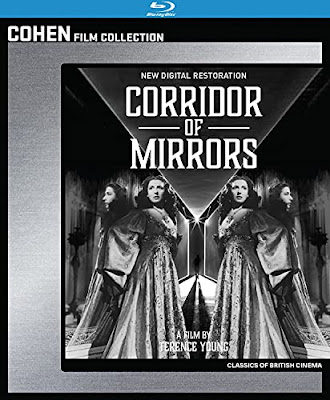
Corridor of Mirrors, Introducing Christopher Lee

It was supposed to be the grand debut of South African thesp Edana Romney, but it is now more remembered as the first films of Sir Christopher Lee and future James Bond franchise director Terence Young. For Lee, it now seems like a reasonably appropriate and not completely inauspicious debut, as a somewhat gothic, Daphne Du Maurier-like psychological thriller (with scenes in a wax museum and a masquerade ball). It was also a film about an artist’s obsession with beauty, so it had to look good. Young’s strikingly lush black-and-white Corridor of Mirrors gets a shiny new digital restoration, which releases tomorrow on BluRay, from Cohen Media.

We know from the in media res prologue, this story will end in tears. When the flashback commences, fans do not have to wait long to see Lee, because he is part of the aimless smart-set the beautiful and eligible Mifawny Conway whiles away her nights with in London’s fashionable clubs, along with Lois Maxwell (who would be forever known as Miss Moneypenny in the Bond films). Reportedly, Young has to lend Lee his dinner jacket for the scene. Apparently Conway is a bit bored with the old gang, because when legendarily ill-tempered artist Paul Mangin walks in, she is quite struck by his Byronic figure.

Soon, she is visiting him in his luxurious but old-fashioned mansion (mostly candle-light rather than gaslight), where he dresses her in his exquisitely rendered historical costumes, complete with matching jewelry sets. It is like she is his personal doll to dress up as he pleases. To some extent, they are also lovers, but their relationship is really one of uncomfortable control and submission.

Eventually, Mangin admits he believes they are the recreation of Renaissance era lovers, whose faithless relationship terminated in violence. Indeed, she is the spiting image of the portrait that fuels his obsession, which sufficiently freaks out Conway to rouse her from her trance-like state.

Visually,
Corridor is a dazzler. Imagine the thematically similar Vertigo (which it predates by ten years), as directed by Cecil Beaton. The technical artistry is remarkable, starting with Mangin’s Escher house, which does indeed include then titular corridor (the mirrored doors conceal closets, holding outfits on one side, with the matching jewels opposite). Somehow, it is also larger enough to house a costumed bacchanal that looks like it could have been cut from Orson Welles’ Merchant of Venice.

Andre Thomas’s glorious cinematography is like a dark, gossamer dream, while the richly romantic soundtrack builds on motifs from “Black was the Color of My True Love’s Hair” and “These Foolish Things” (also heard in a weirdly operatic rendition during the nightclub scene). The sets, dressings, and costumes are some of the finest ever captured on film. The technical artistry is fabulous, but Romney’s screenplay, co-written with her filmmaking partner Rudolph Cartier is definitely a hodge-podge of lurid melodramatic elements, but they predate plenty of classic films, such as
Vertigo, Dead Again, and just barely Portrait of Jennie.

Tuesday, October 02, 2018

Satanic Panic: The Devil Rides Out

An old school British conservative like Dennis Wheatley understood the nature of evil, so he fought the Infernal One tooth-and-nail with his occult horror novels. Someone could do a jolly entertaining mini-retrospective of the seven films and one TV anthology episode based on his books, but this would definitely be the centerpiece. It happens to be the only Hammer film scripted by Richard Matheson and the great Sir Christopher Lee also often identified it as one of his favorites. Lee plays Wheatley’s intrepid Nicholas, Duc De Richleau in Terence Fisher’s The Devil Rides Out (a.k.a. The Devil’s Bride, trailer here), which screens as part of the Arena CineLounge’s Satanic Panic film series.

Despite the devilish goatee, De Richleau is an upstanding Christian gentleman, who has studied the occult in depth, and therefore understands the profound danger it represents. Both he and Rex Van Ryn have taken a fatherly interest in Simon Aron, the son of their late military colleague. Rather mysteriously, Aron has gone off the grid (circa 1929), so the two old friends have decided to pay him a call. Much to De Richleau’s alarm, they walk in on the pre-game for a black mass to be conducted by the villainous Mocata.

De Richleau manages to scuttle the ceremony and then returns later to whisk off Aron, whether he wants to be saved or not. At first, Van Ryn has a hard time believing De Richleau’s warnings, but he soon sees enough to make him a believer. He also starts to fall for Tanith Carlisle, another young recruit due to be initiated into Mocata’s circle.

Devil Rides Out is notably heavy on the occult imagery, particularly for 1968. There is definitely some serious Satanic panic going on in these tony British drawing rooms and on the Salisbury Plain. Somewhat surprisingly, some of the visuals seem to parallel those seen in A Dark Song (which like DRO, was also influenced by the Aleister Crowley mystique).

Regardless, Lee is terrific as De Richleau, clearly enjoying a rare turn as the hero. His De Richleau is rather a bit brusque and mysterious, not unlike his longtime friend Peter Cushing’s portrayals of Sherlock Holmes. He also has some rather engaging British upper-class bro chemistry with Leon Greene’s Van Ryn (dubbed by Patrick Allen, which seems odd, since Greene was an opera singer, as well as an actor).

Beyond the nifty Hammer-style demonic horror, DRO represents a unique assembly of talent. In addition to Lee and Matheson adapting Wheatley, it features future fine artist Niké Arrighi as Carlisle, Paul Eddington (best known as the easily befuddled James Hacker in Yes, Minister and Yes, Prime Minister) as De Richleau even more skeptical friend Richard Eaton, Charles Gray (Blofeld in Diamonds are Forever) as Mocata, and Nigerian playwright Yemi Ajibade as an African cultist.

The direction of veteran Hammer hand Fisher is tight and taut all the way through. Matheson’s adaptation keeps raising the stakes and incorporating ever more sinister occult lore. Plus, dig those vintage cars. Altogether, it is a highpoint in the Hammer filmography, even though it was not a hit in its day. Highly recommended for fans of vintage horror, The Devil Rides Out screens Thursday night (10/4) as part of Satanic Panic at the Arena CineLounge.

Monday, October 19, 2015

Extraordinary Tales: GKIDS does Poe

Finally, the two greatest Draculas are together in one film. It is a posthumous collaboration between Bela Lugosi and Sir Christopher Lee, but that is all the more fitting. Many of the greatest voices in horror cinema bring to life five classic Edgar Allan Poe stories in Raúl García’s Extraordinary Tales (trailer here), which opens this Friday in New York.

Between 2004 and 2014, former Disney animator García unleashed his inner fanboy producing a series of Poe short films that paid tribute to the dark bard of Baltimore, as well as other icons of classic horror cinema and graphic art. They are now finally collected and connected by a framing device naturally set in a gothic cemetery. Poe’s spirit now resides in a raven, but an anthropomorphized Lady of Death tries to convince the writer to accept his final resting, by using his own stories as grim object lessons.

The figures of García’s interstitials and the first tale, The Fall of the House of Usher, are a bit blocky, but the backgrounds are wonderfully atmospheric. Usher is also stratospherically elevated by the late, great Sir Christopher’s drippingly macabre narration. He sounds as sonorously sinister as ever, which make Usher a delight.

However, for classic monster fans, nothing can top García’s The Tell Tale Heart, which was Oscar short-listed as an animated short in 2005. Using a non-professional proof-of-concept recording taped by Lugosi’s agent in the late 1940s when he was trying to package a Poe-themed stage show, García truly taps into the psychologically perverse essence of the story. Rather than phoning it in, Lugosi fully draws out all the twisted drama. With all its hisses and pops, it rather appropriately sounds like some sort of ghostly spirit broadcast. Visually, García’s stark black & white animation, conceived as an homage to Argentine comic artist Alberto Breccia, is also absolutely arresting.

Julian Sands does not exactly have the same stature, but the Warlock and Arachnophobia actor is certainly no stranger to a horror movie set. His narration for The Fact in the Case of M. Valdemar is right on the money, yet he is completely up-staged by García’s visuals. In this case, he renders the story in a style that evokes the pulpy look of EC Comics. It is definitely cool looking, but the master touch is the mesmerist narrator, who bears a surely not coincidental resemblance to Vincent Price.

Frankly, Guillermo del Toro is not a natural born voice-over artist, but the Mexican auteur sounds duly authentic narrating arguably the most faithful English language adaptation of Spanish Inquisition-set The Pit and the Pendulum to date. In fact, the entire film remains remarkably true to Poe’s source material. The expressionism of Pit also makes it one of García’s most sophisticated looking and psychologically engaging tales.

With The Masque of Red Death, Extraordinary ends on a mostly wordless high point. Roger Corman himself, the self-made mogul who helmed all the great Poe adaptations starring Price, has only one line of dialogue as Prince Prospero, but it is worth the wait. Instead of chatter, García builds tension and foreboding by showing the silent figure of death glide through the Prince’s hedonistic bacchanal.

García has truly assembled a horror connoisseur’s dream team by incorporating the work of Poe, Lugosi, Lee, Corman, del Toro, and sort of Price and Breccia into one enormously satisfying film. Even though it is distributed by GKIDS, Extraordinary Tales might be too intense for youngsters, but kids old enough to stay up for Corman classics on the weekends should enjoy its spookiness. García maintains an impressively eerie mood, but older fans might just get caught up in nostalgia for our old midnight movie idols. Either way, it is thoroughly entertaining film. Highly recommended for horror and animation fans, Extraordinary Tales opens this Friday (10/23) in New York, at the IFC Center.

Friday, December 14, 2012

The Hobbit: Peter Jackson Cranks Up the Frame Rate


Does this sound familiar?  A little dude with big feet saves the world.  A magic ring is involved.  Welcome back to Middle Earth.  After the complete triumph of the Lord of the Rings trilogy, a big screen treatment for The Hobbit was almost inevitable.  Fortunately, after a complicated development process, Peter Jackson retook the reins of what is now a prequel trilogy.  As most anyone remotely connected to the media culture knows, Jackson’s The Hobbit: an Unexpected Journey (trailer here) opens today, just about everywhere.

Blink and you might miss him, but Frodo appears in passing early on.  Of course, The Hobbit is Bilbo Baggins story, which he is writing out for Frodo’s edification.  In his younger years, Baggins was recruited by Gandalf the Grey to aid a company of dwarves reclaim their ancestral home from an ancient dragon.  A bookish homebody, Baggins cannot fathom what he would bring to the expedition, but Gandalf just seems to think it will be helpful to have a hobbit along.  Thorin Oakenshield, the fiery heir to the Dwarvish throne, is openly contemptuous of Baggins, but several of his compatriots eventually warm to their halfing compatriot.

Thorin also makes no secret of his resentment for the Elvish kingdom, whom he blames for turning their backs on the Dwarves in their hour of need.  However, Gandalf insists they will need their assistance deciphering a certain magical map.  They could also use a hand with the Orc hordes pursuing them through the mountains.  Frankly, there should not be so many trolls and goblins roaming about the foothills.  There seems to be an evil agency at work, with most signs pointing to the former Dwarvish homeland.

Considering The Hobbit is just one average sized book and The Lord of the Rings is a fat trilogy, one would expect a lot of filler in Unexpected Journey.  Yet, since about seventy-five percent of the film consists of the orcs chasing or battling the dwarves, it’s nearly three hours do not seem so excessively padded (as long as you enjoy fantastical action).

All that melee looks great in 3D.  No lame 2D fix-up (like Clash of the Titans), Journey was clearly conceived for the format.  However, the High Frame Rate (HFR) gimmick is another story.  Frankly, the super sharp clarity of image often makes the effects look more fake rather than the opposite.  Conversely, the early scenes in Bag End lack the warm cozy vibe one would expect.

Even if HFR is more of a distraction than an attraction, Jackson gets the bigger Tolkien picture.  He understands and always remains true to the series’ themes of sacrifice, faith, courage, and humility.  Fans trust him adapting this world, with good reason, so if the HFR experiment is the price to pay for Jackson’s return to Middle Earth, it is probably worth it.

Journey might not be as epic as its LOTR predecessors, but it does not disappoint.  Martin Freeman (Sherlock’s Dr. Watson) has the right everyhobbit presence and looks quite credible as Sir Ian Holm’s younger analog.  Most importantly, Sir Ian McKellen is back as Gandalf, a role he was probably born to play.  Hammer fans will also be pleased to see Sir Christopher Lee return as Saruman the White.  It is sort of more of the same, but Jackson makes it feel right even when it looks a little weird.  Recommended for fantasy fans, The Hobbit is now playing on over 4,000 screens nationwide, including the AMC Loews Lincoln Square in New York.