In 1312, Mansa Musa elevated Timbuktu to lofty heights of culture and
scholarship. In 2012, Islamist jihadists occupied Timbuktu, destroying all the
culture and scholarship they saw. Wisely, these time-traveling children journey
back to the 1312 Malian capital. Frankly, they didn’t truly choose for
themselves. They were chasing a bad guy who had stolen one of their
time-traveling disks in Flordeliza Dayrit’s animated Time Hoppers: The Silk
Road, which releases today on VOD.
Layla’s
father Habib rather rashly and naively invented time-travel. Consequently, they
must sneak out of Seattle, secretly relocating to Vancouver, to keep the
technology out of the hands of the sinister Zoola corporation. Habib hopes to
refine his work with the help of his sister, Hafsa, the dean of Layla’s new
high-tech prep school. Instead, they expend most of their efforts tracking
Layla, her cousin Aysha, and her new friends Khalid and Abdullah through time.
Basically,
it is all Abdullah’s fault, and not just because he is the fat, goofy one. He
accidentally activated a time travel disk, so his three friends grabbed their
own, to bring him back. Unfortunately, he dropped his disk while Fasid, the bad
guy who greatly resembled Jafar from Disney’s Aladdin, was chasing them.
Now, they are chasing him.
Billed
as the first Muslim-American-produced animated feature (which had nationwide
Fathom screenings), Time Hoppers celebrates the great scientists and scholars
of the ancient Islamic world. Yet, sadly many of the time hops take on tragic
irony in light of more recent tragedies in cities like Timbuktu, Aleppo, and
Baghdad. Sadly, the Time Hoppers must go all the way back to 950 AD to find an
edifying moment in Syrian history.
Nevertheless,
there are some worthy history lessons, courtesy of Dayrit and co-screenwriter Sakina
Fakhri. Plus, Dads will also appreciate some of the Ramadan jokes, like “why
don’t you want to race a Muslim during Ramadan? Because they fast.” That’s a
direct quote. However, it will be tame for many preteens and 3D computer
animation will underwhelm connoisseurs of the art-form.
The
characters are also familiar stock figures, starting with Layla, the sensitive
girl still grieving her late mother. Ayla is the bratty tomboy, while Khalid is
the boy genius who explains the significance of the scholars they meet on each
hop, but he sometimes isn’t very practical. Of course, you can tell Abdullah is
comic relief just from looking at him.
Jonathan Riady is single, but he is romancing a married woman. Yet, she is not being
unfaithful, thanks to the paradox of time-travel. The titular Sore wants to
reform all her future husband’s bad habits that contributed to his early
demise. However, she eventually realizes the drinking and smoking were only
symptoms of a deeper issue. Ironically, considering she is a time-looping time-traveler,
Sore might be running out of time to help the once-and-future love-of-her-life
heal himself in director-screenwriter Yandy Laurens’ Sore: Wife from the
Future, Indonesia’s official best international feature submission.
When
Sore arrives, Riady is an Indonesian expat in Croatia, engaged to the very wrong Elsa. He
has not yet met Sore, so he is understandably surprised to wake up next to her.
Blowing up his relationship with Elsa is always the first and easiest thing he does.
Then she picks the right pictures out of his archive for a proposal that jumps
starts his career as a fine art photographer. However, getting him to stop drinking
and smoking are always trickier.
Unfortunately,
each loop inevitably reaches a point when Sore realizes she has failed once again
to “save” Riady. At that stage, her nose starts to bleed, she passes out, and
wakes up back at the start of the loop again. At least that is how it always seems
to work. The future Ms. Riady doesn’t really know the rules and principles of
time travel any better than we do. This is definitely more of a magical realism
time travel, in the tradition of Somewhere in Time, which is also a good
tonal comparison. However, Laurens’ cleverly makes a connection to the North
Pole, which has no time zone.
Wife
from the Future was
a big hit domestically, maybe because local audiences were familiar with Laurens’
web series that his film was adapted from. While Dion Wiyoko reprised his original
role of Riady, Sheila Dara Aisha replaced another thesp as his time-traveling
wife. That is bad luck for the previous Sore, but there is no denying Aisha has
a heck of a screen presence throughout the film. It is a quiet performance, but
she definitely conveys both passion and angst.
To be fair, anything can be dangerous when idiots are doing it. Unfortunately, Ruth
and Megan are incredibly darned dumb and they found a time machine. They
eventually fray the space-time continuum to a dangerous extent, but at least
they bring back some nice inventory for their vintage store in Chris Reading’s Time
Travel is Dangerous, which is now playing in Los Angeles.
After a
horrifying experiment, Dr. Ralph Shedrake binned his time machine, along with
VHS tapes of his old popular science TV show, The Future, Today. You
know who dives through dumpsters? Vintage store owners. Despite Sheldrake’s
unfortunate detour, his invention truly works. Soon Ruth and Megan regularly
dash back in time for collectibles, or to grab takeout from their favorite Chinese
restaurant that closed three years ago.
Before
long, freak storms start erupting in the skies and both women experience
mysterious maladies. They seek help from the local (very unfortunately named)
inventors’ society, where Sheldrake happens to be a member. Obviously, they
have damaged the fabric of time. Reluctantly, they agree to stop, but neither have
large reserves of will power or good judgment.
Time
Travel is Dangerous represents
a genre comedy that is legitimately funny, so hey, how about that? It is not
side-splittingly hilarious, but it is consistently amusing. It helps tremendously
that Reading and co-screenwriters Anne-Elizabeth and Hillary Shakespeare are
not afraid of skewering the clueless co-leads, or of casting them in an
unflattering light. Plus, Stephen Fry’s martini-dry narration also sets the
right note.
Wisely,
the film never wastes time on pseudo-scientific explanations. However,
Sheldrake and his colleagues from the show are oddly engaging characters. While
their concept of time travel breaks no new ground, the [mis]applications are
somewhat fresh (somewhat following in the tradition of Harry Harrison’s novel, The
Technicolor Time Machine). The comedy is still somewhat
hit or miss, particularly the time spent in a liminal time-zone, but Brian Blessed
supplying the voice of Gavin, the Lovecraftian octopus is certainly noteworthy.
If an Old West gunslinger traveled forward in time to 1950’s Hollywood, he would
probably find steady work as a stuntman. It would be a lot harder for him in
today’s film industry. That is also true for Kosaka Shinzaemon. He was, and remains
a real deal samurai from the Aizu Domain, who somehow traveled forward in time
to the Kyoto Uzumasa studio, where most of the Japanese entertainment industry’s
Jidaigeki samurai dramas have been filmed. It is a whole new era for him, but
he retains some adaptable skills in director-screenwriter Jun’ichi Yasuda’s A
Samurai in Time, which screens as part of the 2025 Japan Cuts festival.
It was
a dark a stormy night. Frankly, Shinzaemon really didn’t notice the stormy part
until he started clashing swords with Yamagata Hikokuro, a rival from the Choshu
Domain. Suddenly, a flash of lightning strikes and there he is on the Kyoto
backlot. Confusingly, half the people look normal, but the rest appear to wear
strange foreign garb. He is a bit of a bull in a China shop, but Yuko Yamamoto,
a conscientious young assistant director looks out for the presumed amnesia
case.
Thanks
to her, he finds a place to stay at the nearby shrine frequently used as a
location. He also starts apprenticing with Sekimoto, a master of
stunt-performer swordplay. Sekimoto warns his new apprentice that Jidaigeki
productions just aren’t as popular as they used to be. Nevertheless, Shinzaemon
becomes a regular stunt performer on Yamamoto’s series, because he just looks
so authentic. In fact, he even draws the attention of Kyoichiro Kazami, a
veteran movie star, hoping to reinvigorate the Jidaigeki genre. Indeed, Kazami
shows a particular interest in Shinzaemon.
Samurai
in Time might remind
genre fans of Ken Ochiai’s loving tribute to Jidaigeki extras, Uzumasa Limelight,
with good reason. Ochiai’s star, longtime Jidaigeki bit-player Seizo Fukumoto was
originally cast as Sekimoto, before his unfortunate passing. Instead, his “junior”
colleague, Rantaro Mine, plays the role with the kind of dignified gravitas Fukumoto
brought to Limelight. So yes, the two films would pair nicely.
He has
a bit of a Looper complex. Instead of wanting to kill Hitler or attend a
Coltrane concert, Tim Travers uses time travel to kill himself, so he can
explore the resulting paradox. It is an ambitious but very bad idea that
inevitably goes spectacularly awry in director-screenwriter Stimson Snead’s Tim
Travers and the Time Traveler’s Paradox, which opens this Friday in
theaters.
The
titular paradox boils down to the notion that if you kill yourself in the past,
your time-traveling self would still be alive thereby creating a paradox. It is
a thought experiment that Travers takes to ridiculous lengths. Ill-advisedly,
he also discusses his research with James Bunratty, an “alternate science” talk
radio host. This will be a mistake, because it creates a trail for the hitman
hired by the terrorists, whose plutonium Travers stole to power his time portal.
Fortunately,
by the time Helter the assassin starts tracking Travers, he has already created
at least a dozen other selves through time travel. He started by murdering his previous
others selves, but then he started letting his selves from other times (merely one
minute apart, but often enough to make considerable differences) live, so he could
consult with himself. It also means Helter must keep killing every Travers he
sees. To make things extra complicated, several of the Travers take time out
for his/their date with Bunratty’s resentful producer Delilah, but it always
ends badly, because neither of them is really suitable relationship material,
especially him (all of them).
The
loopy Looper-esque chaos of the first half is wildly entertaining. However,
Snead has trouble maintaining the manic energy during the second half. It is
also clear how desperately he was searching for an exit strategy—judging from the
nearly incomprehensible speed of the double-talk. Nevertheless, Snead earns
credit for developing a fresh take on time travel and for mining the science
fiction material for a good deal of laughs.
Val Armorr was the original “Karate Kid,” predating the 1984 movie by almost
twenty years, from the 31st Century. The member of the futuristic
Legion of Superheroes was never a marque DC character. Presumably, that is why
they never litigated the title (for which they were thanked in the credits).
Unfortunately, Armorr makes a real dog’s breakfast of things in the future,
causing trouble for the Justice League in the past at the outset of Giancarlo
Volpe’s JLA Adventures: Trapped in Time, another animated DC film coming
to Tubi this Saturday.
In
the present, for now, the Justice League foils an attempt by the Legion of Doom
to counter-intuitively build up the polar ice cap, to profit from the resulting
environmental disruption. Unfortunately, Lex Luthor is buried within the ice, where
he remains lost until the 31st Century.
In
the future, Karate Kid and Dawnstar, a more responsible prospective member of
the Legion of Superheroes gawk at his display in the superhero museum. Unable
to control his rash impulses, Armorr accidentally releases Luthor from the ice.
The dangers compound when the mastermind steals a cosmic hourglass bound to the
mysterious Time Trapper.
Using
the Time Trapper’s powers, Luthor first returns to the present, with Karate Kid
and Dawnstar secretly following him. He then sends Bizarro, Solomon Grundy,
Cheetah, and Toy Master back to the past, so they can send Kal-El back into
space. The Flash, Cyborg, Wonder Woman, and Aquaman manage to follow them—but maybe
Aquaman isn’t perfectly suited for the Kansas terrain.
Unlike
the R-rated Justice League Dark, Trapped in Time tries to deliberately
evoke the tone of the 1970’s Justice League/Super Friends Saturday morning
cartoons. However, screenwriter Michael Ryan offers some clever time travel
twists. In fact, it is much smarter in the way it handles potential time
paradoxes than the 2001 Justice League series.
It was supposed to be the ultimate “time-out.” The cops will never find
these sibling outlaws’ time-slip hideout, but someone or something else has
access to their sanctuary in director-screenwriter Michael Felker’s Things
Will Be Different, which releases this Friday in theaters and on VOD.
Joseph
and Sidney share some stormy family history, but they still sufficiently trust
each other to pull off an armed heist. Their getaway could have been cleaner,
but Joseph charted an unusual escape route. Apparently, this quiet farmhouse
has the power to travel to some distant point in time, where they can simply
wait out the cops. For each day spent in this mysterious other time, an equal
day passes in the time-period the siblings left. They figure two weeks should
be sufficient for the heat to blow over, but Sidney will still be home before
her daughter misses her so badly.
However,
just as brother and sister are about to triumphantly stride through that
strange door, they find it mysteriously boarded up, with instructions to meet
at the farm’s old mill. By using an old Dictaphone as a means of
interdimensional, or intertime communication, the siblings learn the strange
forces governing the farm are aware of their intrusion and they are not happy
about it. However, all will be forgiven if they stay to capture and kill the
violent “time bandits” using the portals for their own sinister ends. Of
course, they agree, because what choice do they have, but the waiting takes a considerable
toll, mentally and emotionally.
As
weird as that sounds, Felker builds the premise and the rules of the world
quite convincingly. This is gritty, grounded, lo-fi science fiction in the best
sense. Frankly, viewers never get a full picture of the system that entraps the
brother and sister, but the partial snapshot is pretty trippy. Technically, Things
Will Be Different involves time-travel, but it really is very much its own
thing. It is worth noting Justin Benson and Aaron Moorhead, the team behind
films like Spring, The Endless, and Synchronic served as
executive producers and played supporting roles. Felker’s film should
definitely appeal to their fans, both thematically and stylistically.
Zoya Lowe’s pills
should carry a heck of side effect warning: could cause small internal black
holes. Obviously, that can be fatal. However, she will not die, because of
their time travel properties, taking her back one week in time. As a physicist,
she always wanted to figure out how they worked, so she constantly repeats her final
week, in hopes of completing her research in director-screenwriter Bernardo
Britto’s Omni Loop, which opens Friday in theaters.
Each
loop starts with Lowe’s husband Donald and her daughter Jayne taking her home
from the hospital and trying to make her comfortable, but she has gone through
it so many times, she now just goes through the motions. However, she finally
snaps out of it when she literally runs into Paula Campos, a young student
carrying the quantum physics textbook she wrote with her husband.
Campos
also has access to a dusty but adequate lab, so Lowe convinces her, with the
benefit of repeated time loops, to help her analyze her mystery pills, so she
can finally crack the code of time travel. Frankly, Lowe has no idea where they
came from. They were given to her when she was a young girl, under mysterious
circumstances, and have always defied conventional analysis. However, Campos’s
campus has an incredibly unusual very-science fictional asset that could
provide a new way of looking at Lowe’s pills. Awkwardly, it is now also home to
her cranky old academic advisor, Prof. Duselberg.
Omni
Loop represents
a dramatic departure from most time travel and time loop films, particularly in
terms of the acutely human scale of the narrative. Britto develops several
highly original sf wrinkles, but it is the emotions that really make a lasting
impression. There might be a few logical gaps, especially if you are theoretical
physicist, but it hardly matters, because the film works so pwerfully as such
an honest family drama.
That phrase "return to the future” sure sounds like you could build a
successful science fiction franchise around it, right? In fact, the first Alienoid
was an entertainingly wild ride, incorporating superheroes, magic, time
travel, and alien invasions. Like any aspiring franchise, it ended with a major
cliffhanger, but nobody minded, because everything that led up to it was so
cool. We will pick back up with Earth’s ragtag but superpowered defenders in 14th
Century Korea, where they must obtain the “Divine Sword” to save the
present-day Earth in Choi Dong-hoon’s Alienoid: Return to the Future,
which opens this Friday in theaters.
To
save Earth in the future, the AI “Thunder” must regroup with little Ean in the
past. It is sort of like “going home” for the girl, because Thunder and his humanoid
counterpart “Guard” found her orphaned there some 600 years ago, while they
were chasing a renegade time-traveling alien criminal.
You
might want to revisit the review for the first film, other reviews, its wiki
page, and any other resource you can think of, because there was a lot going
on. Long story short, alien criminals have been imprisoned inside Earthlings.
Ususually, neither the host or the captive are aware of the situation, but when
the alien “wakens,” oh boy, is there ever trouble.
Back
in our time, there is a full-scale alien uprising going on. They plan to takeover
Earth by poisoning our atmosphere. The only off-switch is the Divine Sword that
Ean is looking for in the past. She has grown up to be the mysterious “Girl Who
Shoots Thunder,” who made such an impression on Murak, a clumsy but powerful
Taoist Dosa magician.
In
the first film, the modern-day scenes worked a lot better than those in the
past, largely because of the dopiness of Murak and the shtickiness of Heug-seol
and Cheong-woon, a couple of mage-grifters, who start out as Murak’s rivals,
but become his allies. Fortunately, they will find two new allies, the Satoichi-like
swordsman Nong-pa in the past, and his future descendant, Min Gae-in, a customs
service investigator, who can bust the aliens for not paying their tariffs.
The
first Alienoid was probably the best superhero movie of the last
five-years, because it was a fresh and original alternative to the stale Marvel
and DC worlds. Return to the Future is still fun, but it often feels
like a Marvel movie, because it mostly consists of costumed characters fighting
each other in a one crazy, confusing set piece after another.
All the best slashers take you back to an Eighties state of mind. This one
literally takes Jamie Hughes back to the 1980s. Late in the awesome 80’s, the
mysterious Sweet Sixteen Killer murdered three high school girls, stabbing them
sixteen times. Then, suddenly, he reappears in 2023, killing her mom. Through
an odd chain of events, she travels back in time to stop the killer in
Nahnatchka Khan’s Blumhouse-produced Totally Killer, which premieres
today on Prime.
For
years, Pam Hughes was preparing for the killer’s return, like Laurie Strode in Halloween (2018), but she wasn’t quite prepared enough. The killer targets her daughter
next, but Hughes (as in John?) escapes in her best friend Amelia Creston’s
science fair project, a time machine. Somehow, it works when the killer’s knife
gets jammed in the control panel.
Obviously,
returning will be a problem, especially since it needs wifi. Fortunately,
Creston based her designs on plans in her mother Lauren’s old notebooks. The
1980s Creston will work on the technical problems, while Hughes tries to catch
the killer, but it will be even more difficult than she expected. For one
thing, the teen Pam and her mean girl friends are too busy partying to take her
warnings seriously, until they start getting killed.
Screenwriters
David Matalon, Sasha Perl-Raver, and Jen D’Angelo score some laughs at the
expense of 80’s attitudes that now look dated, as seen through the eyes of the
woke-entitled Hughes. Yet, despite their intentions, the Reagan decade still
looks like way more fun than our current scoldy watch-what-you-say times.
Surprisingly,
their take on time travel is more consistently fun and entertaining. Hughes
will indeed change things, but not always in the way she hoped. Murders still
happen, but the victims and locations change. It turns out fusing slashers and
time travel resulted in a fresh take on both.
Maybe science fiction has done us a disservice, filling our heads with unnecessarily
dire warnings regarding the space-time continuum and time paradoxes. Perhaps if
we ever achieve the means to time-travel, we should just take the opportunity
to see famous bands before they started to suck and load up on collectibles. That
is the approach lunkheaded Casper takes, but there is a decent chance he might
be dangerously moronic in director-editor-screenwriter Luke Higginson’s Relax,
I’m from the Future, which is now playing in New York.
Naïve
Casper has obviously been blessed with good luck rather than brains. When he
arrives through the time-portal thingy, fate delivers him to Holly, a
hard-partying underachiever, who finds his future-talk amusing. Being a
failed-activist millennial, she is sufficiently inconsequential to history,
allowing her to serve as Casper’s front for placing sports bets (a lot of
hockey, since they are in Canada) and buying lottery tickets.
Life
becomes quite enjoyably meaningless for both, at least for a while. Unbeknownst
to them, Doris, an enforcer from the future stationed in the current time-period,
is always on the lookout for potentially disruptive time-travelers like Casper.
Given his knowledge of cataclysmic future events, Casper is fairly confident he
cannot mess things up too badly. However, his obsession with Percy Sullivan, a darkly
cynical cartoonist, leads to trouble. In the future, Sullivan will be a popular
cult icon for fans like Casper, who cannot resist crashing his “celebrated”
suicide. Perversely, all that might change when Sullivan refuses to continue
after Casper’s rude interruption.
The
feature-length Relax grew out of Higginson’s short, which focused on
Casper fateful meeting with Sullivan. In fact, this is the point where the
feature starts getting good. The first act is largely a hodge podge of Casper’s
buffoonery and a lot of radically-charged whining from Holly and her fellow
lesbian friends. In contrast, Casper’s dilemma as to what to do about a
still-living Sullivan constitutes a rather clever and darkly comic time-travel
problem, which continues to compound in increasingly outrageous ways.
Respect physicists. They can kill with equations. You just don’t see it
happening, because of the “observer effect” (you’re not one of the observers).
In this case, a gently mad scientist friend of Sophie Rice’s late husband
created an uninspiring looking contraption that can put a nasty “equation” in
someone’s head, back five years or so in the past, thereby killing them. Of
course, she wants to use it to save her husband, but the ripple effects will be
surprising in Jared Moshe’s Aporia, which opens tomorrow in New York.
Things
have been bad for Rice since a drunk driver mowed down her husband Malcolm.
Money has been tight, their daughter Riley has grown distant and lost ambition,
while the wheels of justice have been insultingly slow to punish the loutish
Darby Brinkley. Then Mal’s old physics buddy Jabir Karim drops his bombshell.
The machine he soldered together with Malcolm can take out Darby before the
accident happens. At first Rice doubts him. Then she presses the button.
Suddenly,
Malcolm is back and Riley has returned to her high academic achieving form.
Only Rice and Karim have miserable memories of the last few months, because of
the observer effect. Of course, Rice should quite while she is ahead, but she
also remembers seeing Darby’s estranged wife Kara looking distressed by his
drunken behavior. When she tries to check on her, she finds the woman and her
daughter Aggie have been evicted and face ruinous medical bills. At first, she
enlists Jabir and her now in-the-know husband to help them conventionally, but
Jabir is itching to apply his machine to the problem.
Aporia
is
the best kind of science fiction—the kind that does not depend on special
effects, because it is driven by ideas and characters. Frankly, the story of Aporia
would not look right in 3D IMAX. It is a grungy tale of grief and
desperation that could be happening in your neighbor’s garage.
It
is shame that all the proper critics and guilds ignore low budget sf (and
barely pay attention when it comes from the likes of Nolan and Cameron),
because Greer gives an awards-worthy performance as Rice. She is not playing a
time traveler. She becomes a woman grieving her husband, as viewers can acutely
feel throughout the first act. She also has solid chemistry with Edi Gathegi’s
Malcolm Rice, which justifies all that anguish.
Vicky Soler is sort of like Inuyasha or Goku from Dragon Ball, but
instead of an anime hero, she is a bullied biracial French girl, who happens to
have an uncannily powerful sense of smell. She can identify and reproduce
anyone’s smell—and maybe even use that aroma to travel into their past. Her
family’s traumatic history turns out to be a really bad trip in Lea Mysius’s The
Five Devils, which opens Friday in New York.
Vicky’s
mother Joanne is distant, but that just makes her daughter even more codependent.
Her parents have a polite but obviously passionless marriage—to the point that
even Joanne’s crusty old father is offering her Dr. Ruth advice. Young Soler
has saved her mother’s scent, via some of her excess body lotion, which she
uses for a hit of motherly togetherness whenever Soler cannot be bothered with
her daughter. However, her latest huffs take her back in time, to her mother’s
high school years.
Those
time-travel interludes take on greater significance when she finally meets her
Aunt Julia, her father Jimmy’s sister, who was recently been released from
prison. Everyone in their small Alpine town seems to know about Julia Soler’s episode,
except Vicky. Regardless, she soon gets an eyeful of her mother’s erotically
charged relationship with Aunt Julia, before she married Vicky’s father. Weirder
still, the teenaged Aunt Julia of the past, appears to know when Vicky is
watching.
Five
Devils
is hard to exactly classify because it contains slippery elements of time-travel
science fiction, dark fantasy, and magical realism, but the underlying
fantastical engine driving the film mostly works. When you get the full picture
of the ironic cycle the family is caught up in, it really is quite compelling. Viewers should still be
warned, the first ten or fifteen minutes of scene-setting and dramatic establishment
are rather cold and standoffish, but once the film gets going in earnest, it is
strangely hypnotic.
It is not the Butterfly Effect that kills you. It is the paradoxes that melt
your mind. Such are the perils of time travel braved by Lee Warner’s band of
thieves. A shadowy time travel syndicate is making time travel larceny even
more dangerous for them, but they inevitably accept one last assignment in director-screenwriter
Bruce Wemple’s The Tomorrow Job, which opens tomorrow in theaters and
releases Tuesday on VOD.
Instead
of Rod Taylor’s elegant throne, these time travelers merely take a pill that allows
their minds to perceive one day into the future or past, for an hour in
duration. Before and after such a trip, Warner’s crew takes great pains to perceive
as little as possible, to minimize the chance of noticing potential paradoxes.
Usually, they like to be blindfolded in an unmarked van.
Once
they “return” from a job, they have to marry-up their actions over the next 24-hours,
to avoid paradoxes. Schrodinger’s Cat is always very much top of mind for them.
Frankly, it does not really make much sense for them to be committing heists in
the future, but they do and Wemple’s fast-talking dialogue keeps viewers from
asking questions in the moment. Warner has also used the technology to place
big bets, which makes more sense.
For
the general population the risk of paradoxes is relatively low. Warner was one
of the few survivors of Dr. Jay Tupple’s time travel experiments—and he stole
the corner-cutting scientist’s remaining stock of pills when he bailed on the
study. The only other supply is in the hands of his fellow guinea pig-turned
rival, Derrick Wagner. The rogue enforcer is determined to get his hands on
Warner’s stash, which would be bad, because Wagner is much less concerned about
the ethics of time-travel. That is saying something, because Warner is pretty
dodgy. Unfortunately, Wagner has the backing of a shadowy Cabal led by “The
Organizer” and he is willing to sacrifice the sanity of his henchmen to get the
job done.
Or
something like that. Figuring out how everything works in Tomorrow Job is
more than a little tricky, but it somehow feels like it is being consistent,
even when you’re confused by it all. At least everyone is trying to adhere to
an internal system of logical, which imposes an intriguing set of constraints
on the characters. However, the business with the Big Brother-like Organizer
just doesn’t land right. His scenes come across as cheesy rather than ominous.
In retrospect, Wagner probably should have simply been his own freelance master.
Still,
there is something about the film’s low-key visuals and vibe that weirdly works
for it. The cast, many of whom have worked previously with Wemple, also have a “Regular
Joe” look that lends the film credibility. Crooks and grifters like Warner have
to blend in, rather than stand-out, even if they are popping time travel pills.
You might think it would be easier to fight off hostile aliens in the year
2022 than back in the Fourteenth Century Goryeo Korea, but Earthlings would be
technologically outclassed in either era. At least back then they had magic and
superheroes. In addition to all of the above, this film also has time travel,
so it pretty much has it all. However, it will not necessarily be clear which
alien from the future is inhabiting which human character from the past in director-screenwriter
Choi Dong Hoon’s wildly inventive Alienoid, which opens Friday in New
York.
630
years ago, the Earth’s resident prison warden, simply known as “Guard” and Thunder,
his AI assistant, drove their SUV into Goryeo times to recapture a fugitive
alien. Guard represents a galactic order that imprisons the consciousnesses of
their criminals inside the brains of humans on Earth. In most cases, both the
host and the imprisoned remain unaware of the situation. However, when the
aliens are awakened, they can take control and run amok. In this case, their
fugitive sought to escape into the past. Guard and Thunder nabbed their quarry,
but the collateral damage left infant Ean an orphan.
Stone
cold Guard was willing to abandon her to fate, but the stealthy Thunder smuggled
her back to 2022 for Guard to raise as his daughter. He is not an affectionate
father, but parenthood helps establish his human cover. However, Ean is smart
for her age, so she suspects Guard is involved in something weird.
Meanwhile,
six centuries earlier, Murak, a clumsy, but sometimes powerful Taoist dosa
magician is on a quest to find a legendary blade. Initially, he finds himself
competing against the mysterious “Girl Who Shoots Thunder,” who wields some
very contemporary firearms, but the real threat comes from a cabal of alien
body-snatchers.
Alienoid
is
a crazy kitchen sink movie, filled to the rim with every possible science
fiction and fantasy element imaginable. Yet, it is also highly refreshing,
because it creates a whole new science fiction universe that is not tied into
and carrying the baggage of the Marvel or DC Universes. Hollywood just doesn’t
have this kind of originality or ambition anymore. Is this really the safest or
most cost-efficient way of imprisoning criminals? Probably not, but it
certainly provides the impetus for a lot of crazy and thoroughly entertaining
mayhem.
Claude Ridder is not your typical time-traveling hero, but he was a fitting
protagonist for Alain Resnais, the late surrealist filmmaker, who was often
associated with the French New Wave, despite never fully identifying with the
movement. In fact, Resnais’s take on time-travel film could represent the
ultimate Nouvelle Vague film, because of its radically fractured approach to
time. After consenting to serve as a human guinea pig in a time-traveling
experiment, Ridder finds himself uncontrollably reliving brief snippets of his
life in Resnais’s Je T’Aime, Je T’Aime (I Love You, I Love You),
which is definitely worth re-watching in honor of the filmmaker’s recent centennial.
Ridder
is a pitiable fellow in many ways. He still works as a shipping clerk at a
Parisian publishing house, due to his chronic lack of ambition. Ridder also
just survived a suicide attempt. Rather symbolically, he tried to shoot himself
through the heart. Yet, his rather cavalier attitude towards life is what
attracts the Crispel Research Center.
As
the various blandly bureaucratic scientists explain to Ridder, they
successfully sent mice back in time for one minute and then returned them
safely. Of course, mice cannot discuss the experience, so they wish to recruit
him to be their first human test subject. Ridder does not have any good reason
to decline, so he agrees.
Much
to everyone’s alarm, something goes wrong with the process this time. Ridder
keeps randomly “quantum leaping” into past episodes of his life, many of which
involve his troubled relationship with Catrine, who struggled with depression until
her early demise. At various times, Resnais leads the audience to suspect
something definitely transpired between them that contributed to her death and his
suicide attempt.
Resnais’s 1968 film is often considered a source of inspiration for Eternal
Sunshine of the Spotless Mind, but it is worth noting Je T’Aime, Je
T’Aime also predates Kurt Vonnegut’s novel Slaughterhouse-Five and
the subsequent George Roy Hill film adaptation. It certainly constitutes a
fractured narrative, by any standard or measure. As Ridder endures the shuffle-play
of his sad history for viewers to watch, each jump gets shorter, with surreal
imagery starting to intrude into what had appeared to be an otherwise mundane
existence.
Arguably,
Resnais’s narrative approach was considerably ahead of the other genre films of
its era. However, the scenes in the Crispel Center have a cold, sterile vibe
reminiscent of classic 1960s science fiction films like Jean-Luc Godard’s Alphaville
and Dr. Heywood Broun’s early sequences in 2001: A Space Odyssey.
That coldness is similarly reflected in the characters, especially Ridder, who
is standoffish and often rather self-sabotaging. Likewise, Catrine is usually
moody and distant—or at least that is how he remembers her.
Resnais
demands the audience’s full attention, by revisiting key incidents from
different perspectives, at slightly earlier or later time-frames. It might look
repetitive, but there are nuances to pick up on. Ultimately, when it all comes
together, it lands with devastating emotional force.
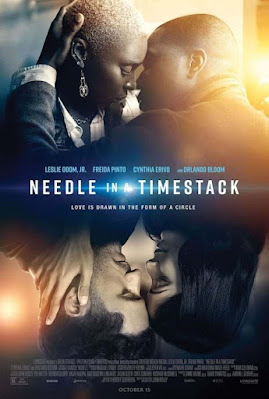
If there is one subgenre that brings out the romance in science fiction, it
would be time travel (as in Richard Matheson’s Somewhere in Time, etc).
Nick Mikkelsen wants to keep time travel romantic, but his desperate attempt to
save his marriage might turn it into tragedy in director-screenwriter John
Ridley’s Needle in a Timestack, a surprisingly faithfully adaptation of
the Robert Silverberg short story, which releases in theaters and on-demand this
Friday.
Nick
and Janine Mikkelsen are happily married, with a dog. However, he suddenly
finds they are happily married with a cat. He hates cats (who doesn’t?), so he
quickly deduces someone has altered their timeline. In their near future (which
looks a lot like the here and now), time travel is a thing for those who can
afford it. Changing the past to influence the future is strictly forbidden, but
it happens all the time.
Mikkelsen
tries to “back-up” their marriage, but it is not sufficient to stop Janine’s
wealthy ex-husband Tommy Hambleton. He is determined to get her back, so after
a particular severe time distortion results in Mikkelsen’s alternate marriage
to his old flame, Alex Leslie, Mikkelsen decides to fight fire with fire and jaunt
back himself.
Ridley’s
adaptation of Silverberg keeps all the clever parts, while shrewdly cranking up
the romantic vibe. The well-balanced balanced results should appeal to fans of
the author, as well as light time travel romances. Yet, there is an element of
darkness to the film that effectively cautions against rashly fooling around
with the time-space continuum.
This is a film Andrew Marvell and Robert Herrick would approve of—or so we
assume. Honestly, all anyone ever remembers of them are “time’s winged chariot”
and “gather ye rosebuds while ye may.” A procrastinator like Teddy isn’t very
good at seizing the day, but he will learn his lesson through drastic
fantastical intercession in screenwriter-director-co-star Josh Lawson’s Long
Story Short, which releases this Friday on VOD.
When
Teddy met Leanne, it was certainly eventful. It took him forever to finally pop
the question, but even after he did, he only agreed to set a date because of a
mysterious stranger’s meddling. Weirdly, she also gave them a strange, mystical
tin can that holds the uncanny and inconvenient power of flashing Teddy forward
one year, every ten or fifteen minutes or so.
Much
to his alarm, Teddy finds himself skipping over Leanne’s pregnancy, the birth
of their daughter, and the increasing tensions threatening their marriage. He
also finds himself forgetting their anniversary, over and over. With the help
of his ever-loyal best friend Sam, Teddy tries to fix his life and stop the
fast-forwarding phenomenon, naturally using Harold Ramis’s Groundhog Day as
a model.
Long
Story Short is
a bit like the dark and downbeat Adam Sandler vehicle Click, but it is
funnier, more optimistic, and generally more pleasant to spend time with. Even
when things look really bad, Lawson retains the possibility Teddy can still fix
things, or at least improve them.
It might be a trip, but it isn’t
necessarily fun to take. However, it is great to watch from the safety of the
audience’s perspective. In this case, the very latest designer drug has an
especially heavy kick. It alters the mind’s perspective of time, inducing
literal time travel. Of course, getting back is the difficult part in Synchronic,
the latest film from Moorhead & Benson (a.k.a. Justin Benson & Aaron
Moorhead), which just opened in actual theaters (but obviously not in the City).
Steve Danube and Dennis Dannelly have been
seeing some pretty horrifying things recently when responding to calls as New
Orleans paramedics. The crime scenes are inexplicably surreal, but there is one
commonality, the newest synthetic: Synchronic. Sadly, double-pronged tragedy
will soon hit very close to home for both first responders. Dannelly’s daughter
Brianna will mysteriously disappear while taking Synchronic at a college party
and Danube will be diagnosed with a brain tumor. As fate would have it, the
growth is right above his pineal gland.
Sick of the destruction wrought by Synchronic,
Danube buys up all the remaining borderline-legal stock, but doing so, he draws
the attention of a stranger who knows its time-traveling secret. Evidently, it
works through the pineal gland, which usually calcifies for those who reach
their third responsible decade or so, but Danube’s has been kept ironically and
unhealthily young. To find Brianna, he will take a series of spectacularly bad
trips, with each one steadily depleting his supply.
Moorhead & Benson are emerging as masters
of genre films that are mind-bending, but also powerfully emotionally charged. As
with their prior collaborations, Benson handles the screenwriting on his own,
but Synchronicity is clearly very much shaped and informed by their
partnership. To a large extent, the film portrays all the hard work necessary to
make bromance work, long after the equivalent of the bro honeymoon. Yet, they
still pull us in with an intriguing genre hook—in this case a take on time
travel that we really haven’t seen before.
Anthony Mackie is flat-out terrific as Danube.
It is a complex portrayal of a flawed man, who shifts from being angry at the
world and life in general to an acute concern over some very extreme
developments—that’s called growing up. He banters and spars with Jamie Dornan’s
Dannelly quite effectively, but the chemistry he develops with Ally Ioannides,
as Brianna, is even more interesting. It is the kind of jury-rigged family
relationships that are so important in real-life, but are rarely seen on film.

Forget
about Seth MacFarlane’s Ted. These Belgian plastic figurines had perfected the
foul-mouthed toy shtick long before he ever came along. Actually, they keep it
relatively clean during their latest misadventure, but Cowboy and Indian are
just as stupid, self-centered, and offensive as they ever were in Vincent Patar
& Stephane Aubier’s latest short film in the A Town Called Panic universe,
The County Fair, which screens as part of a showcase for the production company
Autour de Minuit, during this year’s Animation First Festival.
Fans
will not be surprised when Cowboy and Indian tank their latest test at school.
Horse, their mature guardian is so disgusted he threatens to withhold the
tickets he bought for this year’s county fair. This will be sufficient
motivation for the two dim-witted toys to knuckle down and ace the make-up
test. However, when events conspire to still prevent them from attending the
fair, they do what any wildly irresponsible cartoon character would do. First,
they try stealing tickets, then they resort to time travel to avoid the
obstacles in their way.