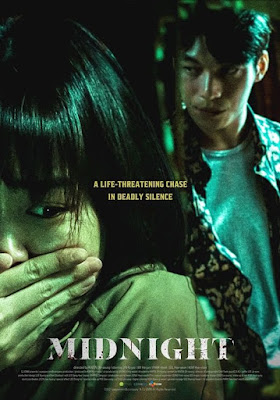
This Korean film could complete a “see-no-evil-hear-no-evil-speak-no-evil”
trilogy with Wait Until Dark and Mute Witness, while maintaining
the same level of quality. In this case,
Kyung-mi and her mother are deaf. They are accustomed to being patronized and
dismissed by society, but that makes them particularly vulnerable when a serial
killer starts stalking them. However, the women are more resilient than he
expects in screenwriter-director Kwon Oh-seung’s thriller, Midnight,
which screens in-person again tomorrow, as part of this year’s Fantasia International Film Festival.
Kyung-mi
gets by okay as a special sign-language customer service rep, living with her
seamstress mother. Unfortunately, after a late night at work, they accidentally
witness a masked serial killer abducting So Yong, the younger sister of her guardian,
Jong Tak, a tough cop recently discharged from military service. Initially, the
predatory Do-shik tries to dispose of them at the scene, but when they manage
to summon the dumb local coppers, he successfully dons his mild-mannered
civilian persona, claiming to also be a concerned family member of a missing
person. Unfortunately, this allows him to get close to enough to Kyung-mi and
her mother to learn things like their address.
Baby-faced
Do-shik (chillingly portrayed by Wi Ha-jun) is one of the creepiest, most
monstrous serial killers seen on film, since maybe the contemporary Korean milestones,
The Chaser and I Saw the Devil. There is also a good deal of
social commentary in Midnight, regarding the way the cops and society in
general treat the deaf, but instead of detracting from the suspense, it
actually intensifies it.
Jin
Ki-joo is absolutely terrific as Kyung-mi. Her performance is scrupulously realistic
and not the slightest bit cringey. Likewise, Gil Hae-yeon is totally
down-to-earth and believably terrified as her mother. Wi just radiates pure,
clammy evil as Do-shik, while Park Hoon is quite compelling as the conflicted
and guilt-ridden Jong Tak.
Carly Spencer is about to plunge into VR world like that of Ready Player
One, but it was designed for therapeutic purposes rather than
entertainment. Unfortunately, there is something else in there—something evil.
The technology is cutting edge, but the evil force has been around for
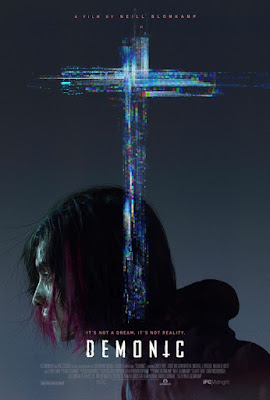
centuries in Neill Blomkamp’s Demonic, which is now playing in New York.
Spencer
changed her name after cutting all contact with her notorious serial killer
mother Angela McDonald. Yet, somehow the clinic treating her now comatose
mother managed to track down her old friend Martin, so it is probably only a
matter of time before they find her, as indeed they will. It turns out they
have plugged her locked-in mother into a simulated reality. However, McDonald
refuses to engage with it, until she talks to Spencer.
Reluctantly,
Spencer agrees to go in, only to tell her mother off, but instead, McDonald
just begs her to leave. Shortly, thereafter, Spencer experiences some extremely
disturbing and life-like nightmares. Martin has a demonic (so to speak) theory
about what is going on, but she doesn’t want to hear it.
To
his credit, Blomkamp has finally delivered a film that does not give viewers a
stern lecturing on a political topic. Instead, he supplies some creepy
atmosphere and several chilling scares. The simulated-world is deliberately
designed to look glitchy, which can be a little jarring, but when Blomkamp
really delves into the demonic aspects, it gets profoundly creepy.
Can't decide if you are in the mood for a sappy teen romance, a samurai
Chanbara film, or some light science fiction? Well, you do not have to choose.
This film does it all—and it might just save the future of filmmaking in the process.
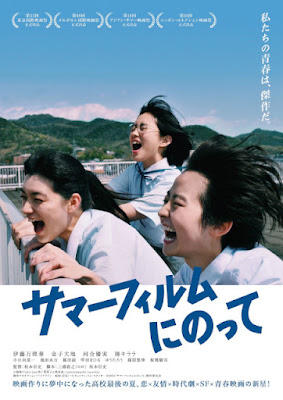
Genres collide, but the can-do spirit of teen filmmakers prevails in Soushi
Matsumoto’s It’s a Summer Film!, which screens on-demand and in-person,
as part of the 2021 Japan Cuts Festival of New Japanese Film, at the Japan
Society.
Nobody
loves samurai films more than “Barefoot.” (She and her friends have somewhat
eccentric nicknames that don’t seem to bother them.) Much to her frustration,
the film club throws all its resources behind the popular Karin’s weepy teen
melodrama instead of her script, Samurai Spring. Her friends, “Kickboard”
(of the Astronomy Club) and “Blue Hawaii,” (a member of the kendo team)
encourage her to go it on her own, but she is reluctant until she suddenly
finds her perfect lead.
For
some reason, the mysterious Rintaro insists she must make her film, but he is
reluctant to star in it. Barefoot is confused when he talks about being her greatest
fan, but there is definitely romantic attraction percolating between them. Things
really get confusing when the crew learns Rintaro’s secret—so much so, it
becomes unclear whether Samurai Spring will be completed in time for the
high school’s summer festival.
In
some ways, Summer Film bears some thematic similarities to the original Bill
& Ted, but its teen characters are much smarter. It might best compare
to One Cut of the Dead, because they both use genre elements to pay “feel-good”
tribute to the filmmaking process. Summer Film has more to offer than
cuteness, but it is indeed as a cute as a button.
Forget about Tom Cruise. In Japan, Tsuginosuke Kawai is often regarded as the
last samurai. At the end of the Shogunat era, his Nagaoka clan found itself
caught between forces loyal to the Shogun and the newly restored emperor. He
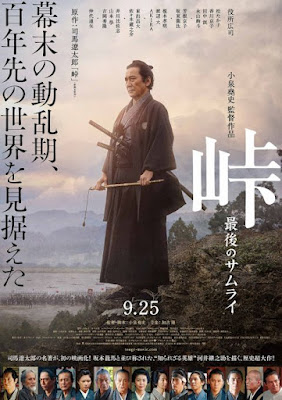
wanted to avoid a fight, but the Boshin War draws him in anyway in Takashi
Koizumi’s The Pass: The Last Days of the Samurai, which screens
live-and-in-person during the 2021 Japan Cuts Festival of New Japanese Film, at
the Japan Society.
Kawai
is the Nagaoka Clan’s chief retainer. Given his lord’s advanced years, he is
also the de facto strategist and decision-maker. He tries to remain neutral
after the Shogun’s abdication, but the two warring factions just won’t have it.
Reluctantly, Kawai assumes command of an alliance of smaller clans, even though
he suspects their efforts will ultimately prove futile. However, they might
have a prayer of survival, if they continue to hold the strategic Enoki Pass.
Whoever controls the pass controls Nagaoka Castle.
Pass
is
a terrific samurai film that is rife with tragic Shakespearean overtones, which
makes sense, given Koizumi was the assistant director on Kurosawa’s Ran.
Hardnosed Koji Yakusho (the star of Takashi Miike’s 13 Assassins and Hara-Kiri)
is instantly credible and immensely compelling as the shrewd, but
world-weary Kawai. In many ways, you could consider this a samurai equivalent
to Eastwood’s late-career cowboy movies. He also perfectly personifies Ivan
Morris’s conception of the “Nobility of Failure” in Japanese history and culture.
Yakusho
also shares some keenly poignant chemistry with Takako Matsu, playing his
eternally patient wife, Osuga. Their marriage is not perfect, but it endures.
As added bonuses, the legendary Tetsuya Nakadai and Kyoko Kagawa turn up in
small parts. However, there is no question Yakusho owns the film, body and
soul.
In fantasies, the son of a warrior is almost always destined to become a
warrior himself. For a young Kazakh boy, destiny calls early. Fate is serious
business on the Central Asian steppe, but so is revenge in Raiymbek Aizhanov’s
longish short film Mergen, included in the Radical Spirits shorts
block, which screens as an on-demand selection of the 2021 Fantasia International Film Festival.
Mergen’s
father is a warrior in the Khan’s army, but he has not been heard from for an
ominously long time. Nevertheless, Mergen’s mother and second-sighted grandmother
decide to stay behind when their nomadic clan departs, in hopes he will
eventually find them later. Instead, it will be other warriors from both sides
of the conflict that intrude upon their yurt (as a former resident of an Upper
Eastside studio, I have to say yurts look pretty spacious and comfy).
Aizhanov’s
nearly half-hour film is filled with hack-and-slash action and sweeping steppe
backdrops, but it also includes a good deal of spiritually-based fantastical
elements: visions, portents, and messages communicated through dreams. It is
exotic looking, but archetypally familiar. Think of it as the sort of film Mel
Gibson would like to still be able to make.
Young
Alikhan Abi is impressively expressive and disciplined, but also looks
age-appropriately small and vulnerable as the title character. Yerzhanov Gazret
adds tragic heft as the Kazakh traitor. Aizhanov stages some satisfying action
sequences and cinematographer Sardar Baimolden makes it all look big and
cinematic.
Even though it was originally a 30-page short story in Nightshift, it
sort of makes sense “Jerusalem’s Lot” has become a mini-series. Technically, it
is a prequel to Salem’s Lot, which still holds bragging rights as best
Stephen King miniseries yet (and maybe second best overall adaptation behind
the original The Shining). This one isn’t quite that good, but it
definitely represents a rebound from the disappointing Lisey’s Story. Maine
(circa 1850) gets weird again in creator-writers Peter & Jason Filardi’s
10-part Chapelwaite, which premieres Sunday on Epix.
There
has been little happiness in the Boone ancestral home of Chapelwaite, but retired
whaler Charles Boone hopes to change that when he inherits the property and the
local mill from his estranged cousin, Stephen. Much to his surprise the
townsfolk of Preacher’s Corners make no effort to hide their hostility when he
arrives. The presence of his mixed-raced children, eldest daughter Honor,
troubled middle daughter Loa, and son Tane, the youngest, only fan their
prejudice, but he promised their late mother he would provide a stable upbringing
for them (on dry land).
Unfortunately,
Chapelwaite appears to have a destabilizing effect on Captain Boone. He is
constantly unnerved by the sound of rats in the walls that only he can hear, especially
in light of the family’s history of insanity. Initially, only their governess,
modern-thinking Rebecca Morgan and loyal mill employee Able Stewart befriend
the Boones, but as the captain uncovers an unholy cabal centered in the nearby
ghost town of Jerusalem’s Lot, the local Constable and deeply flawed parson
also side with the pariah family.
Indeed,
Chapelwaite is at its best during its mid-to-later episodes, when the
rag-tag Team Boone takes its stand (so to speak) against the infernal forces of
Jerusalem’s Lot, led by the ferocious Jakub. There really is a bit of the vibe
from It or The Stand, but set against a wonderfully eerie gothic
setting. You can see the King-ish themes and motifs, but there are also
Hawthorne-like elements. Unfortunately, that also means there is a very
King-esque hostility towards fathers and clergymen, even though both Charles
Boone and Rev. Martin Burroughs grow in stature and have their grand moments.
Adrien
Brody does a terrific job freaking out and brooding hard as Charles Boone. Young
thesps, Jennifer Ens, Sirena Gulamgaus, and Ian Ho, are all quite effective as
the Boone children, but the Filardis maximize Loa’s petulant acting-out, to a
point that becomes tiresome. However, Devante Senior, Gord Rand, and Hugh
Thompson really stand-out, adding depth of characterization as Stewart, Rev.
Burroughs, and Constable Dennison.
Kids shouldn't have to worry about demographic trends, but these classmates
are totally getting done-over by them. So many people are moving out of their
rural community, their school will be forced to close. Instead of proms and homecomings, the students’ time together will culminate in the closing
ceremony. As always, the same old cliquey kid stuff still applies, but there
might possibly be aliens out there too in Yoichi Narita’s Follow the Light,
which screened during this year’s Fantasia.
After
his dad’s acrimonious divorce, Akira moved back with him to his old home town,
enrolling in a new school, only to learn he would have to start over once
again, after the end of the year. He is understandably shy, but when the class’s
queen bee notices his artistic talents, she recruits him for the closing
ceremony. However, it is Maki that Akira has stuck in his head. Due to
conflicts with classmates and difficulties with her parents, Maki has
practically dropped out. She spends most of her days at her Uncle Hideo’s rice
farm, standing on the roof, staring off into the horizon.
Then
one day, a strange light appears in the sky. Akira and a new friend (who is
trying too hard to latch onto him) follow it to Hideo’s farm, finding Maki
communing in the crop circle it produced. The resulting bond between Akira and
Maki could lead to something real, but it also causes jealousies and
resentments.
This review was not planned in advance, much like Biden’s mad, scrambling withdrawal
from Afghanistan. However, there is a compelling justification for its sudden appearance, unlike Biden’s cut-and-run
policies. Even before this week, thousands of Afghan interpreters and civilian contractors
were desperately seeking asylum in America. They are the subject of Andres Caballero
& Sofian Khan’s documentary, The Interpreters, which streams on PBS
Passport and is available on VOD.
To
protect the Afghans and Iraqis who risked their lives to assist the Coalition
forces, in hopes of rebuilding a better country for their families, Congress
passed the supposedly fast-tracked “Special Immigrant Visa” (SIV) program, but
when did you ever know government bureaucrats to be efficient or display a
sense of urgency? What was intended to take months according to statute, takes
years in practice. Plus, the application process requires Kafkaesque reams of
paperwork.
For
the interpreters Caballero & Khan interview, the clock is ticking. Without
their visas, it will only be a matter of time before they are hunted down by
the Taliban or Daesh. Yet, what is truly chilling is the realization matters
just got exponentially worse Afghan interpreters over the last few days.
Caballero
& Khan give the greatest screen-time to a chain-smoking Iraqi interpreter who
adopts the sly alias, “Philip Morris,” mostly likely because he was the easiest
to follow over an extended period of time. Morris kept in contact with Minnesota
National Guard sergeant Paul Braun, who doggedly followed-up on his end in a
long, protracted effort to bring the interpreter and his family safely to America.
The film makes a point of highlighting anti-immigrant sentiment, particularly
that stoked by Trump, but it seems like the way Braun’s family and others in the
MN community embraced Morris and his cause is just as important to the story.
Viewers
also hear from several Afghan interpreters during the course of the doc, which
suddenly makes it acutely topical. To paraphrase Sen. Ben Sasse and others,
what we’re seeing now wasn’t just predictable, it was predicted. The Interpreters
helps put a face on the massive tragedy underway. Yet, what can we expect
for them when the administration cannot even evacuate American citizens at this
time?
This film premiered earlier in the year at Sundance, but it has already aged
badly. In the opening prologue, the 1960s hippy characters daydream about violently
storming the U.S. Capitol, because that is what they think socially concerned
activists should do. Frankly, the entire attitude of the film is nearly as
problematic. Once again, it is the U.S. military and its industrial support
system that are the bad guys of Dash Shaw’s animated feature Cryptozoo,
which opens Friday in New York.
After
waxing poetic about attacking the seat of the U.S. Federal government, Matthew
stumbles across the fence of a Jurassic Park-looking facility, with his more
cautious girlfriend Amber. Eventually, we will meet up with her again, but
first Shaw flashforwards a bit, introducing us to Lauren, a cryptozoologist
working for the crypto-menagerie for mythical creatures founded and funded by
Joan, a slightly dodgy philanthropist.
Unfortunately,
one of their cryptids is missing. As it happens, Lauren has a childhood
attachment to the elephant-looking “baku.” Known as dream eaters, she fondly
credits a baku for vacuuming up her nightmares during her difficult childhood.
With her new Medusa-like sidekick, Lauren sets off on the trail of the missing baku.
Of
course, the leading suspect is the U.S. military-industrial complex, which
naturally harbors ambitions of weaponizing the baku’s abilities. Seriously, do
you think we could maybe briefly refrain from launching attacks on the American
military in a week when our they are desperately airlifting personnel from the
roof of our Kabul embassy, like it is 1975 all over again (thanks entirely to
the appalling misjudgment of the Biden administration)? Again, the timing is
bad for this film, but it is due to its virulent underlying ideology.
Shaw’s
wavy-shimmering style of animation is also a bit of an acquired taste. It bears
a resemblance to the old Dr. Katz show, but it is more creepily
Gilliam-esque here. While his first feature, My Entire High School Sinkinginto the Sea was slight and inconsequential, it still managed to mine mild
laughs from its premise. In contrast, Cryptozoo takes itself agonizingly
seriously.
This will be the last bus of the night. Its route runs from the end of the
line to the end of someone’s life. It will be a bumpy ride, but don’t buckle
up, because some of the other passengers are suspect. Beware of the monkeys too
in Joe Hsieh’s remarkable Taiwanese animated short Night Bus, included
in the Things that Go Bump in the East shorts block, which screens as an
on-demand selection of the 2021 Fantasia International Film Festival.
It
is late, so there are few passengers on the provincial bus headed back to the big
city. The two laborers are used to traveling this way. The rich elderly lady is
not, but since luxury car boke down, she is forced to make do. The pregnant woman
and her husband also look like they are accustomed to better traveling accommodations,
but here they are. They also do not appear to be very affectionate with each other.
Everyone’s fate will become with that of another solitary traveler inside the
bus and a mother monkey with her baby on the outside.
Night
Bus is
one of the best film noirs, of any length, that you could hope to see all year.
It is basically a tightly concentrated thriller in the Alfred Hitchcock
Presents tradition, but the incorporation of the monkeys gives it added
genre dimensions. You could even call it horror without much fear of
contradiction.
Chuseok is described as a Korean combination of Thanksgiving and the Day of the
Dead that is observed in both Koreas. However, it is difficult for North Koreans
to fully celebrate, because they have no food for their holiday feasts and no
access to the graves of their ancestors. That would be fine with a young Korean-American
artist, who gets rather creeped out by old Eastern traditions in Minsun Park
& Teddy Tennebaum’s short film Koreatown Ghost Story, included in
the Things that Go Bump in the East shorts block, which screens as an
on-demand selection of the 2021 Fantasia International Film Festival.
Hannah’s
long-deceased parents were friends of Dr. Moon, who dresses like a medical doctor,
but apparently also practices holistic medicine, notably including acupuncture.
Therefore, when Dr. Moon asks her to come visit before Chuseok, Hannah agrees out
of respect. Before she knows it, Dr. Moon has her on her table for an
acupuncture session. Then things get weird.
A man from the city finds himself stranded in a quaint village, where they
kill him in a ritual sacrifice. There, that’s folk horror for you. Nature can
also be a nasty, vicious beast in such films. Stone circles and pagan cults are
celebrated in Kier-La Janisse’s Woodlands Dark and Days Bewitched, a
three and a half horror documentary survey of folk horror, which screens as an
on-demand selection of the 2021 Fantasia International Film Festival.
Janisse
starts with the folk horror fans know and love best, the so-called unholy
trinity of Michael Reeves’ Witchfinder General, Piers Haggard’s The
Blood on Satan’s Claw, and Robin Hardy’s The Wicker Man (mercifully,
the Nic Cage remake is scrupulously ignored). The film then flashes back to the
sub-genre’s literary roots in stories like Grant Harrow’s Pallinghurst
Barrow and the ghost stories of M.R. James.
It
turns out the BBC was a fount of classic folk horror in the 1970’s. The James
adaptations of the A Ghost Story for Christmas franchise are still well
regarded and the creepy kids drama The Children of the Stone maintains a
nostalgic cult following. The second half of Janisse’s exhaustive study loses
some of its focus and energy, but there is still some interesting coverage of
international folk horror. It is particularly nice to see Mattie Do and clips
of her film Dearest Sister.
Unfortunately,
a good deal of the critical commentary is predictable and repetitive. Honestly,
if you took a shot for every time some uses a form of the word “colonialism,”
you would be lucky to wind up in the hospital rather than the morgue. The same
is true for the word “patriarchy,” so clearly Janisse did not cast a very wide
net for diverse viewpoints. Frankly, Woodlands is a good example of how
the insular world of hipster film criticism is starting to sound like a
brainwashed pagan cult.
Manuel Lamas was no Ed Wood or Tommy Wiseau. His films were ultra-low budget and
ultra-strange, but they could disturb and provoke viewers in a way that
solidified his small but dedicated cult following in Uruguay. Regrettably, he also
lacked Wood’s endearing charm. It turns out Lamas was a bit of a jerk, but his strange
vision still pulls filmmaker Emilio Silva Torres into a trippy wild goose chase
in his documentary-hybrid Straight to VHS, which screens live-and-in-person
at the 2021 Fantasia International Film Festival.
In
1989, Lamas released Act of Violence in a Young Journalist to virtually
no acclaim, but he managed to get a hundred or so VHS cassettes into Uruguayan
video stores, thanks to a shrewd distribution strategy. In subsequent years, it
took on a mythical life of own with idiosyncratic cineastes like Silva Torres.
The title makes it sound like harsher grindhouse fare than it apparently was. There
are random supernatural elements, but essentially the film blends a telenovela-like
sex and revenge melodrama with a documentary-like presentation of the journalist-heroine’s
efforts to explore the nature of violence and document its effects on society.
The
acting was challenged and the production values were bargain-basement, but
there is still something about the film that gets under people’s skin. Silva
Torres assumed finding lead actress Blanca Gimenez would be the key to
unlocking the puzzle. She had been Lamas’s writing and producing partner, so it
was often assumed she was his romantic partner as well. However, that does not
turn out to be the case. In fact, she had all kinds of issues with the late
filmmaker. Then just when the project appears stalled, a batch of previously
unseen Lamas tapes is mysteriously delivered.
Straight
To VHS eventually
goes pretty far out there, but it is really more interesting when it stays
relatively grounded. The truth is Lamas, Gimenez, and their films together are
sufficiently interesting. They really don’t need a stylized punch-up. By the
halfway mark, everyone has us convinced this is a significant work of
indie-outsider cinema, despite its dubious aesthetics.
This film could very well represent the end of an era. It is the final film
of Hong Kong action auteur, Benny Chan, who helmed it through production, but
had to bow out for post. It could also represent the swan song of the gritty HK
cop-and-gangster genre that we know and love. As Xi and the CCP apply the
draconian National Security Law to all aspects of HK life, we can expect local film
production to increasingly mirror the propaganda churned out on the Mainland.
It’s star, Donnie Yen, has publicly sided with the Party against the democracy
protesters, so maybe he will be okay with that. Perhaps it is also telling this
Yen vehicle is already playing in the PRC, but will open in HK after its
American release. The star still has his moves, but the cultural climate has
changed drastically (and not for the better) when Chan’s Raging Fire opens
tomorrow in New York.
A
few years prior, Bong and his protégé Ngo were working a high-profile
kidnapping case. With the clock ticking, the two cops divvied up their prime
suspects. Ngo’s team managed to beat the location of the victim out of their
perp, but then they kept beating him into an early grave. Much to their
surprise, the police brass scapegoated them for the entire affair. Now they are
out of prison and looking for revenge. For compensation, Ngo’s gang also plans
to grab some cash in some spectacularly messy armed heists.
In
terms of themes and tone, Raging Fire is a lot like Alan Yuen’s Firestorm,
but it doesn’t take things quite as far. Were it not for the presence of Yen, a
rather disappointing apologist for HK police brutality against the Umbrella
Movement, it probably wouldn’t see release in its current form. In Chan’s
screenplay, as he filmed it, the upper echelons of police leadership are
shamelessly corrupt. Beating information out of suspects appears to be standard
operating procedure and even the stalwart Bong does not appear excessively concerned
over collateral damage. (Incidentally, the fraught pregnancy of Bong’s wife is
rather lazily manipulative.)
Still,
fans will be happy to see Chan, the genre veteran, stages several impressive action
sequences. The final hands-to-hand confrontation between Bong and Ngo is
especially satisfying. Yen shows his martial arts chops are still finely honed,
but dramatically, he is content to coast, as Bong. In contrast, Nicholas Tse is
a riveting presence power-brooding and death-ray-staring as Ngo. He makes a
great villain, but that somewhat unbalances the film.
Kratts are sort of a folky Baltic equivalent of the golem. They are invoked by
purchasing bargain-basement souls from Satan, to perform arduous labor. They
will slave away at all the tasks given to them, but then they invariably go to
work on their creators. Rather ill-advisedly, two self-absorbed kids try to
create their own demonic drone while staying with their grandmother in her
rustic Estonian farmhouse, but they get far more trouble than they Faustianly
bargained for in director-screenwriter Rasmus Merivoo’s Kratt, which
screens as an on-demand selection of the 2021 Fantasia International Film Festival.
The
last time a lot of us saw Kratts on-screen was Rainer Sarnet’s November.
That was a starkly moody but exquisitely stylish horror-noir. Merivoo’s Kratt
is more like an unruly and unholy union of Stranger Things and PG: Psycho Goreman, but with an intentionally annoying post-Millennial attitude
(amongst the children). Technically, the terrible twosome unleashes all the
chaos with good intentions, to whip up a Kratt to do Grandma’s chores for her,
but it is not a swell thought out plan. However, Merivoo allows plenty allows
plenty of subplots to spin out into oblivion, but he always keeps the manic
energy cranked up to the max.
Merivoo’s
own spawn, Nora and Harri are convincingly rotten and clueless as tweener Mia
and her somewhat less horrible younger brother Kevin. Together they are a pair,
but Mari Lill is more than their equal as their strange and spooky Grandma. There
are plenty of wacky supporting performances, notably including Jan Uuspold, as
the Pastor called into to exorcise the Kratt, who channels Animal House-vintage
Mark Metcalf (Neidermeyer), which is not inappropriate.
It is sort of like And Then There Were None, but everyone is
dysfunctional family. Of course, the servants are keenly aware they aren’t,
even though they secretly might be. Family game night is a miserable, dog-eat-dog
tradition during Galloway family reunions, but this one will be lethal. At
least the survivor stands to inherit a huge chunk of change in writer-creator
Aaron Martin’s Slasher: Flesh & Blood, directed by Adam MacDonald, which
premieres Thursday on Shudder.
Spencer
Galloway always took sadistic delight pitting his family against each other. He
told them it helped them develop the killer instinct necessary to succeed him
as head of the family’s financial empire. However, this time the stakes are for
all the marbles, but he won’t be around to enjoy the drama. Given a terminal
diagnosis, Galloway planned to have his assisted suicide specialist administer
his final exit and then preside over his particularly brutal games. Any family
member who declines to play, regardless of the circumstances, inherits nothing.
That
was the plan, but a psycho-slasher dressed in a mask and 19th
Century coat and tails complicates everything. Suddenly, each eliminated player
also gets eliminated from life. There will also be a few surprise players: a
literal prodigal will return and the housekeeper’s daughter gets her chance for
recognition (and revenge).
The
remote island setting and the Agatha Christie-like one-by-one plot structure
still work pretty well in Flesh & Blood, but it lacks the suspenseful
crackle & pop of the thematically similar (but under-appreciated) Harper’s
Island. Also, F&B has a few kill scenes that are so disturbingly
graphic, they would not be out of place in the Hostel franchise.
On
the other hand, F&B features genre legend David Cronenberg portraying
the nasty patriarch, Spencer Galloway, who will often be seen in uncomfortably
revealing flashbacks. There is a drily manipulative dimension to his gamesmanship
that is definitely chilling. Sydney Meyer and Paula Brancati are both
appealingly energetic as potential “final women” survivors, Liv, the servant’s
daughter and Christy Martin, the disgusted sister-in-law. Unfortunately, only
Sabrina Grdevich really brings the flamboyant villainy as the elitist grown daughter,
Florence.
Shinji Ikari's father issues are pretty extreme. Gendo Ikari has done his best to
sever all connections to his son, while leading a shadowy conspiracy to destroy
the world and re-create humanity into a single collective consciousness. Yet,
you could say “like father, like son,” since Shinji has almost inadvertently
destroyed the world, not once, but twice. That is a lot for one young person to
bear. Not surprisingly, the angst-ridden mecha-pilot is not holding up well in creator-chief
director Hideaki Anno’s Evangelion 3.0 + 1.01: Thrice Upon a Time, the
[most likely] concluding film of the Rebuild of Evangelion reboot series,
which premieres Friday on Prime Video (with a title like that, you know it
must be an anime feature).
As
the film opens, Shinji Ikari is so guilt-ridden, he has practically shut-down
his body and spirit. He has been shipped off to a peaceful countryside
community of survivors to recuperate, along with his fellow EVA pilots, Asuka
Shikinami Langley (who both resents and carries a torch for Ikari) and Rei
Ayanami (a clone of a clone, quietly imploding worse than Shinji).
Of
course, this interlude cannot last. Eventually, Ikari and Langley will return
to WILLE, the global defense agency led by Misato Katsuragi, who was something
like a surrogate mother to Ikari. They first met while they were serving NERV,
ostensibly WILLE’s forerunner, which was secretly founded by his father to
hasten the final, world-shattering “Impact.”
Obviously,
it is time for the final battle (at least until the next one), to be fought by Katsuragi
helming the WILLE fleet, including EVAs piloted by Shikinami and her gifted comrade,
Mari Illustrious Makinami (for whom Ikari might carry a torch) against the
vastly greater forces of NERV. Eventually, Ikari will also have to face his
father, EVA-to-EVA, in Minus-Space, where the rules of physics and scale measurement
do not apply.
There
are some anime series that get pretty apocalyptic, but Thrice Upon a Time tops
them all. It also outdoes all the competition when it comes to neurotic angst.
Yet, that really makes 3.0+1.01 a fitting capstone to the series. Once
again, Anno’s team delivers visuals that are three or four cuts about the
series anime standard. The prologue battle above a ruined Paris is particularly
striking. Arguably, the first act idyl in the village drags out a bit, but it
ends on a potent note that is ever so true to the spirit of the franchise.
Suppose Kevin Costner showed up for the reunion in The Big Chill. That is basically what Kazuki Yoshio did. His five friends
cannot explain his presence (neither can he), but they aren’t
complaining. While they have time together, they try to say the things they
left unsaid and complete some unfinished business in screenwriter-director Daigo
Matsui’s Remain in Twilight, which screens as an on-demand selection of
the 2021 Fantasia International Film Festival.
Yoshio
is generally enjoying hanging with his pals Kinichi Fujita, Tetsuya Akashi,
Taku “Sauce” Sogawa, Taisei Tajima, and Yusaku Mizushima, but he is troubled by
a nagging question: didn’t he die five years ago? Well, to be technical about
it, yes, he did. Nevertheless, here he is, rehearsing their [in]famous school
dance number, clad in unflattering red loincloths.
Needless
to say, the dance gets a rather mixed reaction from wedding guests, but they are determined to double-down and perform it again at the reception. However,
that leaves them several hours to kill. Eventually, they start to address the
elephant in the room, as well as their lingering guilt and grief. Yoshio will
also have a chance to finally express his feelings to Mickie, the classmate he always
carried a torch for.
In
the film, Yoshio’s mates keep saying everything should have ended after his big
scene with Mickie—and they are probably right about that. Instead, the film
gets a little too lost in metaphysical symbolism, but not so far that it
totally undermines all the good will the film previously generated. For the
most part, Matsui’s magical realism is sly, understated, and remarkably
endearing.
It is now Pope Francis’s Church. The conservatives are out and so are their
old school practices. So, what happens when a demon needs exorcising? In this
case, they call in a semi-disgraced old priest. He doesn’t really believe
either, but he thinks the form of the ritual still holds value. However, he hasn’t
yet met the possessed title nun in Mickey Reece’s Agnes, which screens
as an on-demand selection of the 2021 Fantasia International Film Festival.
Sister
Agnes is cloistered in a highly traditional and secluded convent. Nevertheless,
the Devil still found her there. She exhibits all the classic signs of
possession, so the stern Mother Superior is forced to request help from the
Archdiocese. Much to her annoyance, it arrives in the persons of the rakish
Father Donaghue and his young protégé, Benjamin, a Deacon, who will soon take
his vows as a priest.
Father
Donaghue does his thing, assuming the ritual will give Sister Agnes the
psychological or emotional relief she needs. Unfortunately, this case will be a
considerably more difficult—and more real. Yet, the possession is only half the
story. Equal time will be given to the aftermath, as Sister Agnes’ closest
friend, the former Sister Mary, navigates civilian life after losing faith and
leaving the convent.
Initially,
the second half feels like a punishingly long and drawn-out epilogue, but Reece
eventually pays if off with a quiet but really well-written explanation of
faith from the newly ordained Father Benjamin. There is a lot to slog through,
but the light-bulb moment redeems it. Plus, the demonic horror stuff is pretty
creepy.
Reece
has a weird, off-kilter style all his own. His eccentric rhythms and cadences
suggest an unholy union of 1970s art-house cinema and questionably dubbed
Euro-horror movies, but somehow it seems to work for him. Ben Hall and his radio
announcer voice are a perfect match for Reece. Like in Climate of the Hunter,
Hall is an intriguing and unpredictable presence as Father Donaghue—so much so,
we would like to see him leading other horror films, helmed by other directors.
He has the life expectancy of novelist James Gunn’s The Immortals and
the emotional maturity of a test tube. Everyone wants a piece of the
genetically engineered clone, because he can’t die unless he is killed.
Fortunately, he has the protection of former intelligence agent Min Ki-hun. The
ex-spy looks like a basket case, because he is, but Min can still take down the
bad guys in screenwriter-director Lee Yong-ju Seobok, which screens as
an on-demand selection of the 2021 Fantasia International Film Festival.
Disgusted
by the dirty work of his last assignment, Min has walked away from the agency.
He also has a terminal brain tumor. Weirdly, that makes him the perfect
candidate to serve as Seobok’s bodyguard. If he can keep the clone alive, he
gets first dibs on a Seobok mojo-extracting treatment.
Of
course, that will be the tricky part. A shadowy cabal already assassinated the
American scientist evaluating the Seobok project and the clone himself is
presumed to be their next target. However, Seobok (named after a Qin Dynasty messenger
dispatched to find the elixir of life) is hardly helpless. It turns out he has
massive Professor X-like telekinetic powers that were an unanticipated
byproduct of his radical genetic engineering.
Lee
is working with a familiar template (cynical government agent learns to respect
the humanity in the guinea pig is tasked with protecting), but the action
sequences are crisply executed and Gong Yoo is remarkably haggard and world-weary
as Min, despite his babyface. The problem is Seobok (portrayed with utter
emotionlessness by Park Bo-gum) truly has the personality of a lab rat. The
silent steeliness thing works much better for Jo Woo-jin as the sinister
intelligence chief Ahn Ik-hyun. However, some of the best dramatic work comes
from Jang Young-nam as Lim Se-eun, Seobok’s surrogate mother and project scientist.
According to Bill Murray in Ghostbusters, dogs and cats living together
were a sign of the apocalypse. Nevertheless, that is the plan for feline Nimfa
Dimaano. The only question is whether she will choose her burly working-class
lover (he’s a real mutt) or a rich greyhound in Avid Liongoren’s animated
feature, Hayop Ka! The Nimfa Dimaano Story, which screens as an
on-demand selection of the 2021 Fantasia International Film Festival.
These
might be talking animals, but they definitely aren’t for kids. Liongoren’s send-up
of Filipino telenovelas is quite sexually frank in its language (but the action
on screen is mostly PG-13—mostly). True to its genre, Hayop Ka (meaning:
“you animal!,” a frequent telenovela exclamation) involves class-straddling
romantic relationships. Dimaano starts the film in a shacked-up with dirt-poor
but ultra-macho Roger, whom her best friendemy not so secretly carries a torch
for, but she is tiring of his crude manners and lack of ambition.
When
playboy-industrialist Inigo Villanueva drops by the perfume counter where she
works, it is sort of like Pretty Woman, but without the prostitution.
Granted, Villanueva is a bit arrogant, but he is trying to break a union for
the good of the economy, so he obviously isn’t all bad. Nevertheless, Dimaano
is reluctant to fully jump into a relationship with him, because of her deep-rooted
class consciousness.
Last time you had to reclaim your car from the impound lot, did you think: “wow,
this could be the setting of a thrilling film?” Probably not. A good part of
this tale also takes place in the NYC court system, but they try to make it
look as depressing as possible. There is plenty of finger-wagging and a bit of
nonsensical cosmic jibber-jabber, but not much else in Chase Palmer’s Naked
Singularity, which opens today in New York.
Casi
is a public defender, so we are supposed to automatically assume he is pure of
heart. Indeed, he is quite put out when his nemesis judge keeps sending his
clients to jail, for crimes they admit they committed. His new client presents
a slightly different case. Technically, Lea is a repeat customer, who requested
him personally. However, she has leverage to cut a deal. As an employee of the
city impound, she was approached by a sleazy criminal type for info on a towed
SUV loaded with a stash of drugs.
With
her help, the cops hope to bust the cartel when they buy back the black
Navigator at auction, but she has a plan to double-cross everyone. Meanwhile,
Casi periodically drops in on his stoner friend, who mumbles incoherently about
alternate worlds and quantum singularity.
Apparently,
an impound clerk with a criminal record is the only person with access to the
schedule for the city’s confiscated vehicle auctions. In this contrived world,
the narcotics detectives would logically never bother to contact any of her superiors,
to make sure they would not cross up their plans.
Frankly,
every bit of Singularity is simplistic and unrealistic. It is also
dated. These days in New York, bail is practically non-existent, even for
felonies. Manhattan is poised to elect a District Attorney who will not prosecute
any misdemeanors or nonviolent felonies and refuses to resign from the board of
the Legal Aid Society (a clear conflict of interest). Frankly, this film is
just a petulant fantasy.
Somalia is a member of the United Nations, the Arab League, the African Union,
and the Organisation of Islamic Cooperation, but it was considered a failed state
even before the civil war broke out in the 1990s. Yet, as a member of the UN,
it represented a key swing vote in South Korea’s bid to join the body. Of
course, the one-party Somali Revolutionary Socialist Party regime had a greater
affinity for their North Korean totalitarian rivals, but a ragtag ROK diplomatic
contingent still did their best to lobby for their UN membership support. When
the nation plunges into chaos, they must improvise to secure safe passage out,
including possibly even working with their sworn DPRK enemies in Ryoo Seung-wan’s
Escape from Mogadishu, which opens tomorrow in New York.
Mogadishu
is a high-stress, low-reward posting for Han Shin-sung, but it also represents
the Foreign Service Officer’s first posting as an ambassador. Somalia
represents an unambiguous career demotion for his intelligence officer, Counselor
Kang Dae-jin, but they still have a friendly working relationship.
Unfortunately, North Korean Ambassador Rim Yong-su constantly out maneuvers
them when lobbying the corrupt President Barre. Yet, Kang uncovers evidence the
North Koreans are secretly arming the rebels behind the scene (which Rim later
denies and Ryoo’s screenplay remains cagey on).
As
the rebels gain momentum, the country plunges into anarchy. Battles clash on
the streets, but Kang manages to bluff the embattled government into assigning
a security detail to their embassy, for a price. The North Koreans are not so
fortunate. When their embassy is compromised, they are reluctantly forced to
ask Ambassador Han for refuge, which he grants. However, Kang and his opposite,
Tae Joon-ki are not about to set aside their spycraft.
Reportedly,
Escape is indeed based on a true story, but it clearly was not
well-reported in the West. Nevertheless, anyone familiar with North Korean
politics can only imagine how severely an embassy staff would be purged after
seeking shelter with the South Koreans, but the film does not go out that far.
Instead, it is all about getting out of Dodge.
Filmed
on location in Morocco (as was Black Hawk Down), Ryoo and his team vividly
recreate the exotic atmosphere and abject chaos of civil war Mogadishu. Like he
did in The Berlin File, Ryoo nicely marries action with intrigue
throughout Escape. It is tight, tense, and atmospheric. Ryoo really
conveys a sense of fear and unpredictable violence that comes from the failed
state experience.
Sometimes, jazz fans suggest less than enlightened racial attitudes contributed to Leon
Bix Beiderbecke’s alcoholism and emotional decline, because the white cornetist
was not able to openly play with musicians like his hero, Louis Armstrong. That
might be overstating the point, but he surely would have been much happier working
with real deal jazz musicians rather than Paul Whiteman’s sweet symphonic band.
Beiderbecke put soul into Dixieland, but he didn’t live to see his thirtieth
birthday. Brigitte Berman chronicles his life and music in the newly restored
documentary, Bix: Ain’t None of Them Play Like Him Yet, which opens Friday
at Film Forum.
Beiderbecke
is Davenport, Iowa’s favorite son, but his prominent family was not exactly
thrilled by his musical ambitions. Eventually, their snobbish disregard would
contribute to alcoholism and depression. During his short-lived prime, he was
arguably the second most respected jazz musician in America, after Louis
Armstrong, and the most accomplished white soloist. Unfortunately, like Charlie
Parker, he attracted fans who sometimes ill-advisedly encouraged his excesses—in
Bix’s case, that was gin.
Given
his reputation, Paul Whiteman inevitably decided to recruit Beiderbecke for his
big band. Unfortunately, it was not the sort of swinging outfit, where
Beiderbecke could have thrived. He more or less knew it too. Initially, Bix
turned down Whiteman to play with a real-deal band led by Adrian Rollini, but
they were so good, only musicians went to hear them, so Bix was out of work
again in three weeks.
Of
course, the most important part of Berman’s film is Beiderbecke’s music, which
still sounds great. Amazingly, even with its limited audio fidelity, a tune
like “Singin’ the Blues” sounds fresh and effervescent—much more so than ninety
percent of the music of his contemporaries (not including Armstrong).
Berman
does a nice job evoke the vibe and music of Bix’s era. Appropriately, we hear a
lot of vintage Beiderbecke and Whiteman recordings, but there are also legit soundtrack
performances by Richard Williams on cornet as well as Dill Jones and Earl
French on piano (Jones, the late stride specialist notably serves up a lovely
rendition of Beiderbecke’s piano composition, “In a Mist”).
When
watched from the vantage of the 2020s, Berman’s Bix feels like a direct
precursor to the Ken Burns school of documentary filmmaking. With its
combination of voice-overs (Richard Basehart for you MST3K fans),
archival photos, and sensitive music, Bix could easily pass for an installment
of Burns’ Jazz.
Satoshi Kon is such a significant anime filmmaker, his tragic death created a
conundrum. Is there a filmmaker who has the stature required to follow in Kon’s
place and finish his last, unfinished film, who would also completely minimize
their creative inputs, to maintain Kon as the sole auteurist hand guiding it?
Of course, fans sure would like to see his producers figure something out,
since Kon only released four full-length features and one thirteen-episode
series during his lifetime. Pascal-Alex Vincent surveys the work and themes of
the anime legend in Satoshi Kon: The Illusionist, which screens as an
on-demand selection of the 2021 Fantasia International Film Festival.
Four
films and change might not seem like a lot, but his first three films recently had
full theatrical re-releases and his fourth, Paprika, is largely seen as
the “inspiration” for Inception. According to Darren Aronofsky, he asked
and received the master’s go-ahead to include a significant “homage” to Kon’s Perfect
Blue in Requiem for a Dream. He was instrumental to the rise of
anime’s popularity in the West, along with Hayao Miyazaki (Studio Ghibli),
Mamoru Oshii (Ghost in the Shell), and Katasuhiro Otomo’s Akira.
Yet, his popularity cut across genres and fandoms.
Taking
its title from Andrew Osmond’s nonfiction study, The Illusionist follows
a conventional documentary approach, mainly just incorporating talking head
interviews and film clips. However, Kon’s visuals have lost none of their pop.
Most tantalizing are the excerpts from the unfinished The Dreaming Machine.
Ostensibly, it would have been his first children’s film, but still sounds like
it would have featured similarly existential science fiction themes. Had he
completed it, Machine might have been compared to Wall-E in the
way Inception and Paprika are often likened.
2020 must have been a great year for sea monkey sales. Apparently, you could
raise capsule kaiju the same way in Japan. Of course, you never really know
what you might get when you raise kaiju in your apartment, but an unemployed actor
hopes his kaiju will battle the CCP’s Coronavirus in Shunji Iwai’s The 12
Day Tale of the Monster that Died in 8, which screens as an on-demand
selection of the 2021 Fantasia International Film Festival.
Iwai
probably got his minimalist Zoom-style movie in just under the wire. It is time
to declare a moratorium on video chat pandemic-era films, because you have a
standout like Rob Savage’s Host on one hand and all the other dreary
ones on the other. Frankly, the Zoom chatting also grows tiresome here too, but
there is something appealing about the film’s surreal premise.
With
nothing to do, Sato orders a capsule monster to raise. It makes sense
considering Shinji Higuchi (the director of Shin Godzilla and an
upcoming Ultraman movie, playing himself) is available to advise him.
Unfortunately, his kaiju eggs only slowly morph into what look like misshapen
kaiju eraser heads. In contrast, the alien his friend bought is growing like a
weed. Unfortunately, it is invisible on online chats, so he can’t see it mocking
him.
12
Day Tale is
just short of 90 minutes, but it still feels a bit too dragged out. The concept
is clever and the execution hits the right melancholy notes, but this project
probably should have realized as a forty- to fifty-minute short film instead.
You can find the Droste Effect in the paintings of M.C. Escher and the packaging
of Morton Salt, Land O’Lakes Butter, and the eponymous Droste cocoa. You can
also find it in the Kato’s laid-back hipster café. In addition to a vintage
Droste cocoa tin, his friends have used the Droste Effect to extend a two-minute
time loop Junta Yamaguchi’s wildly clever Beyond the Infinite Two Minutes,
which screens as an on-demand selection of the 2021 Fantasia International Film Festival.
After
a hard day of work at the café, Kato retires to his upstairs apartment, where to
his surprise, he starts talking to himself on his computer monitor. According
to his other self, he is speaking from the café’s closed-circuit TV, from two
minutes in the future. Apparently, a very limited time-loop has opened up,
which his scheming slacker friends find far more interesting than he does. Eventually,
they bring together the monitor and the CC-TV to face each other, creating a Droste
Effect. Of course, all Heck will break lose when they start giving themselves
actionable tips from the future.
Makoto
Ueda’s utterly original screenplay will make your head spin if you try to break
down the internal logic, but the breakneck energy of Yamaguchi’s execution will
keep you deliriously distracted. It is hard to say whether, strictly speaking,
this is a time travel movie or a time loop movie, but it hardly matters.
Largely shot on iPhones (probably partly out of necessity, due to the tight
spaces of the upstairs rooms), Infinite Two Minutes is easily the most
inventive science fiction movie, since maybe the films of Melies.
Yamaguchi’s
film has been likened to One Cut of the Dead, not just for its scrappy
resourcefulness but also its one-continuous take structure. Yet, Infinite Two
Minutes is particularly impressive in that respect, because it features
scenes of cast-members playing opposite themselves. Frankly, it required a nearly
superhuman feat of traffic-directing.
If there is one film festival you have to attend in person sometime, it is the
Fantasia International Film Festival, up in Montreal. Sure, the films are always
the kind of weird horror, sophisticated animation, and thrilling Asia action we
love, but it is the traditions that make Fantasia Fantasia.
First
of all, having covered Fantasia in person for the 2019 festival, I have to say their
PR department does more to make press feel welcome than any other fest I
covered. Even more important (for civilians) is the in-person screening
experience. At your first movie, you might be wondering why people are meowing
like cats? The truth is nobody really knows, but there will always be six or
seven people doing it at every screening.
However,
that is nothing compared to how the theaters always erupt in cheers for the
Nongshim cup noodle commercial. Nobody knows how that tradition started either,
but you have to love how epic they are. Even Nongshim was surprised by the love
they get at the festival, so they doubled down on their support. By the way, they
have some of the best cup noodles available in neighborhood grocery stores.
Thanks to Fantasia, we definitely have some in our cupboard.
Sometimes a film without an explicitly political message becomes political because
of who might appear in it. This is a perfect example. Self-exiled
Ukrainian-born Russian filmmaker Vitaly Mansky documented a day in the life of
the Dalai Lama at his Dharamshala headquarters in Sunrise/Sunset. To
their credit, OVID.tv has most likely forsaken the Mainland Chinese market by
streaming his intimate documentary, which starts streaming this Wednesday. They
will probably also be frozen out of Russia too, because they are also picking
up Mansky’s chilling Putin’s Witnesses the same day.
His
Holiness is up early at 3:00 AM, when he starts his full routine of physical
exercise and religious devotion. The Nobel Laureate also has a full agenda of
dignitaries who have scheduled an audience with him. (Ironically, this day he
is receiving an unofficial delegation from Russia.)
Mansky
had total access during his 24-hour window, so he was able to capture an image
rarely seen in Dalai Lama documentaries. That would be the armed guards the
Indian government provides His Holiness. (Sadly, this is a necessary concession
for the Peace Prize recipient.) Those who follow Tibet Buddhism will recognize Sunrise/Sunset
was produced over ten years ago, because The Dalai Lama was still talking
about his next reincarnation (just not in Tibet), whereas lately he has
suggested (including in the doc, The Last Dalai Lama) he just might forego further reincarnations, to prevent the CCP from anointing
a puppet imposter.
Regardless,
he displays the same warm graciousness we are used to seeing from him. For the
last twenty minutes or so, the Dalai Lama is only heard rather than seen, as
Mansky marries up audio of an interview he conducted with footage of his long
train trek back to Russia. Weirdly, His Holiness spends a great deal of time
discussing over-population. However, one of his potential solutions, more recruiting
more monks and nuns, might have been a dry joke.