Today, it would be a scandal if the government supplied cigarettes to our troops,
but during WWII, they were staples of K and C ration packages. At the time, the
government and military figured they might as well give the soldiers fighting
for democracy what they wanted, instead of telling them how to live. Can you
imagine? Consequently, the Lucky Strike company played up its connection to the
troops with its “Lucky Strike Green has gone to war” campaign. Indeed, Captain
Castle goes through Hell with his brand of choice in Rod Lurie’s Lucky
Strike, which is still playing in theaters.
The
opening prologue fully and shockingly establishes the brutality of the Waffen-SS
and the constant specter of death hovering over Allied troops during the Battle
of the Bulge. Unfortunately, that is exactly the sort danger Castle must brave
with his squad. Their orders are simple. Block a vital road to prevent German
troop advances. The execution will be a you-know-what show. In fact, Captain
Castle will be the mission’s sole survivor, unless you also count “Lassie,” the
squad’s trusty Motorola SCR-300 radio, so-nicknamed for its reliability. As the
voice from HQ tells him, Lassie will be his lifeline, until he reaches the
extraction point, so he’d better protect it.
Getting
to the rally spot will be a harrowing journey, as the older Col. Castle explains
years after the fact to the somewhat confused Mrs. Caldwell. For reasons that
are not immediately clear, he invited himself in and started chronicling his harrowing
tale of survival. However, she will indulge him for a while, out of respect, since
she also lost her son, a member of the 761st Tank Battalion, during
the Battle of the Bulge.
Lurie
happens to be a Westpoint graduate, which gives viewers confidence he will
treat his Army characters with the respect they deserve. Indeed, he and
military advisor Jariko Denman (a fifteen-year-plus Ranger combat veteran) realized
the warfighting scenes with a very high degree of historical accuracy, including
the use of vintage tanks and vehicles that were authentic to the combat in the
Ardennes. To his credit, Lurie skillfully stages battle scenes that are
confusing and disorienting, in a deliberate, realistic kind of way.
For the men of the U.S.S. Indianapolis, sharks were deadlier than the Japanese
torpedoes. Allied Prisoner of War in the Pacific also faced a similarly
non-human threat from malaria-carrying mosquitos. However, in this
fictionalized Ardennes, American troops had to contend with sasquatch-like creatures,
as well as the Germans. Yes, this is one of those movies. There is plenty of hair,
but, sadly, the fun is less plentiful in director-screenwriter Jason Mills’ World
War Bigfoot, which releases tomorrow on VOD.
Given
the campfire prologue, “Doc” obviously lives to tell his grandchildren this war
story, thereby further reducing the potential suspense. Frankly, it is not
exactly clear his small detachment was heading into the Ardennes. Regardless, it
is a forested area along the front lines. Their objective is also vague. In
fact, they have no idea what they mission is, but “Sarge” assures them it is
top secret.
Inevitably,
they clash with Nazi troops, whose commanding officer came for the same reason.
He is equally obsessed with the Bigfoot-like creatures after seeing one first-hand.
Apparently, during the late stage of the War, American sergeants and German
junior lieutenants could just cut their own orders and requisition men, with no
questions asked.
Indeed,
their Bigfoot sightings drove both to psychosis. Doc even witnesses Sarge
murdering one of his own men, who threatened to expose his madness. So much for
the “Greatest Generation.” Mills prefers to depict the men who fought and died
to save democracy as sadistic cutthroats—excepting of course, the conscientious
objector medic, who quickly forms an alliance with his similarly enlightened German
counterpart.
As a minimally-budgeted
genre mashup, World War Bigfoot had two promising options. Go all in
with outrageous gore and over-the-top comedy, or play it straight while inviting
the audience to cheer for the American soldiers, against all enemies, foreign
or cryptid. Instead, we get the worst of both options, a slow-moving, agonizingly
self-serious film that openly posits a moral equivalency between the American
and German Armies.
The
best work comes from makeup artist-suit designer Anna Fox and fellow suit
designer Robert M. Bravo. Their creatures look surprisingly great, despite the
severe budget constraints. Honestly, this film does not deserve their
inventiveness.
Oberst (the Norwegian equivalent of Colonel) Birger Eriksen famously predicted “Either
I will be decorated, or I will be court-martialed.” Both sort of came to pass, expressly
because of his command to open fire on the Blucher, a German heavy cruiser that
was part of the first wave of the National Socialist invasion of Norway. Of
course, nobody in the Oscarsborg Fortress knew of the extent of the German operation.
It was Eriksen’s call to make and he made it, as director Daniel Fahre shows in
the historical drama Battle of Oslo (a.k.a. Blucher), which
screens again during the 2026 Palm Springs International Film Festival.
In 1946,
Eriksen is called before a formal military Investigative Commission to account
for the decision he made—mostly his surrender of the fortress. Ironically, the
commission’s star witnesses were the two junior officers who questioned Eriksen’s
decision to open fire on the Blucher.
Admittedly,
it was a tough decision. Nobody could confirm the nationality of the heavy
cruiser sailing down the fjord towards Oslo. Magnus Sodem and August Bonsak
argued against torpedoing the Blucher, fretting it could be construed as an act
of war. However, Eriksen insisted they had a duty to protect Norway’s neutrality.
Obviously,
Battle of Oslo is all about war, but Fahre and screenwriters Axel Hellstenius
and Melike Leblebicioglu Kava emphasize the burdens of command rather than the
shock-and-awe of warfighting. This is an unusually moody, but thoughtful war film.
Frankly, it unambiguously suggests there are two sorts of officers: those who
make decisions and accept responsibility, like Eriksen, who is contrasted with
those who keep their heads down and CYA, as represented by Sodem and Bonsak.
Consequently, Battle of Oslo will likely resonate with many vets, even
if they are not experts in Norwegian military history.
Bjorn
Sundquist portrays Eriksen with appropriate quiet dignity. The audience can
feel the weight of every command he must deliver. He also conveys the officers’
deep sense of responsibility to his country, men, and family. In fact, the most
notable supporting character is that of his daughter Borghild, a polio
survivor, who worked as a civilian staffer at the Fortress. Andrea Berntzen delivers
a smart, grounded performance that conveys the complexity of Eriksen’s
relationship with her military father. We clearly get the sense that there are
things only she can say to the Oberst that nobody else could—and vice versa.
The sinking of the HMAS Armidale was a lot like the tragedy of the U.S.S.Indianapolis. It was bad enough when both were sunk by the Imperial Japanese.
Yet, for the survivors, fending off sharks in the water was even more horrifying.
Everyone knows Quint’s monologue about the Indianapolis in Jaws. This is
Armidale’s story, with a few dramatic liberties taken, in director-screenwriter
Kiah Roache-Turner’s Beast of War, which releases tomorrow on DVD/BluRay.
Will
seems ill-prepared for war, but he makes a good mate in Leo, an Aboriginal
recruit who is probably the fittest for service, assuming he survives some of
the racists also going through boot camp. Unfortunately, they will see little of
the “proper” war, because they ship out on the Armidale, which is way too
lightly armed and armored for the enemy-infested waters it set out to traverse.
Their ill-fate led to a thorough review of such procedures, but that would mean
little to Leo and Will as they watch a giant female great white circle their
makeshift raft.
Of
course, they are also stranded with Des Kelly, the worst racist of their unit,
along Thompson, whose grave head wound makes his judgement dangerously unsound.
It will be uncomfortably tight on that life-raft, but having a comrade to rely
on, unconditionally, like Leo and Will, makes a big difference in their odds
for survival. Indeed, that truly is the film’s takeaway.
Roache-Turner
stays true to his genre roots by conceiving Beast of War as essentially
a historically based sharksploitation horror movie. That is somewhat risky,
considering many brave Australian servicemen died aboard the Armidale. It also shortchanges
some of the heroes who fought and died valiantly, but it also forces viewers to
confront the terrors they endured. Frankly, this is the sort of film that makes
Quint look reasonable and justified.
Mark
Coles Smith is also terrific as Leo. He seethes with anger, but also conveys a
passion for life. Will is a much quieter, more passive character, but Joel
Nankervis develops convincing and compelling comradery with Smith’s Leo, so
viewers will enthusiastically root for them both to survive.
In The Great Escape, Captain Virgil Hilts raced motorcycles before the
War. Likewise, British Wing Commander James Wright studied martial arts according
to the backstory of this film (starting with his youthful years in Hong Kong,
if you were wondering). Both sports have timely wartime applications. However, there
is no question putting his fist into the faces of the Japanese POW camp guards
holds a special satisfaction for Wright. As a result, he doesn’t expect to live
much longer, but he intends to go down swinging in Louis Mandylor’s Prisoner
of War, which is now playing in theaters (and available on VOD).
We can
tell from the prologue Wg Cdr. Wright will somehow survive—and he will not
forget (or forgive) the treatment he received from camp commandant Ito. 1942
was a heck of a time to get shot down over Subic Bay, but obviously that was
never Wright’s intention. Having enough of an idea of what awaits, Wright kills
three Japanese soldiers trying to evade capture. Once apprehended, a junior Japanese
officer orders his immediate beheading, but Wright also kills the execution party.
At this
point, Ito develops an unhealthy interest in his prisoner. He hopes to
humiliate Wright in his makeshift gladiatorial ring, but despite being
outnumbered and facing unfair, unequal conditions, Wright keeps besting every
Japanese soldier Ito throws at hm. However, he recognizes the situation is
unsustainable. The prisoners have also heard rumors of the notorious death
march, so they start hatching escape plans.
Essentially,
Prisoner of War is like a martial arts remake of Unbroken. The
trailer makes it look like Wright fights one cage-match after another, which slightly
overstates the bloodsport aspects (even though they are certainly prevalent). Indeed,
the themes of escape and survival with dignity are equally important.
Nevertheless,
Adkins deserves tremendous credit for the fierceness of his performance. He is
nothing less than spectacular in the fight sequences and there is a visceral
physical intensity to his scenes enduring torture. He is sort of like the John
Wick of the Greatest Generation, in the best way possible.
This is
also the best work yet behind the camera for Mandylor (Adkins’ co-star in the
wildly entertaining Debt Collector films). The camp and surrounding environment
look convincingly oppressive, while the battle scenes are rendered with a fair
degree of realism. Mandylor also nicely handles the stomach-churning cruelty
inflicted on Allied POWs, often with a strategically panning camera, which spares
viewers much of the gore while preserving the chilling emotional impact.
The original Creature from the Black Lagoon was found in the Brazilian Amazon. That
is a long way from a tiny South Pacific island, but the similarly tropical
climate would logically be habitable for similar gill-man-like creatures. Based
on the fin on its head, the monster in question looks like a creature cousin,
but one of the Japanese soldiers recognizes it as a mythical Orang Ikan.
Whatever it is, it is hard to kill and the circumstances of WWII do not help
much either in director-screenwriter Mike Wiluan’s Monster Island (a.k.a.
Orang Ikan), which premieres this Friday on Shudder.
Frankly,
things cannot get much worse for Bronson, considering he is an Allied POW
aboard a so-called Imperial Japanese “Hell Ship.” The captain decides to
execute him for a failed escape attempt, along with Saito, a supposed “traitor.”
However, while the officers focus on executions and torture, the U.S. Navy sinks
the ship.
Ironically,
Saito and Bronson survive, washing up a little speck of an island, chained at
the ankles. The first thing they do is fight each other, but the monster coming
out of the water convinces them to fight together. Despite the language
barrier, they come to an understanding that continues to hold when a group of
more violently militant Japanese soldiers reach their island paradise.
Monster
island starts with
a nifty concept, essentially fusing Creature from the Black Lagoon with Hell
in the Pacific, which Wiluan and company execute quite well. It is a tight,
tense film filled with peril. The design of the Orang Ikan is several steps up
from the vintage Creature, but it looks familiar enough to pay homage.
Dean Fujioka
and Callum Woodhouse (a world away from All Creatures Great and Small)
are also both terrific as Saito and Bronson. They must convince viewers quickly
that their characters can agree to an alliance, which they do, with great
success. They also look believably haggard, beat-up, frightened, and generally
wrung through the wringer. This is not a buddy-movie, it is an extreme survival
film, and both thesps truly act like survivors.
Wiluan’s screenplay
is not particularly complex, but it fully explores the implications of the
wartime setting. Given the circumstances, this might be the most dangerous
island yet, eclipsing Skull Island, because of Saito’s ex-comrades. Very highly
recommended, Monster Island starts streaming Friday (7/25) on Shudder.
Witold Pilecki heroically agreed to go undercover in the Auschwitz
concentration camp to smuggle information back to the Polish Home Army. In
recognition of his heroism, the Communist government executed him for espionage.
Pilecki volunteered for his inconceivable mission. Major Murphy will order two
recent Allied escapees to be re-captured, whether they like it or not, as part
of a desperate plan to free a spy with critical intel. His team isn’t so “dirty,”
but they have Dirty Dozen-like odds of survival in Wesley Mellott’s
WWII: Operation Phoenix (a.k.a. Talons of the Phoenix), which
releases tomorrow on VOD.
As
a protégé of secretive Henry Tasquer Finn, former Continental socialite Katherine
LaRue uncovered blockbuster information. The Gestapo burned through their entire
network, but she temporarily escaped on a neutral freighter, the John Knight,
until a U-boat caught up with her. The Allied brass needs her and her intel, which
seems to involve nuclear secrets and shipments of heavy water, but their
double-talk always keeps intentionally vague.
Regardless,
Major Murphy must devise and execute an unlikely rescue operation, codenamed “Phoenix,”
with the help of the all-woman Resistance field unit, who have sheltered the
two escapees. To really complicate matters, Captain Rand has quickly fallen for
one of his hosts, so he is less than thrilled to return to his former POW camp.
The
limited resources really show throughout Phoenix, which is too bad,
because it features some surprisingly colorful performances, especially among
the Allies. Marcus Lawrence is oddly, but entertainingly flamboyant as Sgt.
Major Colin Lackley. Screenwriter Darrin Archer hams it up as debauched Captain
Jack Travis, their pilot, whose essentially chose the mission over the brig.
Eric Supensky is also more than sufficiently hardnosed as Major Murphy.
Most Americans cannot imagine what it was like in London during the Blitz and
simply couldn’t handle living under such a constant threat of death. There is
one nation that can identify with survivors of the Blitz—Israel, a nation that
endured ceaseless suicide bombings well before October 7th. To a degree, viewers get a taste of the crushing
enormity of the National Socialists’ indiscriminate bombardment in director-screenwriter Steve McQueen’s Blitz, which
premieres tomorrow on Apple TV+.
After
watching the first ten minutes of Blitz, it is easy to understand why
Rita Hanway secured a place for her son George aboard one of the last trains
evacuating children to the countryside. However, he resents his single mother
supposedly unloading him, so his parting words are terrible. Yet, he will
probably better understand her reluctant decision after the events he will
witness during the film.
Indeed,
he feels rather guilty once the train steams away, so he soon hops off, to make
his way back to her. Of course, the journey hopping rails hobo-style would be rather
unsafe, even under ordinary circumstances. With the Luftwaffe carpet-bombing
the East End, it is downright perilous. Even when he makes it back to London,
the dangers are not over, especially when Albert’s Dickensian gang of corpse
and bombsite looters get their claws into him.
Meanwhile,
as Ms. Hanway pines for her son and his Caribbean immigrant father, whose life
might have been ironically saved when the authorities deported him, she is
drawn to the socialist preachings of the leader of a makeshift alternate
bomb-shelter.
There
are huge set-pieces in Blitz that are nothing short of brilliant. The
opening prologue is truly jaw-dropping and a later sequence, showing Ken “Snakehips”
Johnson’s final performance up until and past the point a German bomb falls on
the swanky night where he was performing is probably even more devastating.
Weirdly,
Blitz probably would have been stronger if McQueen had de-emphasized the
narrative and concentrated on the viscerally tactile recreations of the
devastation unleashed on London. There are images in this film that are truly
unforgettable.
On
the other hand, the mother-son melodrama comes across as forced and even rather
contrived, in comparison. Plus, McQueen’s attempts at class-conscious social
commentary ring with pettiness, given the wider circumstances. Frankly, in both cases,
the dialogue sounds rather wooden.
Arguably,
Blitz would have been a much better film if it talked less and showed more.
Young Elliott Heffernan is very strong throughout the film, but McQueen’s
decisions only truly let him shine in a handful of gem-like scenes. One standout
example would be his late-night encounter with Ife, a sympathetic air-raid warden
of West African descent, played with aching sensitivity by Benjamin Clementine.
His relatively small supporting performance is absolutely beautiful and a
highlight of Blitz.
There was a time when G.I.’s expected war correspondents to be on their side.
That was during WWII and maybe sometimes the Korean War. Nobody had more
sympathy for the grunts in harm’s way than Pulitzer Prize winner Ernie Pyle.
Sadly, Pyle was killed-in-action during the Battle of Okinawa, two months before
the film based on his newspaper stories was released. We missed the humanity of
his journalism in future wars, while Pyle missed out seeing his words done
justice in William Wellman’s The Story of G.I. Joe, which has been
freshly restored and released on DVD and BluRay, by Ignite Films.
When
Pyle first embeds with Company C (18th Infantry) in Tunisia, the GIs
see an undersized middle-aged pencil-pusher, but they respect him when he
proves he is tough enough to keep up with them. Subsequently, they immediately accept
as a foxhole-mate when he rejoins them in Italy. Pyle remembers them all well,
especially battle-hardened Lt. Bill Walker, who is now Capt. Walker, because he
“outlived” the other Lieutenants.
Mired
underneath an ancient monastery serving as a German observation post, Pyle serves
as a sounding board, counselor, and too often a eulogist for Walker’s men. Sgt.
Steve Warnicki constantly fiddles with a victrola, hoping to hear the special
pressing his wife sent of his newborn son’s voice. Pvt. Dondaro is a Jersey
ladies man, who conveniently speaks Italian. In contrast, Pvt. Robert “Wingless”
Murphy will marry his sweetheart, “Red,” a Red Cross nurse (played by Wellman’s
uncredited wife, Dorothy Coonan Wellman. However, this is war, so not everyone
will live to see the end of the film, just like the real-life Pyle did not
survive to cover the end of the war.
The
Story of G.I. Joe was
added to the National Film Registry and it earned Robert Mitchum’s only Oscar
nomination for his portrayal of Capt. Walker, so it is hardly an unheralded
film. Nevertheless, if you discover it by watching Ignite’s stunning
restoration, you might rightfully wonder why rarely appears on all-time best
lists.
Seriously,
this is a masterwork. Although Wellman largely maintains an intimate squad-level
focus, there are realistic battle scenes that still hold up post-Saving
Private Ryan. It presents war with brutal honesty, making it clear every starring
or supporting character could very easily fall in battle. The writing is consistently
sharp and sometimes even hilarious, as when Pyle humors the men with ribald Hollywood
gossip, which the sound of artillery “censors” for viewers.
Burgess
Meredith is famous for classic The Twilight Zone episodes, the
Rocky franchise, and dozens of other films, but Pyle might be the greatest
screen performance of his entire career. He has the perfect look for the
43-year-old journalist, even though he was specially discharged from the Army
expressly for this film. When he talks in-character about war, viewers believe
he speaks from experience, which indeed was true for Burgess on a personal
level.
Phonies talk tough, but the truth is no group killed more fascists than the
American military. They were also fighting real, heavily armed fascists, who fought
back. It was a brutal, bloody business—and this would be an appropriate day to
thank them. A ragtag group of soldiers are in for a particularly rough mission
in Shane Dax Taylor’s Murder Company, which releases in theaters and on
demand and digital this Friday.
After
an unusually unfortunate jump, most of Sgt. Southern’s company are dead or missing.
However, he soon finds Pvt. Coolidge, a friend and comrade separated from a
segregated unit and supposedly reassigned to Southern’s. Gen. Hastings lumps
them together with several other strays for a dangerous assignment, under the
command of Lt. Smith.
It
is a two-parter. Rescue French resistance Daquin, who will then guide them to
Major General Erik Ramsey, the National Socialist officer in charge of military
transportation for all of Europe. The goal is to decapitate him before the D-Day
landing. Yes, this is technically an assassination mission, but Daquin, who
happens to be a crack shot with a sniper rifle, will handle the killing. Some
of the men still have qualms, but viewers won’t after watching Ramsey’s skill
as a torturer.
Purportedly,
Jesse Mittelstadt’s screenplay is based on a “true story,” but that probably
just means American did indeed fight Germany in WWII. It is hard to imagine
Coolidge integrating a regular platoon and it is even tougher to figure how
Haskel could have men holding a bridge for Americans coming from Normandy
Bridge, but whatever. It is a WWII movie in which the Americans are the good
guys. The bad guys are the Germans and they are particularly bad. In fact, they
are part of the so-called “Murder Division,” so if Smith’s company bests them
through covert action, they can take the “Murder” name for themselves.
Murder
Company was
definitely produced on a frugal budget, but it wisely leans into its grunginess,
eschewing explosive spectacle. Most of the warfighting consists of
close-quarters ambushes, sniper attacks, and fire fights at either the squad or
platoon level. (Frankly, the Murder Company really isn’t big enough to be a
company.) Regardless, the combat tends to be personal and very deadly.
Although
Kelsey Grammer is best known for Fraser Crane, he has also portrayed several
military officers. Arguably, the steely decisiveness of his performance here
will make Haskell the kind of general many junior officers would wish they reported
to. His grit matches that of the film in general and Joe Anderson and William
Moseley, as Smith and Southern, in particular.
The Memphis Belle is one of the most famous planes in both American and movie
history, right up there with the Spirit of St. Louis and Air Force One. William
Wyer captured the B-17’s flight crew in action in his classic The Memphis
Belle documentary, which has since been preserved on the Library of
Congress’s National Film Registry. However, Wyler and his cameraman shot a lot
more footage of B-17s than he included in his 45-minute doc. Fortunately, those
outtakes survived in the National Archives, waiting to be rediscovered,
restored, and incorporated into Erik Nelson’s The Cold Blue, which airs
Sunday on TCM.
Frankly,
there might be more interest for The Cold Blue now, thanks to the
success of Masters of the Air and its companion doc, The Bloody Hundredth, than when it first released. The title is no joke. Both the sky
and the sea in Wyler’s previously unseen footage appear eerily blue. This color
film has that vintage 1940s look, much like that of the Oscar-winning Marines at Tarawa. The Flying Fortress could also be a brutally cold, sub-zero
ride. In fact, several of the surviving vets providing context for Wyler’s film
clips have stories of crewmates who lost hands or fingers to frostbite.
Even
if the commercial timing was not ideal. It is a good thing Nelson made this
film when he did, because the Army Air Force veterans were not getting any
younger. Sadly, Gunnery Sergeant Paul Haedike, one of Nelson’s funniest and
most colorful commentators just passed away this March. His contributions are
priceless.
Thanks
to him and the rest of the Airmen, viewers really get a sense of what it was
like to serve on the Flying Fortress. The iconic plane emerges as a bit of a
contradiction. In many ways, it was a death-trap, particularly with respects to
the freezing temperatures crew experienced and the thin aluminum fuselage that
offered no meaningful protection from enemy fire. Yet, they also praised the
B-17 for being a tough old bird that could withstand tremendous damage and keep
on flying.
In 1940, Norway’s Krone had real value, because they had a gold standard.
Of course, that meant the national bank had a lot of gold in its vaults, to
back up its currency. When the Germans invaded, stealing that gold was a high
priority. Bureaucrats from the central bank and finance ministry worked with
the military to deliver Norway’s gold to the Allies for safe keeping. They are
losing the battle, but the Norwegians complete their heroic mission in Hallvard
Braein’s Gold Run, which opens tomorrow in New York.
Fredrik
Haslund is a boring mid-level political appointee, but that is why his boss
trusts him. Unfortunately, that means he gets the call when it is time to ferry
Norway’s gold reserves to a British destroyer waiting not so patiently along
the coast. The minister knows Haslund will meticulously account for each and
every gold bar. That is also why he so annoys Maj. Bjorn Sunde, the crusty
commander of his military escort, which includes a celebrity, former communist
poet Nordahl Grieg. (To his credit, Grieg broke with Stalin and the Party when
they signed the Molotov-Ribbentrop Non-Aggression Pact). At least Haslund’s
activist sister, Nini, a veteran of the Spanish Civil War, will lend her skills
as a scout and English translator to his make-shift convoy.
Haslund
is not an obvious hero, but Ingvar Berge from the finance ministry inspires
even less confidence. However, he will be reluctantly paired up with Odd Henry,
a grizzled truck driver, who is man enough for the both of them. They will all
have to get their acts together and work as a team, because Major Otto
Stoltmann is hot on their trail.
Gold
Run is
a solidly respectable war drama that sometimes feels more like the streaming/TV
movie that it started its life as in Scandinavia, representing Viaplay’s first
original film. It is a great story, especially when it shows two undeniably
heroic professions, soldiers and economists, working together at a time of
national emergency. However, most characters are just deep enough to give them
an internal crisis to exploit during critical turning points.
Although
the battery of three screenwriters never really delve into Grieg’s politics (he
was an honest anti-fascist, instead of a Party stooge), the depiction of the
national bard is still far from hagiography. He often appears somewhat full of
himself, but his “first reading” of his classic wartime poem is pretty stirring
stuff.
They were not exactly great hosts, but Germany and Italy better adhered to
the Geneva Convention than their fellow Japanese Axis. Perhaps reciprocity was
a reason—the fear that mistreatment of Allied POW’s would lead to mistreatment of
their own. Such reciprocity will be a very real concern for one German patrol
in director-screenwriter Michael Akkerman’s Reveille, which releases
this Friday on-demand.
In
the first act, Sgt. Jens Artur’s platoon capture a rag-tag group of American GI’s.
Their treatment of the new POW’s is somewhat questionable, but probably not
worth our outrage. Soon thereafter, Staff Sgt. Walter Brander, a WWI veteran
called back into service, takes a small group out for some recon. This time,
the Yanks have the drop on them.
Brander
wanted to find the Americans and that is exactly what happens. It is a one-sided
battle, with only Artur, Brander, and new rookie (who is as green as Kermit) are
gravely wounded, but the rest are KIA. As he should according to the military code
of conduct, “Sarge” prevents his redneck private from finishing them off.
Instead, they take them prisoner. He duly sends for medics, but because they
are pinned down by Germany artillery, the men instead must watch their German POWs
slowly and painfully expire.
The
inherent irony of the German POWs’ situation is ripe for drama. Unfortunately,
Akkerman’s verbose screenplay literally talks around it. A talky film can be engrossing,
sort of in the Playhouse 90 kind of tradition, but the dialogue in Reveille
often feels tangential and unfocused.
The picturesque Austrian village of Altaussee probably boasts the only
working mine that also features an art exhibit. There is a good reason for
that. During WWII, the salt mine served as the secret hiding place for art
looted by the National Socialist regime. You might remember scenes of its liberation
in George Clooney’s The Monuments Men. Screenwriter-director tells the
story from the perspective of the miners in Secret of the Mountain,
which premieres Tuesday on MHz Choice.
Sepp
Rottenbacher keeps himself to himself, but not his childhood friend, Franz
Mittenjager, who is widely known to supply food to the band of deserters encamped
in the mountains. That secret is a little too open for his own safety, but his
equally rebellious wife Leni would not have it any other way. Slowly but
surely, the villagers are also becoming more defiant, as they receive news of
the Axis’s military defeats.
The
mines might not seem like a good place to store art, but the temperature and
humidity in the deeper shafts were almost perfect. Their depth also provided
protection from Allied bombing runs. Unfortunately, Hitler decided to destroy
the Altaussee mine and all the art stored within, as part of his scorched earth
strategy. Blowing up the art would also obliterate the village’s primary source
of employment. Of course, the fanatical National Socialists do not care, but the
catastrophic prospect finally shakes Rottenbacher out of his apathy.
Even
though Secret in the Mountain was produced for Austrian television, but
it is a high-quality period production, with some surprisingly sophisticated
characterization. Unlike many “reluctant heroes,” who cannot hardly wait for
their awakening of conscience, Rottenbacher’s change of heart is a bitter,
hard-fought process. Likewise, the miners’ “courtship” of SS Officer Ernst
Kaltenbrunner to countermand the Altaussee’s standing orders for destruction gives
the film an ironic twist. However, it is worth noting Zerhau’s screenplay
largely lets the mining village off the hook for collaboration, while
short-changing the efforts of the American Monuments Men to secure the
imperiled art beneath Altaussee.
Gen. George S. Patton was not exactly woke, but he was generally
well-remembered by the black soldiers of the 761st Tank Battalion who
served under him. For most of the film, the so-called “Black Panthers” will be
on their own, behind enemy lines. That wouldn’t be so bad, given the hostility
of some of their fellow soldiers, were it not for the crazy German officer setting
ambushes for them. However, a downed American pilot will be happy to tag a ride
with them in Steven Luke’s Come Out Fighting, which releases Friday in
theaters and on-demand.
Maj.
Chase Anderson is the kind of commanding officer Lt. Robert Hayes can respect.
Obviously, Anderson is cool, because he is played by Dolph Lundgren. Unfortunately,
the captain between them is a racist trying to blame Hayes for his mistake. The
captain is also an incompetent, who gets his convoy back to HQ hopelessly lost
and quickly ambushed by the unhinged Captain Hans Schultz.
Hayes
is the only survivor, trying to cross back over enemy lines by himself, until
Lt. Frank Ross blunders into him. Ross survived a dogfight with the Luftwaffe’s
newly redesigned fighter plane, so top brass would like to debrief him. That is
how Maj. Anderson convinces Gen. Patton to sign off on the previously
unsanctioned rescue mission Hayes’ sergeant, Sgt. A.J. “Red” McCarron was planning,
with the help of Black Panthers tanker Sgt. Warren Crecy. Hayes’s platoon and
the 761st are still largely on their own, but they are highly
motivated.
Weirdly,
Come Out Fighting does not feature the most famous 761st
veteran, Jackie Robinson (or it’s the briefest of name-checks that you could
easily miss). Regardless, the gritty, fatalistic attitude of most of the troops
rings pretty true. However, there is the big credibility issue when it basically
lets McCarron and Crecy get away with “taking their own initiative.” Chain of command
is critically important. They do not take too kindly to it if the generals want
your men one place, but you decide to move them someplace else, but hey, it’s a
movie.
It
also seems like the Germans never had a chance, since we have Michael Jai White
and Lundgren in uniform. White definitely looks and acts like a leathery tough
NCO. Lundgren is suitably commanding as Anderson, continuing to gracefully
transition into less physical, but still ultra-manly action-support roles.
The National Socialists had two weird obsessions: purity and the occult. It
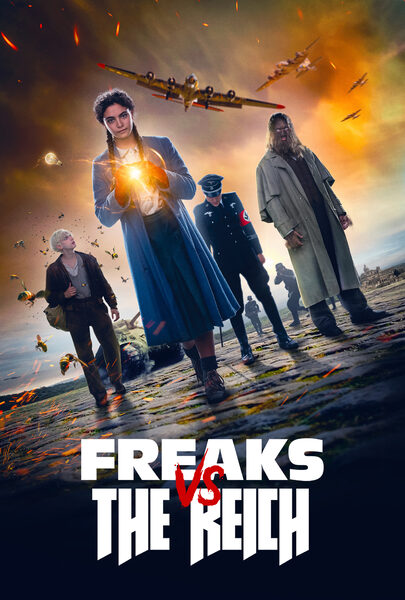
therefore rather follows that a group of super-heroic circus freaks would be
their nemeses. Yet, an increasingly unhinged Nazi pianist has a mad dream of
harnessing their powers to save the regime. That sounds like an unlikely Hail
Mary scheme, but he knows Germany’s defeat is likely from his drug-induced
visions of the future in Gabriele Mainetti’s dark superhero fantasy Freaks
vs. the Reich (a.k.a. Freaks Out), which releases today in theaters
and on-demand.
Fulvio
is the wolfman, Mario is the magnetic clown, Cencio is an albino with an
Aquaman-like power over bugs, and Matilde harnesses the power of electricity.
She is the real deal, not like Rooney Mara in the inferior Nightmare Alley remake.
In fact, all their powers are real, but hers are potentially the most powerful.
However, she has issues when it comes to using them to their fullest extent. Her
conductivity also somewhat alienates her from humanity, since her touch is
potentially fatal. Nevertheless, Cencio still carries a torch for her, which is
also creepy, given their apparent age differences.
Nevertheless,
the four circus freaks regularly dazzle audiences for old Israel’s traveling
sideshow, until the war intervenes. The Germans have invaded their former
Italian allies, but at this point of the war, it is not going well for either
nation. Franz desperately wants to turn it around for the Reich, but he is
probably lucky to be alive, considering he has six fingers on either hand,
making him a freak himself. Through liberal ether-huffing, Franz has seen
images of the future. As a result, he is convinced only Matilde’s powers can
save the Reich.
This
is probably the weirdest circus film since Alex de la Iglesia’s The Last Circus (a.k.a. A Sad Trumpet Ballad), which Freaks also
resembles in tone. It is far more macabre than most superhero movies, but that
is its strength, whereas its weakness is Mainetti’s inclination to excess,
especially the two-hour-and-twenty-minute running time.
Be
that as it may, Mainetti and co-screenwriter Nicola Guaglianone earn a lot of
points for originality, particularly for their distinctive villain, Franz. He
is a sinister psychopath, but it is easy to understand how living with his
conspicuous “deformity” in German society helped warp him into the monster we
see in the film. Those predisposed to object the film uses him to represent the
physically different should keep in mind there is also a band of war-amputee partisans
in the woods, waging guerilla attacks against the Germans.
By Presidential order, there were two U.S. Navy ships with majority African
American crews during WWII, so the submarine chaser depicted in this film is
not the total historical gaffe you might assume. The mission it is trying to
foil is completely fictional, but not because the German U-boat corps would
have had any issues targeting civilians. They just never made it this far in
real-life. Time is running out for the Axis, but a strike on New York City
could turn the tide of the war in Steven Luke’s Operation Seawolf, which
releases Tuesday on DVD.
Captain
Hans Kessler is a disillusioned old school officer, but even with his heavy drinking,
he is the best man available for the last-ditch mission. However, it is hard for
his new first officer to see it that way. Lt. Reinhart was demoted, to make way
for Kessler. He is supposed to lead a wolfpack of U-boats close enough to the
City to launch a V2 rocket attack from their decks, once they surface.
Fortunately,
Commander Race Ingram knows their coming, so he will deploy the Tenth Fleet to
stop them. For the first time ever, Capt. Samuel Gravely’s ship, based on the
USS Mason (DE-529) will be part of the hunt. Luke fudges the historical record
a little with that last part, but plenty of WWII films have taken greater
dramatic license.
Dolph
Lundgren gets to show more dramatic range than usual as Kessler. Indeed, he is
perfectly cast as the commanding but world-weary (and super-blond) officer. On
the other hand, Frank Grillo is grossly underutilized as Ingram, who basically
spends the entire film in the war room, reading coded messages and barking
orders. It wouldn’t really make sense for his character to come face-to-face
with Kessler, but it is still disappointing Grillo and Lundgren appear in the
same film, but never share a scene together.
Hiram
A. Murray is similarly confined to the bridge of his ship playing Capt.
Gravely. He also carries himself with a convincing military bearing, which rather
makes sense, since he is a Marine Corp veteran. However, the sequences aboard
Gravely’s Destroyer do not look as realistic as those within Kessler’s U-boat,
which were shot inside the decommissioned and preserved USS Cod.
Five Americans were awarded the Medal of Honor for their service at Saipan,
all of them posthumously. A campaign was launched to upgrade Guy Gabaldon’s
Navy Cross to the MOH, which still continues after his death. Such valor
testifies to the battle’s high stakes and brutal conditions endured by tens of thousands of
American soldiers, including my grandfather. The attack on an
American field hospital in this film is fictional, but it is consistent with
the Imperial army’s scorched earth “banzai” charge. A handful of soldiers and
medical personnel must stand against several Japanese platoons in screenwriter-director
Brandon Slagle’s Battle for Saipan, which opens tomorrow.
Like
Gabaldon (who was raised in a Japanese-speaking family), Maj. William Porter
speaks some of the local lingo, but it is never explained how he picked it up.
Regardless, he overhears plans of an attack on the nearby U.S. Army field
hospital while dodging a Japanese patrol. He finds a rag-tag facility lacking
proper supplies for the many patients they have. Porter even brought another—the
only other survivor of his scouting party. Vic, the lead surgeon, never
expected to fight, but he completed basic like any other serviceman, so he and
Porter will have to spearhead their defense.
There
are a few reasonably colorful characters in the hospital, particularly, the
demoted commanding officer, Gen. Jake Carroll, but the narrative still boils
down to: the Japanese attack and the Americans defend. It is simple, unfussy,
and pretty effective for what it is. This is hardly Hell to Eternity (based
on Gabaldon’s story), but lead thesp Casper Van Dien bears some resemblance to
Jeffrey Hunter.
Wars are like the old Knicks-Pacers games, in that they aren’t over until they
are truly, officially over. Jack Wallace understands that only too well. Even
though everyone knows WWII is down to its final days, he is still recruited for
a potential-suicide mission in Giles Alderson’s Wolves of War, which releases
tomorrow on VOD.
Wallace
is the only parent his little girl has left, but he worries his success as a
commando might have profoundly changed him as a person. Regardless, there is no
guarantee he will survive this mission to see her again. Under the command of
Captain Norwood, Wallace and his hodge-podge squad must parachute into no man’s
land Bavaria, to rescue expat Professor Hopper from the National Socialist “Werewolves,”
the fanatical remnants of the SS engaging in scorched earth guerilla warfare.
Supposedly,
Hopper and his daughter Hannah were trapped in Germany when the war broke out,
but he was never a regime sympathizer. Obviously, he is not a political science
genius. As it happens, he is a physicist, who has developed a rival atomic bomb.
If Wallace’s team can secure the professor and his notes, they can call in an
airlift. Otherwise, it will become a carpet-bombing airstrike.
In
some ways, Wolves of War is a throwback to old fashioned WWII films, but
Wallace’s existential angst definitely feels contemporary. However, its stiff-upper-lip
Britishness is appealing. The action is respectably gritty, but it lacks a big
set-piece crescendo.
The Soviets had a strange corpse fetish. To this day, you can still gawk at
Lenin’s embalmed body in Red Square. Alas, poor Gorby probably won’t be getting
that treatment. Stalin had something very ghoulishly different in mind for
Hitler’s corpse. However, secretly ferrying it from Berlin to Moscow will be
quite a tricky assignment for Brana Vasilyeva and her comrades in director-screenwriter
Ben Parker’s Burial, which opens tomorrow in New York.
For
a skinhead punk, rumors of Hitler’s body possibly surviving someplace were too
tantalizing to ignore, even in 1991. However, when he breaks into elderly Vasilyeva’s
London townhouse, she is the one who has the drop on him. When he comes to,
handcuffed to the radiator, she decides to tell him the full story, because she
knows it isn’t what he wants to hear.
Only
Vasilyeva and her commander knew the exact nature of their mission. They are
supposed to sneak Hitler’s body into the USSR clandestinely, but that means they
will have to fight their way through the self-styled “Werewolves,” remnants of
the National Socialist occupiers engaging into scorched-earth guerilla warfare.
Unfortunately, when Vasilyeva’s commanding officer is killed in combat, the
next senior officer is the cretinous Captain Ilyasov, who is more interested in
rape and plunder than completing a mission he was not briefed on.
It
is because of Soviet soldiers like him that the Poles are so hostile to the
advancing Russians. Lukasz is a perfect case in point. As an ethnic German Pole,
he suffered at the hands of both the Germans and the Soviets. However, Vasilyev
manages to win his trust, but it does not extend very far beyond her and her
trusted subordinate officer Tor Oleynik (so dubbed in honor of the Norse god,
because of what he did to some Germans with a hammer).
Watching
Burial, you have to feel sympathy for the Polish people. Time and again,
Vasilyeva and Oleynik are confronted with the brutality of their own fellow
Soviets and the resulting bitterness festering in the civilians, whose help
they need. Parker never sugar-coats the brutality of either regime, openly
suggesting something close to equivalency between them. Although this is a war
film, it gets pretty intense and even spooky, given the way the “Werewolves”
take their nickname to heart (and their weaponized use of hallucinogenic
drugs).
Charlotte
Vega makes a suitably quiet but steely action lead as Vasilyeva, but she is
still no match for Harriet Walter, playing her hardnosed, butt-kicking senior
citizen analog. (Reportedly, Dame Diana Rigg was originally cast in the role before
her death, leaving some big shoes to fill, but Walter acquits herself
impressively.)