It sure was a surprise when we discovered China was building a secret
military base in the UAE. They were supposed to be our friends in the Middle
East. After all, who do you think sold them all the hardware we see in this
movie? Nevertheless, UAE’s reasons for joining the Saudi 2015 military
intervention in Yemen were largely aligned with our own interests: countering
the rise of al-Qaeda, Daesh, and the Muslim Brotherhood. Unfortunately, one of
those terrorist groups (the film never specifies which) was waiting for an
Emirati patrol in Pierre Morel’s The Ambush, releasing tomorrow on DVD.
Plenty
of American military personnel could probably empathize with the situation the
Emirati soldiers found themselves in. It is a two-stage ambush, designed to
first incapacitate the two-armored vehicle patrol, but its ultimate target is
the multi-vehicle rapid response unit that comes to rescue them. Unfortunately,
strategic use of land mines and RPGs leave the combined Emirati forces boxed
in, where they must take mortar fire, while a sniper keeps them pinned inside
their vehicles.
Morel
previously helmed Taken and District B13, so he obviously
understands how to handle large-scale action sequences. The problem is the
script by Brandon and Kurtis Birtell is absolutely colorless. According to
press notes, it was written in close-consultation with the survivors of the
incident the film is based on. That might be nice for authenticity’s sake, but
not for the drama. Typically, in war films like this, each soldier gets their
own individual quirks and background details to help distinguish them and allow
diverse audience members to identify with them. In this case, everybody’s thing
is having a concerned family waiting for them back in UAE, which makes it hard
to differentiate anyone, especially when artillery starts exploding around
them.
However,
Morel depicts the step-by-step escalation of the ambush with crisp precision.
If you do not mind sacrificing things like characterization and dialogue, The
Ambush is a very impressively produced war movie. I would want to re-watch
it before setting off on a desert patrol in a war-torn Gulf state. The tactics
and hardware are completely realistic, but the dialogue much less so.
Seriously, nobody in the UAE military curses?
Bohemy, an inmate serving time in 1978 Communist Bulgaria, considers his best
days those he spends toiling as an unpaid laborer, in a state factory, because
that is his only connection to everyday human behavior. Usually, the brutality
is mostly confined to the prison. However, all bets are off when the sadistic
Captain Vekilsky and the notorious axe murderer “Hatchet” are there on the same
fateful day in Martin Makariev’s In the Heart of the Machine, Bulgaria’s
official International Oscar submission, which screens during the AFI’s
European Union Film Showcase.
The
complicated thing about Communist prisons is figuring out how truly guilty your
fellow prisoners might be. Hatchet definitely killed his brother—and he has yet
to forgive himself. However, the Lennie Small-like death-row inmate has
experience with heavy equipment, so Bohemy convinces the warden, Colonel
Radoev, to allow him to borrow Hatchet, to help fulfill their doubled quotas.
If Bohemy (meaning “Bohemian,” his ironic prison nickname) can pull it off, he
might just get a parole. Radoev is a bit corrupt, but in a pragmatic,
world-weary kind of way.
Unfortunately,
Vekilsky is just a brutal martinet. Yet, even he is not inclined to provoke
Hatchet. Instead, he mostly focuses his wrath on Needle, another hardened
criminal. However, the guard is not inclined to indulge Hatchet, when he refuses
to work on his machine, until a pigeon trapped within its gears can be safely
rescued. Therefore, Hatchet launches an insurrection of one, taking Vekilsky
and the rookie guard Priv. Kovachky (a.k.a. “Junior”) hostage. That puts Bohemy
in a real rock-and-a-hard-place situation, trapped inside the shop with
Hatchet, while the military police outside, led by Captain Kozarev (the man who
framed him for the murder), prepare their assault.
Machine
is
an unlikely mixture of gritty prison drama and symbolic fable, yet the basic
premise is based on fact. There was a bird trapped in heavy machinery that
inspired a defiant work-stoppage, but it was resolved with considerably less
violent conflict. Of course, the corruption and abuse of the Communist era “justice”
system are also very definitely based on historical realities. Bohemy was no
anomaly. In many ways, he is a Bulgarian everyman representing thousands, but
Alexander Sano’s grounded and conflicted portrayal makes him feels like a very
real person, rather than a symbolic composite.
Everyone loved the Lithuanian Men’s Basketball Team, the so-called “Other Dream Team,” who made an Olympic run shortly after the Baltic nation declared its
independence from the Soviet Union. However, there were mixed feelings about
the Estonian Kalev team’s pursuit of the final championship of Soviet Republics,
especially in Estonia. Initially, there were calls to boycott, but those gave
way to cheers of “beat Russia.” Of course, the Soviet sports system still tries
its best to rig the tournament against Estonia in Ove Musting’s Kalev, Estonia's official International Oscar Submission, which screens during the AFI’s European Union Film Showcase.
Initially,
Aivar Kuusmaa has decidedly mixed feelings on the independence movement,
because the Soviets rewarded athletes like him for their international
victories. Nevertheless, everyone suspects this year could very well be the
final Soviet championship. Frankly, public opinion is already against Estonian
participation, even before Gorbachev ordered Soviet tanks to invade neighboring
Lithuania.
Despite
public sentiment, their coach, Jaak Salumets, remained committed to the Soviet
Championship. He even recruited a prominent Russian player and George Jackson,
the first (and only) American to play in the Soviet League. During his tenure
with Kalev, Jackson faced racism from fans and opposing teams, which Musting
and co-screenwriters Martin Algus and Mehis Pihla gloss over. However, they fully
expose the corruption and favoritism within the Soviet sports authorities. Honestly,
the referees and sideline judges might has well have suited up in Russian
jerseys.
Musting
focuses much of his attention on Kuusmaa, but the most fully fleshed out
characters in Kalev are Salumets and Riho Soonik, the team’s general
manager (who are portrayed with appropriately complexity, by Mait Malmsten and
Priit Voigemast, respectively). Through them, the film really explores the
ethical questions the tournament posed, as well as the challenges of
maintaining an underfunded Baltic professional team, in a time of great
instability. As for the players, they mostly deal with routine sports dramas,
like playing through injuries and riding the bench.
For those who say conservatives aren’t artistically inclined, try to explain
away Saul Bellow, the Nobel Laureate and arguably the great American novelist.
Seventeen years after his death, Bellow far outshines his contemporaries (seriously,
who reads Norman Mailer anymore?) and remains culturally relevant. Asaf Galay
chronicles Bellow’s life through his novels and marriages in The Adventures
of Saul Bellow, which airs Monday as part of the current season of American
Masters.
Galay
suggests Bellow embraced his identity as an “American writer” and a “Chicago
writer” more than his status as a “Jewish writer,” but that aspect of Bellow is
surely a discernable influence on his writing too. Many of his books
incorporated autobiographical elements, as well as the lives of his literary
and academic colleagues. Perhaps the most notorious example was his final novel
Ravelstein, which outed the homosexuality of his life-long friend, Allan
Bloom, the author of The Closing of the American Mind.
Throughout
the film, we hear from Bellow’s nephew, two sons, his widow, and the ex-wife
who preceded her, all of whom talk about their family dynamics in very matter-of-fact
terms. They are all mature adults, which makes them refreshing to hear from in
a documentary. There are also critical voices too, including novelist Charles
Johnson, who admits an alternative reading might have validity when Galay
challenges him.
As
a result, Adventure is one of the smartest and most judiciously balanced
literary docs produced in years. It offers a comprehensive introduction to
Bellow’s themes and criticisms, while also inviting new “socially conscious” perspectives
on his work, particularly The Dean’s December, his inner-city novel.
It turns out Erdogan and Turkey’s Islamists do not have much of a sense of
humor. What a surprise, right? Of course, that rather complicates life for
cartoonists like Ersin Karabulut. This was a rather disappointing turn of events
for him and his humorist colleagues, because they had been so critical of the military’s
prohibitions against the veil and other such secular regulations. Those in
power were never happy with Karabulut and his fellow cartoonists, but none of
their previous targets consolidated political power as effectively as Recep
Tayyip Erdogan. Although only 41, Karabulut has already satirized plenty of
national turmoil, which he revisits in his graphic novel, Drawing on the
Edge.
Karabulut
grew up in the working-class suburbs of Istanbul with his Kemalist family. That
meant they were secularists, who embraced Ataturk’s progressive vision for Turkish
society. Unfortunately, even in Karabulut’s youth, secularism was starting to
give way to re-invigorated Islamism, especially the authoritarian brand
advocated by Erdogan. At that point, the military could still be counted on to
step in to counter their power grabs, but things like coups were a bad look,
especially to Karabulut’s idols at Turkish humor magazines. Basically, they are,
or at least they were a lot like Mad Magazine, but more ideologically
focused.
For
Karabulut’s risk-averse father, these magazines were not an acceptable place of
employment. Yet, he still started selling them cartoons, because they represented
the lion’s share of the market for freelance work. In retrospect, he came to
understand why his father was so spooked by politics, especially when a shadowy
gang of mullahs starts dogging his steps.
Edge
vividly
illustrates the erosion of liberties under Erdogan, culminating with a full-scale
assault of press freedoms, when the autocrat sues the staff of Karabulut’s magazine
for depicting his as various animals—a case that eerily parallels the Danish
Jyllands-Posten cartoon fatwa and the criticism of Charlie Hebdo (which
led to the tragic terrorist attack), in terms of its perceived slights and
offenses. He also incisively contrasts Erdogan’s remarks on democratic
practices intended for international audiences with those delivered to his
Islamist supporters.
While Karabulut
delights in presenting himself in a goofy cartoony way (in keeping with his
love for the medium), he depicts his family and colleagues in a manner that reflects
the seriousness of the issues and circumstances they had to navigate. Edge is obviously a comic-lover’s
graphic novel, but it vividly captures the realities of contemporary Turkish
history. There is whimsy and humor in it, but it is still an urgent story that
shines a light on Erdogan’s escalating attacks on freedom of expression. Very
highly recommended for the art and the message, Drawing on the Edge is
now available digitally from Europe Comics.
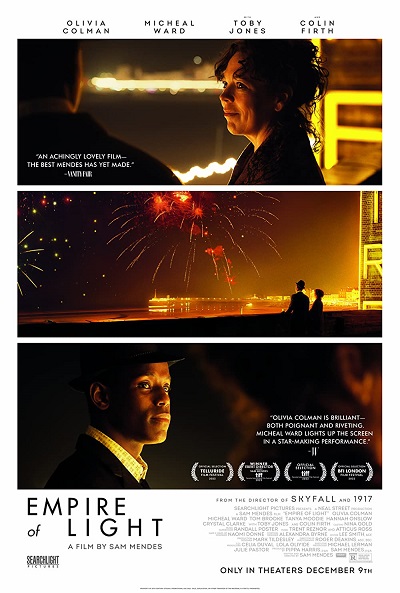
The Empire Theatre is troubled, but the movies it books are not part of the
problem. During the course of this film, we will see it screening Chariots
of Fire, The Blues Brothers, Smoky and the Bandit, and Being There. Unfortunately,
this release is not nearly as good as those that it references in passing. It
is presented as a tribute to the movie-going experience, but like a bad projectionist,
focus is a problem for Sam Mendes’ Empire of Light, which opens
tomorrow.
Hilary
Small is the one who keeps things running at the Empire, in the coastal town of
Margate. However, she is easily dominated by her exploitative boss, Mr. Ellis, who
also uses her for quickies in his office, much to the disgust of the other
employees. Her life of quiet desperation leads to a breakdown, but after her brief
hospitalization, she returns for more of the same, just with more medication.
Things only start to change when Stephen joins the staff. The smart teen aging
into adulthood should be going to university, but he lacks sufficient funds and
the proper skin color (according to Mendes’ didactic screenplay).
He
and Small are drawn together, as fellow outsiders. Their rapport will take a
turn towards the romantic, despite vast differences between them. However,
Stephen will eventually figure out Small’s emotional issues have only been
masked, rather than cured.
If
you want to watch the great cinematographer Roger Deakins paint pretty pictures
with light, then Empire will certainly deliver. However, the melodrama
reeks of sentimentality and the periodic attacks on Thatcherism (which reversed
the UK’s decline into economic stagnation and international insignificance) are
gratingly unnecessary distractions.
Frankly,
despite some rather lovely scenes of projectors streaming down on the movie palace’s
screen, Empire could have just as easily been set in a fish & chips
shop, without losing much beyond Deakin’s visuals. Small’s relationship with her
co-worker stays on the right (legal) side of Summer of ’42, but it is
hard to buy them as a romantic couple. At times, Stephen gets lost in the film,
overshadowed by Small’s angst and resentments. Focus really is an issue here.
Suddenly, the Formalism school of criticism doesn’t look so bad to Apple. Adherents
of that critical theory focused exclusively on the work itself, rather than the
psychological and biographical particulars of the writer. Of course, Apple TV has
largely fostered a different approach, producing work like Roar and Gutsy,
whose entire reason for being is their status as women-created series. Now,
they are releasing a $130 million acquisition, starring Will Smith, post-slap,
hoping audiences will just focus on the work itself. There is indeed some
notable on-screen drama, but it is hard to ignore the odd off-screen
circumstances surrounding Antoine Fuqua’s Emancipation when it premieres
tomorrow on Apple TV+.
Peter
is a slave in Louisiana who would eventually be immortalized in the photo “Whipped
Peter” or “Scourged Back,” which rallied the North and the rest of the world
against slavery. As the film opens, the Confederate Army is about to “nationalize”
Peter, to bolster the war effort. Unfortunately, that means he will be
separated from his family, who remain at Captain John Lyons’ plantation.
The
irony of his position, now toiling to preserve his own enslavement, is not lost
on Peter. He also seethes under the lash of Jim Fassel, the brutal slave-driver,
overseeing the construction of a Confederate artillery embankment. Therefore,
when Peter hears of Lincoln’s Emancipation Proclamation, he decides to make a
break for Baton Rouge, where Grant’s Army is encamped. However, getting there
through the swamp will be grueling, especially with Fassel on his trail.
The
truth is, Emancipation is more of a manhunt-style action film than a
serious issue-oriented awards-bait film, which is perfectly fine. In fact, that
definitely plays to Fuqua’s strengths as a filmmaker. Nevertheless, for a new
Will Smith film, it has had an eerily quiet release, for obvious reasons. Eventually,
there will probably be books written about the behind-the-scenes dramas. There
is no getting around Smith, but plenty of websites claim Timothy Hutton plays “Senator
John Lyons,” but you won’t see the actor (who has faced criminal accusations
that have not as yet led to formal charges) in the film or its closing credits.
Refocusing
again on the film as it is, Smith contributes a very good, very physical
performance. He really transforms himself to look weathered, battered, and aged
well-beyond his years. However, he only has one really Oscar-friendly speech in
the entire film. That is far from a bad thing, because it means the
two-hour-plus film moves along at a good clip.
Ben
Foster is again suitably creepy as the virulently racist Fassel. Mostly, he is
just a nasty villain, but Foster has a key monologue that illustrates how
slavery poisoned him during his innocence youth, which echoes Abolitionist
arguments of the time, regarding the corrupting influence slavery had on whites
as well.
You could easily fill half a dozen cemeteries with the YouTubers and
influencers who get their shallow selves killed in horror movies. That’s why we
know what to expect when Kali Fyre vlogs her friends’ annual boozy river
frolics, even if they don’t. The yokel sounds crazy when he warns them the
river is in a nasty mood this year, but he is not wrong in Zac Locke’s #FLOAT,
which releases tomorrow on VOD.
Frye’s
boyfriend Jackson isn’t supportive of her vlogging, because he doesn’t consider
it a real job. She is just short of 2,000 followers, but her friend Dee still
can’t be bothered to follow her. Only her friend Madison really offers her any
encouragement. Zola and her baby-daddy ex-Blake (whom Dee inexplicably has a
thing for), can’t even support their daughter Thea, whom they have irresponsibly
brought on the friends’ traditional debauched outing.
It
would be different this year anyway, since this it is their first time back
since their late pal Chuy drowned in a drunken, drugged-out stupor. They still
feel guilty about that, but they refuse to listen to the Cassandra-like
redneck, who keeps warning them “the river took him.”
Locke
tries to maintain a sense of ambiguity whether #FLOAT is a slasher or a
supernatural horror movie, but it is obvious to everyone except the
empty-headed Millennials the ginger-bearded mountain man is a harmless red
herring. Unfortunately, Locke is so determined to maintain the uncertainty of what
is afoot, the pacing suffers badly as a result. This is a weirdly languid
horror film. The title is rather ironically appropriate—but “#DRIFT”
would be even more accurate.
Julie Rivers is supposed to stay in bed and avoid stress, but she has a cat.
Have you ever lived with one of those? They’re always stepping on you, in
uncomfortable places. She also lives with some kind of angry ghost, but nobody
believes her, because of her mental history. As a result, she must face it
without the help of her condescending husband in director-screenwriter Lori
Evans Taylor’s Bed Rest, which premieres tomorrow on Tubi.
Julie
and Daniel Rivers lost their first baby a few years ago. Since then, he has
been compulsively moving on, whereas she still feels the loss keenly. Since she
is mega-preggers, they logically just moved into huge fixer-upper in the middle
of nowhere. One fateful night, they get a scare on the staircase, but her doctor
assures them all will be fine if Rivers confines herself to bed for the
duration of her pregnancy.
If
only it were that easy. First, she hears intruders in the lower floors. Before
long, she is visited by a very strange little boy, whom she takes to be the
spirit of her late, stillborn son. Of course, her husband and their visiting
nurse Delmy (who is prone to oversharing) just assume she is having manic
episodes, like before. However, we can tell there must be something to it, or
the film would really be wasting our time (it happens, but mercifully not in this
case).
Nonetheless,
Bed Rest feels very familiar. A lot of the film is devoted to Rivers’
husband and Delmy basically trying to gaslight her back to normal. Obviously,
it doesn’t work, but the film spends a heck of a lot of time spinning its wheels
with these scenes.
On
the plus side, Taylor creates some nicely moody atmosphere. The shadowy figures
are skillfully framed, to build tension without revealing too much.
Technically, it is well executed, but Taylor’s narrative will totally
unremarkable to any horror fan.
This would be the second invasion underway in 20th Century Tibet.
The first came when the Communist-dominated PRC occupied and annexed the
sovereign nation in 1951. The second is the alien intelligence exerting a
sinister influence over a remote Himalayan monastery. One of its tools happen
to be hairy snow beasts. Fortunately, the Tardis finds its way there in “The
Abominable Snowmen,” a formerly lost six-episode Doctor Who story-arc,
recreated with animation and the original audio track, which releases today on
BluRay.
Initially,
the Second (Patrick Troughton) Doctor is thrilled to back in Tibet. He was there
several hundred years prior, when he accepted one of the Detsen Monastery’s
holy relics for safe keeping, during times of turmoil. The Doctor now hopes to
return it, not knowing these too are times of trial for Detsen, but not because
of the PLA invasion, which goes unmentioned during “Abominable Snowmen,” even
though it was originally produced in 1967.
Unfortunately,
the Doctor receives a rather rude welcome, thanks to English explorer Edward
Travers, who stokes the suspicions of Khrisong, the Tibetan warrior protecting
Detsen, against the Time Lord. Travers, who would return in a later mostly-lost
Doctor Who adventure, mistakenly assumes the Doctor is a reporter or a
rival hoping to exploit or sabotage his search for the Yeti.
Amazingly,
Padmasambhava, the high lama of the monastery remembers the Doctor from his
previous visit. However, the ancient monk is not himself. Something latched onto
Padmasambhava during his astral wanderings and now holds the very senior monk
in thrall. Its chief pawns happen to be the hirsute robotic creatures Travers
reasonably took for Yetis. Whatever they are, they trap the Doctor’s bickering
companions, Jamie and Victoria, in a cave at the end of the first episode.
The
BBC’s penny-wise-pound-foolish tape-wiping practices in the 1960s and 1970s
almost makes a nerd’s head explode. How much revenue have they missed out on by
reusing recycling the tapes of old Doctor Who episodes or their
production of Asimov’s Caves of Steel, starring Peter Cushing? In some
cases, where the audio tracks still exist, they have resurrected missing Doctor
Who episodes through original animation, as they have done for “Abominable Snowmen.”
The original video survives for the second episode, which is included in the
BluRay set, along with black-and-white and color animated recreations of all
six installments. Arguably, the best way to experience the authentic viewing experience
is by selection the black-and-white animation for episodes one and three
through six and the surviving second live-action episode.
Regardless,
it is nice to have a “new” vintage Doctor Who episode back in
circulation, especially since it holds special behind-the-scenes significance, co-starring
Jack Watling, who played Travers in multiple adventures, with his daughter,
Victoria Watling, who portrayed the Doctor’s companion, Victoria Wakefield. The
spartan Tibetan setting looks good both in the surviving episode and the
black-and-white episodes. Admittedly, the big furry Yeti robots look weirdly
cute instead of scary, but they are definitely in keeping with the low-budget
aesthetic of vintage Doctor Who fans know and love.
Is Shakespeare's Macbeth cursed? Ask Kelsey Grammer. According to legend, a
coven of witches enraged by Shakespeare including their genuine rituals in his
text placed a curse on the play that endures to this day. Sydney can ask the
Bard himself, when he appears to her while she is rehearsing a production of
you-know-what in screenwriter-director Keith Boynton’s The Scottish Play,
which releases tomorrow on VOD.
You
could maybe compare Sydney to Laura Linney. She is no longer a starlet, but she
has a big name and a reputation for classy work, so it is a coup for Adam, an up-and-coming
theater director, when she agrees to star as Lady Macbeth in his production of “The
Scottish Play,” opening a Massachusetts Shakespeare festival. She wanted to get
away from the movie business for a while, but they also just seem like they are
on the same wave-length.
On
the first day of production, Adam gives a nice curse-schmurse speech, after
which weird things start to happen. The weirdest has to be William Shakespeare visiting
Sydney in ghostly form. He rather empathizes with Adam’s struggles staging Macbeth,
so he promises his help to Sydney. However, the “help” he offers up will be
rather difficult to explain.
Honestly,
I am totally shocked how good The Scottish Play is, given how little
fanfare has surrounded it. Basically, the entire industry and the media
covering it has been sleeping on this film. Boynton has a nice ear for the
iambic pentameter Shakespeare speaks in. Granted, I’m not a Shakespearean
scholar, but I reviewed Macbeth twice on-stage and four times on film.
At least for non-professional ears it sounds legit. Yes, people did not speak
that way during everyday Elizabethan times, but now that he is dead,
Shakespeare can indulge himself—or so he explains.
These retired mercs fancy themselves the old-timer version of “The Wild Geese,”
which is saying something, considering how haggard the hard-living Richard Burton
and Richard Harris looked in that 1978 movie. The crusty old Londoners are
probably twenty years older, but they look healthier. That is fortunate,
because they will have some work cut out for them in Daniel Zirilli’s Renegades,
which releases tomorrow on VOD.
Maj.
Carver just moved his former subordinate Burton off the streets and into his
home, because the veteran officer never leaves one of his men behind. Carver is
pretty American-sounding, but his daughter is all British. Judy Carver was even
elected a local councilor. In representing her district, she made trouble with
the cops for Anthony Goram’ criminal outfit. Carver intended to warn off the
interloping foreign (from parts undefined) gangster, but his thugs killed the
Major instead.
Obviously,
Burton and Carver’s old comrades (and fellow support group members) Peck,
Woody, and Harris do not take kindly to that, so they round up all the weapons they
can scrounge (including a crossbow) to take the fight to Goram. They do a
pretty good job of it, especially since Inspector Moore (who is investigating
their mayhem) has to call in favors from her CIA contact (a cameo appearance
for Michael Pare) to figure out what is going on.
That
is pretty much all there is to Renegades, which wouldn’t be so bad, if
Zirilli’s direction were smoother. His strictly dramatic scenes have an awkwardness
that must embarrass his experienced cast, especially the great Lee Majors, who
brings a gravitas to the film that it doesn’t deserve, as the Major. As Judy
Carver, Patsy Kensit (from Lethal Weapon 2 and Angels and Insects)
is stuck in several dull scenes opposite Nick Moran’s impassive Burton that must
have been a chore for them to plod through.
By Presidential order, there were two U.S. Navy ships with majority African
American crews during WWII, so the submarine chaser depicted in this film is
not the total historical gaffe you might assume. The mission it is trying to
foil is completely fictional, but not because the German U-boat corps would
have had any issues targeting civilians. They just never made it this far in
real-life. Time is running out for the Axis, but a strike on New York City
could turn the tide of the war in Steven Luke’s Operation Seawolf, which
releases Tuesday on DVD.
Captain
Hans Kessler is a disillusioned old school officer, but even with his heavy drinking,
he is the best man available for the last-ditch mission. However, it is hard for
his new first officer to see it that way. Lt. Reinhart was demoted, to make way
for Kessler. He is supposed to lead a wolfpack of U-boats close enough to the
City to launch a V2 rocket attack from their decks, once they surface.
Fortunately,
Commander Race Ingram knows their coming, so he will deploy the Tenth Fleet to
stop them. For the first time ever, Capt. Samuel Gravely’s ship, based on the
USS Mason (DE-529) will be part of the hunt. Luke fudges the historical record
a little with that last part, but plenty of WWII films have taken greater
dramatic license.
Dolph
Lundgren gets to show more dramatic range than usual as Kessler. Indeed, he is
perfectly cast as the commanding but world-weary (and super-blond) officer. On
the other hand, Frank Grillo is grossly underutilized as Ingram, who basically
spends the entire film in the war room, reading coded messages and barking
orders. It wouldn’t really make sense for his character to come face-to-face
with Kessler, but it is still disappointing Grillo and Lundgren appear in the
same film, but never share a scene together.
Hiram
A. Murray is similarly confined to the bridge of his ship playing Capt.
Gravely. He also carries himself with a convincing military bearing, which rather
makes sense, since he is a Marine Corp veteran. However, the sequences aboard
Gravely’s Destroyer do not look as realistic as those within Kessler’s U-boat,
which were shot inside the decommissioned and preserved USS Cod.
George Jones and Tammy Wynette had a relationship that was sort of like A
Star is Born, but slightly less tragic, which is sort of ironic, since they
are the country version. They had some huge hits together, but they couldn’t
stay married. Yet, that old spark never totally went away, musically or
romantically. Even if you are not fans, you will recognize their drama and some
of their songs in Abe Sylvia’s six-episode George & Tammy, directed
by John Hillcoat, which premieres tomorrow on Showtime.
George
Jones was already the biggest act in country music and prone to
self-destructive behavior when hired Tammy Wynette to open for him. He was starting
to slip on the charts, but she was still crazy about his music. She also fell
for him, even though she was still married to her manager, songwriter, and
general coattail-rider Don Chapel. Nevertheless, Jones whisked her off her feet
and literally carried her out of the house she bought for Chapel.
Before
too long, we see Jones’ drinking problem and the violent anger it brought out
in him. Soon thereafter, Wynette develops her own addictions issues with pills,
following a botched operation. However, there are also good times. Unlike,
bio-films like What’s Love Got to Do with It, we totally see why Jones
and Wynette fell for each other and why they kept getting back together, albeit
in more limited ways, after their divorce.
George
& Tammy follows
a similar arc as so many previous music biographies (from Eastwood’s Bird to
Luhrmann’s Elvis), but that really isn’t Sylvia’s fault. The facts are
the facts. Blame the music industry and maybe to some extent the media. In this
case, he manages to humanize his subjects to a remarkable extent. Partly, this
is because his primary source was the book written by Georgette Jones, the
power couple’s daughter.
It
is also impossible to overstate the importance of the two leads, Michael
Shannon and Jessica Chastain, who bear a decent visual resemblance to the performers
and have surprisingly strong singing voices. They really land those tunes,
which often serve as a dramatic climax to each episode. (Weirdly, Shannon also made
a compellingly off-kilter Elvis Presley in Elvis & Nixon.)
Frankly,
Chastain and Shannon shine so bright, everyone else gets lost, including Walton
Goggins as Peanut, Jones’ former bandmember, who becomes a sympathetic Baptist
preacher, and Steve Zahn, portraying Wynette’s sleazy fifth husband (Jones was
the third and Sylvia skips over the brief fourth). Frankly, the only thesp that
makes any sort of impression, whose name isn’t Shannon or Chastain, would be
Pat Healy, playing Wynette’s sleazy second husband, Chapel.
Imagine a stage production as strained with petty jealousies as Noises Off,
but without the comedy. Actually, you don’t have to imagine, because Alex van
Warmerdam provided it, but when things get ugly on-stage, it is all according
to the Church’s plans. That would be the Roman Catholic Church. This must mean
Pope Francis is in on the conspiracy too. Frankly, it all becomes a bit of a
muddle in van Warmerdam’s Nr. 10, which opens today in New York.
Gunter
is having an affair with his co-star Isabel, who is married to the director of
the play they are rehearsing. Unfortunately, he discovers their betrayal,
thanks to Marius, a co-star who resents the abuse Gunter’s character heaps on
his own. Things really escalate during the premiere—so much so Gunter will have
to take some time off.
So
far, everything has gone according to the shadowy monsignor’s plan. He knows
the truth about Gunter, including why the actor only has one lung. He only just
learned, because he has never been sick a single day in his life, but his grown
daughter Lizzy discovered she had the same anatomical irregularity during a check-up—her
first ever.
A
lot of critics are calling Nr. 10 “mind-blowing,” but it really isn’t.
They are just offering clapter for the film’s slams on the Catholic Church. Fine,
lets see van Warmerdam give similar treatment to Shia Islam, a religious doctrine
that is currently killing young people on the streets of Tehran.
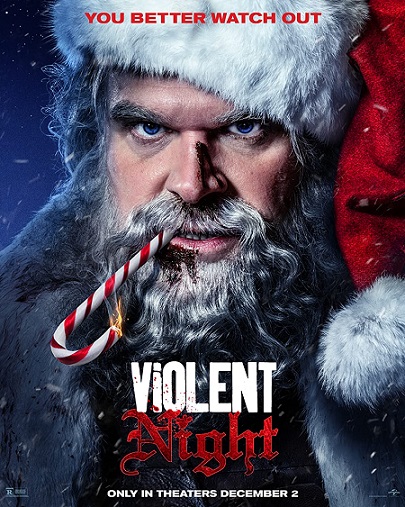
There is a long-standing debate whether or not Die Hard is a Christmas
movie. This one definitely is—and it consciously riffs on the Bruce Willis
franchise. You could say it is Die Hard at family Christmas gathering,
with Santa Claus playing the John McClane role. Regardless, it will not be a silent or holy
night during Tommy Wirkola’s Violent Night, which opens nationwide today
in theaters.
Santa
is pretty burned out, because most people are naughty and even the nice kids
only want video games or cash. Frankly, he probably would not even be stopping
at Gertrude Lighthouse’s stately manor if her extremely nice granddaughter
Trudy were not staying the night. Except for her father Jason, maybe, the rest
of the Lightstones are a nasty venal lot. Of course, her mother Linda does not
count, at least according to her grandmother. However, the Lightstones will not
be the naughtiest ones in the house when “Scrooge’s” band of armed robbers take
them hostage.
As
luck would have it, they start shooting while Santa is still enjoying Trudy’s
cookies and Gertrude’s brandy. Claus has gotten a little cynical, but he can’t
help worrying about Trudy. He also still remembers his mortal life as Norse
warrior, before he assumed the jolly mantel, presumably through some means not
unlike that of The Santa Clause.
There
is no question this is a Christmas movie, because it has Santa. It also slyly
riffs on Christmas favorites, like Home Alone and Die Hard 1 &
2 in knowing and spectacularly violent ways. For instance, somebody gets
it with an icicle. However, Wirkola and co-screenwriters Pat Casey and Josh
Miller probably outdo the body counts of the individual Die Hards, if
not the entire series. Honestly, it is way more satisfying to watch Santa wield
a war-hammer than anything the emasculated Thor did in the last few MCU
releases.
Admittedly,
the middle is a little draggy, but the fight scenes in the first and third acts
are as beautifully choreographed as a top-notch performance of The
Nutcracker. David Barbour (who co-starred in Sleepless, the American
remake of the French Die Hard-in-a-nightclub, Sleepless Night) is
wonderfully grizzled and world-weary as Santa. Weirdly, this is one of the
least caricatured portrayals of Kris Kringle.
The Korean spy thriller Hunt has a wealth of twists, secret agendas, and a secret DPRK warmongering plot that is truly terrifying if it is even remotely based on historical reality. Epoch Times exclusive review up here.
Cliff Secorod, the Rocketeer was the sort of Red-Blooded American comic book hero
we need more of from the comic duopolies. He was a would-be operator out for a
buck, who ended up fighting criminals and Nazis, while lusting after lusting after
his girlfriend, transparently based on pin-up model Bettie Page. The late Dave
Stevens created and drew the popular indie comic hero. The artist’s friends and
colleagues pay tribute to Stevens and his legacy in Kelvin Mao’s documentary, Dave
Stevens: Drawn to Perfection, which releases Friday on VOD.
Fortunately,
in the late 1970s and early 1980s, there was little barrier to entry for an
aspiring professional artist like Stevens, who amassed some pretty amazing
credits drawing layouts for Hanna-Barbera and storyboards for Raiders of the
Lost Ark and Michael Jackson’s Thriller. Comics were where he
belonged, but his big chance came when Pacific Comics had to fill six pages in
one of their issues. Unlike the two majors, Pacific allowed creators like
Stevens to retain ownership of their characters, which would be significant in
the case of the Rocketeer.
Inspired
by 1940s serials and vintage pin-up art, The Rocketeer became one of the
biggest breakout indie hits of the early-to-mid-80s. There was indeed a Disney
movie, which everyone in the film agrees was not quite great but still very
good. Indeed, there is a lot of interesting commentary from the director, Joe
Johnston, who went on to helm Jumanji, Jurassic Park III, and Captain
American: The First Avenger. Sadly, Stevens’ life after the film’s release
is largely a story of professional frustration and the cancer he eventually
succumbed to.
Drawn
is
a straightforward but heartfelt doc that would nicely supplement Mark Mori’s Bettie Page Reveals All, which chronicled the life of the model Stevens helped
re-popularize and befriended late in both of their lives. Stevens’ clean,
splashy, and sometimes busty art looks great on-screen. It is also nice to see
Pacific Comics get some overdue credit (they were also the original home of Groo
the Wanderer and Somerset Holmes).
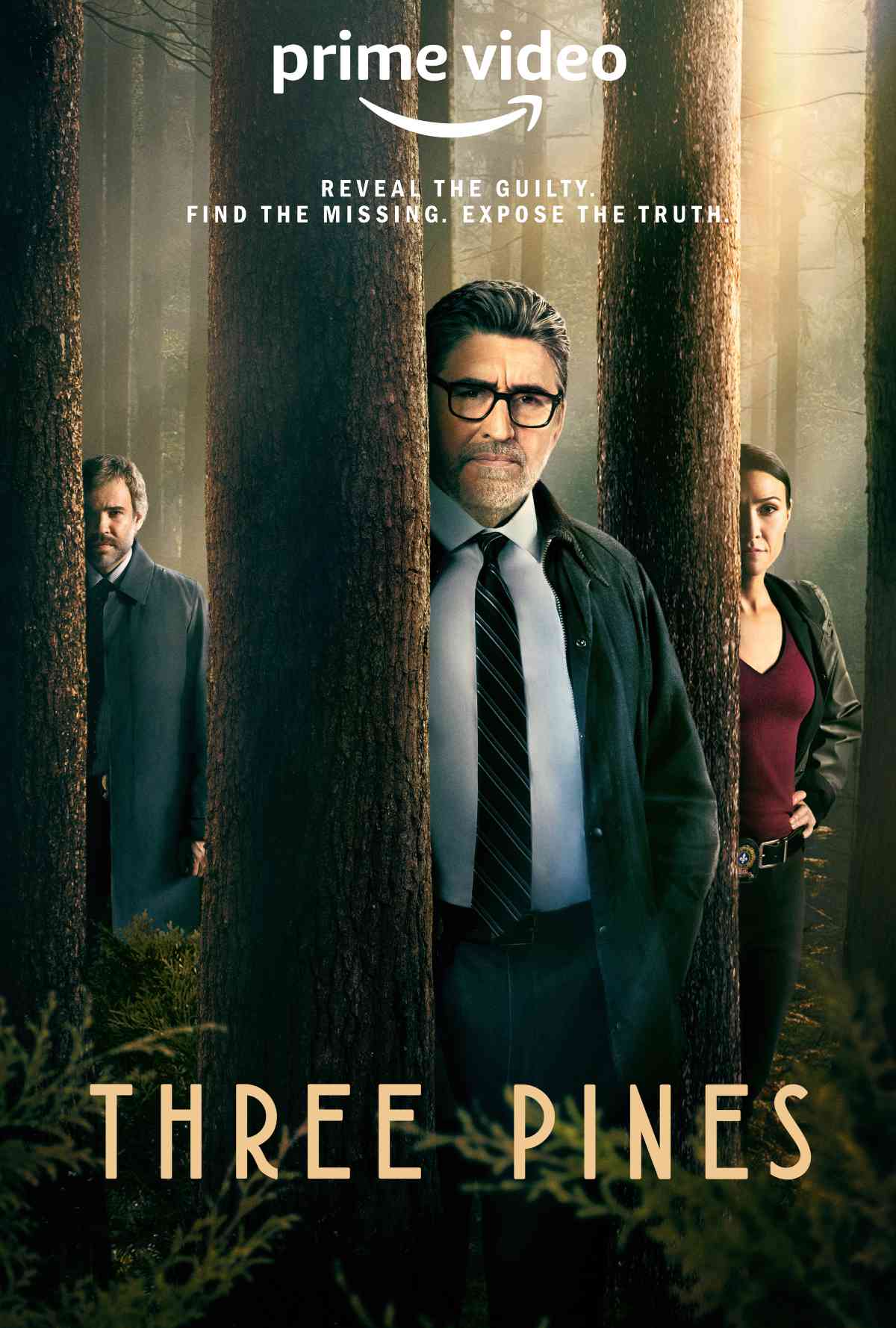
The married, middle-aged Chief Inspector Armand Gamache is sort of like a
French Canadian Maigret. However, he also has some the erudition and emotional
baggage of Adam Dalgliesh. Obviously, it would be folly to deceive the good
Inspector, yet people keeping trying, with often woeful results. Despite the
community’s lack of cooperation, Gamache keeps solving murders in titular Quebec
village throughout the eight-episode Three Pines, adapted from Louise Penny’s
novels by Emilia di Girolamo, which premieres tomorrow on Prime Video.
Gamache
is so competent and well-respected, he won’t be fired when he shows up his
snotty boss, Superintendent Francoeur, but he will be assigned to investigate a
freak death way out in Three Pines. Apparently, the town’s least favorite
self-help guru was electrocuted in her chair while watching a curling match.
Yes, this show is definitely set in Canada. Nobody liked the deceased very much,
but they don’t have much to say to Gamache’s team: moody Jean-Guy Beavoir,
First Nations single-mom Isabelle Lacoste, and the annoying local cop Yvette
Nichol. You’d almost think they were all trying to cover for the killer.
Somewhat
like Hjerson, Three Pines adapts several Penny novels in
two-episode arcs, but it also maintains a series-long investigation into the
presumed death of a missing indigenous teen, Blue Two Feathers. Gamache’s pal Pierre
Arnot originally investigated her disappearance, but the trail has gone
stone-cold, partly because Francoeur never allocates resources to such cases.
Tragedy
begets tragedy when Gamache is next dispatched to Three Pines. The previous
victim’s abandoned house, a former indigenous conversion school, has become the
scene of a fresh crime. Bad karma seems to pile up in Three Pines, but it is
not supernatural, in the Twin Peaks tradition, which the title
inevitably evokes—except maybe the spooky dreams related to the Two Feathers
case that plague Gamache’s sleep.
Even
when Gamache checks into a luxury hotel outside of Three Pines for his
anniversary, Three Pines still finds him. In this case, the estranged sister of
one of the villagers turns up dead, after inheriting the family fortune, much
to everyone’s surprise. The final arc is roughly drawn from Penny’s novel The
Brutal Telling, in which a stranger is found dead after he inexplicably burst
into the café to tell everyone they would get what’s coming to them, because he
knew all their dirty secrets. It turns out that is not advisable in Three
Pines. However, the case of “Arthur Ellis” gets squeezed to the margins, to
make way for the resolution of the Two Feathers case.
The
mysteries of Three Pines are just okay, at least as adapted by di
Girolamo, but Alfred Molina still makes the series worth watching. He is
terrific as the kindly but disillusioned Gamache. He also has great workplace
chemistry with Rossif Sutherland and Elle-Máijá Tailfeathers as Beauvoir and
Lacoste. However, Sarah Booth’s bumbling shtick as Nichol clashes with the tenor
of the series.
Frankly,
the “secret” bad guy stands out like a sore thumb right from the start. It is
like di Girolamo didn’t even bother to attempt any misdirection. That might be
fine for an episode of Cannon or Columbo, but it will irk fans of
Penny’s novels—and there are a lot of them, which is presumably why the series
was produced in the first place.
You would think a serial killer like Bruce Ernst would have more affinity
for Pluto than the Erinyes (a.k.a. The Furies), the Greek deities of vengeance.
However, he cannot resist taking a statuette as a valuable souvenir from his
most recent victim. The next kill will be much more difficult for him in Travis
Stevens’ A Wounded Fawn, which premieres tomorrow on Shudder.
Apparently,
Ernst is an art dealer who represents clients at auctions, which is a very
un-serial killer thing to do. In addition to killing the winning bidder of the
Erinyes, he has also murdered the owner of a rather stylish and conveniently
remote cabin, where he has arranged to spend the weekend with Meredith Tanning,
his new girlfriend and next anticipated victim. She is also connected to the
art world. In fact, she helped authenticate the Erinyes, which really suggests
he should be casting a wider net for his prey.
Of
course, she is surprised to see it on his living room table, but she still settles
down to a nice dinner with Ernst, even though she hears disembodied voices
warning her to leave. Somehow, she doesn’t get alarmed until she sees weird
shadowy figures moving outside the cabin.
Initially,
the first fortysome minutes of Fawn is a highly promising serial killer
film with supernatural overtones. Unfortunately, the sinister cat-and-mouse
game we’re anticipating never materializes. Instead, the film turns into a
trippy but predictable fever dream fueled by the Greek mythology symbolism
introduced in the auction-prologue.
Frankly,
most horror fans have plumbed the depths of more than enough serial killers already,
so taking a deep dive into Ernst’s subconscious is trip we don’t need to take. Sadly,
when the Erinyes assume the forms of Ernst’s victims to torment him, it is not
even cathartic payback, because they are perversely lectury. Granted, it is
certainly punishing to listen to their gender studies buzz words, but we the
audience have to sit through it too.