We're not saying Tomu Uchida’s three-hour film noir masterpiece is dark, but it starts
with a ferry disaster killing hundreds of innocent people. Those currents off
the coast of Hokkaido are so treacherous, they even spit up two extra bodies.
It turns out they were ex-cons, mostly likely responsible for a lethal home
invasion. Det. Yumisaka will pursue the “third man” like Javert in Les Miserables. The cop from The Fugitive might be an even more apt
comparison. Although Takichi Inukai (if that is his real name) is not a
one-armed man, he has a crushed finger that definitely counts as an identifying
characteristic in Uchida’s A Fugitive from the Past (a.k.a. Straits of Hunger), which screens in its
freshly restored glory at the Japan Society.
During the
immediate post-war, black-market years, it was not just those straits that were
hungry. Nevertheless, Inukai seems genuinely distressed by the fate of his
traveling companions and also their victims. With the cops out in full force,
Inukai takes refuge with hostess-oiran-prostitute-borderline dominatrix Yae
Sugito, who gives him a bit of hard time, but rather takes a shine to the rough
but shy character. The feeling is somewhat mutual judging from the whopper of a
tip the mystery man left behind.
As Yumiska
spends years following-up false leads, Sugito uses Inukai’s money to pay off
her family’s debts and start leading a relatively straight life in Tokyo. Yet,
ironically, she will return to her former profession, preferring the stability
of life with her new paternalist mom-and-pop employers. Alas, the government
eventually decides to be progressive and reformist by shuttering legal houses
of prostitution. Forced to make another new start, Sugito happens to notice a
provincial philanthropist’s picture in the newspaper. Mr. Kyôichirô Tarumi
certainly bears a strong resemblance to the man responsible for her nest egg,
who has taken on almost saintly status in her own head.
It is not
hard to understand why Fugitive (or Straits) is regarded in Japan as one of
the finest Japanese films of all time. It truly combines elements of the sympathetic
(if not wholly innocent) fugitive thriller, in the tradition of Hitchcock’s The Wrong Man, with the sweeping scope
and tragedy of Les Mis (which Uchida
adapted straight-up in 1931). His use of gritty widescreen 16mm also gives it a
1960s docu-drama vibe, but what makes the film so appealingly idiosyncratic is
the delight Uchida takes in breaking all the rules. Inukai disappears for a
long period of time, allowing the second movement to become an empathetic
woman’s story, roughly akin to Naruse’s When
a Woman Ascends the Stairs.
It is nice to know a film remotely connected to the reality of life in
China can still slip by the China Film Administration (at least it did in late 2020). This noir melodrama is
based on true crimes and very real government corruption. The fictional part
would be the cops actually enforcing the laws. Regardless, karma remains what
it always is in Li Xiaofeng’s Back to the Wharf, which releases today on
VOD.
Nobody
is a more dedicated plugger in his high school than Song Hao. Yet, his
principal gives away the school’s coveted guaranteed university admissions slot
to his politically connected friend, Li Tang, perversely justifying it for the
good of the “collective.” Call it: “community solidarity with Chinese characteristics.”
Enraged, Song rushes out to confront Li’s father, but since the working-class
teen was never invited to the Li’s tony home, he barges into the wrong house, killing
the enraged occupant in self-defense, during the ensuing scuffle.
Or
so he thought. Actually, his city bureaucrat father, Song Jianhui, finished the
man off, but he allowed his son to assume the guilt was solely his. For fifteen
years, the once-promising Song works as laborer in a distant quarry, fearing
his crime will eventually catch up with him. However, when his mother dies, he
ventures back home for the funeral. There, he reconnects with his now
prosperous father and his old “friend” Li, who witnessed the entire incident
fifteen years ago, unbeknownst to the Songs.
Song
would prefer to leave again as soon as possible, but his former classmate Pan
Xiaoshuang is determined not to let an eligible single man of her “advanced”
age leave town with a fight. While she pursues Song, he starts stalking Wan
Xiaoning, the orphaned daughter of the man he thinks he killed, but out of
guilt, rather than sexual obsession.
Obviously,
this is a highly combustible situation. In many ways, Wharf is
definitely a noir thriller, but Li Xiaofeng also incorporates a good deal social
criticism. Song Hao is a character Clifford Odets could definitely relate to—but
he would presumably be quite surprised to find him in a socialist country like
the PRC.
Jazz fans had our special reasons to watch Rienhold Weege’s popular 1980s
sitcom Night Court. Not only was Mel Torme a regular guest star, it
always started with a jazzy theme song, featuring the great Ernie Watts on
alto. Unlike the family comedies that preceded it on NBC’s original “Must-see”
Thursday night line-up (ironically including The Cosby Show), Night
Court specialized in snarkier, take-no-prisoners humor. Sadly, several stars
of the original series have left us, including Harry Anderson (Judge Harry Stone)
and Markie Post (the public defender), but John Larroquette, who won four Emmy
Awards as Assistant DA Dan Fielding, is alive and very much part of the new Night
Court revival series, which premieres tomorrow on NBC.
Sadly,
Judge Harry Stone has also passed away, but his daughter, Abby Stone, has just
been appointed to the bench in his old New York City Night Court. In the pilot
episode, the new Judge Stone does not think much of the current public
defender, so she tries to recruit her father’s old friend and colleague, Dan
Fielding, to come over to the bleeding-heart side of the Force. That won’t exactly
happen, but Fielding still accepts the PD position, much to his own surprise.
The
pilot episode should please fans of the old show, because it makes extensive
references to Judge Harry. It also catches us up quickly, making it clear widowed
Fielding’s beloved wife helped moderate his extremes, but he always kept his
caustic wit, which has only gotten more acidic since her untimely death.
Even
though he now defends them, Fielding continues to mercilessly mock the court’s
weirdos and perverts. Obviously, that is the best part of the show. Larroquette
can still milk a line for laughs better than anyone in sitcoms. He also brings
a surprisingly wistfulness exploring the sadness of Fiedling’s grief. Of the
first six episodes provided for review, the best is the third, “Dan vs. Dating,”
wherein Judge Stone tries to coax the former ladies man back into the dating
scene. Of course, Fielding is as acerbic as ever, but guest star Wendy Malick
has the attitude and comedic flamboyance to hold her own opposite him. None of
the regular cast-members can also say that, at least not yet.
Still,
Kapil Talwalkar shows some potential as Neil, the lonely-hearted court clerk,
who is desperate to up his romantic game. India de Beaufort also earns some
laughs as Olivia, the self-absorbed, career-minded Night Court ADA. She is a
bit of a mini-Fielding, but the show can always use more of him.
Awkwardly,
the new Judge Stone and bailiff Donna “Gurgs” Gurganous have the same
personality quirks—naïve and eager to be liked. That is unfortunate for
Lacretta, who plays Gurgs, because Melissa Rauch, who stars as Stone, also
serves as a producer and she has a lot of sitcom cred, having co-starred on Big
Bang Theory (she was the one who was pregnant in about half the episodes). So, if one of them will ever be cut from the show, it is unlikely to be Rauch.
In
fact, the new Judge Stone is the new Night Court greatest weakness. Yes,
her father always tried to see the best in people, but he was also an old “friend of Stan Carlisle,” so he always recognized when someone was trying to pull his
leg. His street smarts are dearly missed in the fourth episode, “Justice
Buddies,” easily the worst episode of the initial half-dozen, about a pack of
woke brats who try to occupy the court. Fiedling is trying to exploit the
situation for his own benefit, which is reasonably in character, but that
leaves nobody to deflate their juvenile leftist posturing. Frankly, it is just
nauseating to watch their tantrum play out.
You know when they lose Blumhouse, the Fauci school of pandemic management
has lost the nation. Maybe they haven’t fully lost the studio chief, but
screenwriter Kevin Williamson has a lot of ironic commentary to offer on the quarantine
lock-down era, while staying true to his slasher roots. Unfortunately, two
millennials can’t quarantine themselves from a home-invading slasher in John
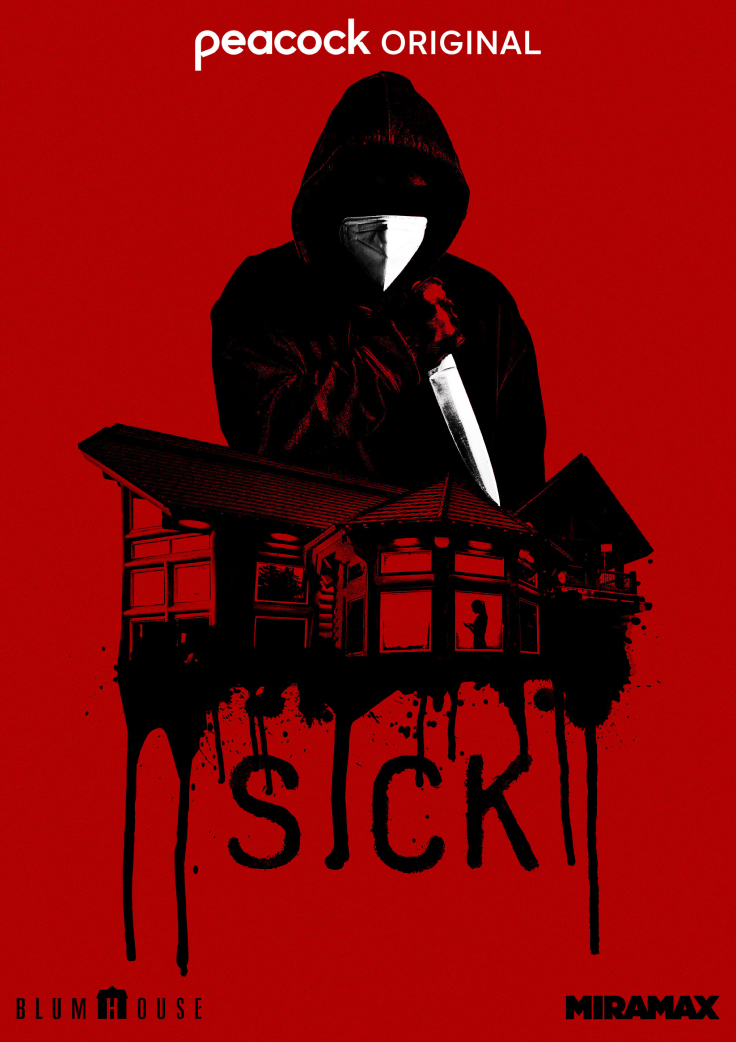
Hyam’s Blumhouse-produced Sick, which is now streaming on Peacock.
With
the economic and educational shutdown of 2020 looming, entitled party girl
Parker Mason and her judgy, strait-laced pal Miri Woodlow decide to quarantine
in the luxury cabin owned by Mason’s dad. Basically, it looks Kevin Costner’s Yellowstone
character might live there, but there do not seem to be any guns in the house,
which stretches credibility.
Of
course, they both announce their every move on social media, so a tech-savvy
stalker can easily follow them to Pop Mason’s cowboy McMansion. We can tell
this psycho is effective, based on the murder he committed during the prologue.
In this case, even Mason’s jealous hook-up, DJ Cole can crash their party. That
means there are three potential victims, waiting to get hacked and slashed.
It
is hard to explain the context without spoiling elements, but Williamson’s
screenplay definitely skewers the compulsive masking experience. It also brings
back embarrassing memories of Clorox wiping your groceries. Perhaps most incisively,
it portrays the weird Covid-Puritanism (sometimes expressed by the likes of
Howard Stern) that blamed victims and carriers. Arguably, the mystery slasher
represents its fullest logical manifestation. However, all of Williamson’s
inspiration is reflected in his razor-sharp dialogue, whereas the
characterization largely falls back on flat stereotypes.
Regardless,
experienced genre director John Hyams skillfully builds the tension and stages
some hair-raising confrontations (even more so than he did in Alone). As
is Scream, the slasher (if there is only one) is definitely a mortal,
who takes bumps and bashes just like the prospective victims. Indeed, each
grisly encounter could go either way, so there is genuine suspense. Among the
cast, the clear standout is Jane Adams as Pamela, whose sinister role would be
spoilery to reveal.
Instead of a "lottery," this rural Indonesian village has “The Harvest.” Each
year, a shooting star appears in the sky and then several people commit suicide
by hanging. Somehow, this was all Hari and Eka’s mother’s fault. When she hangs
herself too, the locals do not offer much sympathy, but her estranged children
are not very broken up over it anyway. Unfortunately, they soon start to
believe the sinister forces plaguing the town are still claiming victims in Cornelio
Sunny’s Death Knot, which releases Tuesday on DVD.
Neither
Hari or his sister Eka had seen their mother in years. She changed after the
birth of her daughter, picking up some rather pagan tendencies. According to
the villagers, their mom made a deal with the devil, taking responsibility for
the Harvest and basically terrorizing the locals. Weirdly, the night she hung
herself, both Eka and Hari had vivid premonitory dreams, warning them to stay
away.
Nevertheless,
they come to do their duty, getting the cold shoulder from just about everyone,
even their swindler uncle, who wants to cheat them out of their mother’s house.
Pretty soon, creepy things start happening, especially to Eka’s boyfriend Adi. Of
course, the locals won’t tell them anything, especially after another round of
Harvest-style hangings.
Sunny
and co-screenwriter Ike Klose conjure up some familiar-sounding folk horrors,
but the execution is first rate. Indonesian horror films like this and Joko
Anwar’s Impetigore certainly make the countryside look like a creepy
place. To that end, Sunny (who also stars as Hari) relies more on suggestion
than visual effects, which tend to be practical and rather modest in scope.
What name could be more synonymous with the Western Frontier experience than
that of Levi Strauss? So, Jews definitely played an important role in the Old
West. Case closed—but wait, there’s even more. Amanda Kinsey documents American
Jewish life on the Frontier in Jews of the Old West, which screens
tomorrow during the 2023 New York Jewish Film Festival.
It
makes sense that people who would travel across an ocean in lousy steerage
conditions to reach America would keep going west in search of a better life.
Obviously, many immigrants settled in Northeastern communities like the Lower
Eastside, but a fair number also settled out west, particularly in San
Francisco, Denver, and Texas. Of course, maintaining traditions and religious observances
was a challenge on the Frontier, but anti-Semitism was much less prevalent
(because most hardscrabble settlers just didn’t have the time).
Many
Jews of the Old West became quite notable, like Wyatt Earp’s wife, who
eventually buried the famous lawman in a Jewish cemetery (even though he never
adopted her faith, at least as far as we know). Some Jewish immigrants started enduring
businesses, like Straus and the founders of Samsonite luggage. Plus, Denver in
the early 1900s was home to a true icon, Golda Meir, during her precocious
childhood years. In fact, Jewish Coloradans were instrumental in establishing
the Denver stockyards, which remain to this day a major livestock hub.
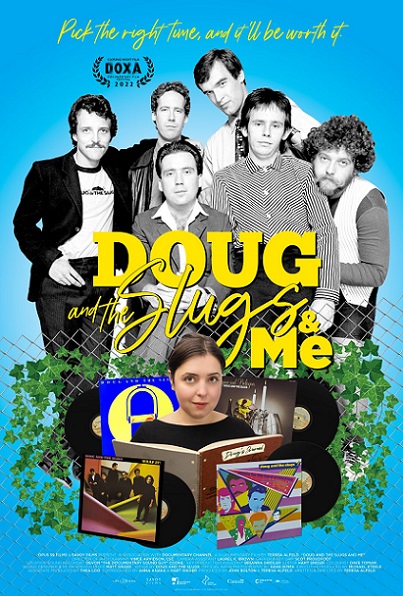
They had a number of top 40 hits in Canada, but Doug and the Slugs’ greatest
exposure in America might have come when their song “Too Bad” was used as the
opening theme of Norm Macdonald’s The Norm Show. (It was a Canadian
connection.) Despite having the original video for “Too Bad” in heavy rotation
on early, music video-playing MTV, they never really caught on down here,
despite their label charging back the costs of several expensive attempts. However,
Teresa Alfeld only thought of lead singer Doug Bennett as her best friend’s
dad, while growing-up next door to the family. Alfeld chronicles the band’s ups
and downs from a half-inside half-outside perspective in Doug and the Slugs
and Me, which airs Sunday night on CBC.
Bennett
didn’t exactly look like Mick Jagger, but he wrote catchy tunes. The Slugs
became known for a brand of pop that combined upbeat melodies with sly humor.
The Barenaked Ladies cite them as an inspiration, which totally follows. Regardless,
to Alfeld, Bennett just seemed like another suburban dad, as indeed he was,
even though he still toured pretty regularly while she and her friend were
growing up.
A
lot of the inter-band drama is not unlike so many other Behind the Music stories.
There were jealousies and creative control issues. Alfeld never mentions drugs,
but she certainly documents Bennett’s problems with alcohol. Still, they
managed to stay together nearly forty years, long outliving many of their
contemporaries. Weirdly, Bennett also wrote a terrific Canadian country song, “House
Without a Soul” that he ultimately had Suzanne Gitzi record, but, of course,
that musical detour also ended awkwardly. However, Gitzi is quite gracious
discussing Bennett.
Football (soccer) is the most popular sport on Earth, but its international
governing body is one of the most despised organizations in the world. Even
after Sepp Blatter’s departure, FIFA probably ranks somewhere between the Mafia
and the FSB in international opinion polls. The six continental football
associations feeding into FIFA aren’t much better (some might be even worse),
yet the European UEFA largely cast itself as the defender of the game when
twelve of its richest clubs proposed a breakaway league. The resulting clash of
money and egos is not quite concluded yet, but Jeff Zimbalist chronicles the
fight so far in the four-part docuseries Super League: The War for Football,
which premieres today on Apple TV+.
It
is clear right from the start everyone underestimated UEFA’s new Slovenian
president Aleksander Ceferin when he was elected. Slovenia was not exactly a
football powerhouse, but the lawyer proved to be a savvy deal-maker. He thought
he was negotiating in good faith towards that end with his friend, Andrea
Agnelli, the chairman of the elite Italian club, Juventus.
Everyone
acknowledged the financial outlook for clubs was growing ever more challenging,
especially those who tried to compete with the salaries offered by English Premier
League clubs. Ceferin thought he close to finalizing a deal to help clubs of
Juventus’s stature, but he was blindsided by the sudden announcement of the
Super League, an unsanctioned league outside UEFA’s jurisdiction, that included
Juventus and six top English Premier League teams.
Zimbalist
and his experts (including Kate Abdo, from Fox’s World Cup coverage team) do an
excellent job explaining the structure of European football leagues and how
revenue generated by the top professional clubs trickle down to the tiers of local
and neighborhood clubs beneath them. A lot of fans saw the Super League scheme
as a threat to this football ecosystem and they did not take kindly to it.
To
his credit, Zimbalist (who previous helmed the football doc The Two Escobars
and the narrative film Pele: Birth of a Legend) allows both sides to
make their cases, which might lead some viewers to question their previous
assumptions regarding the proposed Super League’s dire implications for grass
roots football. (The “founders” insist their plan will disperse more funds to
the small clubs.) However, the Super League’s PR game was extraordinarily tone-deaf.
Naturally,
the current FIFA president, Gianni Infantino (Blatter’s successor) has a role
to play in this drama, which he does so in characteristically opportunistic
fashion. Zimbalist’s talking heads often frame the Super League controversy as
a conflict of fans versus “capitalism,” but that is a simplistically
ideological take. In fact, Super League partisans are not wrong when they
accuse UEFA of acting like a cartel. Indeed, over the last twenty years, FIFA
and the IOC have done more to tarnish sport (through corruption and “sports-washing”)
than anything any owner has.
Nonetheless,
the mini-series raises issues of club ownership it never fully addresses. The
same fans who were up in arms over the Super League scheme hardly reacted when
Russian oligarch Roman Abramovich (considered one of “Putin’s wallets”) bought
Chelsea. He only appears as a footnote in Super League, but he is
arguably quite symbolic of football’s institutional issues.
It is not the Butterfly Effect that kills you. It is the paradoxes that melt
your mind. Such are the perils of time travel braved by Lee Warner’s band of
thieves. A shadowy time travel syndicate is making time travel larceny even
more dangerous for them, but they inevitably accept one last assignment in director-screenwriter
Bruce Wemple’s The Tomorrow Job, which opens tomorrow in theaters and
releases Tuesday on VOD.
Instead
of Rod Taylor’s elegant throne, these time travelers merely take a pill that allows
their minds to perceive one day into the future or past, for an hour in
duration. Before and after such a trip, Warner’s crew takes great pains to perceive
as little as possible, to minimize the chance of noticing potential paradoxes.
Usually, they like to be blindfolded in an unmarked van.
Once
they “return” from a job, they have to marry-up their actions over the next 24-hours,
to avoid paradoxes. Schrodinger’s Cat is always very much top of mind for them.
Frankly, it does not really make much sense for them to be committing heists in
the future, but they do and Wemple’s fast-talking dialogue keeps viewers from
asking questions in the moment. Warner has also used the technology to place
big bets, which makes more sense.
For
the general population the risk of paradoxes is relatively low. Warner was one
of the few survivors of Dr. Jay Tupple’s time travel experiments—and he stole
the corner-cutting scientist’s remaining stock of pills when he bailed on the
study. The only other supply is in the hands of his fellow guinea pig-turned
rival, Derrick Wagner. The rogue enforcer is determined to get his hands on
Warner’s stash, which would be bad, because Wagner is much less concerned about
the ethics of time-travel. That is saying something, because Warner is pretty
dodgy. Unfortunately, Wagner has the backing of a shadowy Cabal led by “The
Organizer” and he is willing to sacrifice the sanity of his henchmen to get the
job done.
Or
something like that. Figuring out how everything works in Tomorrow Job is
more than a little tricky, but it somehow feels like it is being consistent,
even when you’re confused by it all. At least everyone is trying to adhere to
an internal system of logical, which imposes an intriguing set of constraints
on the characters. However, the business with the Big Brother-like Organizer
just doesn’t land right. His scenes come across as cheesy rather than ominous.
In retrospect, Wagner probably should have simply been his own freelance master.
Still,
there is something about the film’s low-key visuals and vibe that weirdly works
for it. The cast, many of whom have worked previously with Wemple, also have a “Regular
Joe” look that lends the film credibility. Crooks and grifters like Warner have
to blend in, rather than stand-out, even if they are popping time travel pills.
This is why most people are suspicious of hippie gatherings in the desert. Th
particular cult in question talks like the Age of Aquarius and acts like the
Manson family. The 1970s retro-grindhouse vibe really drives the message home.
Beware of New Age sects, especially those led by a suggestively clad priestess,
like the one terrorizing the hermit and the potential final girl in Eric Boccio’s
The Night of the Bastard, which releases this Friday in theaters and on
VOD.
Forty
years ago, really bad things happened to a young pregnant couple. Reed wouldn’t
know anything about that. He lives way out nowhere in the desert, because he
wants to mind his own business. That’s why he tries to scare off Kiera and her
loser friends with a shotgun, when they try to camp on his property.
Unfortunately, Reed is our good guy, whether Kiera likes it or not. The bad
guys will be Claire’s satanic cult, who have big plans for transformative
ritual. Sacrificing Kiera’s friends in process suits them just fine.
Despite
a stabbing wound, Kiera manages to find shelter with the reluctant Reed. His
old steel-reinforced farmhouse will hold for a while, but her blood loss definitely
adds to the urgency of the siege that unfolds.
Boccio’s
film certainly isn’t fancy, unless you count the authenticate feel of the grubby
1970’s exploitation-evoking production design. However, if you are in the mood
for some violent satanic panic, Boccio delivers with single-minded consistency.
Claire’s ultimate intentions also turn out to be extraordinarily lurid, so don’t
worry about Boccio wimping out. If you are the sort of infantile cry-baby who
needs trigger warnings, pretty much consider them all applicable to NOB.
Chess Story nicely captures the humanism and tragedy of Stefan Zweig's work. It is also notable (in a good way) to see the Anschluss-era drama features a capitalist money-manager as the good guy. Epoch Times exclusive review up here.
Esoteric Kabbalah famously brought us the Golem, but it can deliver different
kinds of horror as well. For instance, a learned scholar inadvertently raises
Abyzou, a demon who preys on the unborn. He tried to take the evil entity with
him, but the Orthodox mortician and his semi-estranged son do not understand
what they are dealing with when they take delivery of his body in Oliver Park’s
The Offering, which releases Friday on VOD and in theaters.
For
some baffling reason, Arthur decided to pursue a career in real estate rather
than work in his father’s mortuary. It sounds like an understandable choice,
but it might have been a mistake, considering he is days away from financial
ruin. Ostensibly, he has come home to Borough Park with his gentile wife
Claire, to reconcile with his father before their baby arrives, but he needs
the old man to put up his mortuary as collateral.
Initially,
old Saul took the whole marrying out of the faith thing pretty hard, but he has
clearly had a change of heart. Now, the old man is decidedly warm and friendly
towards Claire and he is delighted to be a grandfather. Unfortunately, Yosille’s
body changes everything. The respected scholar tried to resurrect his recently
departed wife, through kabbalistic rituals. Instead, he raises Abyzou by
mistake. He tried to seal the demon inside his own body, via suicide, but
Arthur inadvertently breaks Yosille’s seals, while helping his father with the
late-night in-take process. Before long, the demon is terrorizing the fractured
family.
The
Offering is
a genuinely scary film, very much in the tradition of Keith Thomas’s
Jewish-themed The Vigil. Even though it was shot in Bulgaria, Park
nicely captures the vibe of Borough Park, Brooklyn. It hangs with many of the best
demonic horror films, but its Judaic influences make it particularly
distinctive.
The Archangel Michael is a celestial badass according to Christianity,
Judaism, and Islam. In Paradise Lost, he kicked Satan’s butt and
banished him to Hell. Consider this the horror movie sequel. He is still the
sort of angel who would rather beg forgiveness than ask permission, so jumps
right in (into a dead priest’s body) when a cult of Satanists steal the Shroud
of Turin. They’re only getting started in Nathan Frankowski’s insane film The
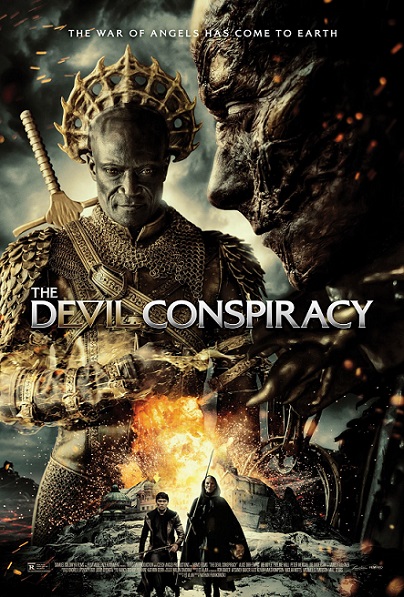
Devil Conspiracy, which opens Friday in theaters.
Comparative
religions student Laura Milton (fittingly) is present in the Turin exhibition when
an elite team of Satan’s minions, led by the mysterious Liz, steal the shroud.
They also kidnap Milton, suspecting she could be “useful,” but they leave her
friend, Father Marconi for dead. However, with his dying breath, he graciously offers
himself as an earthly vessel to Michael, who accepts.
It
turns out Liz and Dr. Laurent, her evil geneticist, need the shroud to clone
Christ’s DNA, to use him as a vessel for their dark lord. They tried before
with regular mortals, but they were not strong enough to withstand the evil one’s
power and rage. Conveniently, the unfortunate Milton looks like an excellent
candidate to carry and birth their unholy infant.
This
is definitely a Revelations-level crisis, but Michael quickly lays plans for
his assault on their stronghold. He only stops for some intel gathered by Cardinal
Vincini, a hardline demonologist, who was packed off into retirement, because
he was considered a little too intense. Recent events have certainly vindicated
him, but neither he or Michael is inclined to much care what people think.
One
can only wonder what the Saints in Heaven might think of this film. It is
basically Paradise Lost mixed with Jurassic Park, on an angel dust
bender. This is the most over-the-top, deranged horror film to get a professional
release since Will Klipstine’s The Harbinger, but that film somehow comes
together at the end, whereas Devil Conspiracy undermines a lot of its wacky
good will with a spirit-crushing seen-it-a-million-times-before ending,
obviously intended to set up a sequel.
It
is a shame, because most of the third act sustains a frenzy archetypal good
versus evil clashes, executed through guns-blazing action sequences. This film
literally goes to Hell and back several times over. The focal point for it all
is the Satanists’ nifty looking fortress, supposedly erected over the crack in
the Earth, where Michael pile-drove Satan into Hell.
In the 1920s Broadway was the place for horror. It looks a lot like
Scooby-Doo horror to us now, given its old dark houses and masked villains, but
it was what they had at the time. John Willard’s 1922 play was the Hamilton of
its era. Universal’s initial silent adaptation established their competitive
advantage for horror, but their subsequent soundie remake, The Cat Creeps,
is sadly considered lost. Even the familiar silent print consisted of the “B
takes” edited together for the international market, rather than the “A takes”
intended for the American release. (Early Hollywood was stunningly penny-wise,
pound-foolish.) Happily, the A-cut has been fully restored and screens at MoMA
as part of their annual To Save and Project film restoration series.
Old
miserly Cyrus West was first driven insane by his greedy relatives and then
driven to his grave by his paranoia. As part of his questionably sound last testament,
all his potential heirs are assembled in his creaky old mansion, on the
twentieth anniversary of his death, for the final reading of his will.
Only
a motley collection of nephews and nieces still survive, including flapperish
Annabelle West, the most distant relative. She also seems like the most decent,
so it makes sense to viewers that old West leaves his fortune to her. However,
there are a few stipulations. She must spend the night in the creepy house and
pass a sanity test, because the crazy old codger was pretty defensive on the
subject of mental health. Should she fail to uphold these terms, the estate
will pass to the alternate heir mentioned in the sealed envelop in the
possession of his trusted attorney, Roger Crosby.
Unfortunately,
Crosby is murdered before he can warn the heiress whom she should look out for.
Presumably, the murder was the escaped lunatic the guard from the asylum has
been searching for. However, West should probably only trust her distant cousin
Paul Jones. He is not a bad guy either and he clearly adores her, but he is
total coward. For context, Bob Hope played in the 1939 Paramount remake, giving
a performance that was not stylistically dissimilar from that of nebbish
Creighton Hale.
While
Hale’s Jones supplies somewhat shticky comic relief, Leni’s gorgeous, German
Expressionistic visuals are a joy to behold. Leni’s approach is largely
credited with shaping the aesthetic of the subsequent Universal monster movies—and
fairly so. His use of perspective is extraordinary. The vanishing point of the
mansion’s long, dark corridor is not unlike that of the split-rail fence in Invaders
from Mars.
Melchior Wakenstede is not a doctor but he understands herbal remedies. When all
else fails, he can sell a cup of wine, which always helps his customers feel
better. Being a man of reason, by Medieval standards, the Sheriff immediately
deputizes Wakenstede when a knight is murdered in the castle. Of course, discovering
the guilty party and bringing them to justice are very different propositions
in Elmo Nuganen’s smash Estonian hit, Melchior the Apothecary, which
screens again during the 2023 Palm Springs International Film Festival.
Knight
Clingenstein just arrived in Tallinn from Gotland, but he already managed to
make enemies with some of the locals. However, the coins stuffed in the mouth
of his severed head were from Gotland. Wakenstede pretty quickly figures out
the how, but the question of who remains.
In
addition to a local merchant Clingenstein swindled (through force), Wakenstede’s
inquiry takes him to the local monastery, where the brothers gave shelter to a
hunchback who shared some nasty history with the knight. However, he is most
likely not the mystery “Prisoner of Tallinn,” Wakenstede finds references to.
Nor is it the sole remaining inmate of Tallinn’s municipal dungeon. That would
be Rinus, the mad leper who murdered Wakenstede’s father.
Obviously,
this is a highly sensitive scandal. Even the shrewd Wakenstede could use some
help, but the Sheriff is entirely out of his depth. Providentially, a prospective
apprentice presents herself to Wakenstede under the assumed (and masculine
name) of “Gerke.” It is pretty obvious to viewers she is a woman who will fall
for the apothecary, but apparently people’s gender-bending radar was not very well
attuned during the Middle Ages.
Frankly,
the business of Gerke’s passing is not very convincing, but the mystery is
definitely intriguing stuff. The secret is not quite as erudite as The Name
of the Rose (the original novel, at least), but the Medieval historical
conspiracy underpinning it all will definitely appeal to fans of Umberto Eco
and Arturo Perez-Reverte. It also shrewdly depicts the competing powers of the
Medieval Church and state, with Wakenstede and his allies caught in the middle.
Marten
Metsaviir does not look very Medieval, but he instills Wakenstede with a lot of
charisma and smarts. He also develops some nice chemistry with Maarja Johanna
Magi, as Keterlyn Kordt (a.k.a. Gerke), which hopefully will deepen over the
next two films. Yes, all three were shot back-to-back during the pandemic—a gamble
that paid off, considering the first two have already done huge box office in
the Baltic Republics.
You don't see a lot of hospitals in science fiction, aside from James White’s
Sector General novels. Dr. Ben Song would have preferred to keep it that
way. He is a theoretical physicist (time travel scientist) rather than a
medical doctor. However, he will have to practice as best he can when he leaps
into a first-year resident’s body in “Paging Dr. Song,” this week’s episode of Quantum
Leap, which airs tonight on NBC.
It
turns out delivering the baby in the cold-open will be the easiest task presented
to him, while he inhabits the good doctor. Somehow, this leap involves three
patients, who have not checked in yet. He finds Eli Jackson rather quickly, but
the retired corporate lawyer wants to check out immediately, rather than
transfer to oncology for the cancer treatment he urgently needs. Song will have
to convince him, but he will need help from Jackson’s estranged daughter, who
happens to be his host’s mentor, third-year resident Dr. Sandra Turk.
“Paging”
builds to a climax involving a subplot in which an experimental drug the
hospital is testing will cause the death of one of Song’s patients. It is your
basic Big Pharma demonization, but it feels rather dated in the era of Covid
vaccine controversies. Seriously, do the writers want to encourage greater
skepticism and distrust of the pharmaceutical industry at a time when only 68%
of the United States is fully vaccinated?
On
the plus side, this episode again draws on the military background of Song’s fiancée
and holographic guide, Addison Augustine, who helps coach Song before breaking
some hard news to a patient. Caitlin Bassett is terrific delivering the second-best
speech of the series so far, right behind Magic Williams’ explanation of his
experience as one of Sam Beckett’s original Quantum Leaps.
Nobody is ever going to forget David Bowie starred in Nicolas Roeg’s The Man
Who Fell to Earth, so, wisely, the creators of this series avoided any need
to accuse the “Wild Eyed Boys” of “toxic fandom.” Their series adaptation of
Walter Tevis’s novel builds on the 1976 film, instead of trying to tear it down
(in a way that is somewhat akin to the 2022 Quantum Leap series). Let’s
give thanks to Bowie, for being such an icon. Decades after Thomas Jerome
Newton arrived on Earth, another alien from Anthea comes looking for him in
Alex Kurtzman & Jenny Lumet’s 10-episode The Man Who Fell to Earth, which
releases this Tuesday on DVD.
It
turns out Newton was an adept, whereas Faraday is just a drone on Anthea. Yes, this
series’ intergalactic sociology is as didactically class-conscious as afternoon
tea at the Glasgow Labour Party HQ. Environmental catastrophe is also on the
horizon for us, but it is already choking Anthea to death. Newton was supposed to
be the planet’s best hope, but he has gone dark, thanks to human fears and his
own adoption of earthly vices. Faraday is supposed to get him back on track. Of
course, his name really isn’t Faraday. He just picks it up from the intake
officer, who processes him after he is arrested for being naked and weird.
Aside
from Newton, the only name Faraday has in his mental rolodex is that of Justin
Falls (presumably short for “Justina”), who should have invented cold fusion,
but came up tragically short. According to his instructions, Faraday is
supposed to help her finish the job, but he needs the double-secret patents
locked in the vault of Newton’s old tech company. Falls was already taking care
of her daughter and her ailing father, but she reluctantly agrees to guide
Faraday on his quest.
After
Newton went-off the grid (and we mean way, way off), the Flood family took over
the company with the CIA’s backing. Yes, the CIA are the bad guys, yet again.
Spencer Clay is the worst of them—and also the most neurotic. Newton has been one
of his two driving obsessions, so when he discovers the arrival of a new
Anthean, he hopes Faraday can lead him to Newton.
The
reclusive weirdo really is out there somewhere. Occasionally, he will even communicate
with Faraday, his former drone back in the day, through the Force, or whatever.
Who could credibly step into David Bowie’s platform shoes? Actually, the
casting of Bill Nighy is pretty shrewd. He has a similar physicality and he projects
the right degree of oddity. Each episode is titled after a Bowie song too, so
Kurtzman and Lumet definitely show the proper respect.
The
first six episodes or so are surprisingly engaging, thanks in large measure to
Chiwetel Ejiofor’s distinctive performance as Faraday. Instead of cutely quirky,
like Starman or Brother from Another Planet, he is so alien (literally)
he is almost non-functional. Naomie Harris portrays Falls with toughness and sensitivity
that successfully counterbalances him. She is definitely one of the best things
going for the series. Plus, Martha Plimpton has a terrific guest shot in the
first episode as Officer Faraday and Zoe Wanamaker is a showstopper as Watt,
Faraday’s unlikely advisor.
Some of these graduating Spetsnaz recruits have likely gone on to commit war
crimes in Ukraine, or died as cannon fodder. Dima Ilyukhin, the filmmaker’s
cousin, was already the latter, having been killed during one of Putin’s black
ops in Dagestan. Alexander Abaturov contrasts the Spetsnaz militarist indoctrination
with the grief and despair of Ilyukhin’s family in The Son, which
premieres this coming Tuesday on OVID.tv.
There
is no commentary on Dagestan or the related operations in Chechnya and Crimean
Ukraine, so Abaturov never directly criticizes Putin’s fascist military campaigns.
However, he captures the tragic results for Ilykhin’s family in scenes of
unvarnished intimacy, which definitely would not be good for Putin’s business, if
more Russians had the opportunity to watch it.
Frankly,
the training sequences do not look particularly extraordinary or damning. Yes,
the process is physically and emotionally demanding. That is what military
discipline is like. Still, I hope someone in the U.S. military eventually
watches this film, in case they pick up on something lost on us civilians.
Regardless,
anyone can see the anguish of Ilykhin’s parents. Surprisingly, his mom seems to
be handling it better. She even seems to be settling into the role of grieving
military mother and the minor leadership status it entails. However, his father
appears to be literally and profoundly inconsolable.
She mostly lives out of her truck, like Frances McDormand in Nomadland,
but she can send people to jail with the bang of a gavel. Kim Wheeler is one of
the last traveling circuit court judges in America, who has just been appointed
to dispense justice in a network of remote rural Nevada communities.
Unfortunately, her predecessor met a rather untimely death. Since Wheeler is
probably even more principled when it comes to applying the law, she inevitably
becomes a target too in Reba McEntire’s the Hammer, which premieres
tomorrow night on Lifetime.
Technically,
Wheeler should have been nick-named “The Gavel.” Regardless, she did indeed go
viral when she knocked a crazed defendant cold when he charged the bench on her
first day. Apparently, the nomad lifestyle suits her fine, since she never
wants to stay in proper motel rooms when traveling the circuit with her bailiff.
Awkwardly,
her predecessor died in the trailer park bordello owned by her mildly estranged
sister, Kris. Now that she is back in the area, Wheeler tries to patch things
up with her, but it is probably too late for her dementia-plagued father,
especially since the judge has yet to forgive him for abusing her as a child.
Frankly, the abuse-themed sub-plot rather clashes with the TV movie’s generally
light-hearted sassy tone.
The
biggest case on Wheeler’s docket is the negligent homicide charge lodged
against tech entrepreneur Bart Crawford’s surly and entitled son. The late
judge refused him bail and Wheeler declines to over-turn his judgement. That
definitely makes Crawford a prime suspect, but the judge still finds him
strangely fun to drink with.
Indeed,
somewhat logically, the best scenes showcase the chemistry between McEntire and
her real-life off-screen partner Rex Linn (who recurred on CSI: Miami and
co-starred in the Oscar-worthy Zombeavers), as Wheeler and Crawford.
This is not exactly the most complex screenplay ever filmed, but the uncertain
direction of their relationship is entertaining to watch.
James Cameron's mega-expensive Avatar saga owes a debt of gratitude to William
Cameron Menzies’ 1953 cult classic. Up to that point, science fiction had always
been the cheapest of the B-movies. His film was the first alien invasion movie
filmed in color and possibly the first science fiction film overall, depending
on how you define science fiction and whether you allow far less vivid earlier
color processes. The SuperCinecolor process became obsolete soon after it was
produced, so it presented considerable restoration challenges, but it looks
terrific in the new 4K-restored Invaders from Mars, which ships on
BluRay this month from Ignite Films.
Little
David MacLean wants to be a scientist like his indulgent father George, which
is why he is constantly watching the sky late at night. This is how he happens
to be the only Earthling who witnesses an unusual meteorite-like object crashing
in the dunes behind his house. Through the same telescope, he sees his father sucked
into the sand. The next morning, his father returns, but he is not nearly as
cool as he used to be. Likewise, the two police officers investigating his
reported disappearance return from the dunes behaving in a similarly cold,
withdrawn, and contemptuous manner.
Before
long, young MacLean finds other adults in town acting equally suspiciously, including
the chief of police. (It is important to note Invaders predates both Don
Siegel’s Invasion of the Body Snatchers and the Jack Finney novel it was
based on.) However, Dr. Patricia Blake is at least willing to hear him out and they
soon learn his pseudo mentor, astronomer Dr. Arthur Kelston, already harbored
suspicions an invasion could be underway.
Invaders
deserves
a place in the holy quartet of alien invasion films, alongside Body Snatchers,
The Thing from Another World, and the George Pal-produced War of the World, which Invaders beat into theaters by a few months. Each film
has its own merits and its own unique spin on the alien menace.
Menzies
keen visual sensibilities definitely sets this film apart from subsequent
knock-offs. Perhaps most acclaimed for his art and production design work,
Menzies took a rare double credit as director and production designer on Invaders—and
he put his stamp on nearly every scene. At times, he harkens back to the German
Expressionists, with sequences like those in the police station, using scale sets
built to accentuate a child’s perspective. Given how much consideration went
into the look of the film, it is nice to be able to better appreciate it with
the new restoration.
Arguably,
Invaders does not get the credit it deserves as a cultural trail-blazer.
Beyond employing expensive color for formerly trashy sf, it depicts Dr. Blake
as MacLean’s savior. She is a doctor, not a nurse. She is also sufficiently
intuitive to recognize little David is absolutely terrified—and the adults
around him are very strange. Helena Carter plays her with smarts and
sensitivity, but her character was not presented as forcefully in the cheap-looking
reshoots ordered a year later for the European market, without Menzies’ participation.
(Ignite includes then as bonus content, but they add little to the viewing
experience.)
Is there a more frightening prospect than watching a stranger’s home
movies? At least Paul Owens never breaks out the old school slide tray. To be
fair, he puts his father’s old VHS camcorder footage to creative use, achieving
a Boyhood-like effect in LandLocked, which releases tomorrow in
theaters and on-demand.
As
he explains in a video tape, Mason’s father arranged to have their old family
home demolished a year after his death. It is still packed with the memories
and detritus of the years they spent living there, so Mason has come to pick
over whatever might be worth taking. While rummaging, he comes across a
camcorder that mysteriously records scenes from their past.
Despite
visits from his brothers, Mason becomes increasingly obsessed with revisiting
and capturing the past. It seems like their family history was mostly happy,
but there are hints of something ominous lingering over the house. Something
bad must have happened, right? Why else would his father want it razed to the
ground?
There
are a few scenes of some kind of supernatural or fantastical something.
However, LandLocked is mostly about mundane ghosts—the artefacts and
stains that stubbornly persist, reminding us of the past. It is a thoughtful
genre film, but Owens (screenwriter-director-cinematographer-everything else)
sometimes gets lost down the same rabbit hole as his protag (and real-life brother).
Nevertheless, the marriage of the vintage home movies with the original footage
is eerily realistic. It is more than “found footage,” but it is more believable
than most found footage films.
Deep sea oil rigs are an effective setting for movies like ffolkes and
The Burning Sea and series like Brazil’s Ilha de Ferro (“Iron
Island”), because when something goes wrong out there, the crew has to fix it
out there. Far off in the Scottish North Sea, Kinloch Bravo station boss Magnus
MacMillan has all the usual personnel challenges, but his team must also face a
fantastical (and perhaps even primordial) threat in creator David Macpherson’s
six-episode The Rig, which premieres Friday on Prime Video.
Many
of the crew, especially Baz Roberts were already upset, because they were
bumped from their scheduled rotational flight home, to accommodate a corporate
meeting arranged by company hack, Rose Mason. Unfortunately, that chopper won’t
be coming anyway when the weather takes a freakish turn and all the
communications signals cut out.
Tempers
flare when Roberts is hurt during the storm, perhaps because Mason’s
not-so-secret workplace lover, Fulmer Hamilton did not fully follow procedures
and protocols. On the plus side, Roberts physically recovers at a superhuman
pace. However, he seems to have a personality-altering “infection.” Between creepy
Roberts and Lars Hutton, an openly insubordinate, crusty old field worker, MacMillan
will have unnecessary distractions inside the platform, diverting his attention
from the growing danger outside.
As
you might guess, there is an environmental angle to all this ominous chaos, not
unlike Larry Fessenden’s The Last Winter, but Macpherson and his
co-writers present and explain it with much more intelligence. They are clearly
sf-literate, considering MacMillan’s trusted manager Alwyn Evans is often seen
reading John Wyndham’s The Kraken Wakes.
Despite his frail, dissolute image, Edgar Allan Poe fared rather well as an Army
enlisted man, rising to the rank of Sergeant Major. Rather unconventionally,
his success as a soldier convinced his patron to secure Poe an appointment to
West Point, where he effectively started over, as the Academy’s oldest cadet.
He is now probably the most celebrated cadet to be court martialed and
expelled. As this films starts, Poe has not yet completely sabotaged his
officer prospects, but he is happy to assist Det. Augustus Landor’s
investigation, at the expense of his studies in Scott Cooper’s The Pale Blue
Eye, which premieres Friday on Netflix.
Remember,
Poe’s reputation as a drunken basket case is largely the result of a slanderous
biography, written by his greatest literary rival, Rufus Wilmot. However, all
objective sources agree Poe did not thrive under the Academy’s discipline. The
cadet found strung-up in a noose presumably had it worse. It certainly looks
suspicious, especially when the body is subsequently mutilated in a ritualistic
manner, so the Superintendent (a position that would be held by Robert E. Lee
and William Westmoreland) recruits retired New York City Det. Landor to investigate
death, which becomes the first of several violent crimes.
Despite
Poe’s poetic soliloquys, Landor recognizes the cadet’s intelligence, so he
recruits him to be his eyes and ears. Eager to help cast an unflattering light on
the military academy, Poe immediately accepts. However, as Poe ingratiates
himself with the dead cadet’s social circle, largely through heavy drinking, he
falls for Lea Marquis, the sister of the Academy’s alpha cadet and the daughter
of West Point’s physician, the questionably competent Dr. Daniel Marquis.
Essentially,
Pale Blue Eye is a mystery, but Cooper’s adaptation of Louis Bayard’s
source novel cleverly incorporates elements of gothic horror and the occult.
Yet, the final revelation sequence rivals the conclusions of some of the best
Agatha Christie films.
Compared
to William Mosley in Raven’s Hollow and John Cusack in The Raven,
Harry Melling might be the most Poe-looking movie Poe yet. Melling still portrays
Poe as a bit of mess, but a romantic, romanticizing mess, rather than non-functional
Wilmot-suggested mess. However, Christian Bale is even more compelling as the
grizzled and tormented Landor. He slow
burns like nobody’s business. Plus, Toby Jones is appropriately squirrelly and
off-puttingly nebbish as Dr. Marquis and Timothy Spall is suitably gruff as
Superintendent Player.
It is nice to see some filmmakers resist the temptation of virtue-signaling.
Of course, even if Jean-Marc Mineo made a show of cutting ten minutes of “gun
violence” from his latest film (like James Cameron claims he did), there would
still be one-hundred six minutes of guns blazing left. Basically, the other two
minutes consists of our hero sitting on the couch watching cartoons. He has
been difficult for his wife and daughter to live with since he came home from a
mission-gone-bad, but when terrorists take his family hostage, he immediately
reverts to action-mode in Mineo’s Last Resort, which opens this Friday
in theaters.
Michael
Reed was left for dead in Syria, but it was his captors who ended up dying.
Since then, he has been such a mope around the house, his wife Kim is planning
to leave him. She even went to the bank with their daughter Anna to open her
own account. Unfortunately, they are taken hostage by a group of Islamic terrorists
led by Cooper, a ruthless mercenary. It turns out they are really after a WMD
stashed in one of the safety deposit boxes. Of course, Cooper thinks he can
stall and deceive the Bangkok police, but Reed easily infiltrates the bank and
starts knocking off Cooper’s gun-toting extremists, one by one.
Admittedly,
Last Resort is not exactly original (the Die Hard elements are so
obvious, they hardly need pointing out), but it goes about its business with
gusto. It delivers dozens of shoot-outs and fight scenes that are all executed
with energy and clarity. This is quality VOD-action workmanship. Mineo and much
of the cast and crew previously collaborated on Bangkok Revenge. Since
then, they have learned to play to their strengths. There is considerably less
extraneous drama in Last Resort, and even more action.
Are we suitably prepared for a potential encounter with an alien
intelligence. Sure, there are plenty of governmental and UN protocols. That was
true for global pandemics too, but when one actually happened, a lot of that
went out the window. Also, do we really feel comfortable with the prospect of
the United Nations managing first contact? After all, the current UN Council on
Human Rights includes China, Cuba, Sudan, and Kazakhstan. (Russia was a member
too, until April of last year.) Scientists might handle the science the way
this hypothesizing hybrid-documentary suggests, but the political leaders are
another question. At least, screenwriter-director Nic Stacey encourages us to
think about the issues and process in First Contact: An Alien Encounter,
which premieres Wednesday on PBS.
It
all (hypothetically) starts with a transmission that does not act like any
other signal our interstellar telescopes have picked up before. However, there
is still some precedent for it, like the 1977 “Wow! Signal” detected at Ohio
State University. Earth had never picked up any similar since then—until (hypothetically)
now.
Over
the course of 12 days, Stacey’s fictional scientists determine the object’s
trajectory and identify potential star systems that could be the source, based
the elements they detect. Meanwhile, real scientists, like George Mason
University Prof. (and Baking Impossible judge) Hakeem Oluseyi explain
the underpinning science and technology that drives their investigation.
In
many ways, First Contact is very similar in tone to Michael Madsen’s
docu-essay The Visit, but it actually creates a case study to show how
this could all play out. It is worth noting, nobody explicitly refers to Chinese
sf writer’s Liu Cixin’s “dark forest” concept that argues any first contact
must be assumed hostile, because the potential downside is so profound.
Unfortunately,
the pacing of First Contact is also comparable to Madsen’s
unapologetically cerebral Visit. However, Stacey is much more concerned
with the impact first contact would also have on the public consciousness,
showing how each new revelation is reported in the media—and reacted to by
social media.
If you could travel through time, preventing Clifford Brown’s fatal auto
accident and the plane crash that killed Ritchie Valens, Buddy Holly, and the
Big Bopper could be musically rewarding ways to use that technology. Dr. Ben
Song will have that chance when he leaps into the body of the bodyguard working
for Carly Farmer, a fictional late 1970s pop singer. However, even after he
saves her from a freak stage accident, someone still murders her a few days
later. Despite Song’s efforts, the killer remains lethally persistent and motivated
in the “Fellow Travelers” episode of the Quantum Leap continuation series,
which premieres tonight on NBC.
Despite
the title, this episode does not feature the rival leaper introduced in “Salvation or Bust,” or 1950s Communist sympathizers. This is basically the Quantum
Leap take on The Bodyguard, with Farmer being a Carly Simon-like vocalist,
who is starting to fall for her bodyguard, Jack Armstrong. Farmer basically
understands her manager is a snake, but she does not realize he has manipulated
her to turn against her former-junkie sister Jamie.
Unfortunately,
someone is also about to frame Jamie for the murder of Farmer. Each time Song
prevents her death, the mystery killer simply murders her “again” the next day.
This happens to be a particularly cleverly-written episode, because much of the
dialogue exchanged by Song and Addison Augustine, his fiancée and holographic
guide, appliers both to Armstrong’s efforts to save Farmer and Song’s
revelation that his unsanctioned premature leap was intended to save her life
at a future date. If only he could imagine the details.
Many laid claim to inventing it, including a police officer and an academic. Somewhat
ironically, it was the cop who worried about its civil liberties implications.
The academic was the weirdo who created Wonder Woman. Right from the start, the
so-called “polygraph” was controversial, but it eventually supplied some work
for ambulance chaser F. Lee Bailey, who hooked people up to it on his early
1980s reality TV show. The history and disputed authorship of the polygraph is
chronicled in writer-director Rob Rapley’s The Lie Detector, which airs
Tuesday as part of the current season of American Experience.
John
Larsen was a rookie cop with a PhD, who actually wanted to make policing more
scientific and less thuggish. On the Berkley, CA police force, he had a
reformer Chief, who was open to his potential creations. A lot of shrinks had
already created dodgy lie detectors, measuring one thing or another, but with
the help of his high school intern, Leonarde Keeler, Larsen put them all
together and created the iconic print out of the subject’s responses.
Yet,
Larsen quickly started second guessing his invention after it supposedly help
solve a rash of thefts at a Berkley women’s dorm. He would argue his device
only measures strong emotional responses and not necessarily lies. However,
Keeler broke with his one-time mentor, applying his lie detector with great fanfare
in Los Angeles. William Marston was an inventor of one of the half-baked
predecessors, but he could talk a good game. Eventually, the three became
bitter rivals of each other in the media.
Rapley’s
documentary is only one-hour long, but it tells an interesting story. The
subject definitely raises issues regarding civil liberties and law enforcement,
but it does so in a reasonable, levelheaded manner. It helps that all of his
talking heads are real experts, rather than cheesy celebrities trying to virtue-signal.