Hong Kong used to literally be a safe harbor. From 1950 to 1980, two million
refugees swam to the freedom of Hong Kong from the Mainland. That was then. Now
the waters surrounding Hong Kong represent something veery different, as the
case of the 12 Hong Kong Youths, abducted on the high seas and held incommunicado
in the PRC so grimly illustrates. Their crime was seeking freedom in the
democratic nation of Taiwan. The grandfather of this short film’s narrator fully
understands the circumstances then and now, so he encourages his unidentified
granddaughter to follow his example in Olivia Martin-McGuire’s partially
animated short Freedom Swimmer, which screens as part of this year’s DOC NYC.
One
afternoon over tea, the woman’s grandfather tells her the harrowing story of
his flight from the Cultural Revolution. He rigged a crude raft and braved
roiling surf with her mother, who was then a very little girl. Of course, it
was dangerous, but staying would be more perilous. He tells her
matter-of-factly, when there is no hope, there is no fear. Ever since then, he
has led a modest but free life in Hong Kong, but the point of his story is to
convince his granddaughter to now leave Hong Kong, so she too can live in
freedom.
In the West, we have comedians that want to censor jokes and journalists
that want to censor the internet if it reports the wrong kind of stories.
However, the Belarus Free Theatre (BFT) still believes in freedom of speech and
expression—and they practice what they preach, despite the dangers they run
under Alexander Lukashenko’s crude dictatorship. The BFT have been the subject
of previous documentaries, including Madeleine Sackler’s Dangerous Acts Starring the Unstable Elements of Belarus, but it is a fellow countryman
Aliaksei Paluyan who turns his lens on the free-thinking company in Courage,
which opens this Friday in Los Angeles.
Maryna
Yakubovich, Pavel Haradnizky, and Denis Tarasenka are talented performers, but
like most of the BFT they are under-employed, because they have been
blacklisted. 2010 was a bad year for the troupe and the company, but the lead
up to the 2020 sham elections is shaping up to be even worse. Sackler’s doc
largely concentrated on their rebellious stage performances, but Paluyan
focuses more on their participation in the massive popular street protests.
Yet, they had to coordinate their street demonstrating, so there would always
be sufficient members to arrange lawyers and prison care packages for
colleagues should they be arrested.
Frankly,
the film’s slow start does not reflect the urgency of the Belarussian situation,
but once Paluyan immerses us in the protests, we get a visceral sense of the
strange combination of fear, violence, and hope that marked last summer for
fed-up Belarussians. Sometimes, Courage captures sprawling chaos not
unlike that depicted in Sergei Loznitsa’s Maidan, but there are also
acutely personal moments, like the look in the eyes of young OMON secret police
shock troops, who obviously want to be anywhere else but there.
Unfortunately,
Paluyan’s film also makes it clear Belarussian activists need a refresher in
Dr. Gene Sharp’s principles for revolutionaries, particularly when it comes to
putting women and senior citizens at the front of demonstrations and having
signs in English for the international press to read. Regardless, nobody can
fault the average Belarussian protesters for the commitment and yes, their
courage.
Few original films from 1979 are still generating sequels, theatrical documentaries,
and even unlikely stage adaptations. Sure, the recent sequels have been
questionable, but the second film has nearly equal status as a classic—and so
does the third, for Fincher fans. Given extreme events that transpire, the idea
of reconceiving Ridley Scott’s Alien for the stage would be daunting for
anyone, especially for a company of limited means, like this amateur troupe of
Dorset bus company employees. Nevertheless, they did just that, winning over
super-fans Lucy Harvey & Danielle Kummer, who subsequently documented the
production’s West End premiere in Alien on Stage which screens during
this year’s DOC NYC.
Ordinarily,
the Dorset bus drivers, known as “Paranoid Dramatics” would mount an annual
holiday “pantomime” to raise money for charity. Basically, these were broad
farces that encouraged ruckus responses from the audience. However, they
decided to go serious for a year and agreed to give Luc Hayward a shot at
adapting Alien. It would be a family affair, with his mom Lydia playing
Ripley and his father Raymond creating sets.
As
director, Dave Mitchell drew on his military background to whip the company
into shape and keep them focused. However, Peter Lawford might have had the
hardest assignment as the creature designer. Their initial week-long run in
Dorset was not the sell-out they hoped for, but it attracted two curious
patrons from London, Harvey and Kummer, who were inspired to arrange their special
one-night only premiere on the West End.
Alien
on Stage is
an amiable film, but it is rather narrowly focused on the show’s genesis and
the preparation for their West End “transfer.” (It isn’t much of a spoiler to
say the Dorset players became a cult hit and would return in the year
following.) However, they do a nice job of capturing the flavor of the show,
which is unpolished but impressively resourceful. The Xenomorph costume really
looks cool, while the chest-bursting effects are admittedly crude, but that is
part of their charm.
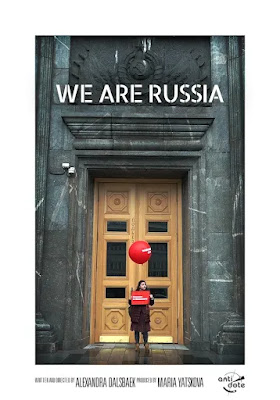
You would expect it would make American headline news if an
opposition party in a large influential country arrived at their headquarters
one morning to find the doors locked, the door knobs removed, and iron bars
freshly installed over their windows. To make matters worse, one of their
volunteers was locked inside with the people who had performed this surprise renovation.
This is exactly what happened in Moscow, but our media is only interested in Putin
in connection with conspiracy theories regarding Trump collusion. By the way,
the kicker was the only person to face prosecution after this abuse of power was
the innocent campaign worker trapped inside. He was a friend of the youthful
activists documentarian Alexandra Dalsbaek followed when they took Navalny’s
2018 presidential campaign to the streets in We Are Russia, which screens
during this year’s DOC NYC.
There
are no talking heads in WAR and no dry backgrounders. If you don’t know
who Putin is by now and how profoundly undemocratic his imperial presidency has
been, I think you’re an idiot and Dalsbaek probably does too. Regardless, if
you don’t get it by now, you will after watching these kids’ experiences (one
of the Navalny volunteers is only sixteen).
When
we first see Milena and her friends protesting, their efforts look almost negligible
by American standards. One of them merely stands in front of government
building holding a sign not much larger than a sheet of notebook paper, while
the other two film and post on social media. Yet, time and time again, they get
hassled and often even arrested by the cops.
In
fact, Dalsbaek’s film makes it clear Putin’s Russia is, by any standard or
definition, a true police state. It is impossible to effectively campaign for
legit opposition candidates and those who try and inevitably arrested and prosecuted.
It is hard to imagine the deafening outrage if western democracies kept their
accused in cages during trial, but it is standard practice in Russia.
First
and foremost, these activists deserve all kinds of credit for the guts and
commitment they display. Fearless Milena even tries to hold her sign in front
of FSB headquarters, prompting a police response in seconds (literally). They
are risking their [relative] liberty and perhaps even their lives for a better
government and a brighter future.
Aulcie Perry was Michael Jordan, before Jordan was anything in sports—but in
Israel. Perry nearly joined the New York Knicks, but was cut at the last minute.
Instead, he signed with the Maccabi Tel Aviv pro club in Israel, whose 1977
European championship season was the subject of Dani Menkin’s previous
documentary, On the Map. Perry was a major contributor to their success.
Israel opened its arms to its new superstar, but Perry was not prepared for the
temptations that come with fame. Menkin chronicles his rise, fall, and
redemption in Aulcie, which opens this Friday in Los Angeles.
Perry’s
family faced discrimination at its ugliest in the Jim Crow south and he grew up
amid economic stagnation and gang violence in Newark, New Jersey. However, he
found immediate acceptance in Israel, even though he conspicuously stood out
from everyone around him. He literally towered over most Israelis, including
his teammate. Then one night, Perry met Israeli supermodel Tami Ben-Ami, who
was also quite famous for her long legs—and it was love at first sight, at
least for him. He would later convert to Judaism, partly for her and partly
because it truly spoke to his spiritual needs. He adopted the name Elisha ben
Avraham, but remained widely known as Aulcie.
Unfortunately,
Perry left a lot of unfinished business back in America. Later in his career, lingering
injuries got him hooked on pain pills, which led to harder stuff. As with other
athletes, drugs would be his downfall. Yet, even when he was expelled from the country,
Israel still loved him. Actually, Israel was happy to welcome him back, but finally
meeting the daughter he never knew would be trickier. In fact, that is the goal
that drives Perry during the film’s contemporary scenes.
Aulcie
is
probably the best sports film of the year, so far (and Menkin’s On the Map is
even more rousingly entertaining). It does justice to Perry’s dramatic life
story, but it also speaks very directly about what it means to be Israeli.
Perry was born an underdog, so it makes sense he found a home in an underdog
nation like Israeli. He also had a great, but sadly tragic romance with the
late Ben-Ami, who was truly the love of his life and vice versa.
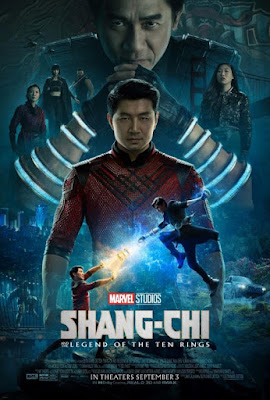
Serious question: did Disney/Marvel accidentally hire the wrong Tony Leung? They
were quite distressed when their first martial arts film was not granted a
coveted release slot for Chinese theaters, despite their profuse, prostrating
apologies for the original comic book licensing Sax Rohmer’s notoriously
stereotyped villain Fu Manchu, way back in the 1970s. Yet, it is worth noting
Tony Leung Chiu Wai had issued statements in support of Umbrella protestors, whereas
Tony Leung Ka-fai publicly backed the abusive HK police. (Also, it was partly
filmed in Australia, a nation the CCP has been particularly belligerent towards.)
Regardless, it seems Hollywood has been hellbent on selling its soul to a devil
it does not understand. There is still no Mainland release date for Destin
Daniel Cretton’s Shang-Chi and the Legend of the Ten Rings, but it
finally starts streaming on Disney+ this Friday.
Shaun
is not merely a laid-back valet attendant. He is really the son of powerful
crime-lord Xu Wenwu, a.k.a. “The Mandarin,” but absolutely, positively not Dr.
Fu Manchu. He came to America to break ties with his father’s organization, but
they inevitably come looking for him. Fortunately, he manages to fend of his
father’s unnaturally enhanced henchmen, much to the surprise of his
hard-drinking platonic bestie, Katy. Fearing Xiu will next come after his
estranged sister Xu Xialing, they rush off to Macau to warn her.
Now
the leader of a rival Triad, Xu is less than thrilled to reconnect with Shang-Chi,
but their father’s assassins essentially force them into a truce. The reunion
with Dad is even more awkward, but eventually they get a warmer reception from
their Aunt Ying Nan, a mystical guardian of the legendary city Ta Lo. They will
help her protect their late mother’s idyllic home from Xu’s army and the power
of the titular ten rings that keep him looking so youthful.
From
the CCP’s perspective (and maybe Marvel’s) Tony Leung Chiu Wai might have been
the wrong Tony, but for anyone who believes in principles like freedom of
expression, democratic governance, human rights, and free enterprise, he is the
right Tony—and he is indeed terrific in Ten Rings. Despite the plentiful
CGI, his training for The Grandmaster clearly did not go to waste. More
importantly, he truly humanizes the super-villain, while brooding like nobody’s
business. Twenty years from now Ten Rings will probably be programmed
alongside In the Mood for Love and 2046 during “Little Tony”
Leung retrospectives.
Leung
makes the movie, but Simu Liu holds up his end as the action lead. He also has winning
chemistry with Awkwafina, providing non-cringy comic relief as Katy. You can
sort of see her coaxing Liu out of his dramatic shell, just as her character
draws his out socially. As Xialing, Meng’er Zhang matches Liu step-for-step in
their fight scenes. Yet, nothing can match the thrill of seeing the great
Michelle Yeoh continue to command the screen as Ying Nan. It is also fun to see
Benedict Wong briefly turn up as Wong from Dr. Strange. However, Sir Ben
Kingsley inspires face-palms with his shticky sad clown routine as Trevor
Slattery, the woeful actor set-up to be the Mandarin’s fall guy (and supply a
link back to Iron Man 3).
In movies and TV, there are some serial killers who need only one name to
be identified, like Hannibal, Michael, and Jason. Dexter Morgan was definitely
like that, especially since his show was simply called Dexter. After his
disappearance at the end of his 8-season run, he has been known as Jim Lindsay
(in honor of the author of the source novels, Jeff Lindsay). For ten years,
Morgan/Lindsay has kept his predatory urges in check. Of course, killing is
like riding a bike. It all immediately comes back to you. However, he is a
little rusty on the cover-up afterward in Clyde Phillips’ Dexter: New Blood,
which starts tomorrow night on Showtime.
After
slipping away under the cover of a hurricane in the previous series’ conclusion,
Morgan is now living as Lindsay in Iron Lake, New York (it will not be very
placid there). He works at the local sporting goods store, where his knowledge
of knives and guns comes in handy. So will his budding romance with Angela
Bishop, the town’s chief of police. He thought he cut all ties to his past, so
he is shocked when his son Harrison comes looking for him. The teen does not
know his father’s shocking secrets, but he is enough of a Morgan to keep his
mouth shut regarding family business.
Morgan
managed to keep his “Dark Passenger” at bay through conversations with the interior
projection of his late sister Debra, but the obnoxious and entitled Matt
Caldwell will sorely test them both. Honestly, the mean-spirited wastrel is
just asking to be murdered, pretty-please-with-sugar-on-top. Meanwhile, there is
another, more traditional serial killer also operating in the woods around Iron
Lake, but we only see the mystery perp heavily bundled up and in shadows, at least
during the first four episodes supplied for review (out of ten).
If
you are new to Dexter (aside from a general awareness of the premise),
Phillips and his writers make it pretty easy to dive into Morgan’s new world
and catch up on relevant backstory along the way. It is also really grabby
thanks to the protagonist’s sly and admittedly twisted voiceovers. Morgan/Lindsay
remains an enormously intriguing character, whom Michael C. Hall plays to the hilt.
He still has the ironic smirk and the piercing death stare, but this Morgan is
also haunted by the things he has seen and done. There is a lot to this character
that Hall fleshes out nicely.
Pre-existing
fans should be psyched by the return of Jennifer Carpenter, who is terrific
offering Dexter her relentlessly tough love inside his head. We only just start
to see the great Clancy Brown as the father of the missing Caldwell, but it is
enough to show he brings his usual compulsively watchable craftiness. Jamie Chung
also promises to be a scene-stealing wild card as true crime podcaster Molly
Park.
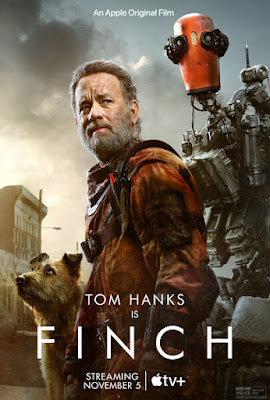
In the not too distant future, next Sunday A.D. There was a man named Finch
Weinberg, not so different from you and me. To keep his sanity, he built some
robot friends, but they never got to riff on any cheesy movies, even though Jeff,
his newest invention, shares similar coloring with Crow T. Robot. Instead, they
are preoccupied with survival—that of Finch and his dog Goodyear—in Miguel
Sapochnik’s post-apocalyptic Finch, which premieres today on Apple TV+.
The
world is pretty much over and only a few survivors like Weinberg remain holed
up in their hiding places. In his soul-scarring experience, nobody works
together anymore. Weinberg’s scientific background has served him well,
allowing him to hole-up in a power plant he manages to keep in limited
operation. Unfortunately, his health is deteriorating, so he created Jeff to
help him care for Goodyear. His service drone Dewey just does not have
sufficient functionality.
Not
long after he is powered up, Jeff helps Weinberg detect an incoming mega-storm.
They must flee the entire Midwest region, so Weinberg decides to head towards
San Francisco, for sentimental reasons, even though he has never left St. Louis
before. Thus begins a road trip across the desolate wasteland ravaged by the
vague cosmic disaster that is never fully spelled out. For Jeff there will be
growing pains, but even crusty Weinberg will learn late life lessons too.
Craig
Luck & Ivor Powell’s screenplay definitely leans into sentimentality, but
the ever-reliable Tom Hanks bails out the film’s more indulgent moments with
his haunted and world-weary performance as Weinberg. The comparisons with Castaway
are obvious, but we come to understand he retreated to his own island long
before Armageddon came crashing down. It is a smartly calibrated performance
and Hanks truly looks gaunt and grizzled—you almost have to wonder if he shot
the film while he was recovering from Covid.
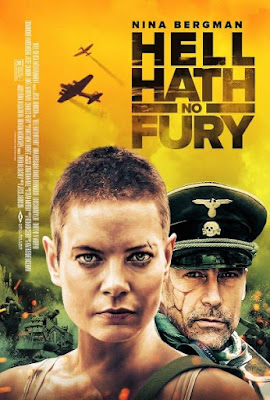
People forget Germany first occupied France was during WWI—that’s why the front
line was in France. Those who collaborated the first time faced reprisals that they
repaid with interest during the National Socialist occupation. Many in turn
faced similar or worse humiliation after the Allied liberation, like Marie Dujardin,
the former mistress of a high-ranking SS officer. Ironically, Dujardin was in
fact a resistance mole, but she has nobody left to vouch for her. However, she
has knowledge of a secret stash of gold that is definitely worth something in
Jesse V. Johnson’s Hell Hath No Fury, which opens this Friday in Los
Angeles.
When
we meet Dujardin, she is cooing romantically with the ruthless Von Bruckner.
Yet, when their car is ambushed by the resistance, she claims to be on their
side. He manages to take care of his would-be executioners, but she gets the
drop on him. Or so she thought—those darned glancing face shots. She left him
for dead, but she really left him facially scarred.
That
leads to a nasty reunion when she leads three American GI’s and Major Maitland,
their Kelly’s Heroes-style officer to the cemetery, where she tells them
she hid Von Bruckner’s gold. He wants it too—and he is marching their way with
all the SS troops still loyal to him.
HHNF
is
not exactly a love letter to the “Greatest Generation.” Technically, Dujardin
is not exactly a stereotypical “woman scorned” either. However, Johnson, the prolific
action director, stages some nifty battle sequences. Stuff gets blown-up and Germans
get killed many satisfactory ways, but Johnson always keeps it all clean and
legible on-screen.
He
also has the benefit of a gritty, experienced cast, including Louis Mandylor,
who certainly knows his way around a Johnson set (including the Debt Collector movies and maybe half a dozen others). Timothy V. Murphy is a
real standout for the grizzled swagger and snarling attitude he brings as the working-class
sergeant.
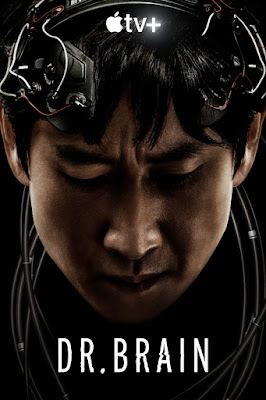
Brain scientists are often a little socially awkward, at least in movies and
TV, but Dr. Koh Se-won takes the brain biscuit. He can literally get inside
peoples’ heads, but it is almost impossible for him to open up to anyone, not
even his wife and son. However, when they are taken from him prematurely, he
just so happens to have technology to help him get answers, from other people’s
memories. Of course, as with any great innovation, his revolutionary process comes
with unforeseen side effects and complications in Kim Jee-woon’s six-episode Dr.
Brain, adapted from Hong Jac-ga’s web-comic, which is now streaming on
Apple TV+.
The
exact circumstances are not spelled out, but Koh was born with a different brain
structure that contributed to his intellectual brilliance, but also put him somewhere
on the spectrum. Despite his impassive emotional reserve, he marries Jae-yi and
they have a son, Do-yoon, who is very much like his father. Unfortunately,
Do-yoon was killed in a freak accident, from which Jae-yi never recovered—except
maybe he didn’t. Suddenly, Dr. Koh has reason to wonder.
Using
his handing-dandy brain-synching apparatus, Koh is able to transfer memories
from recently dead brains into his own. It is a process he is still refining. It
turns out he also inadvertently synchs many of their skills and instincts.
However, the process is dangerously erratic when attempted with a living brain.
Instead of true memories, Dr. Koh is flooded with images from their
subconscious. Regardless, each time he synchs, his brain absorbs another huge
download. If it were not for his atypical brain structure, he probably could
not handle it.
Dr.
Brain
follows in the tradition of psyche-plumbing thrillers like Spellbound,
Battle of Memories, and Dreamscape, where the subconscious is an equally
important setting for the drama to play out as the offices and homes of its
primary characters. It definitely plays to the strength of genre auteur Kim (Age of Shadows and I Saw the Devil), who brings a bit of a horror sensibility
to first installment (a la Flatliners), before setting into psychological-thriller
bag for the following five episodes. There are some devilishly inventive developments,
including a brain-synch with a cat. Yet, Kim always keeps the conspiracy-driven
tension and suspense cranked up high.
Lee
Sun-kyun (the “have” father in Parasite) does the nearly impossible. He scrupulously
maintains Koh’s emotional frozen nature, while making us care about his plight.
Lee also believably portrays the changes that come over the scientist as he continues
to transfer other people’s memories and feelings into his brain-basket. It is a
real challenge, but he totally pulls it off.
Yet,
the fan favorite of Dr. Brain is sure to be Park Hee-soon, who is
wonderfully sly and grizzled as private investigator Lee Kang-mu. He and Koh
come to collaborate together in an inventive way that would be spoilery to reveal.
Regardless, whenever he comes on-screen, everything kicks up several notches.
Seo Ji-hye does not get much backstory or character development as the cop
investigating the bodies that start to pile up, but she is appealingly
no-nonsense and quite credible in her action scenes.
The Desilu production studio founded by Lucille Ball and Desi Arnaz holds
several notable distinctions. It even won a Peabody Award for Orson Welles’ The
Fountain of Youth, the only time an unsold pilot to have been so honored.
However, they will always be best known for two series that became cash-cow
franchises. Mission: Impossible was one. Star Trek was the other
(and the more profitable, in the long run). By the time Desilu was producing
both shows, it was entirely Lucille Ball’s company, so she gets well deserved
credit for her support in “Lucy Loves Trek,” the first episode of History
Channel’s 10-episode The Center Seat: 55 Years of Star Trek, which
premieres this Friday.
Ball
and Arnaz were remarkably savvy and even prophetic with regards to the
television business. They bought the old RKO studio for their own productions,
but started making money by leasing space to other productions. They also
understood and secured re-run rights before anyone else, including the
networks. When Ball and Arnaz divorced, he also divorced himself from the
studio, so it was Ball herself who greenlit Star Trek.
Trek
fans
know it still almost didn’t happen. The network rejected the original pilot,
but took the unusual step of ordering a second one, with an entirely new cast.
The rejected pilot, “The Cage,” is now quite well-known, since it incorporated
into the two-parter “The Menagerie” and has since been restored and released in
its own right.
“Lucy
Loves Trek” does a nice job of chronicling Trek’s development at Desilu,
but it then mostly glosses over the entire run of the original series, focusing
on the letter-writing campaign that saved the show at the end of its second
season, the final cancelation, and its surprising success in rerun syndication.
Subsequent episodes will focus on the animated show, films, and successive
series, which must surely be leaving a lot original series lore and history on
the table. Sadly, many original cast/crew members are no longer with us, but we
do hear from Walter Koenig, Nichelle Nichols, and the late Leonard Nimoy (in archival
video).
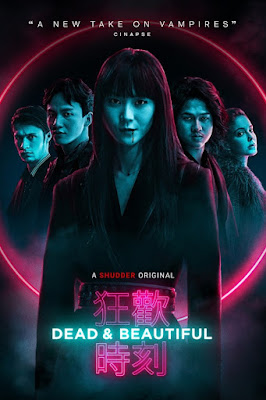
Apparently, the only thing that brings out an individual’s true inner nature more
than mutant superpowers is vampirism. That is what Lulu Wong discovers when she
and her beautiful and entitled friends suddenly wake up with fangs following a
bizarre ritual in David Verbeek’s Dead & Beautiful, which premieres
tomorrow on Shudder.
Who
needs New York or Hong Kong when the exclusive clubs of Taipei are so lavish
and alluring? Yet, her fab five still inevitably grow bored with their constant
partying. To liven things up, they establish a weekly tradition, in which each
member takes their turn orchestrating some kind of surprise. However, when Anastasia
Rublov arranges for a Shamanic ritual in the rainforest, they get more than the
New Agey nature vibes she anticipated—perhaps due to influence of the original
aboriginal people that maybe still haunt the land.
They
obviously now have the fangs, but they do not know how many other traditional vampire
tropes apply to their new conditions. Alexander Tsai, who still jealously
carries a torch for Wong, is eager to embrace the vampire undead-style. In
contrast, having recently embraced a half-baked version of Buddhism, Mason Van
Der Bilt is hesitant to give up on their humanity. Shallow Lo Bin-ray falls
somewhere in the middle, enjoying goofy shtick of vampires, whereas Rublov is
confused on how it all affects her Instagramming influence.
D&B
is
super-stylism, filled with neon-lit clubs and glowing Taipei nightscapes, but
it also has some interesting thoughts in its pretty head. Verbeek’s screenplay
uses the vampire phenomenon to make some sly allegorical points regarding class
and gender. (Anastasia’s talk of “transitioning” rings with current
significance, without beating viewers over the head.) Yet, more than anything,
their new undead state really seems to bring out who they really are.
Unfortunately, in the case of the confused Wong, she still doesn’t seem to truly
know herself.
Frankly, the bomb squad is probably the only department of the Hong Kong Police Force
that hasn’t generated complaints for brutality so it makes sense that Andy Lau’s
newest film involves bomb disposal. Of course, he has been here before, playing
bomb squad Superintendent JS Cheung in Shock Wave. His story was pretty
self-contained, but the franchise continues with a thematic sequel, in the
tradition of the Overheard films. However, Lau’s new character is much
darker and more conflicted this time around in Herman Yau’s Shock Wave 2,
which releases today on VOD.
Nobody
was better at disarming bombs than Poon Shing-fung, not even his partner Tung Cheuk-man.
Tragically, it will be Poon’s career that will be cut short when the two are
suddenly engulfed by a hidden bomb, after defusing two explosive booby-traps. Despite
a prosthetic leg, Poon exceeds all the physical requirements to return to
service, but the brass will only give him a desk job. Soon, Poon is consumed
with self-destructive anger and anti-social resentment.
He
is also quite suspiciously found knocked unconscious at the site of a hotel bombing.
Rather inconveniently for everyone, the resulting shock wave left him in a
state of complete amnesia. His old colleagues suspect he was working with the
anarchist terrorists known as Vendetta, but we have to believe he was really working
under deep-cover to infiltrate them, right?
Believe
it or not, the handling of the amnesia angle is somewhat original and pretty
intriguing. This being a Herman Yau film, a lot of stuff gets blown-up—in this
case, a whole lot. However, the timing of Shock Wave 2’s apocalyptic images
of mass destruction terrorism problematically come at a time when the puppet
Carrie Lam regime is hyping up the threat of terror to justify Beijing’s
draconian National Security Law. Yet, the truth is the law is being applied to forbid
Hong Kongers from reading certain books, viewing certain movies, and voting for
genuinely democratic candidates—none of which would prevent any of the crimes
depicted in this film. As a result, there is a disingenuous vibe to the SW2 and
its timing.
Andy
Lau gives one of his best performances in recent years, seething with existential
rage as Poon. Nevertheless, Lau’s fans have been disappointed by his cautious
wait-and-see attitude during the height of the 2019 demonstrations and it was
less than thrilling to read he serenaded the CCP at its anniversary bash. Again,
seeing him now turn up in a “terrorism” thriller sets off alarm bells.
Everyone that ever testified before a congressional committee has said “enhanced
interrogation” or whatever does not work, because terrorists just make stuff
up. However, the American military’s long-standing policy of not court-martialing
POWs for anything they might divulge under torture would seem to contradict
them (and it feels like a just position to adhere to). In Jean-Pierre
Melville’s Army of Shadows, it was taken for granted that resistance
members captured by the Germans would inevitably reveal all they knew. (It is a practice we don't condone, but we're also opposed to governing by slogan.) Regardless, characters keep telling us harsh interrogation just does not work,
so they resort to a Hail Mary to avert a terror attack in James Nunn’s One
Shot, which releases this Friday in theaters and on VOD.
This
ill-fated mission will unfold in one seemingly continuous take for Jake Harris
and his small team of SEALs. Their mission is to escort CIA analyst Zoe
Anderson as she collects terrorist financier Amin Mansur to shuttle him to DC,
where a dirty-bomb attack he bank-rolled is due to explode. He has said nothing
while site commander Jack Yorke held him, but when he sees his pregnant wife is
within the blast radius, she is sure he will change his tune.
Unfortunately,
a small army of terrorists attacks the black site soon after Harris and
Anderson land. Apparently, Haken Sharef and his jihadists do not trust Mansur
to keep his mouth shut. They have the initiative and superior numbers, but they
did not expect to find four SEALs on this grim island rock.
The
Rope-style one-take thing can be a distracting gimmick, but it works better
than you would expect here. The way Nunn constantly pans across the field of
battle, viewers are keenly aware of how each of the combatants is moving
independently. When we lose sight of one, only to have them suddenly pop up somewhere
else, it feels like a real combat experience. Despite the one-take pressure,
there is still some cool looking fight choreography. Of course, it helps to
have someone with Scott Adkins’ chops as the lead.
As
you would expect, Adkins is totally credible as Harris. Dino Kelly, Emmanuelle
Imani, and Jack Parr do not get to take their SEAL characters on much of a
developmental arc, but they keep up with Adkins during the long extended fire-fights.
Ashley Greene Khoury plays Anderson with workmanlike competence, but it makes
no sense for a junior desk officer to be on such an assignment.
In its 1960s prime, Hammer Films did gothic horror better than anyone. However,
for their most successful TV series, they leaned into folk horror. Even in
episodes that do not rely on traditional folk horror tropes, bad things tend to
happen to anyone who visits the countryside. Hammer had co-produced a
Frankenstein pilot that failed to sell as well as a previous anthology series
that came and went, but in 1980 they scored a hit with genre fans when Roy
Skeggs created Hammer House of Horror, which airs today as a Halloween
binge on Decades TV (hang on, this will be a long one).
Rather
fortuitously, the series starts with probably its best episode, “Witching Hour”
(directed by Don Leaver and written by Anthony Read), wherein viewers quickly
get a taste of the series’ blend of the sinister and the sexual. Film composer
David Winter rightly suspects his actress wife Mary is having an affair (as we
see with absolute certainty), but Winter has no idea she is in fact sleeping with
his best friend.
Unfortunately,
Winter’s jealousy and resentment leaves him vulnerable to the attacks of
Lucinda Jessup, a 17th Century witch, who transported herself across
time to avoid a date with the stake. Ironically, it will be his estranged wife
who tries to save Winter from her sexual and spiritual domination. Jon Finch
(star of Hitchcock’s Frenzy, who turned down an offer to play James Bond)
is a spectacular mess as Winter. Prunella Gee (the nurse in the rogue Bond
movie Never Say Never Again) is terrific, but underappreciated by horror
critics for her forcefulness as his wife (probably because of her sex scene),
while Patricia Quinn chews the scenery like a world champion as Jessup. The folk
horror is pronounced and pretty scary.
In
contrast, “The Thirteenth Reunion” (directed by Peter Sasdy and written Jeremy
Burnham) is more darkly ironic than outright frightening. Yet, it is interesting
in its way, because it serves up some rather mordant cultural commentary. The
strange business involves a reporter infiltrating a trendy but abusive New Age
weight loss clinic—definitely shades of EST here. There is also an appealing
budding romance between her and another patient, because neither are typical
romantic leads, but it is rudely interrupted.
While
“Reunion” is a product of its day, “Rude Awakening” (directed by Sasdy and
written by Gerald Savory) feels somewhat ahead of its time, because of its
circular structure. Norman Shenley is an estate agent who keeps waking up from
dreams in which he is repeatedly punished for a crime he has not [yet] committed—the
murder of his wife. Resolving to get to the bottom of things, he keeps driving
back out to the creepy old manor of his nightmare, only to befall another gruesome
fate, before waking up again.
This
episode really doesn’t seem fair, because it almost amounts to cosmic
entrapment. However, the variations of each successive go-round are quite compelling
and Denholm Elliott is perfect as the luckless Shenley.
“Growing
Pains” is an underwhelming evil kid-ghost story and “Charlie Boy” we’ll skip
because its too apt to become cancelation bait. “The House that Bled Death”
(directed by Tom Clegg and written by David Lloyd) is not perfect television
either but it became notorious in the UK for a scene of blood showering down
from the ceiling on a child’s birthday party. It turns out the house a young
family bought at a bargain price really wasn’t such a good deal after all. This
episode appears to be inspired by the Enfield Poltergeist that was also the
subject of The Conjuring 2. The Hammer take is very different, until
suddenly it isn’t.
Probably
the most viewed episode is “The Silent Scream” (directed by Alan Gibson and
written by Francis Essex), because it stars long-time Hammer favorite Peter
Cushing. Martin Blueck looks like a kindly old man, but he is really a National
Socialist war criminal (masquerading as a camp survivor), who befriends
down-on-their-luck ex-cons like Chuck to lure them into his cruel Skinner-esque
behavioral experiments.
“Scream”
is easily the darkest, bleakest episode of the anthology. Cushing’s knack for shifting
from kindly to malevolent at the drop of a hat serves the story quite well. The
working-class pathos Brian Cox brings as Chuck heightens the episode’s claustrophobic
discomfort. It is creepy, but a real downer.
A
couple gets stranded on a country road in “Children of the Full Moon” (directed
by Clegg and written by Murray Smith), as they often do in Hammer House.
The reference to a full moon is not accidental, but the payoff monster fans expect
comes very late in the episode. Mostly, it is about more creepy kids and a
creepy old lady.
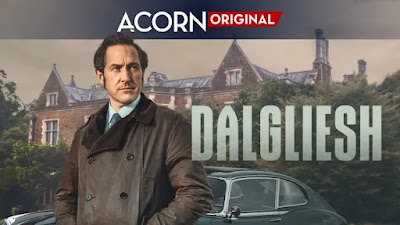
Most British TV detectives are usually DI’s or DCI’s (Morse, Lewis, Lynley,
Frost, Banks), but P.D. James’ signature eventually rose to the advanced rank
of Commander. He was also a published poet, with a tragic backstory, so he well
understood the dark places of the human soul. Most importantly, Adam Dalgliesh
was unfailingly professional and competent. The no-nonsense detective was a
war-horse anchor for ITV (and then the BBC) in the UK and PBS’s Mystery in
America, so it is not surprising to see him get a fresh new series treatment in
Dalgliesh, which premieres Monday on Acorn TV.
In
series’ first two-part case, “Shroud for a Nightingale,” DCI Dalgliesh is less
than impressed with his new DS, the crass Charles Masterson. He does not take
to Dalgliesh either, but he is somewhat intimidated by the detective’s
commanding bearing. Still mourning his wife and unborn child, Dalgliesh is
assigned the case of a poisoning in a nursing college, because of its sensitive
nature. The school has powerful patrons and is expecting a high-profile visit.
Tragically, there will be further murders, to cover the killer’s tracks.
The
second two-parter, “The Black Tower” represents an improvement, because of the
remote but visually striking location and it also gives us a break from the
Dalgliesh/Masterson dynamic, which gets a bit tiresome. Dalgliesh arrives to
visit an old friend in priestly orders, who is on staff at a provincial home for
disabled residents, only to find he passed away a few days prior. That is just
what Dalgliesh needs, more grief. However, he soon starts to suspect his friend
was murdered, especially when more bodies start piling up.
Steven
Mackintosh makes a worthy suspect and foil as Wilfred Antsey, the arrogant
director of the almost cloistered home. He provides the sort of sparring
partner “Nightingale” lacks. Although the local police chief is too lazy to
mount a serious investigation, Dalgliesh finds an ally in Constable Kate
Mishkin. In terms of themes, this could be the episode of Dalgliesh that
hardcore fans of the original adaptations most appreciate.
The
initial reboot season concludes with “A Taste for Death,” which auspiciously
starts in a church. Inside, a disgraced politician and a local homeless man
were sliced up, in a transparent effort to make it look like a struggle between
them. To help his team, Dalgliesh has transferred Mishkin from Bristol, not
exactly thrilling Masterson.
There
is some decent procedural stuff in “Taste,” and it is great to see distinctive
character actors like Jim Norton (seen on Broadway in The Mystery of Edwin Drood) and David Pearse pop up as Father Barnes and pathologist Miles
Kynastone, respectively. Patrick Regis is also quite a notable presence as
Gordon Halliwell, the loyal chauffeur of the deceased’s stonewalling mother.
Frankly,
the rivalry between Masterson and Mishkin (nicely played by Carlyss Peer) feels
flat and predictable, However, “Taste” really gives Bertie Carvel a chance to
shine as Dalgliesh during the emotionally heavy third act. Although Martin showed
a bit of feeling in his two Dalgliesh mysteries, Roy Marsden was always
scrupulously reserved and detached (that was what made Dalgliesh Dalgliesh).
Arguably, Carvel combines the best of both.
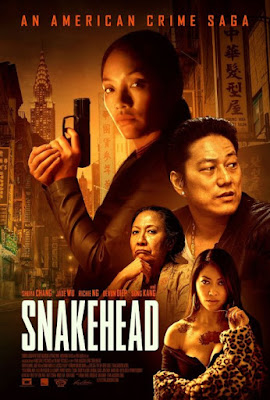
It only makes sense that a former Red Guard leader during the Cultural
Revolution could so easily segue into human trafficking. In both roles, human
beings were just masses to be exploited. The prosecution of her Chinatown syndicate
brought wider media attention to the practice of human smuggling and the term “Snakehead”
that described it. Her shrewd underworld domination inspired Evan Jackson Leung’s
Snakehead, which opens today in theaters and on-demand.
As
the woman who will become known as “Sister Tse” makes clear in her opening
narration, she is neither an economic migrant nor a political refugee. She came
to America, via Dai Mah’s trafficking network, for very personal reasons. To
find her daughter. Unfortunately, she must first pay-off a debt of over $50,000
to Dai Mah. Initially, the Sister Ping-analog figures she can simply be
consigned to a brothel, but Sister Tse is not so inclined. Impressed by her
toughness and resilience, the Snakehead boss starts giving her low-level tasks
in her criminal outfit.
Soon,
Sister Tse earns Dai Mah’s trust and confidence, but also the jealousy of her thuggish
son Rambo. His scheming girlfriend Sinh also has her claws out for Sister Tse. Plus,
through these new associations, she attracts the attention of the FBI. As a
result, each new high-priority assignment comes with considerably risk, but it
is hard for Sister Tse to pass up chances to slash her debt.
Leong,
who helmed the terrific doc Linsanity, brings a gritty street-level
perspective and New York attitude to this years-in-the-making passion project.
It is two-thirds crime thriller and one-third family tragedy, but the two parts
fit together cohesively. He mostly refrains from lecturing the audience on policy
issues, aside from an unflattering portrayal of a minutemen-style border patrol.
(You could even argue it discourages illegal immigration.)
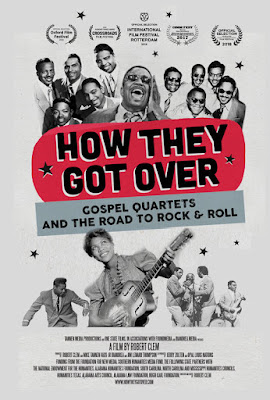
There would be no rock & roll without “Rock Me.” You could say that
satanic rock owes its existence to the Church. Indeed, Elvis Presley always
acknowledged Sister Rosetta Tharpe’s influence on his music. Tharpe was a
pretty big name already, even before he copied her act. Yet, it was the success
of those who came before her who made gospel music a viable career opportunity for
the musicians (primarily vocalists) whose oral history informs Robert Clem’s
documentary How They Got Over, which opens tomorrow in Los Angeles.
Unlike
other gospel docs (like Rejoice and Shout), Got Over does not go
all the way back to the roots of gospel and Thomas A. Dorsey. He basically
starts immediately post-war, when there were little job prospects for blacks in
the Jim Crow South. Life and entertainment almost entirely revolved around the Church,
where touring gospel artists might make gas money to the next town if they were
okay, but could build a following if they had talent.
Although
Clem covers Sister Rosetta and some of the women’s gospel ensembles, he deliberately focuses on the male harmony singers, who followed the lead of the original
Golden Gate Quartet. Among those groups, he largely spotlights the Dixie
Hummingbirds, thanks to original member Ira Tucker, whose commentary helps
drive the film. Probably, the next most prominent group would Clarence Fountain
and the Blind Boys of Alabama, which makes sense given their recognition beyond
the gospel world.
In the 1930s, Hollywood studios were reluctant to criticize the National
Socialist regime, out of fear their films would lose access to the German
market. Sound familiar? By the 1970s, Nazis were regular movie villains, but
there was still great interest in adapting Albert Speer’s spin-controlling memoir
Inside the Third Reich. Eventually, it became a two-part TV movie after
his death, but Paramount thoroughly kicked the tires of a prospective feature
film in the early 1970s. Vanessa Lapa contrasts Speer’s evasive recorded
conversations with spec-screenwriter Andrew Birkin against the tapes of his
Nuremberg tribunal in Speer Goes to Hollywood, which opens tomorrow at
Film Forum.
The
notion of Speer as the moderate National Socialist persists today, in large
measure due to his widely read book. An architect by training, Speer was
appointed Minister of Armaments, which entailed responsibility for the widespread
use of slave labor at munitions plants. Of course, he claimed he never fully
understood the horrific conditions workers endured. Based on the tapes, it
sounds like Birken (whose credits include The Name of the Rose, The Final
Conflict, and King David) gave him some benefit of the doubt, but
kept hoping to hear some genuine remorse from Speer.
The
thing is, we don’t really hear any of it, because much of the tapes had
degraded to such an extent, Lapa was forced to re-record the transcript, which
raises questions similar to those surrounding the Anthony Bourdain doc. The
tapes were thoroughly cataloged and documented, so the words themselves are
authentic, but there is maybe a degree of subjectivity in their presentation.
Yet,
the real problem with the film is its over-reliance on unimpeachable footage of
the Nuremberg Tribunal, which play out in long extracts. As a result, viewers
who have seen Stuart Schulberg’s historically significant Nuremberg: It’s Lessons for Today might understandably feel like there is a good deal of
redundancy Lapa’s film.
This rural French mountain village is worlds away from the Texas seen in Blood Simple or the Kentucky of The Devil All the Time, but its rural noir
dynamics are very similar. You might logically wonder how a tragedy there could
be related to Abidjan in the Ivory Coast. Eventually the truth will be
revealed, but director-screenwriter Dominik Moll will take his time teasing it
out through flashbacks and narratives games in Only the Animals, which
opens this Friday in New York.
Evelyne
Ducat disappeared on the way to her winter vacation home, but Alice Farange
does not understand how anyone she might know could be involved. She is also distracted
by her own issues. Lately, she has conducted a rather open affair with Joseph
Bonnefille, a rustic farmer, whom she met through her work at his insurance
company. Unfortunately, that relationship is also about to take a sour turn,
for reasons she does not understand.
Meanwhile,
things are still frosty with her husband Michel, who is acting especially
distracted lately. Regardless, she is still genuinely concerned when he returns
home late at night, bloodied and battered. She assumes they are fighting over
her, but what is really going on is much darker and more complicated—and it
will take a while for the full picture to reveal itself.
Only
the Animals
is definitely constructed like a puzzle box, in which clues are teased in full
sight, but viewers need Moll to keep rewinding the narrative, to provide the
context needed to put the pieces together. Fortunately, they all really do fit
together at the end. The truth will indeed be revealed, but before then, Moll
manages to wring a fair amount of suspense out of the mystery. There is also a
rather surreal left-turn taken during the third act, somewhat akin to Charles
Sturridge’s A Handful of Dust.