Thursday, December 23, 2021

Vigil, on Peacock

This BBC-produced miniseries might have been set in the state of Georgia rather than Scotland. Had the Scottish independence referendum passed, the Atlantic Fleet’s King’s Bay submarine base was one of the proposed contingency homes for the United Kingdom’s Vanguard subs (being a NATO port). Apparently, nationalist politicians are still determined to evict the UK’s nuclear subs and they are willing to capitalize on a murder committed on-board to do so. Initially, a civilian DCI finds herself investigating the suspicious death, but she is soon pulled into a web of sabotage, espionage, and politics in Tom Edge’s Vigil, which premieres today on Peacock.

The Royal Navy surely has its equivalents to MPs and the NCIS so the idea DCI Amy Silva would be dropped from a helicopter into HMS Vigil’s hatch is a bit far-fetched. In the US Navy, sub crew are thoroughly vetted both physically and emotionally, to ensure they can withstand the demands of submerged service. Presumably, the Royal Navy does likewise, so it is unlikely a malcontent like the late Craig Burke and his thuggish nemesis Gary Walsh would be assigned such duty. Of course, you could never find submarine passages wide enough for sailors to walk side-by-side, but hey, dramatic license.

Regardless, if you can get past the dubiousness of
Vigil’s premise, its sub-bound dramatic dynamics, and the unrealistic representation of its setting, it is actually a surprisingly suspenseful thriller. As Silva investigates the crime scene, her colleague (and ex-lover) DS Kirsten Longacre dives into Burke’s history, including his romantic involvement with a woman active in the Scottish anti-nuclear movement.

Of course, much like the “three-hour cruise” of
Gilligan’s Island, Silva’s three-day embedment with Vigil is soon extended, due to grave mechanical problems and ominous Russian submarine activity. Supposedly, the coxswain, Warrant Officer Elliot Glover will be facilitating her inquiries, but nobody wants to talk to her. Inevitably though, the Vigil’s captain, Commander Neil Newsome starts to begrudgingly respect her, as she uncovers information on the secret sabotage campaign, mostly likely related to Burke’s murder.

Even if it does not pass muster with
Jane’s Defense Weekly readers, Vigil’s procedural mystery and submarine techno-thriller elements are totally grabby and addictively compelling. On the other hand, the flashbacks to Silva’s backstory, including guilt over the death of her pseudo-fiancé, her relationship with her presumptive step-daughter, and her aborted romance with Longacre, are whiny, overwrought, and gratingly distracting from everything that actually works in Vigil. If we could cut out all that cringy melodrama, it would probably be a much tighter and tonally consistent five episodes, versus six with the bloated soap opera interludes.

That said, Suranne Jones and Rose Leslie are both very good when they get to play competent, intuitive cops, rather than wounded lovers. Paterson Joseph plays Commander Newsome with a 100% credible military bearing, but also with an appropriate edge, given his somewhat tense relationship with his overbearing, politically connected executive officer Lt. Commander Mark Prentice. Initially, Prentice is positioned as a cliched martinet, but Adam James nicely fleshes him out, as he becomes more complicated in later episodes. Shaun Evans also solidly portrays Glover’s intriguing ambiguity and Stephen Dillane is all business as Admiral Shaw, the serious-as-a-heart-attack commander of the Valiant fleet.

Wednesday, December 22, 2021

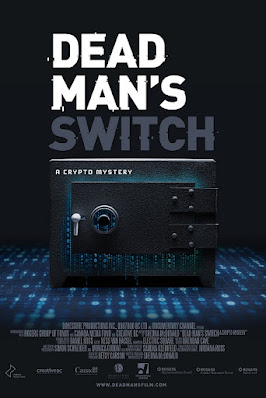
Dead Man’s Switch, on Discovery+

Crypto has come a long way baby, but it is still valid to ask whether it is truly money, by the classical economic definition. It can certainly function as a store of value, although it did not turn out that way for customers of QuadrigaCX. However, its lofty but fluctuating exchange rate does not make it practical as a medium of exchange or a measure of value. Prices that go on for eight or nine decimal places simply are not efficient. Yet, only Paul Krugman would argue crypto has no value (for the record, I’m suggesting it is too valuable to serve as currency). As a result, many people were ruined by the mysterious disappearance of their QuadrigaCX holdings. The murky circumstances surrounding the death of the exchange’s co-founder and the subsequent exchange lock-out are chronicled in Sheona McDonald’s Dead Man’s Switch, which premieres tomorrow on Discovery+.

There was a time when QuadrigaCX was Canada’s largest exchange. Founders Gerald Cotten and Michael Patryn came around at the right time and they shrewdly courted the Vancouver crypto community. Cotten was the Zuckerbergish public face of the company, so when he had a falling out with Patryn, he became the only one with access to Quadriga’s off-line “cold wallets.” That meant when he died while visiting India (for rather uncharacteristic reasons) nobody could access the bulk of the crypto investments parked in the exchange.

Millions of dollars-Canadian were lost, spurring fruitless audits and litigation. Not surprisingly, many of Quadriga’s creditors started to suspect Cotten faked his death and absconded with their Coins when the founders’ scandalous background came to light. McDonald does a great job handling this line of inquiry. She never indulges in fanciful speculation, but what she uncovers in India is definitely grounds for suspicion. In fact, it is utterly bizarre and undeniably fishy.

Tuesday, December 21, 2021

Gustav Stickley, American Craftsman, on OVID.tv

Even a master craftsman like Gustav Stickley could be undone by the fatal combination of high inflation and high interest rates. For a while, he was a leading furniture manufacturer, wholesaler, and retailer, as well as a pioneering design publisher, but he was undone by soaring consumer prices and a credit crunch. Although largely forgotten by the 1920’s, he would be rediscovered posthumously in the 1960’s (thereabouts). Director Herb Stratford and his co-writer-co-producer, Stickley biographer David Cathers chronicle the designer’s life and legacy in Gustav Stickley, which premieres today on OVID.tv.

After a downturn in his family’s fortunes, the young Stickley found unexpected satisfaction working in his uncle’s furniture factory. Before long, he and two brothers had their own furniture manufacturing company. Most of their output was conventional and their partnership would not last long. However, “Gus” stayed in the business, perfecting his own style.

Directly influenced by John Ruskin and William Morris (the essayist-textile artist, not the talent agent), Stickley developed furniture that rejected the faux-Euro-Chippendale ornamentation that was then commonplace in the American market. His pieces embraced the grain and weightiness of the wood and emphasized the pegs, joints, and fasteners holding them together. They were rugged, but not crude. With the arrival of designer-architect Harvey Ellis, Stickley’s furniture line somewhat moved away from its Spartan austerity, adding decorative wood inlays.

To untrained eyes, vintage Stickley appears like it would be extremely compatible with Frank Lloyd Wright’s Prairie period, especially pieces with the Ellis inlays. Although it was decades before Stickley was reappraised by critics and collectors, his work also looks like it could have been an early, subconscious influence for some of the WPA furniture craftsmen. If you appreciate one, there is a high degree of likelihood you would also appreciate the other.

Monday, December 20, 2021

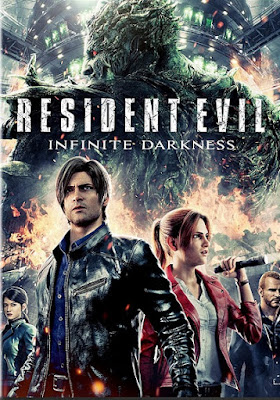
Resident Evil: Infinite Darkness (Anime Series)

Whether it came from a lab leak or a wet market, there is no serious debate that the CCP regime in China covered up the Covid outbreak we are all still enjoying two years later. However, the folks managing the Resident Evil franchise apparently did not notice. In their new anime series, it is the American government that covered-up the zombie viral outbreak in Raccoon City and now the corrupt Defense Secretary hopes to provoke a war with China to distract the President. Fan favorite characters Leon Kennedy and Claire Redfield must save the day in the anime series Resident Evil: Infinite Darkness, directed by Eiichiro Hasumi, which releases tomorrow on DVD and BluRay.

Something bad happened in Penamstan six years ago. It started out like
Black Hawk Down, but then the zombies showed up. The leader of the “Mad Dogs” unit barely survived. Now, he is known as the “Hero of Penamstan,” but he is uncomfortable with that title. Likewise, Kennedy would be uncomfortable to be called the “Hero of Raccoon City,” but it gave him enough credibility for the President to ask for him by name.

He and the Mad Dog commando will be investigating Sec. Wilson’s suspicions that China was behind the Penamstan incident, along with Shen May, a Chinese American officer, who still has highly-connected family in Shanghai. Meanwhile, Redfield turns up evidence of a suspicious biological agent is still infecting residents of Penamstan, but there are people in the administration who want to keep a lid on her allegations.

Since there have already been six
Resident Evil films in the Mila Jovovich continuity, a reboot, and three anime features, so practically no time is given developing Kennedy and Redfield. You either know them or you don’t. Jason “the Mad Dog” is not much more than a stock character either. Although Infinite Darkness is packaged as a series, there are only four twenty-four-minute episodes, so it is really more like another anime feature cut into quarters. There is plenty of action, but it often looks more like a video game on-screen, which sort of makes sense, given its source material. There is also a fair amount of halls-of-power intrigue, but it is largely derivative and entirely half-baked.

Sunday, December 19, 2021

Holiday Gift Guide ’21: Heartworn Highways Revisited

Outlaws are cool, so there is always a younger generation eager to follow in their footsteps. The question is whether Millennials are equal to the task. It is always tough to compare the original generation with those who come after them, but the disparity is particularly glaring in the case of “Outlaw Country.” Nearly forty years after the late James Szalapski filmed his classic documentary, Heartworn Highways, Wayne Price applied his methods to a new generation of Nashville musicians in Heartworn Highways Revisited, which has now is available on DVD and BluRay from Kino Lorber.

Sadly, Towne Van Zandt died from his hardcore outlaw lifestyle in 1997, so he does not appear as an honored alumnus in
Revisited. Guy Clark and Steve Young are no longer with us either, but Price was able to film them before they passed. As you might expect, their scenes, along with those of David Allan Coe, are the best in the self-positioned sequel. However, the absence of the original doc’s biggest star, Charlie Daniels is quite glaring. Could it be the rightward turn his politics took after September 11?

In fact, there seems to be a rather perverse slant to the film, considering the general market for Country music (including the Outlaw variety), reflected for instance in Bobby Bare Jr’s joke about Republicans and Robert Ellis’s “Sing Along,” which describes the horrors of a fire-and-brimstone upbringing.

On the other hand, it is nice to hear some of the musicians incorporating jazz and blues influences. The acutely personal Outlaw singer-songwriter tradition is clearly still represented by the likes of Justin Towne Earle’s “Am I that Lonely Tonight” and Ellis’s “Tour Song.” However, there is no question the jaw-dropper highlight of the film is Guy Clark’s climatic performance of “L.A. Freeway,” with most of the younger musicians offering reverential support.

Saturday, December 18, 2021

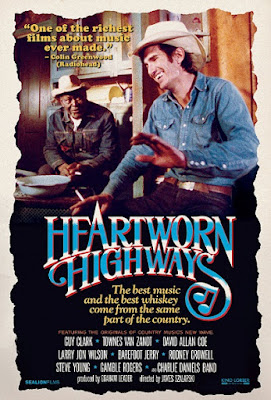
Holiday Gift Guide ’21: Heartworn Highways

It is the perfect DVD gift for all the tramps, ramblers, and hobos on your Christmas list. The artists it documents would probably be okay with that characterization. They were the performers associated with the early development of the “Outlaw Country” school of Country & Western music. The movement’s biggest stars (like Willie Nelson) eventually filed off their rough edges, but the many of the most talented outlaws achieved cult fandom and status as country musicians’ country musicians. Those were the sort of artists James Szalapski recorded in performance throughout his 1976 documentary Heartworn Highways, which has now been restored and is available on DVD and BluRay from Kino Lorber.

Technically, there are talking head segments in
Heartworn, but they feel more like chill hang-out sessions. People talk to each other rather than the camera. They drink too, which contributes to the idiosyncratic vibe. Szalapski also often marries up the music with impressionist footage of the highways and roadhouses that make up a traveling country artist’s world.

Frankly, those who have preconceived notions probably should not think of tunes like Guy Clark’s “That Old Time Feelin,’” Townes Van Zandt’s “Waiting’ Around to Die,” David Allan Coe’s “I Still Sing the Old Songs,” and Steve Young’s “Alabama Highway” as country songs at all. Consider them Americana roots music, because they tap into deep, archetypal sources. They are profoundly felt and cut to the bone.

In some ways, the film confirms a few Country cliches, in that many of these tunes very definitely address God, booze, patriotism, and prison. Yet, there is also Van Zandt serenading to tears his friend and neighbor, “Uncle” Seymour Washington, the so-called “Walking Blacksmith,” who was known for supporting both black and white musicians. The truth is, all those New York and Beltway writers who churned out think-pieces wondering “how can we ever understand those Red States” should listen to tunes like “I Still Sing the Old Songs.”

Szalapski’s film appreciated in reputation over time, because he had the good fortune to catch a number of artists on the way up. Even though Van Zandt was a supporting character in Ethan Hawke’s
Blaze, probably the biggest attraction, then and now, would be the Charlie Daniels Band. Yet, it is instructive to see how they were still operating outside the supposed mainstream. It looks like their concert performance takes place in a large school gymnasium, but the place is truly packed to the rafters.

Friday, December 17, 2021

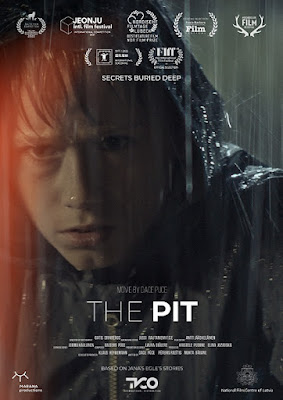
Submitted by Latvia: The Pit

This adaptation of Jana Egle’s short stories is sort of like a Latvian Short Cuts. It is also a coming-of-age story—a really dark one. Markuss is a tough kid to love, but we come to understand just how unloved he feels in Dace Puce’s The Pit, Latvia’s official Oscar submission for best international feature, which releases today in theaters and exclusively on Film Movement Plus.

Markuss is in big trouble, because he lured Emilija, a snotty little princess in his new neighborhood, into a pit in the woods and left her there. He was already a pariah in this provincial town. Now he is considered a monster. His grandmother, who is reluctantly serving as his guardian, seems to openly resent his presence. The rest of his local kin treats him with cold disdain, but their dysfunctional and sometimes abusive behavior behind closed doors is not so very different. His only friend is Sailor, the town outcast, whom his grandmother helps to support, despite her obvious contempt.

Some of the revelations Puce and co-screenwriter Monta Gagane have in store for viewers are fairly logical (a nicer term than predictable, in this case), but the way they emerge organically as the film progresses is still quite potent. There are some flashbacks, but they are employed judiciously and cleanly. After ten minutes, viewers will despise Markuss, but after seventy minutes, hearts will ache for him. It is a drastic dramatic reversal, but it is well-earned.

It is also helps that young Damir Onackis’ lead performance is remarkably powerful. He is raw and honest—quiet, but violent. This could very well be the best youthful performance of the year. Dace Eversa surprises us down the stretch as Grandma Solveiga, while the acutely human sadness of Indra Burkovaska’s Sailor is the perfect counterpoint to Markuss’s rage and confusion.

Thursday, December 16, 2021

Swan Song, on Apple TV+

If science fiction predicts something enough times, does that mean it will truly come to pass? Should that be so, the terminally ill will eventually be able to replace themselves with healthy clones that carry their memories. We have already seen dying fathers come to terms with their clone successors in Guy Moshe’s LX 2048 and the “Tom” episode of Solos, so we can anticipate the mixed emotions Cameron Turner feels in Benjamin Cleary’s Swan Song, which premieres tomorrow on Apple TV+.

So, Turner is doing poorly. His outlook is fatal, but he hasn’t told his wife Poppy or their son anything. It is better that way, if he goes through with the radical treatment proposed by Dr. Scott. She will clone him in every respect, except for that obvious congenital defect, including his memories. However, they will need his help to verify all his old recollections synchronized acutely. That trip down memory lane will be painful, especially since it requires spending time with “Jack,” his replacement.

Despite the basic science fiction premise,
Swan Song is more a film about death and letting go than the speculative implications of cloning. True, there are self-driving cars, but those are supposed to be coming right around the corner, finally. Fortunately, much of that drama is quite well done, especially the strange relationship that develops between Turner and his clone.

Mahershala Ali is very good in what is sort of, but not exactly a dual role, as Turner and his clone. Frankly, it is quite impressive how good he is playing opposite himself. He also has some nice sequences with Naomie Harris, as his wife Poppy, especially during memories of their first meetings. Harris does indeed have some effective moments, but her character’s complete lack of intuition somewhat strains credulity.

Wednesday, December 15, 2021

Close to Me, on Sundance Now


If Jo Harding had to lose a year to amnesia, her most recent would be the one to forget. Her dog died, she finally checked her dementia-plagued father into a care-home, and she bitterly quarreled with both her son and her best friend. It is unclear whether it is any consolation, but she also suspects she was having an affair. With whom, she has no idea. Bits and pieces will come back to her in Angela Pell’s six-part adaptation of Amanda Reynolds’ novel, Close to Me, which premieres tomorrow on Sundance Now.

Harding took a bad step on her staircase and suddenly one year was gone. (Honestly, the disorienting tile pattern of their foyer could make anyone swoon.) Or was she pushed? That is what she starts to suspect, even though the doctors warn her she will be a bit spacy and “disinhibited” for a while. Frankly, it seems like she was always a little blunt, at least judging from the confused flashbacks. Regardless, she will be a lot for her husband Rob to handle. He was the one who found her bleeding at the bottom of the staircase and he has been acting super-squirrely ever since she came to.

In terms of tone, Pell’s adaptation is like a more sexually frank Mary Higgins Clark thriller. It is very much a woman’s story and a domestic setting, but the relatively small circle of characters rather limits the potential field of suspects. Rather awkwardly, Jo Harding can really be a pill, both pre- and post-accident. After five and a half episodes with her, we were almost expecting a meta revelation, in which we learn it was a group of exasperated viewers who pushed her down the stairs. It is also unclear whether this was an intentional strategy to play up her status as an unreliable narrator or some dubious characterization choices.

Tuesday, December 14, 2021

Left Unfinished: The Forbidden Reel

Rather remarkably, the staff of Afghan Films already saved their film archive from the Taliban once. Sadly, they will probably have to do it again, because Joe Biden got bored with Afghanistan. Hopefully, Taliban enforcers have not seen this documentary, but wisely the employees of the state film agency was already racing to digitize their archive, in recognition of the nation’s continuing instability. Ariel Nasr documents the history of Afghan cinema and the efforts to save it in the NFB-produced documentary, The Forbidden Reel, which screens online as part of the Smithsonian’s Left Unfinished: Recent AfghanCinema series.

Not surprisingly, the series also features
What We Left Unfinished, the story of five incomplete, rediscovered Soviet Era films that offered in window into Afghan cinematic history. In fact, the director, Mariam Ghani (who also happened to be the daughter of former President Ashraf Ghani, now in exile in the UAE, for obvious reasons) appears throughout Reel, as one of Afghan Film’s chief supporters and consultants.

Not unexpectedly, the Taliban did indeed come to burn their country’s cinematic heritage. However, the forewarned Afghan Film employees were able to hide their true archive, by serving up their storeroom of international films instead. As of 2019, they were well into their digitization campaign, with Ghani’s assistance.

Initially, the Soviet-era was seen as a boon for filmmaking, but as the puppet government imprisoned and executed more and more Afghans, many of the directors attached to Afghan Films joined the Mujahideen, serving in the filmmaking unit attached to Ahmad Shah Massoud’s fighters. The moderate commander was one of the most effective at battling the Soviets, but he was tragically assassinated by his more extreme Taliban rivals, which directly led to an existential crisis for Afghan Films.

When watching
Forbidden Reel, it is clear Afghanistan does not have to be the way it is. Most Afghans want to work hard, take care of their families, and maybe take in a movie now and then. Yet, a lack of will on our part turned back the clock to 2001. Perhaps most chillingly, we understand many of the people interviewed by Nasr are now in grave danger, if they have not managed to secure safe passage out of their country. Obviously, they can’t expect much help from us. We still have Americans we have yet to evacuate, but the Biden administration is loudly patting itself on the back, because they believe the total number is “fewer than 12.” (We’re midway through December, by the way.)

Monday, December 13, 2021

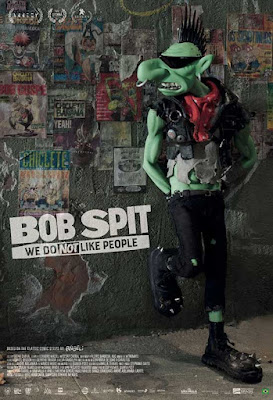
Bob Spit: We Do Not Like People

Punk is not dead and neither is Bob Spit (a.k.a. Bob Cuspe). Brazilian cartoonist Angeli thought he had killed off his creation in the pages of his underground comix Chiclete com Banana, but a punker like Spit is hard to kill. When word reaches him of his creator’s attempt to do him in, Spit sets off to give him a piece of his mind in Cesar Cabral’s ultra-meta and super-rude stop-motion animated feature, Bob Spit: We Do Not Like People, which opens this Wednesday in Los Angeles.

Spit is your basic hardnosed, unreconstructed punker. (He is also a bit phlegmy, hence his name.) Ever since Angeli thought he killed off his best-known creations, Bob Spit and feminist icon Re Bordosa (who maybe isn’t completely dead either), he has been somewhat blocked creatively. Maybe because everyone keeps talking about his iconic characters, including his closest colleague, transgender cartoonist Laerte, who is quite a fan of Bordosa.

Supposedly, Spit was killed by a horde of mutant Elton Johns, who symbolize the pestilence of pop music. However, the perennially angry punk seems to handle them just fine in the cartoon wasteland he stalks through. Inadvertently, he saves the goonish Kowalski Brothers, who have been piecing together “prophecies” regarding him from the pages of
Chiclete com Banana. When they show Spit the death Angeli wrote for him, it makes him mad, so he intends to teach the “old cartoonist” a lesson. Meanwhile, the animated Angeli has weird dreams and visions of Bordosa and Laerte, who appears to him as a Roma fortune-teller.

Cabral takes viewers on a bizarre post-modern animated ride that features the real voices of Angeli and Laerte, appearing as themselves. It is sort of like an animated cross between
The Young Ones and Wes Craven’s New Nightmare, but the feral Elton John mutants have no precedent. This is a crazy, self-referentially Borgesian film, but it stays true to the defiantly anarchic spirit of the original Bob Spit.

What unfolds is near-total bedlam, but the stop-motion animation is quite masterfully rendered. The movement and facial designs are reminiscent of Adam Elliot’s
Mary and Max, but thematically, the two films could not be more dissimilar. Bob Spit has no interest in personal growth or moral uplift, but he just might have some insights into the nature of art and the creative process.

Sunday, December 12, 2021

Achoura, Horror from Morocco

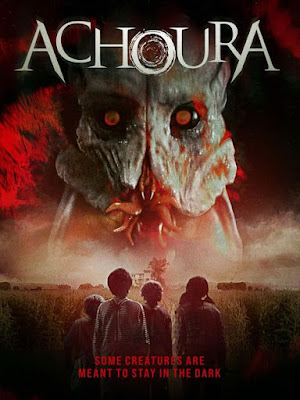
It is hard to enjoy “La Nuit des Enfants,” Morocco’s annual children’s night festival, when you are a child bride married to a creepy sixty-year-old. The injustice of Bashira’s situation leaves her particularly vulnerable to a demon named Bougatate. Her flashback starts the story, but she certainly won’t be its last victim in Telal Selhami’s Achoura, which releases Tuesday on DVD and VOD.

Achoura
has been likened to a Moroccan IT, but for a while, the multiple early flashbacks make it difficult to understand why. Years after Bashira’s fateful “Children’s Night,” a group of four friends barely survive an encounter with it, but frankly, Ali’s brother Samir draws a rather unfortunate fate.

That was twenty years ago. Despite a pledge to never forget what happened, Ali and his wife Nadia have largely repressed the incident. However, their estranged friend Stephane still recollects it vividly, as we can see from his morbid paintings and performance art. However, they must start remembering when Bougatate is inadvertently unleashed.

Yes, the kids who barely survived the monster must reunite to defeat it. Despite structural similarities to King’s novel (and a lot of tall grass),
Achoura is stylishly creepy. Selhami has a great eye for visuals and the folkloric elements add further layers of archetypal resonance. However, it really takes about half-hour for him to finally establish how the first six or seven scenes relate to each other.

Saturday, December 11, 2021

Last and First Men: Adapting Olaf Stapledon

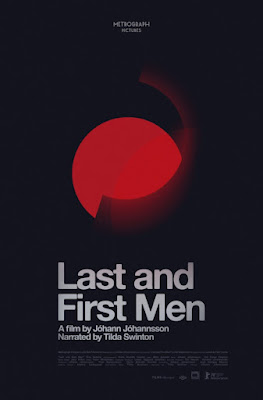
Many millennia from now, will human beings still be wearing cloth masks? The voice from the future never specifies, but apparently, we evolved to have telescopic eyeballs on the top of our heads. Mankind survived several extinction-level events, but fate will eventually catch up with us on the plains of Neptune in the late composer Johann Johannsson’s unlikely but spiritually-faithful adaptation of Olaf Stapledon’s Last and First Men, which is now screening at the Metrograph.

We are hearing a communication from the far, far future. They want something from us in the past, but it is not to recruit us to fight aliens, as in
The Tomorrow War. Unfortunately, it will be solar events and cosmic gaseous bodies that spell mankind’s demise, but they are resigned to it at this point. Their business is more philosophical.

This is why Stapledon was always considered so unadaptable. His best-known novels were not about ray-guns and rocket-ships, but rather the rise and fall of galactic civilizations and species. Although Johannsson and co-writer Jose Enrique Macain incorporate a mere fraction of his text into Tilda Swinton’s anesthetizing voice-overs, they faithfully convey the vibe and sweep of his work.

To accompany these grand and sometimes dire descriptions of future humanity, Johannsson films the imposing and often crumbling Brutalist monuments of the former Yugoslavia. These de-humanized vistas are lensed in starkly glorious black-and-white by cinematographer Sturla Brandth Grovlen. Some of them even look akin the statuary of Easter Island and the neo-primitivist masonry designed by Burle-Marx.

There is a narrative of sorts to
Last and First, but no characters per se. Yet, there is plenty to intrigue the curious mind, like the development of “navigators,” a “hardy” folk, who prefer to travel space beyond the range of future man’s hive-mind telepathy. So, there will still be Red-Staters thousands of millions of years from now.

Friday, December 10, 2021

Even Mice Belong in Heaven: An Animated Czech Fable

Heaven--its not just for dogs anymore. All animals go there, but this isn’t exactly a paradise with 72 virgins. It is more like an afterlife in the tradition of What Dreams May Come. It can actually be a pretty scary place, but Whizzy the mouse might have a friend to go through it with, if they can get past their earthly history as prey and predator in Jan Bubenicek & Denisa Grimmova’s Even Mice Belong in Heaven, which releases today on VOD.

Whizzy is a bit of a scaredy-cat, but she tries to over-compensate by bluffing and showing off. It is not her fault. She still has lingering trauma from her father’s death. Ironically, he became a hero to the mice, by saving her from a fox. She feels compelled to repeat his heroics, by picking a fight with Whitebelly, a shy, stuttering young fox. Unfortunately, when he gives chase, they both end up flattened by a car.

Right, this might not be such a good film for kids, since the cute, furry main characters literally die in the first ten minutes. It really is more of an adult beast-fable, sort of in the tradition of
Watership Down and Plague Dogs. However, the animation style definitely signals viewers to expect something cuter and lighter.

Regardless, the evolution of Whizzy’s post-mortem relationship with Whitebelly is quite touching. Whizzy can be more than a little annoying and self-centered, but death tends to be quite a learning experience. Whitebelly also has a dramatic arc in store for himself, but by accepting each other, they can overcome the hang-ups that held them back in life. At least that is what Heaven is trying to teach, if they would only pay attention.

The Last Son

Isaac Lemay has been cursed by a tribal elder, who has apparently read his Sophocles. The old man actually called it a prophecy, but the way Lemay lets it consume him definitely makes it a curse. Told he will one day be killed by one of his offspring, Lemay sets out to systematically kill his kin in Tim Sutton’s The Last Son, which releases today in theaters and on-demand.

Killing is what Lemay does best. It is what earned him the “curse.” However, he still found time to visit many prostitutes. Anna is one of the last, whose sons are not yet accounted for. Lemay makes quick work of the one she acknowledged, but Cal, the one she gave up for adoption for his own protection, is a slippery outlaw. In fact, he is a lot like his old man.

Cal’s feelings towards his mother are a little confused (again, see the literary allusion above), but the man who makes her swoon is Solomon, a hardboiled cavalry officer. Having been raised by the Cheyenne as a foundling, Solomon always remains a bit of an outsider in white society. Nevertheless, he is determined to bring to justice the outlaws who stole a gatling gun and murdered a detachment of troops. Yes, that would be Cal and his associates.

This is a dramatic change of pace for Sutton, who was previously known for moody art-house fare like
Memphis. There is still a whole lot of brooding in Last Son, but everyone also takes care of Western genre business. As Westerns go, it is super-revisionist, but there is also a pinch of Weird West too, which makes things interesting.

Thursday, December 09, 2021

Snoopy Presents: For Auld Lang Syne

Like a lot of people, Lucy had a Charlie Brown kind of New Year’s last year. This year, her Christmas is not panning out either. Lucy Van Pelt is not the sort of person you want to disappoint, so Linus and Charlie Brown agree to help make her New Year’s Eve party an unforgettable bash. Yet, her bossiness keeps getting in the way in Snoopy Presents: For Auld Lang Syne (directed by Clay Kaytis), the first new Peanuts holiday special in ten years, which premieres tomorrow on Apple TV+.

It is December, but we end up skipping over Christmas, after Grandma Van Pelt calls to say she can’t come this year. Linus is a little relieved, but Lucy is very disappointed. To cheer herself up, she decides to throw herself a New Year’s party. Naturally, she assigns everyone a job to do, but they wouldn’t mind, if she would just let them do things their ways.

Meanwhile, Snoopy’s entire litter is visiting for the holidays, including big lovable Olaf and his sister Belle. Crusty Spike wants to finally get a picture of them all together, but his efforts are constantly frustrated.

Evidently, Apple’s
Peanuts originals must all use Snoopy rather than Charlie Brown in the title. The “Snoopy Presents” makes him sound like a celebrity executive producer, but this is probably the best of the Apple-produced Peanuts programming to date. Kaytis and co-writers Alex Galatis and Scott Montgomery rekindle the spirit of the eternal Peanuts classics, even though they give Lucy some vulnerability and sentimentality that we have never seen from her before. (Seriously, she is the girl with the football, remember?)

The Real Charlie Chaplin, on Showtime

Enjoy this documentary while you can. It seems like it will only be a matter of time before Charlie Chaplin gets an Ansel Elgort-Woody Allen-style canceling. After all, he had a habit of marrying young women in their early teens. According to his second wife’s memoir, Chaplin was quite an abusive husband. He also financially supported his friend Fatty Arbuckle after the screen comedian was acquitted on notorious rape and murder charges. Of course, Chaplin’s stature as the first true mega-movie star and a genuine cinematic auteur should trump all that—but it doesn’t work that way under the current anti-cultural climate. Probably arriving just under the wire, Peter Middleton & James Spinney’s The Real Charlie Chaplin premieres this Saturday on Showtime.

Chaplin’s origins could be any humbler. After his father absconded and his mother was institutionalized, the young boy was literally consigned to a work-house. Eventually, he found success as a vaudeville performer in a particularly physical troupe. While on tour in America, he was signed to a film contract by Mack Sennett. Chaplin had a less than auspicious debut, but once he adopted his famous “tramp” persona, his career sky-rocketed.

By any measure, Chapin was the biggest, traffic-stopping star of the silent era. He was such a big star, he could still produce a silent classic like
Modern Times in 1936, well after the industry adopted sound as a standard. He eventually went talkie with his classic satire The Great Dictator, which skewered Adolph Hitler mercilessly. However, much of the pro-Soviet sounding rhetoric he engaged in during this time would come back to haunt him. Yet, arguably, Chaplin’s antagonism with the HUAC Committee has ironically helped insulate him from criticism of his personal life.

Indeed, that was certainly true of prior bio-docs, like partisan spin displayed in
Chaplin—Legendof the Century. Instead, The Real Charlie Chaplin does a decent job of presenting a comprehensive warts-and-all portrait of Chaplin that never whitewashes his problematic personal behavior. They still largely give him a pass on his political pronouncements, even though they happened at a time when the Moscow Show Trials were well in public record (but the Ukrainian Holodomor genocide story was still getting spiked in Western media outlets). Still, this is not hagiography, by any measure.

Wednesday, December 08, 2021

Revolution in Our Times: Hong Kong History as it Happened (Tragically)

7.4 million Hongkongers have lost their freedom and the younger generations that protested were beaten, battered, and arrested without just cause by the Hong Kong police. Yet, it has all been remarkably well documented, for those who have not chosen to turn a blind-eye. Recent documentaries like Days Before Dawn and We Have Boots have done excellent work recording the street protests and the violent tactics used to suppress them, but the shocking brutality exposed in this film surpasses them all. Your heart will ache and your jaw will drop after watching Kiwi Chow’s Revolution in Our Times, which opens Friday in New York and Los Angeles.

Chow previously helmed “Self-Immolator,” an astonishingly bold contribution to the narrative anthology film
Ten Years. That was a biting critique of what was then the creeping specter of Mainland oppression. In Revolution, he took to the streets and the safe houses, shooting protesters guerilla-style, as they manned barricades and fled from raging police detachments. He provides plenty of context, but essentially picks up with the later “Extradition Bill” demonstrations rather than going back to the original 2014 Umbrella protests.

Most of the subjects he follows are young “Valliants,” the more confrontational protesters, rather than the self-described “Non-Violents” led by Benny Tai. Although their voices are distorted and their faces are pixelated, for their own protection, viewers will come to care about them very much, especially as they increasingly come under literal fire. Some of this footage is especially raw and shocking, but one of the biggest takeaways from Chow’s doc is the respect Tai expresses for the Valliants, acknowledging just how much they risked for freedom.

There are indeed some remarkable scenes, such as aerial footage of the “Be Water” styled protesters, seen from above as they retreat and disperse over a dozen or so city blocks, to keep ahead of advancing police shock troops. However, viewers should brace themselves for video of the vicious 721 Yuen Long train station attack, conducted by white-shirted (suspected Triad) gangs with the obvious collusion of the HK cops. Independent journalist Gwyneth Ho was there and reported on the carnage as it happened, getting severely beaten for her troubles. Fortunately, she survived to address on-camera the attack and the events that led up to it.

To What Remains: The Honorable Work of Project Recover

The recent death of Sen. Robert Dole reminds us how few WWII veterans, the men of the “Greatest Generation,” are still with us. Time has continued to pass, but it is also a function of the cruel mortality rate of the battles they had to fight. Decades later, thousands of fallen veterans remain missing-in-action (MIA). Most of their families have given up hope for their recovery, but an intrepid band of volunteer divers and forensic specialists continue to privately search for the remains of the 800,000 servicemen declared MIA since the end of WWII. Chris Woods documents the Project Recover team at work and the significant friendships they forged with eye-witness veterans in To What Remains, which has special theatrical screenings tonight in 300 cities.

For founder Dr. Pat Scannon, the forerunner of Project Recover started as an endeavor for a group of scuba divers and sky-divers to pursue their sports in a way that carried wider positive implications, but it soon became a mission and a calling. Together with academic colleagues, they scour jungles and ocean floors, seeking remains, based on military incident reports.

In the process of conducting fact-finding interviews (usually informally, at military reunions), Scannon befriended several WWII veterans, who were all still sharp as a tack at the times they were filmed. Project Recover also recruited Marcus Luttrell (the subject of
Lone Survivor), who frequently joins them in the field. Throughout the film, Scannon finds himself repeatedly frustrated in his attempts to locate Lt. Roland Richard “Dick” Houle, a friend and squadron-mate of Pres. George H.W. Bush, who was shot down in the Pacific, which raises the film’s narrative stakes somewhat.

Tuesday, December 07, 2021

Beijing Spring: Documenting the Thaw After the Cultural Revolution

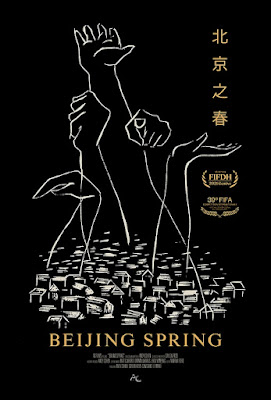
For Chinese artists, things could only get better when the Cultural Revolution ended—and they did—to an extent—for a while. During the thaw of the early Deng years, a group of artists emerged that pushed for liberalization in the artistic sphere and more democratic governance. Many of them are now living abroad (for obvious reasons). Andy Cohen and Gaylen Ross chronicle the “Stars Art Group and the related samizdat magazines that revolved around Beijing’s short-lived “Democracy Wall” in Beijing Spring, which opens Friday in New York and Los Angeles.

The “Stars” group intended their name to be modest, signifying them as small points of light, rather than super-stars in the Western sense. Although many members directly challenged Party censorship, many largely non-political artists were attracted to the Group, simply because they wanted to create without the CCP’s interference, including nude studies, which were banned under Mao.

Eventually, the Group mounted an underground exhibition on the gates of the National Arts Museum. When the government dismantled and confiscated their works, the artists staged the first Tiananmen Square demonstration. That would be the one truly nobody has heard, yet it ended much more peacefully. For a while, the Stars Group was even allowed to exhibit legally, until the Party got a good hard look at some of their work. Wang Keping’s carving “Silence,” in which the knot of his wood serves as a gag for its contorted face, was a particularly notable offender.

Beijing Spring
is an absolutely terrific film because it both reports critically important historical incidents and showcases some remarkably striking art. Indeed, it is visually much more interesting than 99% of well-meaning docs that secure theatrical distribution. For those wondering, Ai Weiwei was a late joiner to the group, but he is only briefly seen in Cohen & Gaylen’s film, probably because he and they did not want him to overshadow the other artists, who are lesser known internationally, but played greater roles in the Group’s development.

When watching the film, it is striking just how much more rigid and totalitarian the PRC has become under Xi-Who-Must-Be-Obeyed. In the late 1970s and early 1980s, Deng was keenly interested in what the Western press wrote and they in turn had greater access to average man-in-the-street opinion. Yet, inevitably, the arts documentary evolves into a thriller, when the surviving artists explain their clandestine efforts to save Democracy Wall activist Wei Jingsheng, who was on-trial for his writings and facing potential execution.

Death Valley, on Shudder

California’s Death Valley is in the Mojave Desert, but it is actually teeming with life. This film titled Death Valley takes place in a secret research facility hidden somewhere within a former Soviet Captive Nation, but it is filled with stupidity. The practical monster effects are cool, but nothing else makes much sense in Matthew Ninaber’s Death Valley, which premieres this Thursday on Shudder.


Obviously, vanity had nothing to do with Ninaber’s decision to direct himself in
Death Valley, since he portrays the creature in the looked-down lab (that looks a little bit like the titular deranged space alien he also played in Psycho Goreman). Eventually, a team of mercenaries will come face to face with him, as part of an ill-advised and ill-fated mission.

They have been hired to extract Chloe, who just barely survived the prologue. However, they must first fight through a vaguely Balkan militia locked outside the facility before they can fight the monsters inside. However, the nature of the lab’s business and the aims of the militia outside might not be what their brief led them to believe. Isn’t that always the way?

One of
Death Valley’s most conspicuous problems is it is rather difficult to tell our two primary mercs apart. Beckett and Marshall, played by Jeremy Ninaber (familiar name) and Ethan Mitchell, have different backstories. One of them is on the verge of retiring to spend more time with pregnant wife, while the other is the playboy team leader, but I honestly couldn’t tell you which is whom. They are both decent in the action sequences, but neither really distinguishes his character to any discernable extent.

Monday, December 06, 2021

Encounter, on Amazon

If you have seen Saul Bass’s Phase IV, you know you should always be distrustful of insects. If you have seen either classic version of Invasion of the Body Snatchers, you also know you shouldn’t trust anyone. Rogue Marine Malik Khan has either seen them both or he doesn’t need to. In contrast, most of the rest of the world is unaware of galactic micro-invasion underway in Michael Pearce’s Encounter, which premieres this Friday on Amazon Prime (following a brief theatrical run).

We should all stock up on bug spray, just like Khan. Apparently, a species of alien insects rode a meteor to Earth. To conquer the planet, they bite human hosts, releasing parasites into their blood stream that will take control over their bodies. Most of the population remains blissfully ignorant, but Khan is in the know. To stay safe, he must make his way to a secret desert base, but he would never leave his two young sons behind.

To rather complicate matters, he does not have custody, nor has he been present very much in recent years. It would be hard to explain and his ex-wife probably wouldn’t believe him anyone, assuming she isn’t already infected, so he just shows up and takes them one night.

There is a big twist that we’re apparently supposed to keep secret, but it drastically alters the complexion of the film, quite early in the going. However, the edginess of Riz Ahmed’s performance really helps sell it. Khan clearly isn’t someone you would want to screw-around with or even good-naturedly rib. Yet, his love for his sons (well-played by Aditya Geddada and Lucian-River Chauhan) is evident in his every action and facial expression.

Sunday, December 05, 2021

Broadcast Signal Intrusion

Where does the mystery of analog media intersect with the danger of digital, besides the Twilight Zone? In this case, Chicago, a much scarier and more violent place. In 1987, broadcasts of a local sports report on WGN and an episode of Dr. Who really were interrupted by a person or persons who remain unknown to this day. It is the kind of conspiratorial lore that made great fodder for chatrooms in 1999, right at the cusp of the online revolution. A grieving video archivist goes down that rabbit-hole in Jacob Gentry’s Broadcast Signal Intrusion, which releases Tuesday on DVD and BluRay.

Years ago, James’ girlfriend disappeared in a presumed suicide, but her body was never recovered. He still carries guilt and lingering doubt that makes him receptive (or vulnerable) to the urban legends surrounding the broadcast signal intrusions. He comes across the first one while working on a temp project converting broadcast tapes to DVD. He soon learns the tape of the second incident was confiscated by the FCC and the FBI have a standing request for information on anyone who comes looking for it.

Instead of the Max Headroom mask aptly used in the real-life pirate intrusions, the videos James obsesses over feature a woman in a mask inspired by “Tara the Android.” The audio is drastically distorted, but the vibe suggests the woman is in a position of jeopardy. Digging deeper, James learns two Chicago women disappeared without a trace the day before each intrusion. His investigation really hits close to home when he uncovers rumors of a third interruption tape, recorded the day after his girlfriend vanished.

For the most part,
BSI is a super-intriguing conspiracy thriller that wears its 1970s influences on its sleeve, while smartly integrating the early online culture and mindset. It sort of collapses in the last ten minutes, as conspiratorial thrillers almost always do, because they must decide to either reveal something (that is likely to be disappointing) or double-down on unknowable mystery, which is unsatisfying. Screenwriters Phil Drinkwater and Tim Woodall somehow manage to do both, but the weird trip they take viewers on to get to that point is still worth the price of admission.

Saturday, December 04, 2021

Monkey King: Reborn—Sun Wukong Animated Again

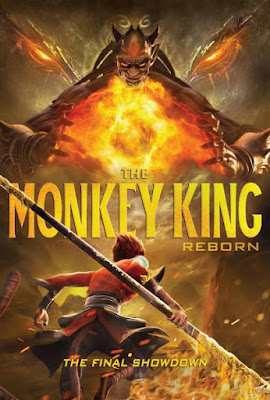
The Monkey King (a.k.a. Sun Wukong) is sort of like the Chinese Loki. He is a demigod and a trickster, but he can also be a bit of a screw-up. In this film, he calls himself a demon (with a soul), but same difference for us mortals. Whatever you consider him, he messes up big time in Wang Yun Fei’s Monkey King: Reborn, which releases this coming Tuesday on DVD and VOD.

This indeed the Monkey King, who we have seen in numerous
Journey to the West, of radically varying quality. This is the reformed Monkey King, who serves as the legendary monk Xuanzang’s disciple, along with Pigsy and Sandy (a.k.a. Bajie). However, he is still a handful. While staying in a Taoist monastery, he rather undiplomatically (but ever so archetypally) steals fruit from the Tree of Life in their garden. When the obnoxious caretakers blame him for their own theft of a special fruit, he goes on a rage bender and inadvertently destroys the tree.

Ever so inconveniently, it turns out the mystical tree was keeping the mega-evil “Father of Demons” buried underneath (much like the Monkey King himself was once imprisoned under a mountain). At least Sun Wukong is determined to clean up his mess, but he will need the help of the embodiment of human qi, whom the Monkey King calls “Fruitie,” because he initially mistook him for a fruit spirit.

Maybe not so weirdly, Fruitie looks a lot like the “radish” creature from
Monster Hunt and it is similarly annoying. However, Sun Wukong’s in-your-face swagger is definitely entertaining. The character design of this animated Monkey King is not so very different from that of Tian Xiao Peng’s Monkey King: Hero is Back, but he has more hardnosed attitude this time around.

In fact, this really is not an animated film for young children. Sun Wukong is prone to cussing and his big battle with the Father of Demons gets impressively brutal. On the other hand, adult wuxia fans will appreciate the action.

Friday, December 03, 2021

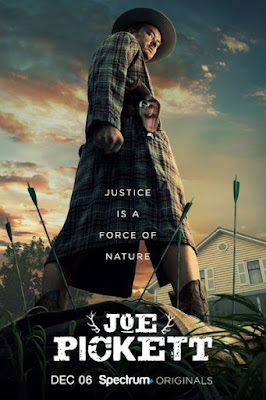
Joe Pickett, on Spectrum

Wyoming is one of the least populated states, but it probably ranks relatively highly when it comes to authors per capita. Not surprisingly, their crime novelists often incorporate neo-western elements, as in Craig Johnson’s Longmire books. C.J. Box’s novels also follow in that tradition (they have horses and sheriffs). His signature character, game warden Joe Pickett is more comfortable around nature than people, so WY should be the best place for him. Unfortunately, he uncovers a thorny mess of trouble in season one of showrunners John Erick Dowdle & Drew Dowdle’s  Joe Pickett, which premieres Monday on Spectrum.

Pickett is still fresh on the job, but he is already notorious for ticketing the governor for fishing without a license. He believes the rules should be enforced, so he is not inclined to look the other way when he catches low-life Ote Keeley poaching. In the resulting scuffle, he temporarily loses his gun to Keeley, before getting it back. Obviously, there is bad blood between them, so Pickett is duly surprised when Keeley rides his horse all the way to Pickett’s yard, to die from the illegally modified arrow shot through his torso.

Although not considered a suspect, the situation is uncomfortable for Pickett, especially because he worries for the safety of his pregnant wife Marybeth and their two daughters. His slightly sleazy predecessor, Vern Dunnegan cautions him to let everything blow over. However, Pickett is too much of a cowboy to resist following up on his own leads, especially when he suspects the lazy sheriff has arrested the wrong man, Nate Romanowski, a rather intimidating survivalist and falconer.

Immediately starting with Pickett’s standoff with Keeley, the pilot episode (directed by John Erick Dowdle) really grabs viewers. It is a tense action sequence, but it viscerally establishes how high the stakes are for both men. Evidently, the mortality rate for game wardens is shockingly high—and you can see why during this sequence.

It also introduces the lingering trauma of Pickett’s difficult childhood, which often rears up in the present for Pickett. We understand right from the beginning why he is so socially awkward. The truth is the Dowdles maybe overdo his angst a bit. It seems like poor Joe can’t even get a cup of Joe without a flashback. Regardless, the restraint and gritty integrity of Michael Dornan’s lead performance provides an impressive foundation for the series.

Thursday, December 02, 2021

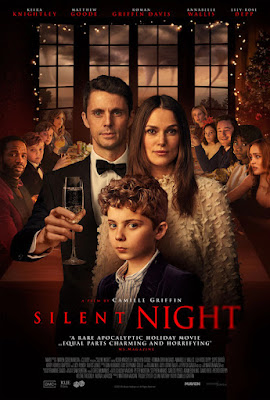
Silent Night: Last Christmas, Ever

It is sort of like The Big Chill, but the suicide[s] haven’t happened yet. Unfortunately, the world is ending, so a group of old college friends decided to spend their last Christmas together before the inevitable. The government says we’re doomed, so it must be true, right? One of the kids is not so sure and he is willing to risk it in director-screenwriter Camille Griffin’s Silent Night, which releases in theaters and streams on AMC+ tomorrow.

Frankly, even if you had decades of holidays ahead of you, it is hard to imagine wanting to spend even one with some of these obnoxious people. The worst are Sandra, who clearly thinks she is Kim Cattrall’s
Sex and the City character, her dopey husband Tony, and their massively spoiled daughter Kitty. The caustic Bella and her passive girlfriend Alex are not much fun either. Frankly, James and Sophie are far and away the most likable, but everyone is against her, because the younger woman is not part of their clique. Ordinarily, Nell and Simon are probably decent enough, in a British upper-crust kind of way, but they are on edge and trying way too hard. Their disgustingly precocious and sensitive son Art is not making things any easier.

For some strange reason Art is not ready to just give up and die. As in many end-of-the-world movies,
Silent Night is cagey about the exact “science” of the apocalypse. Apparently, it involves a green cloud sweeping the planet. Regardless, it is surely our fault somehow. Fortunately, the British government has supplied all legal residents with a handy no-more-mornings-after pill. Yet, Sophie is reluctant to take it, because she is pregnant.

There is something in
Silent Night to rub everyone the wrong way. Not bothered by the vacuous characters or a gratuitous swipe at the UK Conservatives? Well, maybe you will be put off by its invitation to doubt the pronouncements of governments and so-called “science” authorities (like, I don’t know, Fauci maybe?). As a result, you really have to respect Griffin for staking out some a-plague-on-both-your-houses territory. However, the people are still horrifyingly cringy.

Wednesday, December 01, 2021

Mr. A & Mr. M: The Story of A&M Records, on EPIX

Like it or not, A&M Records truly shaped the sound of the 1960s and 1970s. They were the record label home to Herb Alpert and the Tijuana Brass, the Carpenters, Captain & Tennille, Carole King, Sergio Mendes, and Burt Bacharach. They also signed 1980s-defining bands like the Police and the Go-Go’s. Even though they are no longer an active label, they have more than enough history to fill the two-part Mr. A & Mr. M: The Story of A&M Records, directed by Ryan Suffern, which premieres this Sunday on EPIX.

Herb Alpert was a scuffling musician when he founded Carnival Records over a hand-shake with Jerry Moss, a relatively green record promoter. Turns out the name was taken, so they simply dubbed themselves A&M. Musician-led labels historically had a hard time of it (arguably, Charles Mingus’s Debut was one of the most prolific at that point, which is saying something), but they had an early breakout hit with Alpert’s Mexican-flavored over-dubbed trumpet stylings on “The Lonely Bull,” which got them off and running.

Instead of talking heads, Suffern uses archival interviews and disembodied voices accompanying footage of the era to tell the labels history (employing the techniques seen in
Ailey and Billie). Ironically, the record label opened their studio complex on the grounds of the old Charlie Chaplin Studio, the one-time home of the silent star (but he did write the tune “Smile”).

Frustratingly, Suffern never discusses the years Creed Taylor’s CTI Records operated as an imprint at A&M. (There are entire art books dedicated to CTI covers, but the history of their association is admittedly complex.) Several important jazz artists are briefly referenced during the two-parter (including Gerry Mulligan and Dave Brubeck), but the only jazz-related artist who gets any serious discussion is A&M’s first big, non-Alpert signing, Sergio Mendes, who came along just in time for the Bossa Nova explosion.

Castle Falls, Starring and Directed by Dolph Lundgren

Big creepy abandoned institutional buildings are always perfect for horror movies, like Gonjiam Asylum in Korea. Carraway Methodist Medical Center in Birmingham, AL has been the subject of its own YouTube exploration videos, but in this case, it is the setting for an action throwdown. There is money hidden in the [renamed] decommissioned hospital and a couple of average blokes hope to find it before a ruthless gang of criminals—and also before the building is demolished in Dolph Lundgren’s Castle Falls, which releases Friday in theaters and on-demand.

Mike was once a MMA contender, but we watch him blow his very last shot during the prologue. Now he is a day-laborer living out of his car, so he is relatively happy to get a few days work stripping down the old Castle Falls hospital. At the eleventh hour of their last day, he uncovers a large cache of cash.

Lt. Ericson knows about it too. He is an honest corrections officer, but he desperately needs money for his daughter Emily’s surgery. It turns out the money was stolen from a vicious white power gang by a non-violent inmate looking to do a deal. The trouble will be getting out alive when the also gang turns at Castle Falls. With the building rigged to explode in 90 minutes, so Mike and Ericson will have to trust each to survive, but they get off to a rocky start.

Scott Adkins and Lundgren (who worked together before in films, like
Legendary) certainly know their way around a gritty beatdown and they certainly work well together here. Adkins shows off his martial arts chops (and has some nice scenes with Vas Sanchez as his new work buddy), while Lundgren acts his age convincingly as the shrewder but somewhat tired and broken-down Ericson.

He also has some appealingly tender and humanizing scenes with Emily, played by his real-life daughter, Ida Lundgren. As a director, Lundgren maybe over-complicates the opening, but the action sequences are raw and sometimes brutal. He is also a producer and the fictional demolition company is named “Lundgren,” so there is no question this is a Dolph Lundgren joint.